
Our Expert in Romania
No results available
Search and seizure of electronic devices in Romania is now one of the most consequential compliance exposures that in-house counsel, CISOs and executives face when criminal investigators arrive at a Romanian business. The combination of the EU e-evidence framework becoming operational and tightening local practice around biometric unlocking, cloud data and privilege segregation means that the decisions made in the first hour of a search can determine whether privileged material is protected, whether operations survive the disruption, and whether evidence is later admissible or excluded. This guide sets out the Romanian legal framework, the warrant requirements, the limits on compelled unlocking, and the practical on-site playbook your team needs in 2026.
It is written for people who will have to act fast and advise under pressure, not for academics.
Who this is for: In-house counsel, CISOs, security and IT leads, corporate executives and outside defence counsel who must respond to or advise on criminal searches and seizure of electronic devices in Romania. The focus is on immediate on-site decisions, preserving attorney-client privilege, maintaining chain of custody, and preparing for any follow-up litigation.
When investigators present themselves for a search and seizure of electronic devices in Romania, the first fifteen minutes matter more than any later legal argument. A calm, documented, procedurally correct response protects both the evidence record and your privileged data. The following checklist should sit in the hands of every reception desk, office manager and senior employee likely to encounter a dawn raid.
If police arrive without a warrant: Remain polite and do not obstruct. Ask whether they are acting under the limited urgent circumstances permitted by law or a supervisory order, request the legal basis in writing, and contact counsel before consenting to anything. Consent can waive protections, so no voluntary handover should occur without legal advice.
Romanian criminal searches of devices are governed primarily by the Criminal Procedure Code (Codul de procedură penală), the authoritative text of which is published on the official legislative portal. The Code draws a critical distinction between a search of premises (percheziție domiciliară), the seizure of physical equipment or objects, and the forensic search of data stored on a device or system (percheziție informatică, literally “computer search”). Understanding which authority is being invoked is the first step in assessing whether investigators are acting within their mandate during any search and seizure of electronic devices in Romania.
A percheziție informatică, the forensic examination of a phone, laptop, server or computer system, is a distinct procedural act that generally requires judicial authorisation. The seizure of the physical device is one thing; accessing and analysing the data it holds is another, and the Code treats the latter as an intrusion into private life that ordinarily demands authorisation from a judge rather than the unilateral decision of an investigator. The practical consequence is that your team should check whether the authorisation on the table covers both the physical taking of the hardware and the subsequent data search. A document authorising seizure does not automatically authorise an unlimited forensic examination of everything the device contains.
The Directorate for Investigating Organized Crime and Terrorism (DIICOT) is the specialised prosecution structure responsible for organised crime, terrorism, serious cybercrime and complex related offences. DIICOT routinely coordinates dawn raids and large-scale digital seizures and brings specialist forensic capability to bear. Where DIICOT is involved, the stakes and the complexity rise: investigations are often multi-site, cross-border and data-heavy, and the procedural footprint is correspondingly larger. If the officers at your door identify themselves as acting for DIICOT, the matter should immediately be escalated to counsel experienced in DIICOT practice, because the operational tempo and the breadth of the data demand differ markedly from a routine police enquiry. DIICOT publishes its structure and procedural information on its official site.
Judicial oversight is the backbone of a lawful search and seizure of electronic devices in Romania. A percheziție informatică ordinarily requires authorisation from a judge, and the lawfulness of the resulting evidence can be tested before the courts, up to and including the High Court of Cassation and Justice (Înalta Curte de Casație și Justiție), whose jurisprudence is a key reference on the admissibility of digital evidence. National policy and practice on criminal procedure and cooperation with EU mechanisms are handled by the Ministry of Justice.
The key message for corporate responders is that every intrusive step should trace back to an identifiable judicial authorisation, and the absence of one is a red flag that must be documented in real time.
Not every search and seizure of electronic devices in Romania means your hardware leaves the building. There are materially different ways investigators can secure data, and they carry very different consequences for your operations and your privilege exposure. Understanding the menu allows counsel to argue for the least disruptive, most privilege-protective option that still satisfies the investigation.
Physical seizure means the device is removed from the premises and examined later at a police or forensic laboratory. It is the most disruptive option: a laptop or server taken away can paralyse a function for days or weeks, and the data sits outside your control throughout. Forensic imaging on site is the alternative. A bit-for-bit copy (an “image”) of the device is created at your premises, verified by a cryptographic hash, and the original hardware can in appropriate cases remain with you. Imaging is generally preferable for corporate devices precisely because it reduces operational harm and because a neutral imaging process, witnessed by counsel, creates a cleaner record for later privilege review.
The EU e-evidence framework, the Regulation and Directive on European Production and Preservation Orders for electronic evidence in criminal matters, explained on the European Commission’s electronic evidence page, allows designated judicial authorities in one Member State to order the preservation or production of electronic data held by service providers across the Union, subject to the Regulation’s phased application. For a Romanian company this cuts two ways. Your business may be on the receiving end of a preservation or production order concerning data you host or control; alternatively, where the data an investigation needs sits with a cloud provider or on servers in another Member State, these mechanisms may replace or supplement a physical search.
Preservation orders freeze data so it cannot be deleted while a production request is prepared; production orders compel its handover. Because these orders arrive through legal channels with defined scope and timelines, they are often less operationally disruptive than a raid, but their scope must be read carefully for privilege and over-breadth.
Where a device holds live business data, privileged communications, or information belonging to third parties and clients, counsel should press for on-site imaging by a neutral expert rather than wholesale seizure. The argument is one of proportionality: the investigative objective, securing the data in an unaltered, verifiable form, is fully achieved by imaging, while the collateral damage of removing operational hardware is avoided. Imaging also makes it far easier to run a privilege filter before investigators see the contents, which is central to protecting attorney-client material in any search and seizure of electronic devices in Romania.
An authorisation is only as strong as its contents. Many challenges to a search and seizure of electronic devices in Romania succeed or fail on whether the authorisation was specific, properly issued and respected in practice. Your on-site team should read the document against a mental checklist rather than accept it at face value.
A valid search authorisation should identify the issuing judicial authority, the case and the offence under investigation, the premises or systems to be searched, the categories of data or device targeted, and the temporal scope. It should bear a date and a signature from the authorising judge. If any of these are missing, illegible or inconsistent, record the defect immediately, a photograph and a contemporaneous note are worth more than a recollection weeks later.
Scope is where over-reach most often occurs. An authorisation targeting a specific custodian’s email over a defined period does not license a forensic sweep of every device in the building or an open-ended harvest of cloud accounts. The distinction between locally stored data and data residing in cloud services is particularly important: accessing a user’s cloud account from a seized device may exceed the authorisation and may engage the EU e-evidence route instead. Your counsel should track, in real time, whether investigators are staying within the authorised data categories, timeframes and device list.
Examples of problematic authorisations include those that name no specific offence, that authorise the search of “all electronic devices” without limitation, that fail to specify a temporal window, or that are used to examine data categories plainly outside the stated investigation. When you identify such a defect, the correct on-site response is not to obstruct but to object clearly and have the objection recorded in the search minutes (proces-verbal). Preserving the objection in the official record is what makes a later challenge to admissibility viable before the court.
Few issues are evolving as quickly as compelled unlocking. Modern phones and laptops are routinely protected by passcodes, fingerprint and facial recognition, and strong encryption, and the legal question of whether an individual can be forced to unlock a device sits at the intersection of criminal procedure and constitutional protection. Any search and seizure of electronic devices in Romania that depends on getting past such protections must be approached with care.
Compelling a person to reveal a passcode or to apply a biometric to unlock a device raises the privilege against self-incrimination and the broader fair-trial protections recognised in Romanian and European law, including the European Convention on Human Rights. The legal position is genuinely contested and still developing. The practical takeaway is that an employee should never be instructed by the company to unlock a device under pressure, nor to refuse unlawfully; the individual should be advised of their right to counsel, and the decision left to them with legal advice.
Biometric unlocking occupies a particularly uncertain space. Some argue that applying a fingerprint or face is physical and therefore distinct from disclosing a known passcode; others contend that compelling any act that exposes the contents of a protected device engages the same protections. Because the law here is unsettled, the safe course for a corporate responder is to treat any compulsion to unlock, biometric or otherwise, as a matter requiring immediate legal input, and to ensure the demand and the response are documented in the search record.
Where investigators cannot unlock a device, they may seek assistance from device or platform vendors through lawful disclosure channels, or deploy forensic tooling. These avenues are governed by their own legal processes and have their own limits. For the company, the relevance is that vendor-assisted or tool-assisted access does not cure a defective authorisation: if the underlying authorisation does not cover the data, the method of access does not legitimise examining it.
Protecting attorney-client confidentiality is often the single most important corporate objective during a search and seizure of electronic devices in Romania. Devices belonging to executives and in-house counsel are saturated with legal advice, strategy and confidential communications, and once investigators have seen privileged material the damage can be difficult to undo.
Confidential communications between a client and a lawyer, made in the course of the lawyer’s professional activity, attract protection under Romanian law, notably the professional secrecy obligations set out in the Law on the profession of lawyer and the Statute of the profession, and the National Union of Romanian Bars (UNBR) and the Bucharest Bar maintain rules on professional secrecy and the safeguards that apply during searches. Not everything on a lawyer’s device is protected, and the scope of protection for in-house (salaried) versus external counsel communications should be assessed with care, but the existence of protected material on a device is a legitimate and powerful basis for demanding segregation before any substantive review.
The moment devices with confidential legal content are targeted, counsel should assert professional secrecy on the record and request that the material be segregated rather than reviewed by the case team. Where imaging is used, segregation can be built into the workflow: the image is taken, but protected material is filtered out before investigators access the remainder. The objective is to prevent the investigating prosecutors from reading legal advice that should never cross their desk.
A robust protection is the use of a filter team or a neutral third-party expert, individuals walled off from the investigation who review the data, identify protected items, and release only non-privileged material to the case team. A neutral forensic examiner conducting the imaging and an independent reviewer conducting the privilege filter together create a defensible process that courts can trust. Where disputes arise over what is protected, counsel can ask the court to rule on the review.
A privilege log documents each item withheld and why, so that the claim can be tested without exposing the content. A usable log should record the following for each item:
Evidence that cannot be shown to be authentic and unaltered is vulnerable to exclusion. Chain of custody for digital evidence is therefore not a technicality but a battleground, and in any search and seizure of electronic devices in Romania both the investigators and the defence have an interest in a clean, documented record.
The gold standard for securing digital evidence is the creation of a forensic image, a complete, bit-for-bit copy of the storage medium, using write-blocking methods that prevent the original from being altered during copying. Examination should then be conducted on the image, leaving the original pristine. Where this discipline is absent, the reliability of the evidence can be challenged.
A cryptographic hash is a digital fingerprint calculated over the data at the moment of imaging. Recording the hash and re-verifying it later proves that the data has not changed. Preserving metadata, timestamps, file origins and system information, is equally important, because altered or missing metadata undermines confidence in the evidence. Hashing and imaging discipline are reflected in Romanian forensic and court practice.
Once imaged, devices and images must be transported and stored under documented, tamper-evident conditions, with every transfer logged. The court will expect to see an unbroken custody trail from seizure to presentation, supported by the search minutes, inventory receipts and custody logs. A gap in that trail, an unexplained period, an unrecorded handover, is exactly what a defence challenge will exploit. The company’s role is to ensure its own records of what was taken, by whom and when are complete, because they may become essential to contesting or confirming the integrity of the evidence.
Beyond the legal framework, a search and seizure of electronic devices in Romania is an operational crisis that has to be managed in real time. A pre-agreed playbook turns panic into process.
The first calls are to internal counsel, external criminal defence counsel and the CISO. Internal counsel coordinates the legal response and confidentiality assertions; external counsel brings DIICOT and digital-evidence experience; the CISO and IT lead manage the technical reality of which systems are affected and how to isolate them without destroying data.
Mobile device management systems often allow remote wiping, and any automatic or manual wipe triggered after a search begins is likely to be treated as destruction of evidence, exposing the company and individuals to serious consequences. Remote wipe capabilities should be understood in advance and, where lawful to do so, disabled for devices under seizure. Equally, maintaining secure, independent backups of critical business data means that even if hardware is removed, operations can continue, reducing the pressure that often leads to procedural mistakes.
Every company with meaningful exposure should maintain a written standing protocol and a short internal memo distributed to staff explaining what to do if investigators arrive. The memo should include the contact numbers for internal and external counsel, the do’s and don’ts above, and a simple script: be polite, ask to see and copy the authorisation, state that you wish to contact counsel, do not consent and do not alter any data. A one-page on-site checklist kept at reception ensures the right behaviour even when senior staff are absent.
A search and seizure of electronic devices in Romania is not the end of the story. The Criminal Procedure Code provides remedies to contest unlawful searches, to seek the return of seized property, and to exclude evidence obtained in breach of procedure, and these remedies are detailed in the official legislative text.
Where devices are no longer necessary for the investigation, or were seized unlawfully, counsel can request their return or the return of copied data. Procedural challenges, raised through the appropriate motions and, where applicable, before the preliminary chamber judge (judecătorul de cameră preliminară), can target defects in the authorisation, breaches of scope, or failures in the segregation of protected material. The objective is twofold: recover property and operational capability, and lay the groundwork for excluding tainted evidence from the case.
Where a search exceeds its lawful bounds, remedies may extend beyond exclusion of evidence to the vindication of the affected party’s rights. Evidence obtained in breach of the law may, in the conditions set by the Criminal Procedure Code, be ruled inadmissible, and the integrity failures recorded on site become the factual basis for that argument. Relevant case law, including decisions touching on the admissibility of evidence and the limits of investigative powers, is found in the jurisprudence of the courts, including the High Court of Cassation and Justice and, on constitutional questions, the Constitutional Court.
When responding to a search and seizure of electronic devices in Romania, know which authority you are dealing with and when a cross-border route is in play. DIICOT handles organised crime, terrorism and serious cyber and related offences and publishes its procedural and organisational information on its official site. The Romanian Police operate under the General Inspectorate of the Romanian Police. The Ministry of Justice is the reference point for national policy and EU cooperation, and the courts, up to the High Court of Cassation and Justice, determine admissibility.
Where the data an investigation needs resides with a provider or on servers in another Member State, the EU e-evidence mechanisms described by the European Commission may be the appropriate channel, and counsel should assess early whether preservation and production orders, rather than a domestic seizure, are the correct and least disruptive route.
| Option | Authority required | Operational impact | Privilege risk | Typical timeline | When recommended |
|---|---|---|---|---|---|
| Police physical seizure | Judicial authorisation or limited urgent circumstances permitted by law | High, device removed | High unless segregated | Days to weeks to return | Serious investigations or risk of remote deletion |
| On-site forensic imaging by neutral expert | Consent or authorisation specifying imaging | Moderate, device may stay | Lower if filter team used | Hours to days | Corporate data with protected content |
| Remote preservation / production (e-evidence) | EU or national preservation / production order | Low disruption | Medium, depends on order scope | Hours to days | Cross-border data or cloud content |
| Voluntary disclosure to police | Consent only | Variable | High, risk of waiver | Fast | Minor requests, with counsel present |
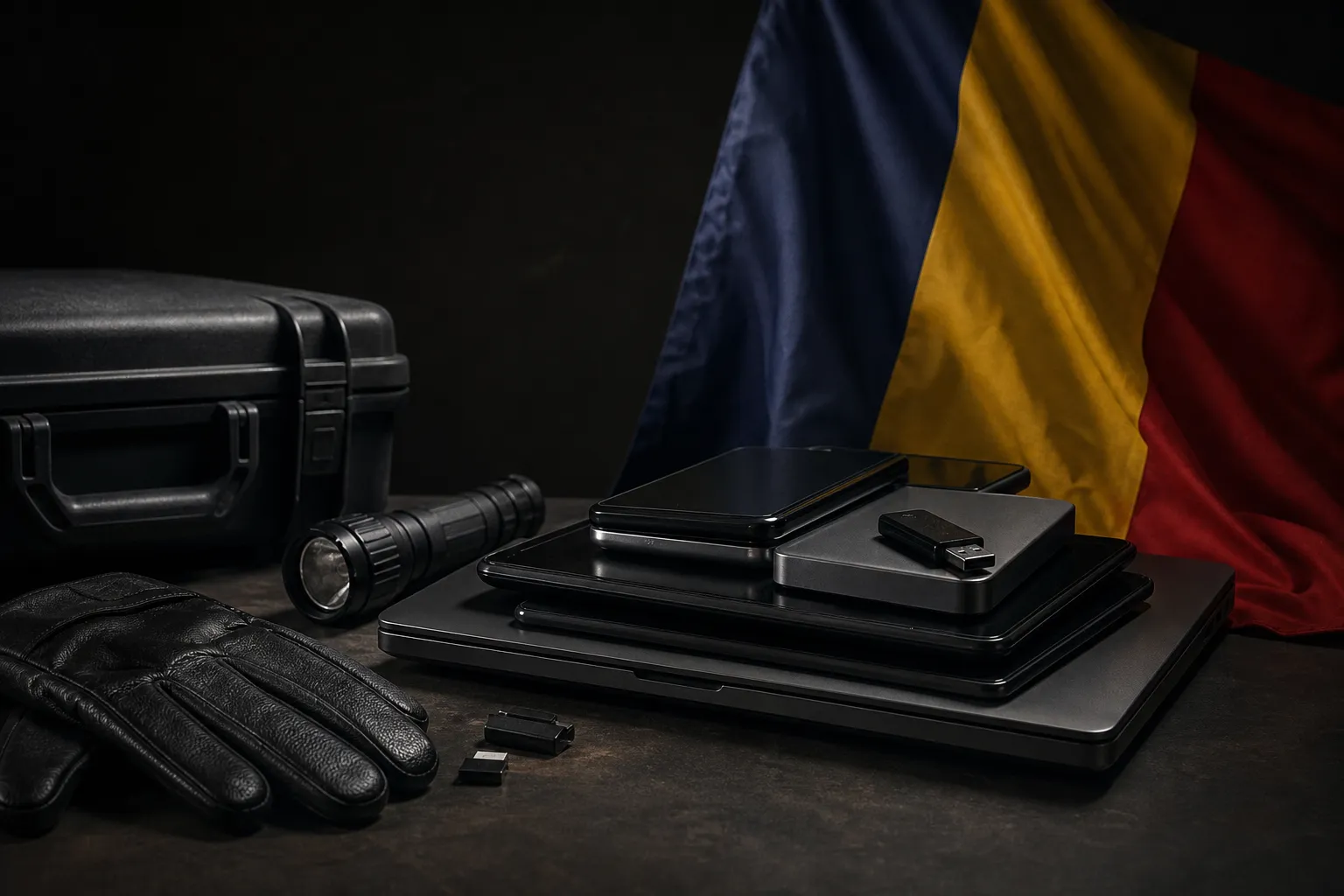
Alt: Forensic imaging of mobile phone and laptop during a police percheziție informatică in Romania, comparing search and seizure of electronic devices options.
Search and seizure of electronic devices in Romania has become a frontline corporate risk in 2026, driven by the operational EU e-evidence framework, the uncertain law on compelled and biometric unlocking, and the ever-present danger of protected material being exposed during a raid. The companies that fare best are those that prepared in advance: a standing protocol, a trained reception desk, pre-identified counsel, understood remote-wipe controls on devices under seizure, and a clear preference for neutral on-site imaging and privilege filtering over wholesale hardware removal. Every intrusive step should trace back to a valid judicial authorisation, every objection should be recorded in the search minutes, and every seized item should be documented for chain-of-custody purposes.
Handled with discipline, a search and seizure of electronic devices in Romania can be navigated without surrendering confidentiality or compromising the integrity of your evidence record, and that discipline begins long before investigators ever arrive.
This article was produced by Global Law Experts. For specialist advice on this topic, contact Serban & Asociatii at Serban & Asociatii, a member of the Global Law Experts network.

posted 24 minutes ago

posted 42 minutes ago

posted 60 minutes ago

posted 1 hour ago

posted 1 hour ago

posted 2 hours ago

posted 3 hours ago

posted 3 hours ago

posted 3 hours ago

posted 4 hours ago

posted 4 hours ago

posted 4 hours ago
No results available
Find the right Legal Expert for your business

Send welcome message