
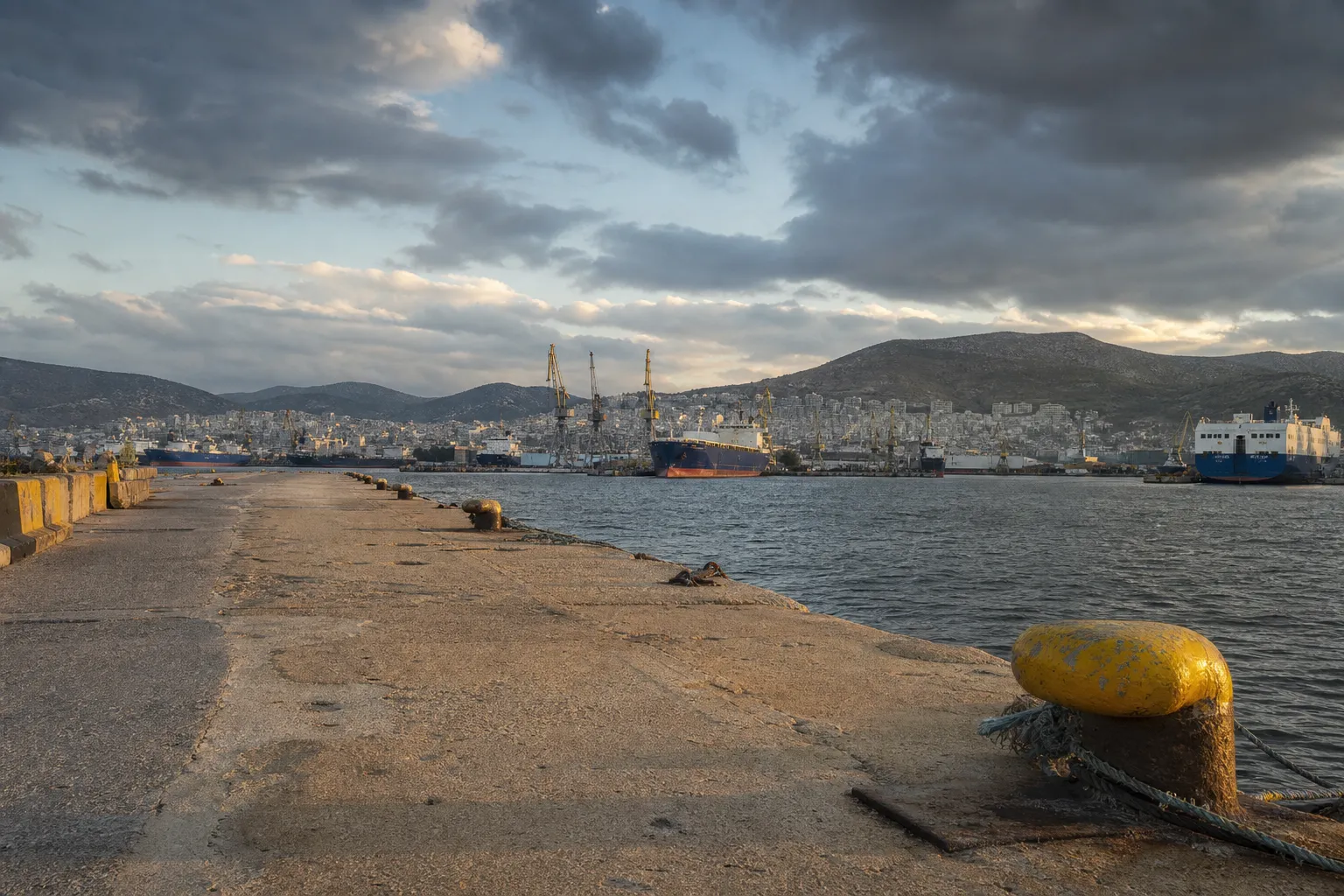
Who this guide is for: Piraeus marine arbitration greece is the forum many shipowners, charterers, P&I clubs, yacht owners, brokers and in-house counsel must weigh when a dispute arises under a Greek shipping contract. This practical guide sets out the rules, the procedure for urgent relief, seat selection and enforcement, and tells you when to choose Piraeus-seated maritime arbitration over the alternatives.
Piraeus marine arbitration greece has become a sharper decision point since Greece modernised its arbitration framework with Law 5016/2023 on international commercial arbitration, which replaced Law 2735/1999. For owners, charterers and their counsel, forum choice is no longer a box-ticking exercise buried in a charterparty, it directly shapes speed, cost, access to emergency relief and, ultimately, whether an award can be enforced against assets. Piraeus sits at the centre of one of the world’s largest shipping clusters, and maritime arbitration conducted in Piraeus offers a local, specialist route for resolving marine disputes. This article takes a position: for Greek-law, Greek-asset shipping disputes, a Piraeus seat is frequently the strongest option, and the sections below show you exactly when and why.
International maritime law governs the rights and obligations arising from the use of the sea, carriage of goods, charterparties, collisions, salvage, vessel arrest and marine insurance. Maritime arbitration is the private, binding mechanism parties use to resolve those disputes outside national court litigation, and in Greece it has matured considerably in recent years.
Read on if you are negotiating an arbitration clause for a Greek-flagged or Greek-owned vessel, if you face an urgent arrest or injunction scenario in a Greek port, or if you hold an award you now need to enforce. This guide gives you a rules walkthrough, an emergency-relief timeline, a side-by-side decision table and model clauses you can adapt.
Piraeus has long served its shipping community through dedicated, specialist arbitration. The practice is rooted in the recognition that maritime disputes benefit from decision-makers who understand ships, trades, charterparty mechanics and the commercial realities of the port. Maritime arbitration in Piraeus draws on a pool of experienced professionals, lawyers, master mariners, naval architects and marine surveyors, and typically handles charterparty disputes, bills of lading claims, sale and purchase disputes, newbuilding and repair conflicts, demurrage, and marine insurance matters.
Shipping disputes in Greece may be referred to ad hoc arbitration or administered by an arbitral institution. An institution provides rules, a secretariat and an arbitrator list rather than acting as a court. Parties who agree to Piraeus arbitration opt into a framework designed for shipping, administered locally and anchored in Greek arbitration law. Scope of jurisdiction flows from the parties’ agreement: the tribunal’s authority is only as wide as the arbitration clause allows, which is why precise drafting matters so much.
Understanding the applicable rules is the foundation of using the forum well. The rules govern how an arbitration is commenced, how the tribunal is constituted, how the case is managed, the seat and language, document exchange, the hearing and the deposit regime. The practical distillation below is organised around the lifecycle of a reference and reflects the general framework of Greek arbitration law and typical institutional rules.
An arbitration begins when the claimant serves a request to arbitrate on the respondent (and, where the arbitration is institutionally administered, on the secretariat). The request should identify the parties, the contract and arbitration clause relied upon, a summary of the dispute, the relief sought and the claimant’s arbitrator nomination where the clause provides for party nominations.
Commencement checklist:
Most shipping references proceed before a sole arbitrator or a three-member tribunal, depending on the clause and the value of the dispute. Where each side nominates an arbitrator, the two nominees (or the appointing authority) select the chair. Arbitrators must be independent and impartial, and Greek arbitration law provides a route to challenge an arbitrator where justifiable doubts arise about independence, impartiality or qualifications.
Challenges should be raised promptly once the grounds are known; delay can be treated as a waiver. If a challenge succeeds, or an arbitrator resigns or becomes unable to act, a replacement is appointed following the same method used for the original appointment. Early attention to conflicts, particularly in the tight-knit Piraeus market, avoids costly interruptions later.
After constitution, the tribunal fixes a procedural calendar, typically covering statements of case, document production, witness and expert evidence, and the hearing. Piraeus references are generally streamlined for shipping disputes, and straightforward demurrage or freight claims can proceed on documents alone without an oral hearing. An indicative calendar runs roughly as follows:
Timelines vary with the complexity of the case and the applicable rules. Document-only disputes conclude considerably faster. The deposit regime requires parties to fund arbitrator fees and administrative costs in advance, usually in equal shares, with the tribunal able to call for top-ups as the case develops.
Emergency interim measures greece is where piraeus marine arbitration greece shows a distinct practical edge. Shipping disputes frequently need urgent action, arresting a vessel for security, freezing bunkers or sale proceeds, or preserving evidence before it disappears. Under Law 5016/2023, the Greek arbitration framework recognises both tribunal-ordered interim measures and the concurrent jurisdiction of the Greek courts to grant provisional relief in support of arbitration. That dual track is the key to getting fast, enforceable protection.
The decision turns on what you need and how fast you need it:
A practical urgent-relief timeline looks like this:
These timings are indicative only and depend on court availability and the facts of each case.
Urgent applications live or die on evidence and speed. Keep the following checklist ready before a crisis hits:
An award is only as valuable as your ability to enforce it. For piraeus marine arbitration greece, the enforcement picture is strong: a Piraeus-seated award benefits from local familiarity and a well-understood recognition process, while cross-border enforcement rides on the New York Convention on the Recognition and Enforcement of Foreign Arbitral Awards 1958, to which Greece is a long-standing contracting state.
To enforce a Greek-seated award domestically, the successful party applies to the competent Greek court for a declaration of enforceability, which converts the award into an enforceable title against the debtor’s assets.
Where the debtor’s assets sit outside Greece, enforcement proceeds under the New York Convention in the relevant jurisdiction. Priorities are to identify where enforceable assets are located, confirm that jurisdiction is a Convention state, and move quickly before assets are moved. Keep certified copies of the award and arbitration agreement, and, where needed, authenticated translations, ready, because enforcement courts will require them.
Under the Greek framework, which follows the UNCITRAL Model Law and aligns with the New York Convention, the grounds to set aside or resist an award are narrow. They typically include:
Annulment (set-aside) applications are time-limited under Law 5016/2023, so a party contemplating a challenge must act promptly once the award is received and should take advice on the applicable deadline. Conversely, a well-run reference, with clean constitution, fair process and a reasoned award, closes off most of these procedural trapdoors.
This is the heart of the decision. The table below compares a Piraeus maritime seat with a Greek institutional forum, London/LMAA and the ICC across the dimensions that actually drive forum choice in shipping disputes.
| Dimension | Piraeus maritime arbitration | Greek institutional forum | London / LMAA | ICC (international) |
|---|---|---|---|---|
| Typical users | Greek owners, charterers, local P&I | Domestic commercial disputes, mixed users | International owners/charterers, English-law preference | Large cross-border commercial disputes |
| Seat / legal regime | Piraeus seat; Greek arbitration law (Law 5016/2023) | Greek seat; Greek arbitration law | London seat; English arbitration law | Seat agreed (often Paris, Geneva, HK, Singapore) |
| Cost (typical) | Low–medium | Low–medium | Medium–high | High |
| Speed | Fast for local cases; streamlined for shipping | Medium | Medium–fast | Variable; can be lengthier |
| Arbitrator expertise (shipping) | High (local shipping specialists) | Variable | High (international specialists) | High (global expertise) |
| Emergency interim measures | Tribunal measures + Greek courts; local advantage | Available via Greek courts | Urgent relief via English courts / emergency arbitrator | Emergency arbitrator via ICC |
| Enforceability in Greece | Strong, local seat + familiarity | Strong | Enforceable via New York Convention; extra local steps | Enforceable globally; local enforcement via domestic courts |
| Language | Greek or agreed English | Greek or agreed language | English | Multilingual (usually English) |
| Neutrality perception | Local; best where parties accept Greek seat | Domestic | High, neutral international seat | High for multi-jurisdiction cases |
| Best for | Quick, cost-sensitive Greek shipping disputes; local enforcement | Domestic Greek commercial matters | Parties wanting English law and procedure | Complex multi-jurisdiction disputes needing global reach |
| Sample clause (short) | “All disputes shall be referred to maritime arbitration in Piraeus, Greece, with the seat in Piraeus, governed by Greek law.” | “All disputes shall be settled by arbitration in Athens, Greece. Seat: Athens.” | “Any dispute shall be referred to arbitration under the LMAA Terms, seat London.” | “Any dispute shall be finally settled under the ICC Rules, seat [city].” |
The central trade-off is between local efficiency and international neutrality. A Greek seat delivers speed, lower cost and seamless enforcement in Greece, but assumes the parties accept a Greek seat. London/LMAA and ICC deliver internationally recognised neutrality and deep arbitrator pools, at higher cost and with extra steps when you later enforce against Greek assets. For a dispute whose centre of gravity, contract law, parties and assets, is Greek, the local forums win on most practical measures except perceived neutrality for a non-Greek counterparty.
When negotiating an arbitration clause for Greek shipping work, run through this checklist before signing:
Model clause 1, Piraeus seat clause: “All disputes arising out of or in connection with this contract shall be finally resolved by arbitration seated in Piraeus, Greece, in accordance with Greek law.”
Model clause 2, Piraeus seat with emergency carve-out: “…seated in Piraeus, Greece. Nothing in this clause shall prevent either party from applying to any competent court for provisional or protective measures, including vessel arrest.”
Model clause 3, court fallback for provisional measures: “The parties agree that an application to a court for interim measures in support of arbitration shall not be treated as incompatible with, or a waiver of, this arbitration agreement.”
Adapt the clause to reference any specific arbitral institution and rules you intend to use, and confirm the institution’s name and current rules before signing.
Budgeting realistically keeps a case on track. Arbitration seated in Piraeus is typically lower-cost than ICC or London references: administrative fees are modest, and arbitrator remuneration reflects local market rates rather than premium international tariffs. Market rates for counsel and arbitrators in Piraeus are competitive, which is part of the forum’s appeal for cost-sensitive owners and charterers.
Plan your budget around four buckets: administrative deposits, arbitrator fees, counsel fees and enforcement costs. Deposits are usually funded in advance in equal shares, with top-ups as the case develops. For enforcement, add court fees for the enforceability application in Greece, and, where you enforce abroad, translation, authentication and local counsel costs. Where the counterparty’s covenant is weak, budget separately for security measures such as bank guarantees or counter-security against wrongful arrest. Multi-jurisdiction enforcement should be scoped early so that the cost of recovery never exceeds the value recovered.
Three illustrative vignettes show how piraeus marine arbitration greece works in practice:
Good drafting prevents jurisdictional fights before they start. The essentials are a clear reference to the arbitral mechanism, an unambiguous seat (“seat: Piraeus, Greece”), a stated governing law, the chosen language, and an express preservation of the right to seek court provisional measures. Where relevant, address consolidation and the number of arbitrators.
Avoid these red flags:
To put this guide to work on piraeus marine arbitration greece: add a vetted Piraeus arbitration clause template to your standard contracts, brief your risk team on the arrest-versus-arbitration decision, pre-agree an emergency evidence bundle so you can move within hours, and confirm your enforcement strategy against the likely location of the counterparty’s assets. For complex or high-value matters, engage a Piraeus specialist early. You can find qualified practitioners through the GLE Lawyer Directory, Greece / Shipping & Maritime Arbitration and review the Shipping & Maritime Arbitration, Greece practice area page.
This guide is general information and not legal advice. For case-specific guidance, consult a qualified lawyer. Last updated: 2026-10-01.
This article was produced by Global Law Experts. For specialist advice on this topic, contact Konstantinos Bachxevanis at BAX LAW, a member of the Global Law Experts network.

posted 9 minutes ago

posted 27 minutes ago

posted 1 hour ago

posted 2 hours ago

posted 2 hours ago

posted 2 hours ago

posted 2 hours ago

posted 3 hours ago

posted 4 hours ago
posted 4 hours ago

posted 4 hours ago

posted 5 hours ago
No results available
Find the right Legal Expert for your business

Send welcome message