

| Scenario | Recommended Route |
|---|---|
| You need direct UAE market access, government contracts, or retail presence | Mainland (DET) licence |
| You primarily export or serve international clients and want simple 100% ownership + potential 0% corporate tax on qualifying income | Free zone licence |
| You are already in a free zone, but now you need mainland customers | Hybrid: Free zone licence + DET Free Zone Mainland Operating Permit (per Executive Council Resolution No. 11 of 2025) |
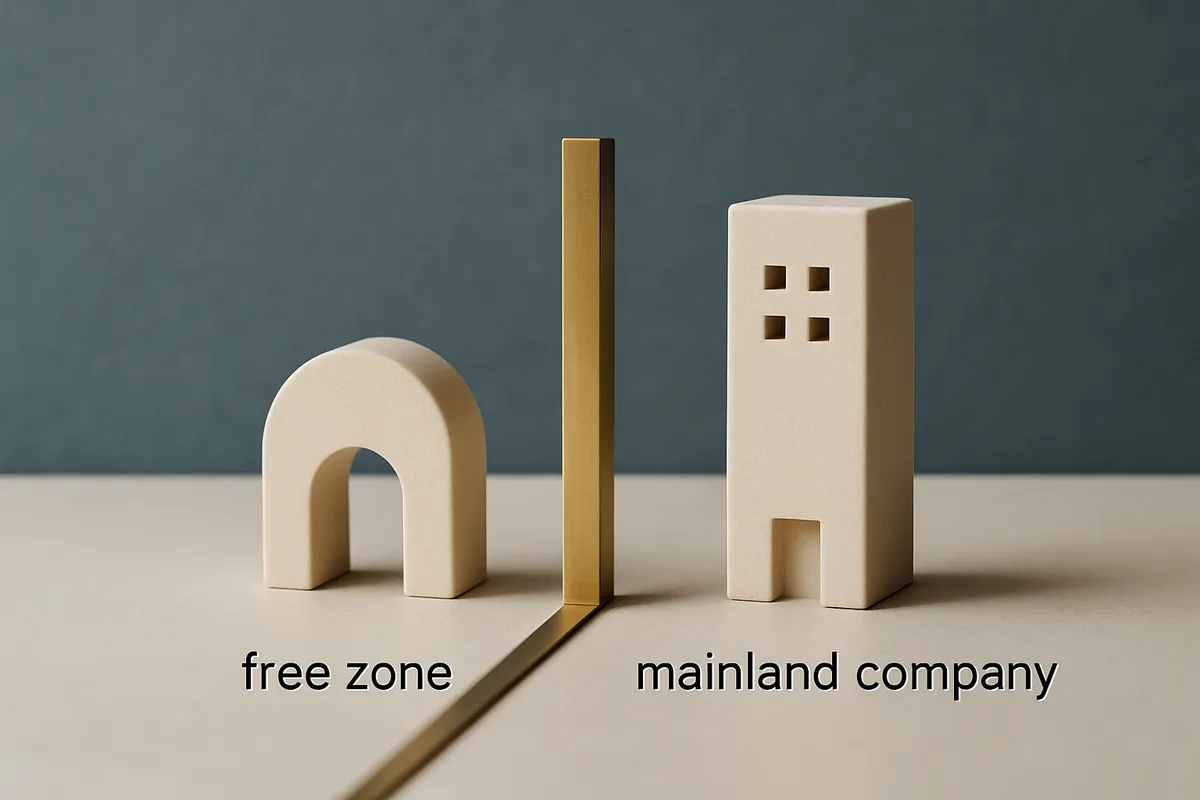
Choosing between a free zone vs mainland UAE company licence is the single most consequential formation decision a founder will make in the Emirates. The choice determines who you can sell to, how many visas you receive, how much you pay in corporate tax, and what office you must lease. Since early 2025, that decision has become more nuanced: Dubai’s Executive Council and the Department of Economy and Tourism (DET) have introduced permit pathways that allow free-zone entities to operate in mainland Dubai under defined conditions, effectively creating a third, hybrid option. This guide walks through every variable: ownership, market access, visas, costs, tax treatment, and timelines so you can select the right structure from day one.
Regulatory update Dubai Executive Council Resolution No. 11 of 2025: Issued on 3 March 2025, this resolution regulates the conduct of free zone establishments’ activities outside their designated zones within the Emirate of Dubai. For the first time, a unified legal framework governs how free zone companies can carry out specific commercial activities on the mainland without forming a separate mainland entity.
The resolution introduced three principal mechanisms:
Crucially, these new pathways interact with the UAE’s federal corporate tax regime. A free zone company that generates mainland-sourced revenue may risk losing its Qualifying Free Zone Person (QFZP) status and the associated 0% rate on qualifying income. The Federal Tax Authority’s guide on Free Zone Persons (CTGFZP1) sets out the conditions founders must monitor. The practical effect is that the free zone vs mainland UAE company licence analysis now requires integrated legal, regulatory, and tax planning rather than a simple binary choice.
For most of the UAE’s commercial history, 100% foreign ownership was available only inside free zones. That changed with legislative reforms enacted in 2020–2021 and implemented by individual emirates from 2022 onward. Today, the majority of commercial and professional activities on the mainland permit 100% foreign ownership, though strategic sectors including oil and gas, banking, insurance, utilities and certain defence-related activities still require an Emirati majority shareholder or specific regulatory approval.
Free zones uniformly allow 100% foreign ownership. A single shareholder (individual or corporate) can hold the entire equity of a free zone limited-liability company (FZ-LLC) or free zone establishment (FZE). There is no requirement for a local partner or service agent. Corporate structuring flexibility is generally straightforward, with most zones permitting holding company models and multi-shareholder vehicles.
Mainland companies registered with DET (formerly DED) now allow full foreign ownership for the vast majority of activity codes. However, founders should be aware of several practical qualifications:
In sum, ownership parity between the free zone and the mainland has largely converged. The choice now hinges on market access, tax treatment, visa mechanics, and cost, as discussed in the sections that follow.
Market access remains the most material operational difference in the free zone vs mainland UAE company licence comparison. Understanding the default restrictions and the new exceptions is essential.
A company licensed in a UAE free zone is, by default, permitted to trade only within that zone, with other free zone entities, and internationally. It cannot directly invoice customers located in mainland UAE, open a retail outlet outside the zone, or bid for mainland government contracts. This restriction exists because free zone authorities issue their own commercial licences, which are not recognised as mainland trade licences by DET or equivalent emirate authorities.
Before the 2025 reforms, free zone companies that needed mainland access typically used one of three approaches:
The Executive Council Resolution No. 11 of 2025 materially expanded the options. A free zone entity may now apply to DET for a branch licence, a temporary permit (limited duration, AED 5,000 fee), or the new Free Zone Mainland Operating Permit. Each route has an approved activity list; not every free zone activity code maps to a permitted mainland activity. Founders must verify their specific commercial activity against DET’s published schedule and comply with ongoing reporting obligations.
Free zones designated as “designated zones” under UAE VAT legislation are treated as being outside the UAE for VAT purposes, meaning goods movements between designated zones and the mainland trigger import VAT at 5%. Non-designated free zones are generally treated as mainland for VAT purposes. Founders in goods-intensive sectors (trading, logistics, manufacturing) must factor customs duty deposits, bonded warehouse requirements, and VAT cash-flow implications into their cost analysis.
Example A: E-commerce exporter: A tech accessories brand selling via its own website to customers in the GCC and EU. A free zone licence (e.g., DMCC or IFZA) is typically optimal: the company invoices international customers, ships from a designated zone warehouse, and benefits from 0% customs duty on re-exports. No mainland permit is needed.
Example B: Free zone trader wanting a Dubai retail shop: This trader must either obtain a DET Free Zone Mainland Operating Permit (if their activity is on the approved list), open a mainland branch, or form a separate DET-licensed company. The 2025 reforms make the first option materially cheaper and faster than the second and third but the trader must confirm retail is within the permitted scope.
Visa entitlement in free zones is determined by the type of office or workspace a company leases. Taking DMCC as a representative example: a flexi-desk package may entitle the company to 1–3 visas, a serviced office to 4–6 visas, and a dedicated physical office to a quota calculated by office floor area (typically one visa per 9 sq m of office space). Warehouse and retail spaces have separate formulas. Each zone publishes its own quota table DMCC’s 2025 setup guide provides detailed visa-to-office mappings. Check the issuing authority’s site for the latest quota table (date of last check: 15 July 2026).
Mainland employers receive visa quotas through the Ministry of Human Resources and Emiratisation (MOHRE) electronic quota system. The initial quota is linked to the company’s Ejari lease area and commercial licence category. MOHRE quotas are more scalable than free zone quotas; companies can apply for quota increases as headcount grows, subject to Emiratisation compliance (Nafis targets for companies with 50+ employees). The UAE Government portal outlines the mainland hiring process, including labour card issuance, medical fitness tests and Emirates ID stamping.
Free zones offer tiered workspace solutions: flexi-desks (virtual presence with a physical address), serviced offices (furnished, shared facilities), and dedicated physical offices or warehouses. DMCC’s setup page illustrates a representative range. All free zone companies must maintain a registered address within the zone; this is a licence condition. Companies in designated zones must also comply with customs-bonded area requirements if dealing in physical goods.
Mainland companies require a physical lease agreement registered with Ejari (Dubai’s tenancy registration system). The office may be located anywhere within the emirate. Retail, industrial, and food-related activities require additional municipal approvals (Dubai Municipality or equivalent). The Ejari contract is a prerequisite for MOHRE quota applications, making timely lease execution critical for visa processing timelines.
Note: Regulated activities (healthcare, education, food, financial services) require additional sector-specific approvals from bodies such as the Dubai Health Authority, KHDA, or Dubai Municipality, which can extend timelines by 4–12 weeks. If applying for a DET Free Zone Mainland Operating Permit, allow additional processing time for DET’s review of the activity match and compliance requirements.
Formation costs in the UAE depend on the Emirate, zone, activity type, office choice, and number of visas. The tables below provide indicative Year 1 cost ranges based on publicly available fee schedules and typical market rates. The fee schedule annexed to Executive Council Resolution No. 11 of 2025 provides the regulatory basis for DET permit fees. Check the issuing authority’s site for the latest fee and permit lists (date of last check: 15 July 2026).
| Cost Category | Free Zone (DMCC-type) | Mainland (DET) |
|---|---|---|
| Registration & licence fees | AED 12,000–20,000 | AED 12,000–25,000 |
| Office/workspace (Year 1) | AED 8,000–18,000 (flexi-desk / small serviced) | AED 15,000–30,000 (Ejari lease, small office) |
| Visas (3 employees’ medical, EID, stamp) | AED 8,000–12,000 | AED 10,000–15,000 |
| PRO/government liaison fees | AED 3,000–6,000 | AED 4,000–8,000 |
| Bank account opening (admin/intro fees) | AED 2,000–5,000 | AED 2,000–5,000 |
| Estimated Year 1 Total | AED 35,000–60,000 | AED 45,000–80,000 |
| Cost Category | Free Zone (Trading, Warehouse) | Mainland (General Trading) |
|---|---|---|
| Registration & licence fees | AED 25,000–50,000 | AED 30,000–60,000 |
| Office/warehouse (Year 1) | AED 60,000–150,000 | AED 80,000–180,000 |
| Visas (20 employees) | AED 55,000–80,000 | AED 65,000–100,000 |
| Customs deposit / bonded guarantee | AED 20,000–50,000 | AED 10,000–30,000 |
| PRO/government liaison/MOHRE compliance | AED 10,000–25,000 | AED 15,000–35,000 |
| Miscellaneous (bank, insurance, Emiratisation) | AED 10,000–45,000 | AED 20,000–75,000 |
| Estimated Year 1 Total | AED 180,000–400,000 | AED 220,000–480,000 |
Assumptions: Costs are illustrative and vary by emirate, free zone authority, activity code, office grade and prevailing market rents. DET Free Zone Mainland Operating Permit fee (temporary permit): AED 5,000 per the resolution’s fee schedule. A tailored cost assessment is recommended before committing to either route.
The introduction of federal corporate tax has fundamentally altered the tax calculus in the free zone vs mainland UAE company licence decision. Federal Decree-Law No. 47 of 2022 established the UAE’s corporate tax regime, effective for financial years starting on or after 1 June 2023. The standard rate is 9% on taxable income exceeding AED 375,000, with 0% applying to the first AED 375,000.
A company incorporated in a free zone may elect to be treated as a Qualifying Free Zone Person under the FTA’s Free Zone Persons guide (CTGFZP1), potentially benefiting from a 0% rate on “qualifying income.” Key eligibility conditions include:
Income that does not qualify, including revenue from mainland UAE customers invoiced directly, is taxed at the standard 9% rate. This is why the 2025 permit reforms require careful planning: a free zone company that begins invoicing mainland clients through a DET permit could generate non-qualifying income, potentially breaching the de minimis threshold and losing QFZP status entirely.
Small service startup (AED 300,000 annual revenue, mainland licence): The entire AED 300,000 falls within the AED 375,000 nil band. Corporate tax payable: AED 0. If the founder uses small-business relief (available for revenue under AED 3 million), taxable income is treated as nil regardless of actual profit. Mainland formation therefore, carries no immediate tax disadvantage for very small firms.
Free zone exporter (AED 2,000,000 qualifying income): If the company meets all QFZP conditions, adequate substance, qualifying activities, and audited accounts, the qualifying income is taxed at 0%. Compare this with a mainland company earning AED 2,000,000 in taxable profit: the first AED 375,000 at 0% and the remaining AED 1,625,000 at 9% = AED 146,250 corporate tax. The free zone structure can yield significant savings for export-oriented or inter-zone businesses.
Free zone company with mainland permit income: If the same exporter begins generating AED 150,000 from mainland clients via a DET permit, this non-qualifying income must stay below the de minimis threshold. At AED 2,150,000 total revenue, the AED 150,000 represents approximately 7%, exceeding the 5% ceiling. The company would lose QFZP status, and its entire profit would become taxable at 9%. This illustrates why hybrid permit strategies demand specialist tax advice.
| Free Zone | Mainland | |
|---|---|---|
| Pros | • 100% foreign ownership (guaranteed) • Potential 0% corporate tax on qualifying income • Streamlined registration (often 2–3 weeks) • Customs/duty benefits in designated zones • Purpose-built business parks and infrastructure |
• Unrestricted UAE market access • Government tender eligibility • Scalable MOHRE visa quotas • Office flexibility (any location in the emirate) • No customs duty on domestic sales |
| Cons | • Restricted mainland trading (unless a permit obtained) • Visa quotas tied to office size • May lose QFZP status with mainland revenue • Limited to zone-approved activity codes • Office must be within the zone |
• Higher typical formation costs • Longer setup timelines • Emiratisation obligations (50+ staff) • Ejari lease is mandatory • Corporate tax at 9% on profit above AED 375,000 |
Recommended route: Free zone. An accessories brand shipping from a designated zone warehouse to GCC and EU markets generates qualifying income under QFZP rules. A flexi-desk or small office supports 2–3 visas. Corporate tax is likely 0% on qualifying income. No mainland permit needed. Estimated Year 1 cost: AED 35,000–55,000.
Recommended route: Mainland (DET). A building materials supplier selling to contractors across Dubai and Abu Dhabi needs direct invoicing to mainland customers and potential government project eligibility. MOHRE quotas accommodate a 20-person team. Corporate tax applies at 9% above AED 375,000 profit. Estimated Year 1 cost: AED 220,000–480,000 depending on warehouse size.
Recommended route: Mainland or hybrid. A management consultancy serving both UAE corporates and regional clients could form on the mainland for unrestricted invoicing. Alternatively, if most revenue is MENA (non-UAE), a free zone licence with a DET temporary permit for occasional local engagements may work but only if mainland revenue stays within the de minimis threshold. Tax advice is essential before choosing this path.
Use the following logic to determine your optimal formation route:
START
 │
 ▼
Will you invoice UAE mainland customers
or bid for government contracts?
 │
 ├── YES ──► Is mainland revenue expected
 │ to be >5% of total revenue?
 │ │
 │ ├── YES ──► MAINLAND (DET) LICENCE
 │ │
 │ └── NO ───► FREE ZONE + DET PERMIT
 │ (Hybrid verify activity
 │ list per Exec Council
 │ Resolution No.11/2025)
 │
 └── NO ───► Do you need >5 employee visas?
 │
 ├── YES ──► FREE ZONE (larger office
 │ package) or MAINLAND
 │ (better visa scalability)
 │
 └── NO ───► FREE ZONE
 (choose zone by activity,
 cost & tax qualification)

 ALL PATHS ──► Register for corporate tax with FTA
 Confirm QFZP eligibility if free zone
This flowchart provides a starting framework. Every decision node involves nuances activity code matching, zone-specific rules, and corporate tax interaction that benefit from professional legal review.
The free zone vs mainland UAE company licence decision is no longer binary. The 2025 permit reforms, combined with the federal corporate tax regime, have created a spectrum of formation strategies from pure free zone (export-focused, QFZP-eligible) to pure mainland (full market access, scalable hiring) to hybrid structures that blend both. The right choice depends on a precise analysis of your target customers, revenue mix, headcount trajectory, activity codes, and tax position.
Key intersections demand specialist attention: the interaction between DET mainland permit revenue and QFZP de minimis thresholds; the alignment of free zone activity codes with DET’s approved mainland activities; and the Emiratisation obligations that apply as mainland headcount scales beyond 50 employees. Getting these details right at formation stage prevents costly restructuring later.
Whether you are forming a lean export startup, a trading operation requiring warehousing and mainland distribution, or a consultancy serving both local and regional clients, the formation structure you choose will shape your operational cost base, tax obligations, and market reach for years to come.

posted 22 minutes ago

posted 1 hour ago

posted 1 hour ago

posted 2 hours ago

posted 2 hours ago

posted 3 hours ago

posted 3 hours ago

posted 3 hours ago

posted 3 hours ago

posted 4 hours ago

posted 4 hours ago

posted 4 hours ago
No results available
Find the right Legal Expert for your business

Send welcome message