
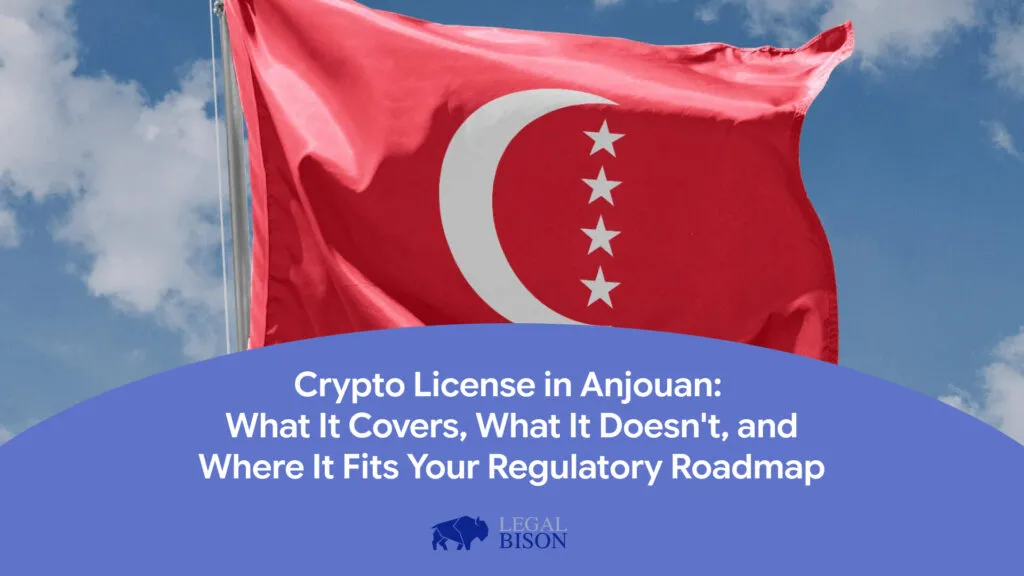
If you’ve spent any time researching offshore crypto licensing, you’ve probably come across the usual jurisdictions; Seychelles, BVI, Cayman Islands. But there’s a smaller, far less crowded jurisdiction quietly gaining traction among crypto founders who want regulatory coverage without the regulatory headache: Anjouan.
The Anjouan crypto license has emerged as one of the more pragmatic offshore options on the market, and if you’re building a crypto business and haven’t looked at it seriously, it’s worth your attention.
Let’s be upfront: Anjouan is not MiCA. It is not a Tier-1 regulatory framework. What it is, however, is a legitimate offshore licensing pathway that offers operational flexibility, low barriers to entry, and meaningful cost advantages for founders who need regulatory coverage while they scale. Used correctly, it belongs in a well-structured jurisdictional strategy; and that’s exactly what we help clients build at LegalBison.
What Is the Anjouan Crypto License?
Anjouan is one of the three islands of the Comoros archipelago in the Indian Ocean, off the eastern coast of Africa. Technically, it is an autonomous island of the Union of Comoros, and its autonomous government issues financial services licenses; including licenses for crypto and digital asset activities; through the Anjouan Offshore Finance Authority (AOFA).
The Anjouan crypto license is a financial services license issued under Anjouan’s domestic framework, covering a range of digital asset activities including crypto exchange operations, trading platform activity, and related services. It is an offshore license, meaning it is designed for international business and not for operators targeting the domestic Comorian market.
Think of it like a flag of convenience for ships: the license grants you a recognized legal status under a specific jurisdiction’s rules, giving your operation a documented regulatory foundation. Whether that foundation is sufficient for your target markets, your banking relationships, and your long-term roadmap depends entirely on how it fits into your broader structure; and that’s where the analysis has to be honest.
Who Issues the Anjouan Crypto License?
The license is issued by the Anjouan Offshore Finance Authority, the regulatory body responsible for financial services licensing in Anjouan’s autonomous government. The AOFA administers the licensing framework under Anjouan’s Financial Services Authority legislation and has been issuing offshore financial services licenses across several sectors; including forex, gaming, and more recently crypto; for a number of years.
It is worth noting that Anjouan’s licensing framework operates somewhat differently from larger offshore jurisdictions. The AOFA is a smaller authority with a tighter process, which cuts both ways: application turnarounds can be faster, but the international recognition profile is also more limited than, say, a Seychelles FSA license or a BVI SIBA registration. Founders who understand this going in make better decisions than those who discover it afterward.
What Activities Does the Anjouan Crypto License Cover?
The Anjouan crypto license covers a range of digital asset service activities. Depending on the specific license class applied for and the AOFA’s current framework, covered activities typically include:
The precise scope depends on the license category and the business model presented during the application. This is why a well-prepared business model analysis is not optional; it’s the document the AOFA uses to determine which activities your license actually covers.
Why Are Founders Looking at the Anjouan Crypto License?
The honest answer is cost and speed. If you compare an Anjouan crypto license against, say, a Lithuanian VASP license or a UAE Virtual Asset License, the differences are stark across three dimensions.
Cost: An Anjouan crypto license is significantly cheaper than Tier-1 and Tier-2 regulated jurisdictions. Licensing fees and associated costs run in the range of a few thousand dollars, compared to tens of thousands; or more; for licenses in the EU, UK, or Singapore.
Speed: Application processing under the AOFA framework is generally faster than most regulated jurisdictions. For founders under commercial pressure who need to show regulatory status to early partners or investors, this matters.
Requirements: The capitalization requirements, AML compliance program requirements, and operational infrastructure requirements are lighter than what MiCA, FCA, or MAS would demand. For a lean startup, that operational load is genuinely significant.
But here’s the analogy that matters: a crypto license from Anjouan is like a learner’s permit, not a full driving license. It gets you on the road, legally, under a recognized framework. It does not automatically open every door; banking relationships, institutional partnerships, and expansion into heavily regulated markets will still require more. Smart founders use the Anjouan license for what it actually does well, and build their regulatory roadmap with future steps in mind.
What Are the Requirements for a Crypto License in Anjouan?
The Anjouan crypto license application process is more accessible than most regulated frameworks, but it is not trivial. The core requirements generally include:
Corporate Structure: The applicant entity must be incorporated; either in Anjouan or in a recognized offshore jurisdiction; with clear ownership documentation. LegalBison can handle the incorporation as part of the overall licensing engagement if needed.
Business Model Documentation: A clear description of the crypto activities to be conducted under the license. This is where founders need to be specific: what products, what user interactions, what fund flows. Vague applications create delays and ambiguity about what your license actually covers.
AML/KYC Compliance Program: A documented anti-money laundering and know-your-customer policy and program. This doesn’t need to meet the complexity of a MiCA-grade compliance program, but it must demonstrate that the business has genuine compliance procedures in place.
Fit and Proper Assessment: Key personnel; typically directors and beneficial owners; must pass a fit and proper assessment. This involves identity verification, background checks, and disclosure of any prior regulatory history.
Registered Address in Anjouan: The licensed entity must maintain a registered address in Anjouan for correspondence and compliance purposes.
Application Fee and License Fee: The AOFA charges both an application processing fee and an annual license fee. These are relatively modest compared to other jurisdictions.
There is no minimum capital requirement in the same sense as MiCA or UK FCA licensing, which is part of the reason the license is accessible to early-stage operations. However, the entity must demonstrate it has sufficient resources to conduct the activities described in the license application; so a credible operational budget is still part of the picture.
What Does the Application Process Look Like?
We’ve walked many clients through offshore licensing applications, and the Anjouan process is more streamlined than most. At a high level, the steps are:
Step 1: Business Model Analysis: Before anything is submitted, we work through the client’s specific business model to determine what activities are covered, what license class fits, and what additional requirements apply based on the client’s user base, fund flows, and target markets. This step exists because founders who skip it often get a license that doesn’t actually cover what they do.
Step 2: Entity Preparation: The applicant entity must be properly structured and documented. If the entity needs to be incorporated, that happens here.
Step 3: Documentation Package: Preparing the full application set; corporate documents, business model description, AML/KYC program, KYC documentation for directors and beneficial owners, and any other materials the AOFA requires.
Step 4: Submission to AOFA: The application package is submitted to the Anjouan Offshore Finance Authority for review. The AOFA may request additional information or clarification during the review period.
Step 5: License Issuance: Upon approval, the license is issued by the AOFA with the authorized activities specified. The license is typically renewed annually.
The timeline, assuming a complete and well-prepared application, tends to be faster than comparable offshore processes; often within weeks rather than months. But completeness matters enormously: incomplete applications or poorly documented business models are the primary source of delays in any licensing process.
What Are the Limitations of the Anjouan Crypto License?
We want to be direct here, because licensed regulatory guidance means telling you what a license can’t do as clearly as what it can. The Anjouan crypto license has real limitations that any serious founder needs to understand.
Banking Access: One of the biggest practical challenges for offshore-licensed crypto businesses is banking. Major banks in the EU, UK, and North America are unlikely to open accounts for an Anjouan-licensed entity without additional substance and structure. This doesn’t mean banking is impossible; it means your banking strategy needs to be thought through separately, typically using crypto-friendly EMIs, payment processors, or jurisdictions with more banking infrastructure.
Market Access: An Anjouan license does not grant passporting rights into the EU, UK, or other regulated markets. If you want to actively solicit clients in Germany, France, or the United Kingdom, you need the relevant local licenses for those markets. Anjouan gives you a regulatory foundation for your international operations, not a key to every door.
Institutional Credibility: Institutional counterparties; funds, regulated exchanges, certain payment partners; may require a higher-tier license before engaging. If your roadmap involves institutional clients or regulated market partnerships, the Anjouan license is a starting point, not an endpoint.
Long-Term Positioning: As global crypto regulation matures; and it is maturing, with MiCA in the EU, VARA in the UAE, and increasing clarity from the FCA, MAS, and others; the offshore license landscape faces more scrutiny. A jurisdictional strategy that relies exclusively on Anjouan for the long term carries regulatory risk that a well-structured multi-jurisdictional roadmap can mitigate.
None of these limitations mean the Anjouan license is the wrong choice. They mean it needs to be the right choice for the right reasons, in the right context.
How Does the Anjouan License Fit Into a Broader Jurisdictional Strategy?
This is where the strategic conversation gets interesting. At LegalBison, we don’t approach licensing as a one-jurisdiction question. We approach it as an architecture problem: what structure serves the business model, the target markets, the banking requirements, and the long-term regulatory roadmap optimally?
For many clients, the Anjouan crypto license functions as a layer within a broader structure. A common pattern is to use an Anjouan-licensed entity for international B2B or retail operations outside heavily regulated markets, while building toward a Tier-1 or Tier-2 license; such as a Lithuanian VASP, a Seychelles FSA registration, or a UAE Virtual Asset License; for higher-value market access and institutional engagement. The two layers can coexist, each serving a specific commercial purpose.
Another pattern is the sequential approach: Anjouan first to get operational with regulatory status quickly and at lower cost, followed by a higher-tier license within 12–24 months as the business generates revenue and the regulatory roadmap becomes clearer. This is not corner-cutting; it’s operational sequencing, and it’s a legitimate strategy when executed transparently.
What we don’t do is issue licenses as isolated transactions. A crypto license without a supporting corporate structure, AML compliance program, and banking strategy is like a key without a lock; technically a real object, but not particularly useful until it connects to something.
What Does a Crypto License in Anjouan Cost?
The total cost of obtaining a crypto license in Anjouan covers several components: the AOFA application fee, the annual license fee, legal and compliance preparation costs, and if applicable, incorporation fees for the licensed entity.
Without disclosing figures that may have changed by the time you read this; and they do change; the overall cost is significantly lower than comparable EU licenses (which often run into the tens of thousands of euros when compliance preparation and legal work are included) but still represents a real investment that should be budgeted properly.
What founders often underestimate is the cost of the preparation work: a well-drafted AML/KYC program, proper corporate documentation, and a clear business model description all require professional input. Trying to minimize this part of the cost is where applications go wrong. A rejected application costs more than a well-prepared one.
Is the Anjouan Crypto License Right for Your Business?
The honest answer is: it depends, and we’ll tell you clearly either way. Some business models and regulatory contexts make Anjouan a strong fit. Others need a different foundation from the start.
Anjouan tends to work well for founders who are early-stage and need regulatory status without the capital and operational overhead of a Tier-1 license, who are targeting markets where Tier-1 EU or UK regulation is not required, who have a clear banking strategy that doesn’t depend on opening accounts with major traditional banks from day one, and who understand the license for what it is and are building a roadmap that evolves with their business.
It tends to be the wrong choice for founders who are planning to actively market to EU retail clients and need passporting access, who require institutional banking relationships from the outset, or whose investors or partners have explicit requirements for specific higher-tier licensing.
The due diligence question is not “is Anjouan a legitimate jurisdiction?”; it is. The question is whether it fits your specific business model, your target markets, and your operational reality. That’s a structured analysis, and it’s exactly the kind of jurisdictional strategy work we do.
Conclusion
The Anjouan crypto license occupies a specific, legitimate space in the global offshore licensing landscape. It offers accessible entry-level regulatory coverage for international crypto operations, with lower cost and faster timelines than most regulated alternatives. Used with clear-eyed understanding of its scope and limitations; and positioned within a coherent jurisdictional strategy; it can be a pragmatic foundation for early-stage operations or a supplementary layer within a multi-jurisdictional structure.
What it is not is a shortcut past regulatory reality. Banking, market access, and long-term institutional credibility all require more than any single offshore license can provide. The founders who get the most from an Anjouan license are those who treat it as one component of a larger architecture, not the architecture itself.
At LegalBison, we help crypto businesses structure that architecture properly; from initial business model analysis through license application, compliance program design, and post-licensing support. If you’re evaluating a crypto license in Anjouan and want a frank assessment of whether it fits your specific situation, get in touch.
Author


No results available

posted 2 hours ago
posted 2 hours ago
posted 2 hours ago

posted 2 hours ago

posted 2 hours ago

posted 2 hours ago

posted 2 hours ago

posted 2 hours ago

posted 2 hours ago
posted 2 hours ago
posted 3 hours ago

posted 3 hours ago
No results available
Find the right Legal Expert for your business
Sign up for the latest legal briefings and news within Global Law Experts’ community, as well as a whole host of features, editorial and conference updates direct to your email inbox.
Naturally you can unsubscribe at any time.
Global Law Experts is dedicated to providing exceptional legal services to clients around the world. With a vast network of highly skilled and experienced lawyers, we are committed to delivering innovative and tailored solutions to meet the diverse needs of our clients in various jurisdictions.
Global Law Experts is dedicated to providing exceptional legal services to clients around the world. With a vast network of highly skilled and experienced lawyers, we are committed to delivering innovative and tailored solutions to meet the diverse needs of our clients in various jurisdictions.
Send welcome message