
Our Expert in Hong Kong
No results available
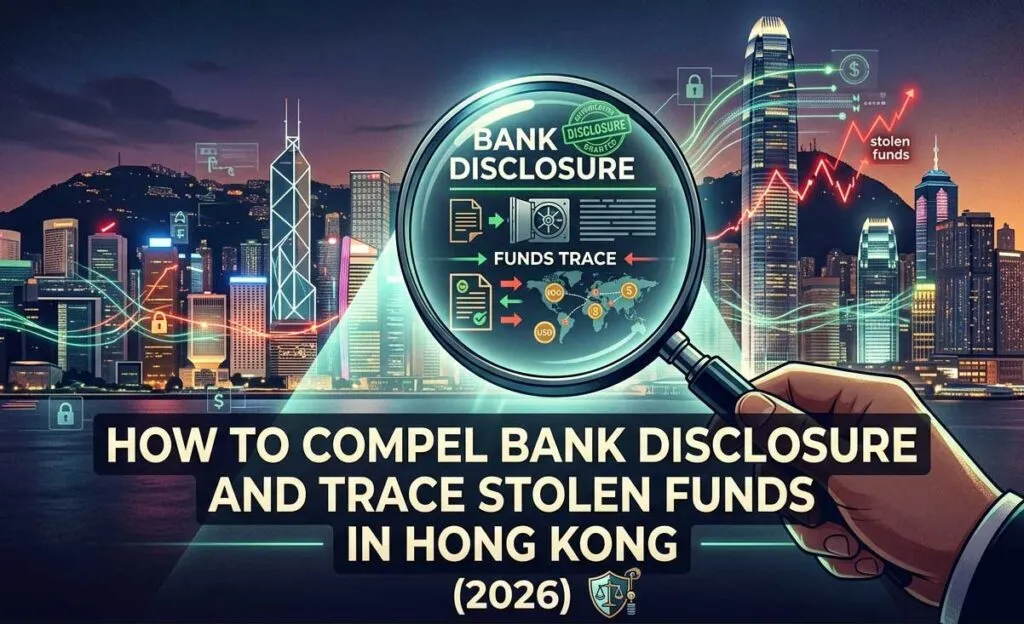
When funds vanish into a web of Hong Kong bank accounts, the victim’s most urgent priority is identifying who holds the money and preventing its dissipation. The Norwich Pharmacal order Hong Kong 2026 landscape gives fraud victims, insolvency practitioners and in-house counsel a powerful, and evolving, set of tools to compel banks to disclose account information, freeze assets and trace stolen proceeds. Two developments make this guide especially timely: the revised PRC Arbitration Law, which took effect on 1 March 2026, reshapes cross-border interim relief options for claims involving mainland parties; and concurrent Hong Kong legislative and Department of Justice activity, including proposed amendments to the Arbitration Ordinance, is refining how local courts assist with third-party disclosure and emergency measures.
This article is a practical, step-by-step playbook covering Norwich Pharmacal relief, freezing injunctions, gagging orders and the critical litigation-versus-arbitration decision that claimants must now navigate.
What you will learn: the legal tests for obtaining a Norwich Pharmacal bank order, the evidence you need before approaching court, how to combine disclosure with freezing relief, when confidentiality protections apply, and how the Arbitration Ordinance amendment 2026 debate affects your strategic choices. Each section includes checklists, comparison tables and realistic timelines.
A Norwich Pharmacal order (NPO) is an equitable remedy that compels an innocent third party, most commonly a bank, to disclose information or documents needed to identify a wrongdoer or trace the proceeds of fraud. The jurisdiction traces back to the 1974 House of Lords decision in Norwich Pharmacal Co v Customs and Excise Commissioners, and Hong Kong’s Court of First Instance (CFI) has adopted and refined the doctrine over decades of local case law. In its January 2026 Commercial Monthly Digest, Denis Chang’s Chambers emphasised the historical roots of Norwich Pharmacal orders while noting that recent CFI decisions continue to develop the remedy’s scope and limits.
Hong Kong courts will grant an NPO where three conditions are met:
The court retains a broad discretion and will weigh factors including potential prejudice to the respondent or affected third parties, the strength of the underlying claim, and any competing public interest (such as banking confidentiality).
Typical orders against a Hong Kong bank require disclosure of:
Orders are typically crafted to cover a defined date range and specific accounts, keeping the scope focused to satisfy the proportionality threshold.
Obtaining a Norwich Pharmacal order Hong Kong 2026 practitioners will recognise as effective requires meticulous preparation. Banks routinely scrutinise applications, and an under-prepared originating summons invites delay. The following chronological walkthrough covers everything from evidence gathering to enforcement.
Before approaching the CFI, assemble the strongest possible evidentiary foundation. The table below summarises what you need, why it matters and where to source it.
| Evidence Type | Why It Matters | Where to Get It |
|---|---|---|
| SWIFT / MT103 payment messages | Proves the fund flow and identifies intermediary banks | Remitting bank; victim’s own bank records |
| Transaction chronology | Demonstrates the pattern of fraud and connects accounts | Forensic accountant; internal finance team |
| Police report / crime reference | Corroborates the allegation of wrongdoing | Hong Kong Police (Commercial Crime Bureau) or foreign law-enforcement agency |
| Suspicious Activity Report (SAR) reference | Shows AML processes have been engaged; supports urgency | Compliance department; Joint Financial Intelligence Unit |
| Forensic accountancy report | Traces funds professionally and strengthens the necessity argument | Instructed forensic firm (Big Four or specialist) |
| Contractual / corporate documents | Establishes the underlying relationship and the basis for the claim | Client files; Companies Registry searches |
| Prior correspondence with the bank | Demonstrates that voluntary disclosure was sought and refused, reinforcing necessity | Client records; solicitor correspondence file |
Most Norwich Pharmacal applications in Hong Kong are commenced by originating summons (OS) in the CFI. Where dissipation risk is acute, for example, funds are actively being moved, the applicant may seek ex parte (without notice) relief. Ex parte applications require full and frank disclosure of all material facts, including points that may be adverse to the applicant. Failure to observe this duty can result in the order being set aside, costs penalties and reputational damage. In non-urgent cases, an inter partes OS with abbreviated service on the bank is more common and gives the court comfort that both sides have been heard.
Effective drafting of a Norwich Pharmacal bank order limits the scope to what is genuinely necessary. Best practice includes:
Once the order is served, banks in Hong Kong typically have legal teams experienced in responding to NPOs. Common objections include reliance on banking secrecy obligations, data-privacy concerns under the Personal Data (Privacy) Ordinance (Cap. 486), assertions that the order is overbroad or disproportionate, and arguments that the applicant has alternative means of obtaining the information. Courts will generally override secrecy objections where the necessity and proportionality thresholds are met, but applicants should anticipate and address these challenges in the supporting affidavit.
Banks frequently comply in stages, producing core account-holder information first and fuller transaction records later. Expect the bank to seek confidentiality undertakings restricting onward disclosure. In a notable 2025 decision, the High Court granted a variation of Norwich Pharmacal undertakings to allow the applicant to use documents obtained from a disclosing bank in subsequent proceedings against that same bank, a development practitioners should note when drafting initial undertaking language. Once disclosure is received, further tracing may reveal additional accounts or intermediaries, prompting supplemental applications or follow-up discovery in the substantive proceedings.
A freezing injunction (commonly called a Mareva order) prevents the respondent from dissipating assets up to a specified value. Where fraud victims need both to identify wrongdoers and to preserve assets, combining a Norwich Pharmacal order with a freezing injunction Hong Kong is a potent strategy. In May 2025, Eversheds Sutherland confirmed that the High Court recognises ancillary disclosure jurisdiction to support freezing orders, including those in aid of foreign proceedings, reinforcing the court’s willingness to compel banks to reveal asset positions alongside a freeze.
Industry observers expect the combined application to become increasingly standard in 2026, particularly where funds have been identified in transit through Hong Kong accounts. The advantages are clear: the freezing order preserves the target assets while the NPO uncovers details needed to trace further or to bring substantive claims. Tactically, filing both together on an ex parte basis maximises the element of surprise and reduces the window for dissipation.
Key considerations when drafting freezing relief alongside a Norwich Pharmacal bank order include:
| Relief Type | Purpose | When to Use | Typical Timeframe |
|---|---|---|---|
| Norwich Pharmacal order | Compel third-party disclosure (identity, documents, fund flow) | Unknown wrongdoer or need to trace funds through a bank | 2–6 weeks (OS track); days if ex parte |
| Freezing injunction (Mareva) | Prevent dissipation of assets pending trial or enforcement | Known or identifiable assets at risk of removal | Hours to days (ex parte); return date at 7–14 days |
| Ancillary disclosure order | Require respondent / bank to reveal asset positions to support a freeze | Always sought alongside or shortly after a freezing order | Granted concurrently with the freeze or at return date |
One of the most frequent concerns for applicants is whether seeking a Norwich Pharmacal order Hong Kong 2026 will inadvertently alert the fraudster. The short answer is that Hong Kong courts have well-established mechanisms to manage this risk.
Sealing orders restrict public access to the court file, preventing the respondent or any third party from learning of the application through a registry search. Gagging orders go further, prohibiting the bank from notifying its customer that disclosure has been ordered. Courts grant gagging relief where there is a genuine risk that the account holder will dissipate assets, destroy evidence or flee the jurisdiction if tipped off.
Practical tactics for maintaining confidentiality include:
The revised PRC Arbitration Law, effective 1 March 2026, represents the most significant overhaul of mainland China’s arbitration framework in decades. According to analysis published by Allen & Gledhill, the revised law modernises tribunal powers, including the scope of interim measures available from mainland arbitral tribunals, and strengthens provisions on cross-border enforcement. At the same time, Hong Kong’s Department of Justice has been progressing proposals to amend the Arbitration Ordinance (Cap. 609), as detailed in papers filed with the Legislative Council. Together, these developments create a more dynamic, but also more complex, environment for fraud recovery involving PRC-connected parties.
For claimants bound by an arbitration clause, the 2026 changes raise several immediate questions about asset tracing Hong Kong strategies and cross-border disclosure Hong Kong mechanisms:
The decision whether to approach the Hong Kong High Court or an arbitral tribunal for interim relief depends on several intersecting factors: the location of assets, the contractual dispute-resolution clause, the need for compulsion against banks and the importance of confidentiality. The comparison table below distils the key trade-offs.
| Relief / Forum | Speed and Enforceability | Best Uses |
|---|---|---|
| HK High Court interim relief (freezing order, NPO) | Fast, emergency ex parte possible within hours; directly enforceable against HK banks and assets | Assets or bank branches located in Hong Kong; need to compel third-party disclosure; public-hearing risk mitigated by sealing/gagging orders |
| Arbitral tribunal emergency measures / emergency arbitrator | Fast where emergency arbitrator mechanism exists; enforceability depends on the seat and supporting legislation | Parties bound by an arbitration clause who value confidentiality; may still require court enforcement against non-parties (banks) |
| Mainland PRC tribunal measures (post-1 March 2026) | Subject to revised PRC Arbitration Law rules; cross-border enforceability may involve additional procedural steps | Mainland-seated disputes with PRC respondents; check revised law provisions and bilateral Hong Kong–mainland assistance mechanisms |
In practice, the Norwich Pharmacal order remains a court remedy, arbitral tribunals cannot compel third-party banks to disclose. Where bank disclosure is critical, industry observers expect claimants to continue seeking NPOs from the CFI even if the underlying dispute proceeds in arbitration, treating court disclosure as a complementary tool rather than a substitute.
The following decision matrix helps claimants and their advisers determine the optimal route for a Norwich Pharmacal order Hong Kong 2026 recovery action.
| Factor | Favour Court Litigation | Favour Arbitration / Tribunal Measures |
|---|---|---|
| Asset / bank location | Assets or bank branches in Hong Kong | Assets primarily outside Hong Kong; mainland nexus |
| Need for third-party bank compulsion | Essential, only court can compel banks via NPO | Not required (or court assistance available under s.45) |
| Contractual dispute-resolution clause | No arbitration clause; or court proceedings already commenced | Mandatory arbitration clause (HKIAC, ICC, CIETAC) |
| Confidentiality priority | Manageable with sealing/gagging orders | High, arbitration offers inherent confidentiality |
| Speed of enforcement | Immediate in Hong Kong | May require separate enforcement proceedings |
| Stage | Typical Timeframe | Key Action |
|---|---|---|
| Evidence gathering and forensic instruction | 1–5 days | Assemble SWIFT records, police report, forensic memo; instruct counsel |
| Ex parte application (freezing + NPO) | Day 5–7 | File OS and supporting affidavit; attend before duty judge |
| Order granted and served on bank | Day 7–8 | Serve sealed order on bank compliance team with gagging direction |
| Return date hearing | Day 14–21 | Respondent may appear; court considers continuation or variation |
| Bank provides initial disclosure | Week 3–4 | Account-holder identity, core statements, KYC documents |
| Follow-up tracing and supplemental applications | Week 4–6+ | Forensic analysis of disclosed material; further NPOs if new accounts identified |
The Norwich Pharmacal order Hong Kong 2026 framework, combined with freezing injunctions, gagging orders and the evolving arbitration landscape, gives fraud victims a formidable toolkit. Success depends on speed, preparation and strategic choices made at the outset: gathering strong evidence, choosing the right procedural route, and deciding whether court litigation or arbitration best serves the recovery objective. With PRC arbitration reforms reshaping cross-border dynamics and Hong Kong’s own legislative machinery in motion, claimants who act promptly and with experienced counsel stand the best chance of tracing and recovering stolen funds. To speak with a specialist dispute-resolution practitioner, find a Hong Kong dispute resolution lawyer through Global Law Experts.
This article is for general information purposes and does not constitute legal advice. Last reviewed: 27 April 2026.
This article was produced by Global Law Experts. For specialist advice on this topic, contact Gregory Payne at Payne Velasco, a member of the Global Law Experts network.

posted 6 hours ago
posted 11 hours ago

posted 11 hours ago

posted 12 hours ago

posted 12 hours ago

posted 13 hours ago

posted 13 hours ago

posted 14 hours ago

posted 14 hours ago

posted 15 hours ago

posted 15 hours ago

posted 16 hours ago
No results available
Find the right Legal Expert for your business
Sign up for the latest legal briefings and news within Global Law Experts’ community, as well as a whole host of features, editorial and conference updates direct to your email inbox.
Naturally you can unsubscribe at any time.
Global Law Experts is dedicated to providing exceptional legal services to clients around the world. With a vast network of highly skilled and experienced lawyers, we are committed to delivering innovative and tailored solutions to meet the diverse needs of our clients in various jurisdictions.
Global Law Experts is dedicated to providing exceptional legal services to clients around the world. With a vast network of highly skilled and experienced lawyers, we are committed to delivering innovative and tailored solutions to meet the diverse needs of our clients in various jurisdictions.

Send welcome message