
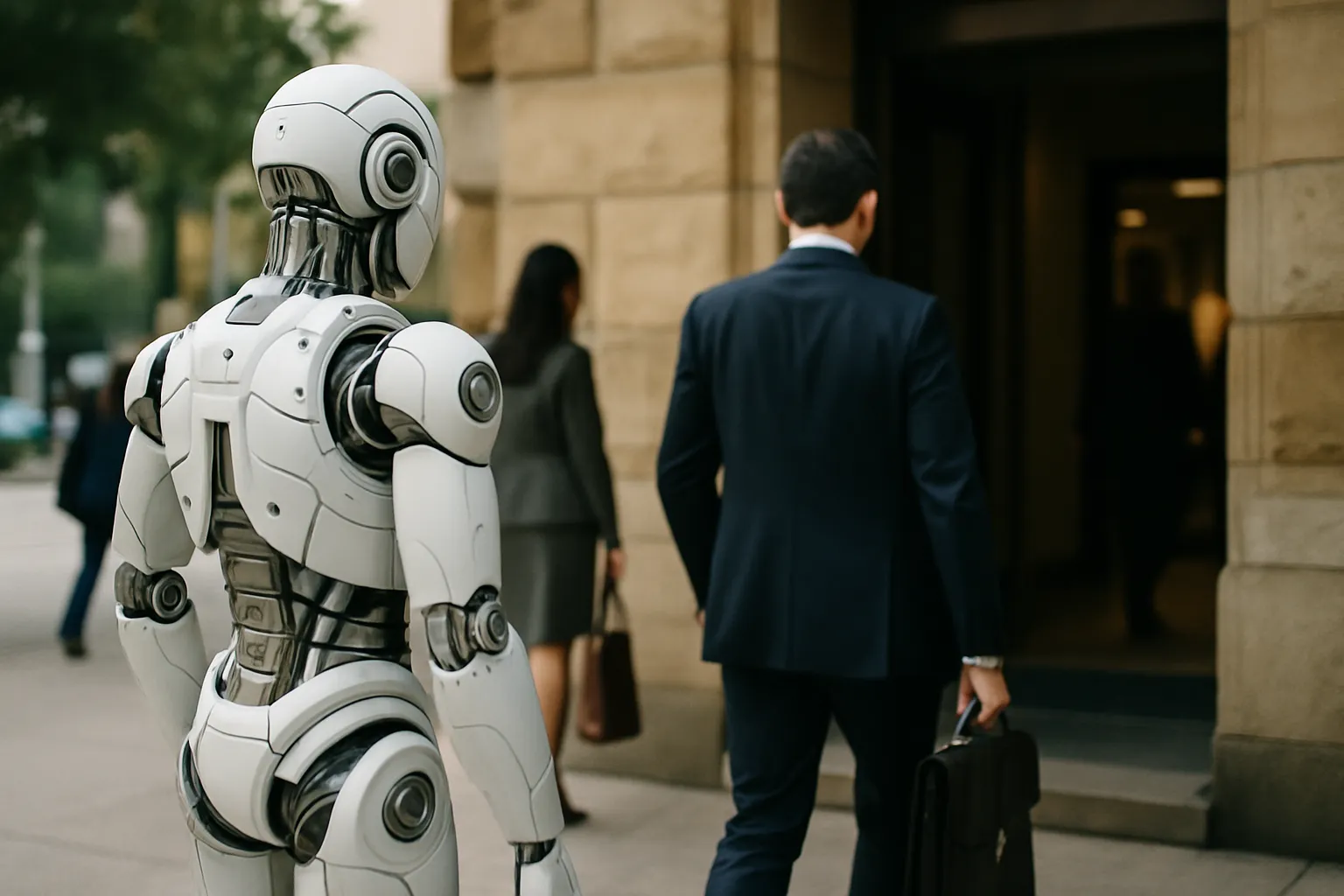
The ai vs patent attorney australia question has become one of the most consequential decisions facing life‑sciences and advanced‑materials inventors in 2026, because generative AI now drafts claims, sifts prior art and summarises examination reports in seconds, yet still cannot verify experimental data, argue inventive step before an examiner, or protect your disclosure under professional privilege. The short verdict: use AI as a supervised drafting and search aid, but hire an Australian patent attorney the moment your invention involves experimental support, high commercial value, or the prospect of enforcement. This guide gives you a jurisdiction‑specific decision framework, a side‑by‑side comparison, and the practical hiring triggers that matter for chemistry, biotech, polymers and materials inventions.
It is written for R&D managers, founders and in‑house counsel who need a recommendation, not a hedge.
Search intent: Decision, a pragmatic, Australia‑specific guide to deciding when generative AI is an acceptable drafting and prior‑art tool, and when life‑sciences and materials inventors should engage a registered Australian patent attorney.
If you take nothing else from this article, take this. Generative AI is a productivity multiplier for early‑stage ideation and broad prior‑art scanning. It is not a substitute for a registered Australian patent attorney when the invention carries technical or commercial risk. The four immediate triggers to stop relying on AI and hire an attorney are:
Everything below expands these triggers into a workable framework grounded in the Patents Act 1990 (Cth) and IP Australia examination practice.
Expert attribution: technical and strategic commentary in this article is attributed to Dr Neil Ireland, PhD, a Principal in the Chemistry and Life Sciences practice at Phillips Ormonde Fitzpatrick, with around three decades of patent prosecution experience across pharmaceuticals, specialty chemicals and materials. See the Dr Neil Ireland, expert profile.
The debate over ai vs patent attorney australia is no longer theoretical. Generative tools have moved from novelty to daily workflow, and the stakes for inventors who misjudge their limits have risen accordingly.
Across the past few years, generative AI has been absorbed into research and legal workflows at speed. IP teams now use large language models for first‑draft specifications, claim brainstorming and prior‑art summarisation. Australia’s national policy posture increasingly emphasises responsible adoption while flagging governance, transparency and privacy obligations, reflected in guidance and consultation published by the Department of Industry, Science and Resources on the safe and responsible use of AI. For inventors, the practical consequence is that AI is now cheap, fast and everywhere, which makes disciplined use more important, not less.
Search engines now surface AI‑generated summaries above traditional results. These summaries are useful for orientation but frequently blur jurisdictional distinctions, treating patent drafting as universal when Australian support, sufficiency and inventive‑step tests have their own contours. That confusion is precisely why a considered ai vs patent attorney australia analysis, anchored to primary Australian sources, is valuable.
Life‑sciences and materials inventions carry risk characteristics that magnify AI’s weaknesses. Patentability in these fields often depends on experimental data, assay results, pharmacokinetic profiles, mechanical or thermal performance figures, that an AI cannot generate, verify or design. Claim scope typically spans chemical genera or compositional ranges, where the boundary between fair breadth and unsupported over‑claiming is subtle. Under the Patents Act 1990, a specification must disclose the invention clearly and completely enough for it to be performed by a person skilled in the relevant art, and claims must be supported by matter disclosed in the specification.
A drafting tool that hallucinates an embodiment or overstates a working example does not merely produce a weaker application, it can introduce subject matter that goes beyond the disclosure, or destroy novelty through premature or inaccurate public description. In these fields, the ai vs patent attorney australia decision is a risk‑management decision first and a cost decision second.
This is the operational heart of the article. Use it to make a fast, defensible call. Match your invention against both lists; if any attorney trigger applies, engage a patent attorney regardless of how many AI triggers also apply.
The framework is deliberately asymmetric. AI triggers are permissive; attorney triggers are decisive. That asymmetry reflects the reality that the downside of under‑using AI is wasted time, while the downside of over‑relying on AI in a high‑stakes matter can be an unrecoverable loss of rights.
Each row is a dimension of patent prosecution risk. Read the AI column as “what the tool can do unsupervised” and the attorney column as “what a specialist adds.” Where the two columns diverge sharply, added subject matter, sufficiency, advocacy, liability, that divergence is your signal that the ai vs patent attorney australia decision should favour professional engagement. Where they converge, breadth of prior‑art scanning, early drafting speed, AI delivers genuine efficiency.
| Dimension | Generative AI / Automated Tool | Australian Patent Attorney (specialist life‑sciences/materials) |
|---|---|---|
| Ability to assess inventive step | Can surface prior art; may miss nuanced technical teachings or obviousness arguments | Expert judgement, technical intuition and experience with inventive‑step arguments; frames the inventive contribution for examiners |
| Drafting claims for chemistry/biology | Often too literal or overbroad; risk of unsupported breadth and inadequate support | Tailored claim drafting, aware of enablement and support requirements and common Australian examiner objections |
| Handling experimental data & sufficiency | Cannot verify or design experimental evidence; risk of over‑claiming | Advises on required experimental disclosure and drafts to meet sufficiency and support tests |
| Added subject‑matter risk | High, hallucinations may introduce unsupported embodiments | Low, attorney keeps claims within the disclosure and amends strategically |
| Prior art search quality | Good for breadth; may lack expert curation and miss domain‑specific prior art (family, legal status) | Specialist searches (patents plus non‑patent literature) with legal analysis; FTO and prosecution strategy aligned |
| Prosecution strategy & advocacy | No procedural advocacy; cannot engage examiners or litigate | Prepares prosecution responses, negotiates amendments, advises on enforcement strategy |
| Cost | Low immediate cost; hidden downstream risk costs | Higher upfront, but reduces the risk of rejection, costly amendments or litigation |
| Timing | Fast for drafts and searches; may create rework | Slower but produces prosecution‑ready documents |
| Liability & privilege | Outputs may be unprotected; confidentiality and IP‑ownership issues with third‑party tools | Work product may attract client‑attorney privilege, with a clear duty of care |
| Best use cases | Early ideation, broad prior‑art sifting, non‑binding drafting | Anything with commercial value, experimental data or enforcement risk |
The pattern is consistent. AI wins on speed and breadth at the front of the process; the attorney wins decisively on judgement, support, advocacy and protection at every point where rights are actually secured. A sensible operation uses both, but never lets the tool make the calls reserved for the professional.
To weigh ai vs patent attorney australia properly, you need to understand exactly where the technology fails in these fields, not in the abstract, but at the level of claim language and disclosure.
Chemical and materials claims live or die on scope. Draft too narrowly and a competitor designs around a single substituent; draft too broadly and the claim collapses for lack of support or enablement. Generative AI tends toward the extremes, either parroting the described embodiment verbatim or inflating scope with plausible‑sounding but unsupported generalisations. It does not understand that under Australian practice a claim to a chemical genus must be enabled across its breadth and supported by the disclosure. A specialist life‑sciences patent attorney calibrates a claim set, independent claims pitched for commercially meaningful breadth, dependent claims building fallback positions tied to actual working examples.
That calibration is a matter of technical and legal judgement that no current model reliably reproduces, because it requires knowing which parts of the genus the evidence can actually carry.
Hallucination is not a curiosity in patent drafting; it is a legal hazard. If an AI introduces an embodiment, a numerical range or a mechanism that was never in the inventor’s disclosure, and that language finds its way into the filed specification, it can create problems of support and, on later amendment, of added subject matter that extends beyond the original disclosure. Australian courts have consistently treated the boundaries of disclosure and claim construction rigorously, the reasoning of the High Court in Lockwood Security Products Pty Ltd v Doric Products Pty Ltd illustrates how carefully questions such as fair basis, support and claim scope have been analysed.
Content that goes beyond the disclosure frequently cannot be corrected later without abandoning the offending subject matter, and in the worst case it undermines the validity of the granted claim. An attorney controls the specification against the inventor’s actual disclosure; an unsupervised tool cannot, because it has no ground truth for what the inventor actually did.
In pharma, polymers and advanced materials, the patent bargain is data. You disclose enough experimental support to justify the monopoly you claim. IP Australia’s published examination practice reflects examiners’ expectations around support and sufficiency, and these expectations are demanding where a claim asserts a technical effect across a range. AI cannot run an assay, cannot judge whether three examples justify a claim to a genus of hundreds, and cannot design the additional experiments needed to shore up a weak position. A patent attorney advises on precisely these questions before filing, identifying where the data is thin, what comparative results strengthen an inventive‑step case, and how to draft so the claim breadth matches the evidence.
This is the single clearest reason the ai vs patent attorney australia decision tilts to the professional in data‑dependent fields.
None of this means AI has no place. Used within guardrails, generative AI genuinely accelerates the early stages of the patent process and reduces professional cost by arriving at consultations better prepared.
Several tasks are low‑risk and well suited to AI, provided a human checks the output:
The winning model is hybrid: AI handles volume and speed at the front end, and a registered attorney controls everything that touches legal effect. In practice this means a set of standing controls. First, treat every AI output as a draft to be verified against the inventor’s actual records, never as a source of fact. Second, keep confidential technical disclosures out of third‑party tools that do not guarantee data segregation, because feeding an unpublished invention into an open model can raise novelty and confidentiality problems. Third, log where and how AI was used, so that the boundary between machine‑generated text and professionally settled work product is documented. Fourth, ensure a registered professional settles the specification and claims before filing.
The Trans‑Tasman IP Attorneys Board, which administers the registration and professional conduct of patent and trade marks attorneys in Australia and New Zealand, sets the professional obligations that make attorney sign‑off meaningful, a duty of care and a standard of competence that no tool carries. Within these controls, AI is an asset. Outside them, in the ai vs patent attorney australia calculus, it is a liability.
When a trigger fires and you engage a professional, arrive prepared. Knowing when to hire a patent attorney in Australia is only half the task; briefing them well is the other half. Ask these questions at the first consultation:
The answers reveal whether the attorney has genuine life‑sciences or materials depth, the technical fluency that separates a specialist life‑sciences patent attorney from a generalist.
Costs vary with complexity, the number of jurisdictions and the volume of examination correspondence, so treat any figure as indicative rather than fixed and confirm current fees with your attorney and with IP Australia’s published fee schedule. Broadly, a provisional application in a technically demanding field costs more than a simple mechanical filing because the drafting effort is greater. A complete specification for a chemistry or biotech invention, with carefully calibrated claims and worked examples, sits at the higher end of drafting effort. Examination responses add cost each time an examiner raises support, sufficiency or inventive‑step objections, and these objections are common in data‑dependent fields. National‑phase entry multiplies filing and, where required, translation costs per jurisdiction.
The economic case for professional engagement is that a well‑drafted application reduces the number and severity of these downstream events. Money spent on quality drafting is often recovered many times over in avoided rejections, amendments and disputes.
Two governance issues deserve attention. First, liability: an AI vendor does not owe you a professional duty of care, whereas a registered attorney does. Second, privilege and confidentiality: registered patent attorneys in Australia have a statutory privilege in respect of certain IP advice under the Patents Act, while text generated by a third‑party tool may not be protected and may raise ownership and confidentiality questions. Document your AI use, keep unpublished technical detail out of open tools, and route legally significant work through your attorney so privilege can attach cleanly.
Vignette A, AI used safely. A materials start‑up used a generative tool to scan for prior art around a new polymer additive and to produce a rough background section. The output flagged several relevant patent families the team had not seen. They handed the indexed results and the rough draft to a patent attorney, who ran a specialist search, confirmed apparent novelty, and drafted calibrated claims. AI compressed weeks of preliminary work into days, and professional oversight ensured the filing was sound. This is the ideal hybrid outcome.
Vignette B, AI error causing loss of scope. A biotech founder used an AI tool to draft claims for a new compound series and filed without professional review. The tool had generalised the disclosure into a broad genus unsupported by the two working examples actually performed. During examination the claims were objected to for lack of support, the founder was forced to narrow drastically, and commercially valuable scope was lost. A specialist would have matched the claim breadth to the evidence, or advised generating more data before filing. The hiring trigger, experimental support, had fired and been ignored.
The honest forecast is no. AI will keep automating drafting and search tasks, and industry observers expect it to raise baseline productivity across the profession. But the tasks that define patent prosecution, constructing claims to match evidence, arguing inventive step, satisfying sufficiency and support, and advocating before examiners and courts, are matters of judgement, not pattern completion. International analysis, such as WIPO’s technology‑trends work on artificial intelligence, generally frames AI as an augmenting technology within the IP system rather than a replacement for legal decision‑making. The likely practical effect is that demand for technically qualified attorneys will hold or grow, because more AI‑drafted material means more expert oversight is required, not less.
For the foreseeable future, the ai vs patent attorney australia question resolves to collaboration, not substitution.
The ai vs patent attorney australia decision is not a binary between old and new; it is a discipline for using both well. Let AI accelerate the early, low‑risk work, broad prior‑art scanning, rough drafting, summarisation, under human supervision. Then hand the legally significant work to a registered Australian patent attorney whenever experimental data, complex chemistry, commercial value or enforcement enters the picture. In life‑sciences and materials, those triggers fire often, and the cost of ignoring them can be an unrecoverable loss of rights. Use the framework, apply the comparison table, and when a trigger fires, engage a specialist.
This article is for general information only and does not constitute legal advice. For advice on a specific invention or filing strategy, contact a registered Australian patent attorney.

posted 40 minutes ago
posted 2 hours ago

posted 2 hours ago

posted 4 hours ago

posted 4 hours ago

posted 5 hours ago

posted 5 hours ago

posted 6 hours ago

posted 8 hours ago

posted 8 hours ago

posted 10 hours ago

posted 11 hours ago
No results available
Find the right Legal Expert for your business

Send welcome message