
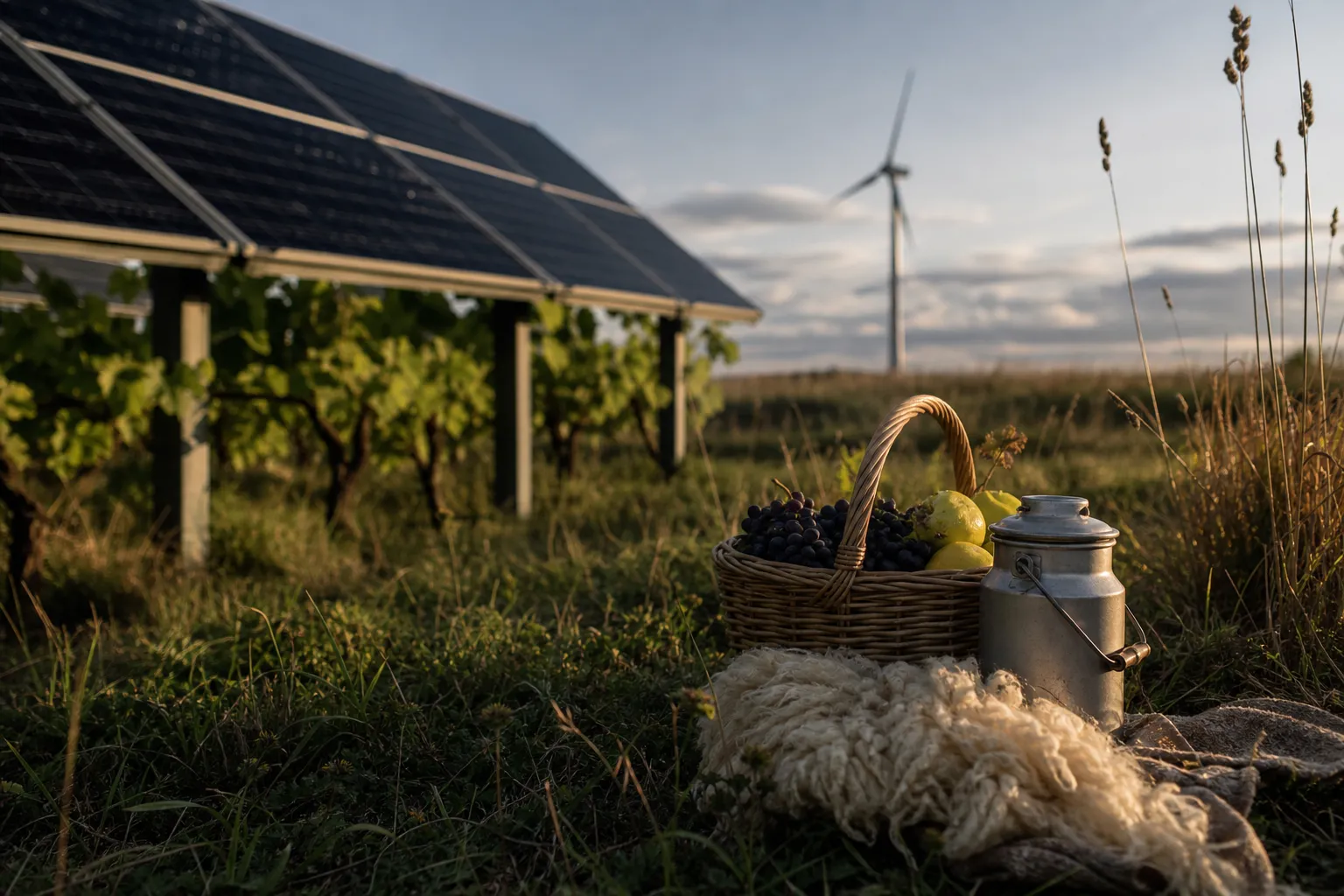
Agrivoltaics france regulations have moved decisively from policy aspiration to enforceable legal framework, and 2026 is the year developers must treat them as a hard compliance discipline rather than a market talking point. The implementation of the Loi relative à l’accélération de la production d’énergies renouvelables (Loi APER, Law No. 2023‑175 of 10 March 2023) and its follow‑on implementing decree (notably Decree No. 2024‑318 of 8 April 2024) has fixed a legal definition of agrivoltaïsme, set conditionality tests for solar on farmland, and mapped out which permitting routes apply to which projects.
For solar developers, independent power producers (IPPs), EPC contractors and agricultural landowners, the practical question is now sharp: can I build agrivoltaics on this particular French plot, and what permits and local approvals will I need to secure it? This guide sets out the legal definition, the Loi APER criteria, the zoning and land‑use constraints, the permitting pathways, and the local stakeholder processes, with a developer checklist and risk‑mitigation pointers you can apply to a live project.
Before Loi APER, agrivoltaics occupied a legal grey zone. Projects were assessed case by case against general planning law, with local authorities and departmental commissions applying inconsistent standards. The absence of a statutory definition created uncertainty over what counted as a genuine agricultural project with solar co‑production, versus a ground‑mounted solar farm dressed up to occupy protected agricultural land. That uncertainty translated directly into financing risk: lenders were reluctant to underwrite projects whose planning basis could be challenged.
The current framework changes this. Agrivoltaics france regulations now provide a codified test for what qualifies as agrivoltaïsme (inserted into the Code de l’énergie by Loi APER and detailed in the 2024 implementing decree), explicit conditions on how installations must interact with agricultural activity, and a clearer permitting architecture. This is good news for well‑structured projects and a warning for opportunistic ones: the same rules that legitimise genuine dual‑use projects are designed to exclude solar developments that would displace farming. Anyone evaluating a site in France should read the definition and criteria carefully before committing capital.
The short answer is yes, agrivoltaics is permitted on agricultural land in France, provided it satisfies the conditions established by Loi APER and its implementing decree, together with the applicable local zoning and permitting requirements. The law expressly recognises agrivoltaïsme as a legitimate use of agricultural land, which is a significant departure from the historic presumption that agricultural zones should remain largely free of energy infrastructure.
Under the Loi APER framework, agrivoltaïsme is defined by the coupling of a photovoltaic installation with an agricultural activity, where the solar installation provides a direct service to the agricultural operation without significantly compromising it as the primary purpose of the land. The key legal concept is that the agricultural production must remain the significant activity on the plot; the solar generation is co‑located and must support, protect or improve that production rather than replace it. The exact statutory wording and its implementing decree are set out on Legifrance, and developers should quote the current text directly when framing project applications.
The legislation distinguishes between installations that genuinely serve agricultural activity, and therefore qualify as agrivoltaïsme on agricultural land, and ground‑mounted photovoltaic plants that do not provide a demonstrable agricultural service. The latter are, as a general rule, steered towards degraded, artificialised or otherwise compatible land identified in a departmental document (documents cadres) rather than productive farmland. This distinction is the single most important go/no‑go trigger under the agrivoltaics france regulations: a project that cannot demonstrate a genuine, maintained agricultural service will struggle to qualify as agrivoltaïsme, regardless of its scale or the willingness of the landowner.
Loi APER agrivoltaics criteria are the core of the compliance analysis. A qualifying project must satisfy several cumulative conditions: it must preserve agricultural production, meet technical parameters compatible with farming, be reversible, and be monitored over its lifetime. Each of these is examined below. In every case the controlling text is the Loi APER itself and its implementing decree on Legifrance; the summaries below are plain‑language translations intended to guide feasibility work, not to substitute for the statutory wording.
The central requirement is that the plot must remain agriculturally productive. In practical terms, the criteria require that:
These tests are cumulative. Failing any one of them is likely to result in an unfavourable assessment from the departmental commission and, ultimately, a refusal or a legally vulnerable authorisation.
The implementing decree translates the agricultural‑use principle into measurable design parameters. Developers should expect scrutiny of:
ADEME publishes technical guidance and studies on agronomic compatibility and monitoring, and its recommendations are a useful benchmark when preparing the technical justification that the agrivoltaics france regulations require.
Reversibility is a defining feature of the regime. An agrivoltaic installation must be capable of removal so that the land can be restored to its prior agricultural state at the end of the project’s life. This has three practical consequences:
Because the regime is deliberately restrictive, applications benefit from a robust dossier demonstrating why the project qualifies as genuine agrivoltaïsme. That dossier should include the agronomic study, the identified agricultural service, evidence that yields will be maintained, and the reversibility and restoration plan. The more clearly a project evidences that farming remains the primary and continuing purpose of the land, the smoother its passage through the agrivoltaics france regulations assessment will be.
Meeting the Loi APER criteria is necessary but not sufficient. A project must also be compatible with local zoning. Agricultural land zoning france renewable energy questions turn on the Plan Local d’Urbanisme (PLU) and, where relevant, the acceleration zones introduced to speed up renewable deployment.
The PLU is the municipal or inter‑municipal planning document that classifies land, typically into urban (U), zones to be urbanised (AU), agricultural (A) and natural (N) categories. Agricultural (A) and natural (N) zones are, by default, highly restrictive of construction. Whether an agrivoltaic installation is admissible in an A or N zone depends on how the PLU is drafted and on the national provisions that permit agriculturally compatible installations. The first practical step in any feasibility exercise is to obtain the current PLU zoning for the plot and read the applicable zone regulations closely, because two adjoining communes can treat identical projects very differently.
Loi APER introduced the concept of zones d’accélération for renewable energy, defined at municipal level following public consultation. These zones are intended to concentrate and encourage renewable development in areas the municipality has designated as suitable. Where a plot falls within an acceleration zone, the project may benefit from a more supportive local posture. Developers should establish early whether the target commune has adopted acceleration zones and whether the plot sits inside one, as this materially affects both timeline and political risk. Note that these zones do not themselves grant a permit or override the substantive permitting requirements.
Zoning is not the only spatial constraint. Environmental designations, Natura 2000 sites, protected habitats, water‑sensitive areas and landscape protections, can override the apparent availability of a plot. A site that is zoned agricultural but overlaps a protected habitat will face a far heavier environmental assessment burden and may require an environmental authorisation. Environmental screening must therefore run in parallel with the zoning check, not after it.
If the existing PLU does not permit the installation, the developer faces a choice: pursue a modification or revision of the PLU, or reconsider the site. A PLU change is a public, political, multi‑stage process controlled by the local authority, not the developer, and it adds substantial time and uncertainty. In many cases it is more efficient to identify plots whose zoning already accommodates agriculturally compatible installations than to bet the project on a favourable PLU amendment. The agrivoltaics france regulations reward developers who front‑load this zoning diligence.
One of the most common questions is whether agrivoltaic projects require a building permit or an environmental authorisation. The answer depends on the size, configuration and environmental impact of the installation. French planning law offers several routes, from a simple prior declaration through to a full environmental authorisation, and the correct pathway is determined by thresholds and site sensitivity. Getting this determination right at the outset is central to agrivoltaic permitting france and avoids the costly error of submitting under the wrong regime.
The déclaration préalable (prior declaration) is the lightest route, appropriate for smaller installations that fall below the thresholds triggering a full building permit. It is faster and less document‑intensive, but it is only available where the project’s scale and impact remain modest. Developers should confirm the exact surface and capacity thresholds against the current Code de l’urbanisme provisions on Legifrance before assuming this route applies.
The permis de construire (building permit) is the standard route for installations exceeding the déclaration thresholds. It requires a fuller application including plans, and it engages the local authority’s substantive assessment of the project against zoning and, for agricultural land, the agricultural‑use criteria. For most utility‑scale agrivoltaic installations on farmland, a building permit will be the baseline planning consent.
Depending on installed capacity and site characteristics, a project may be subject to a systematic environmental impact assessment (étude d’impact) or to a case‑by‑case examination (examen au cas par cas) by the competent environmental authority. This assessment is integrated into the planning application and addresses the installation’s environmental externalities. Developers should confirm the applicable thresholds in the annex to Article R.122‑2 of the Code de l’environnement on Legifrance.
Larger or higher‑impact projects, particularly those affecting water, protected species or habitats, or requiring measures under the water or nature‑protection regimes, may need an autorisation environnementale (environmental authorisation). This is the most demanding route, consolidating several environmental consents into a single procedure and typically involving public participation. Projects overlapping sensitive designations should assume this pathway until screening confirms otherwise.
The route is driven by a combination of installed capacity, ground surface, zoning and environmental sensitivity. As a practical decision flow:
| Permit route | Trigger (capacity / surface / zoning) | Typical timeline | Main documentation | Key constraints / mitigation |
|---|---|---|---|---|
| Déclaration préalable | Smaller installations below building‑permit thresholds; zoning must permit | Shorter than a building permit | Simplified plans and project description | Only for modest projects; verify thresholds on Legifrance before relying on this route |
| Permis de construire | Installations exceeding déclaration thresholds on compatible land | Several months, subject to consultation | Full plans, project description, agricultural‑use justification, agronomic study | Engages substantive zoning and agricultural criteria; strong dossier reduces refusal risk |
| Étude d’impact / case‑by‑case examination | Where capacity or site characteristics reach the Code de l’environnement thresholds | Integrated into the planning consent | Environmental impact assessment or screening request | Confirm thresholds in Article R.122‑2 annex early |
| Autorisation environnementale | Larger / higher‑impact projects affecting water, species or habitats | Longest route; includes public participation | Consolidated environmental dossier and impact assessment | Assume this route where sensitive designations overlap; plan for enquête publique |
| Projects requiring PLU modification | Where existing zoning does not permit the installation | Substantial; controlled by the local authority | Zoning change dossier plus underlying permit application | High uncertainty; often better to select an already‑compatible plot |
Timelines are indicative only and depend on the specific PLU, environmental designations and whether an environmental assessment or authorisation applies. Verify all thresholds against the current Code de l’urbanisme and Code de l’environnement on Legifrance.
Even a project that satisfies the statutory criteria and the correct permitting route must navigate local stakeholders. Three actors dominate: the CDPENAF, SAFER, and the municipality, with a public inquiry engaged for larger projects.
The Commission Départementale de la Préservation des Espaces Naturels, Agricoles et Forestiers (CDPENAF) gives a departmental opinion on land‑use decisions affecting agricultural, natural and forestry space. For agrivoltaic projects on agricultural land, a CDPENAF opinion is a central procedural step: the commission assesses whether the project genuinely preserves agricultural use consistent with the Loi APER criteria. Practically, developers should engage with the process early, present a clear agronomic case, and anticipate the questions the commission will ask about yield maintenance, reversibility and the identified agricultural service. A well‑documented dossier that maps directly onto the statutory tests gives the best prospect of a favourable opinion.
The Sociétés d’Aménagement Foncier et d’Établissement Rural (SAFER) hold pre‑emption rights over certain transactions involving agricultural land. Where a land sale falls within SAFER’s scope, the transaction must be notified (typically by the notary) and SAFER may exercise its right to acquire the land in priority. For an agrivoltaic developer relying on purchasing the site, this is a material risk that must be managed before the deal completes. Mitigation strategies include:
The timing of notification relative to completion is critical, the process must be respected before a sale is finalised.
The mayor and municipal council are significant political stakeholders, particularly where acceleration zones are being defined or a PLU change is required. Municipal support can smooth a project; opposition can stall it. For larger projects and those subject to an environmental impact assessment, a public inquiry (enquête publique) or public participation procedure allows the community to comment, and the conclusions feed into the decision. The relevant State services at departmental level, the Direction Départementale des Territoires (et de la Mer), DDT(M), administer much of the planning and consultation process, and early, constructive engagement with them helps developers understand local expectations before submitting.
The following checklist condenses the compliance sequence into actionable steps. It is designed to be worked through in order, because each stage informs the next and early failure points are cheaper to discover than late ones.
| Step | Action | Responsible party | Typical lead time |
|---|---|---|---|
| 1 | Land title verification and current PLU zoning check | Project counsel / developer | Early stage |
| 2 | Agricultural viability assessment (is farming genuinely maintained?) | Agronomist / developer | 1–2 months |
| 3 | Crop‑specific agronomic compatibility study | Agronomist | 2–6 months |
| 4 | Environmental screening (Natura 2000, water, habitats) | Environmental consultant | 1–3 months |
| 5 | SAFER and tenant notifications / engagement | Project counsel | Before land deal completes |
| 6 | Determine permit route and assemble application pack | Project counsel / developer | Concurrent with studies |
| 7 | Secure land rights (lease / option) with escrow arrangements | Project counsel | Concurrent |
| 8 | Submit application and manage CDPENAF / public inquiry process | Developer / counsel | Several months to award |
Bankability sits behind every line of this checklist. Lenders will want to see clean land title, a defensible planning basis under the agrivoltaics france regulations, a robust agronomic study, and secured, long‑duration land rights. Weakness in any of these areas will surface during due diligence and can delay or derail financing.
Beyond permitting, the durability of an agrivoltaic project depends on the strength of its land rights and its allocation of regulatory risk. The points below are high‑level pointers; lease structuring in particular warrants dedicated legal drafting.
Because agrivoltaic assets have long operating lives, the land rights must match. Developers commonly consider longer‑term arrangements, including forms adapted from the rural leasehold framework (baux ruraux) and long‑duration civil law leases such as the bail emphytéotique. The essential requirements are duration aligned to the asset life, transferability to accommodate financing and refinancing, and compatibility with the constraints that govern agricultural tenancies. Where the land is farmed by a tenant rather than the owner, the tenant’s rights and consents must be addressed carefully. A dedicated follow‑up analysis on lease structuring is warranted given the complexity of reconciling energy‑project needs with rural tenancy protections.
Contracts should anticipate the principal regulatory failure points. Recommended clauses include conditions precedent tied to obtaining the permit and a favourable CDPENAF opinion, provisions addressing SAFER pre‑emption, and clear termination and cost‑allocation mechanisms if a required consent is refused. Allocating these risks explicitly avoids disputes when a process does not go as planned and gives lenders comfort that the project has a defined path if a consent fails.
The reversibility and restoration duties inherent in the agrivoltaics france regulations create a long‑tail liability. Developers should provide for restoration through appropriate financial security, a bond or guarantee, and consider insurance to cover the obligations. Securing restoration commitments financially also strengthens the CDPENAF and permitting case by demonstrating a credible end‑of‑life plan.
The current agrivoltaics france regulations give developers something they long lacked: a defined legal basis for solar on farmland, with clear go/no‑go triggers. The decisive questions are whether the plot’s zoning permits the installation, whether the project genuinely preserves agricultural production and provides an identified agricultural service, whether it is reversible with a funded restoration plan, and which permitting route applies given its scale and environmental sensitivity. Because outcomes are highly site‑specific, turning on the local PLU, environmental designations, CDPENAF assessment and SAFER exposure, every project should be tested against these criteria before capital is committed. For a project‑specific assessment of feasibility, permitting strategy and land‑rights structuring under the agrivoltaics france regulations, seek specialist French energy and land‑law advice early.
This article was produced by Global Law Experts. For specialist advice on this topic, contact Cendrine Delivré at Franklin, a member of the Global Law Experts network.

posted 19 minutes ago

posted 38 minutes ago

posted 1 hour ago

posted 1 hour ago

posted 2 hours ago

posted 2 hours ago
posted 2 hours ago

posted 2 hours ago

posted 2 hours ago

posted 2 hours ago

posted 2 hours ago

posted 2 hours ago
No results available
Find the right Legal Expert for your business

Send welcome message