
Author
No results available
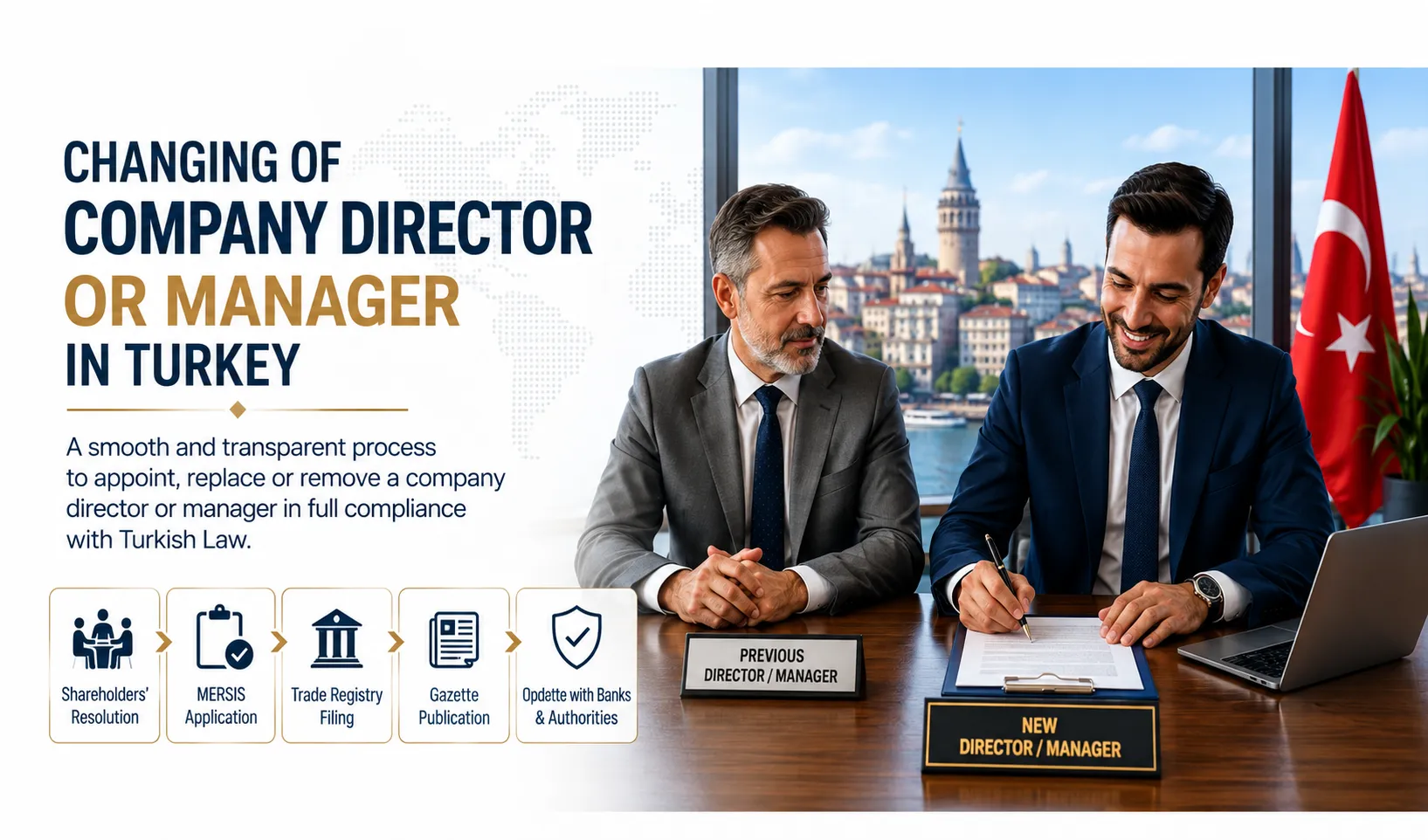
Changing a company director or manager in Turkey is a formal corporate procedure that must comply with the Turkish Commercial Code, the company’s articles of association and the registration requirements of the relevant Trade Registry Directorate.
The procedure differs depending on whether the company is established as a joint stock company (Anonim Şirket – A.Ş.) or a limited liability company (Limited Şirket – Ltd. Şti.). For foreign-owned companies, additional issues may also arise concerning representation authority, foreign documents, work permits, banking arrangements and powers of attorney.
Understanding the correct corporate procedure is important because a management change is not simply an internal decision. Where the change is subject to registration, the company’s official records and representation information must also be updated.
Turkish companies commonly operate through two principal corporate structures: joint stock companies and limited liability companies.
In a joint stock company, management and representation are primarily carried out by the board of directors. The board may consist of one or more directors, subject to the requirements of the Turkish Commercial Code and the company’s articles of association.
In a limited liability company, management and representation are carried out by one or more managers or a board of managers. Turkish law requires at least one manager to be appointed from among the shareholders, while non-shareholders may also be appointed as managers.
The distinction between these two structures determines which corporate body has authority to appoint or remove a director or manager and what documentation is required.
For a broader overview of the establishment and legal structure of Turkish companies, see the guide to Company Registration in Turkey.
A company may need to change a director or manager for a number of corporate or operational reasons, including:
For foreign-owned companies, management changes are particularly common when a parent company appoints a new representative for its Turkish subsidiary or when an international group reorganizes its local management structure.
In a joint stock company, the board of directors is the company’s principal management and representation body.
The Turkish Ministry of Trade states that directors of a joint stock company may be elected for a maximum period of three years and may be re-elected unless the articles of association provide otherwise.
The appropriate corporate decision depends on the nature of the change.
Directors are appointed by the company’s general assembly in accordance with the Turkish Commercial Code and the company’s articles of association. If a board position becomes vacant under circumstances regulated by the law, the board may have mechanisms available to temporarily fill the vacancy, subject to the applicable legal requirements.
The corporate resolution should clearly identify:
The company’s articles of association and the specific circumstances should always be reviewed before preparing the resolution.
For further information about the management and governance structure of this type of company, see Joint Stock Company in Turkey.
The procedure for a limited liability company differs from that of a joint stock company because the company is managed and represented by one or more managers.
Under Turkish law, at least one manager must be appointed from among the shareholders. Non-shareholder individuals may also be appointed as managers through the company’s articles of association or by the general assembly.
The general assembly generally plays the central role in appointing or removing managers.
The decision should identify the outgoing and incoming managers and, where relevant, specify the representation and signing powers of the newly appointed manager.
Unlike joint stock company directors, Turkish law does not establish a fixed statutory term for limited liability company managers. The term may be determined by the competent corporate body.
For more information about the management structure and legal characteristics of a Turkish LLC, see Limited Liability Company in Turkey.
The documents required for a director or manager change depend on the company type, the nature of the change, the nationality of the incoming person and the requirements of the relevant Trade Registry Directorate.
Depending on the circumstances, the documentation may include:
Additional documentation may be required depending on the circumstances of the company.
Foreign investors should pay particular attention to documents issued outside Turkey.
Depending on the document and applicable procedure, foreign corporate documents may need to be:
The precise requirements should be confirmed before filing because incomplete or improperly certified foreign documents can delay the registration process.
Generally, Turkish company law does not impose a general Turkish citizenship requirement for directors of joint stock companies.
Foreign nationals can also hold management positions in Turkish companies, subject to applicable corporate, immigration and employment legislation.
However, companies should distinguish between being appointed as a director or manager and physically working in Turkey.
Corporate appointment does not automatically resolve immigration or employment requirements.
This distinction is particularly important for foreign shareholders and executives who intend to reside in Turkey and actively manage the company’s operations.
No.
Appointment as a company director or manager does not automatically grant a foreign national unrestricted authorization to work in Turkey.
The Turkish Investment Office states that foreigners who intend to work in Türkiye generally require a work permit, subject to applicable exemptions and specific rules.
Work permit requirements can depend on factors including:
Therefore, a company should assess corporate appointment and work permit requirements as separate but potentially related legal matters.
Turkey uses MERSİS (Central Registry Record System) for company and commercial enterprise registration procedures.
The Turkish Ministry of Trade explains that MERSİS is designed to facilitate electronic registration, amendment and deletion transactions for companies and commercial enterprises, while also storing and providing relevant Trade Registry information electronically.
The official system is available through MERSİS – Central Registry Record System.
Depending on the transaction, the relevant corporate change is prepared through MERSİS and submitted to the competent Trade Registry Directorate.
Once the change is registered, the company’s official records are updated and matters requiring publication may be announced through the Turkish Trade Registry Gazette.
This is particularly important because third parties such as banks, customers, suppliers and public authorities may rely on the company’s registered representation information.
A director or manager change may also affect the company’s representation and signing authority.
For example, a company may change from:
The representation structure should therefore be expressly addressed when preparing the corporate resolution.
Turkish law contains specific rules regarding limitations on the representation authority of directors and managers. The Ministry of Trade notes that certain limitations may be registered and announced, while other limitations may not be effective against good-faith third parties.
For this reason, simply replacing the name of a director or manager without reviewing the company’s signing authority can create practical and legal problems.
The Trade Registry registration should not necessarily be regarded as the final operational step.
After a director or manager change, the company should review and update its information with relevant third parties and institutions, including:
Banking arrangements are particularly important.
If the outgoing director was an authorized bank signatory, the bank may require updated Trade Registry records, signature documentation, corporate resolutions and identification documents before changing the authorized signatory.
For companies managed by foreign executives, banks may also conduct their own KYC and compliance checks.
Therefore, the company’s banking records should be updated promptly after the corporate change.
There is no single processing period that applies to every director or manager change in Turkey.
The timeframe may depend on:
A straightforward domestic change may be completed relatively quickly once the required documentation is ready. Foreign-document and regulatory issues can make the process more complex.
Not every company is subject to the same corporate registration procedure.
Companies operating in regulated sectors may be subject to additional approval or notification requirements.
For example, Turkish legislation identifies certain companies whose establishment and amendments to their articles of association are subject to Ministry approval. The applicable requirements should therefore be checked according to the company’s sector and legal structure.
This is particularly relevant for businesses operating in regulated financial, insurance, capital markets and other specially regulated industries.
Foreign-owned companies can encounter avoidable problems when management changes are treated solely as an administrative filing.
Common mistakes include:
The decision must be adopted by the appropriate corporate body and comply with the company’s articles of association and Turkish law.
An internal decision does not necessarily complete the public registration process. Where registration is required, the change should be properly filed with the Trade Registry.
Foreign documents may require apostille, legalization, translation and notarization.
A director change may also change who can legally sign contracts and represent the company.
Foreign directors should not assume that corporate appointment alone gives them unrestricted authorization to work in Turkey.
Banks and payment institutions may continue to rely on their existing authorized-signatory records until the necessary updates are completed.
Regulated businesses may be subject to additional requirements that do not apply to ordinary commercial companies.
A management change can be connected with other corporate changes, including:
For companies carrying out several changes simultaneously, it is often more efficient to coordinate the procedures as part of a broader corporate compliance process.
A broader overview of these procedures is available in the guide to Corporate Changes in Turkey.
Changing a company director or manager in Turkey can involve more than preparing a corporate resolution. Foreign-owned companies may need to coordinate corporate law, Trade Registry, MERSİS, representation authority, foreign-document formalities, banking, tax and work permit considerations.
A&M Consulting Co. provides corporate and compliance support to foreign investors and international companies operating in Turkey. Its services can include assistance with corporate changes, preparation and coordination of corporate documentation, Trade Registry procedures, management changes, representation updates and related tax, accounting and compliance matters.
For companies that need professional assistance with changing a company director or manager in Turkey, A&M Consulting Co. can coordinate the process and help ensure that the relevant corporate and administrative requirements are addressed.
A&M Consulting Co. – How to Change a Company Director or Manager in Turkey
The firm’s support can be particularly useful for foreign shareholders, international groups and companies whose directors or managers are based outside Turkey.
Changing a company director or manager in Turkey is a formal corporate process that should be handled in accordance with the Turkish Commercial Code, the company’s articles of association and applicable Trade Registry requirements.
The procedure differs between joint stock companies and limited liability companies. Foreign-owned businesses may also need to consider foreign-document formalities, representation authority, banking updates and work permit requirements.
The safest approach is to review the company’s legal structure and existing representation powers before preparing the corporate resolution and Trade Registry application.
For foreign investors and international companies, professional assistance can help coordinate the corporate documentation, MERSİS and Trade Registry procedures and related compliance requirements.
Changing a company director or manager in Turkey involves corporate, administrative and, in some cases, immigration and compliance considerations. Professional advice can be particularly valuable when the company has foreign shareholders, foreign directors, complex representation powers, foreign-issued documents or operations in a regulated sector.
Before proceeding, a professional adviser can help determine the correct corporate decision-making procedure, prepare the required documentation, coordinate MERSİS and Trade Registry filings, and assess whether related updates are required for banks, tax records, accounting systems or work permits.
A&M Consulting Co. assists foreign investors and international companies with director and manager changes, corporate changes, Trade Registry procedures, MERSİS applications, representation authority updates and related tax, accounting and compliance matters in Turkey.
If you are planning to replace a director or manager of a Turkish company and want to ensure that the process is handled correctly from both a corporate and compliance perspective, you can contact A&M Consulting Co. for professional assistance.
Get professional advice on changing a company director or manager in Turkey.

posted 10 minutes ago

posted 26 minutes ago

posted 49 minutes ago

posted 1 hour ago

posted 2 hours ago

posted 2 hours ago

posted 2 hours ago

posted 2 hours ago

posted 3 hours ago

posted 3 hours ago

posted 3 hours ago

posted 4 hours ago
No results available
Find the right Legal Expert for your business

Send welcome message