
Our Expert in Singapore
No results available
This guide explains when and how parties can recover legal costs and post‑award interest in Singapore‑seated international arbitration, including the current statutory framework and SIAC rules, with practical steps for counsel and in‑house teams assessing recoverability, calculation and enforcement.
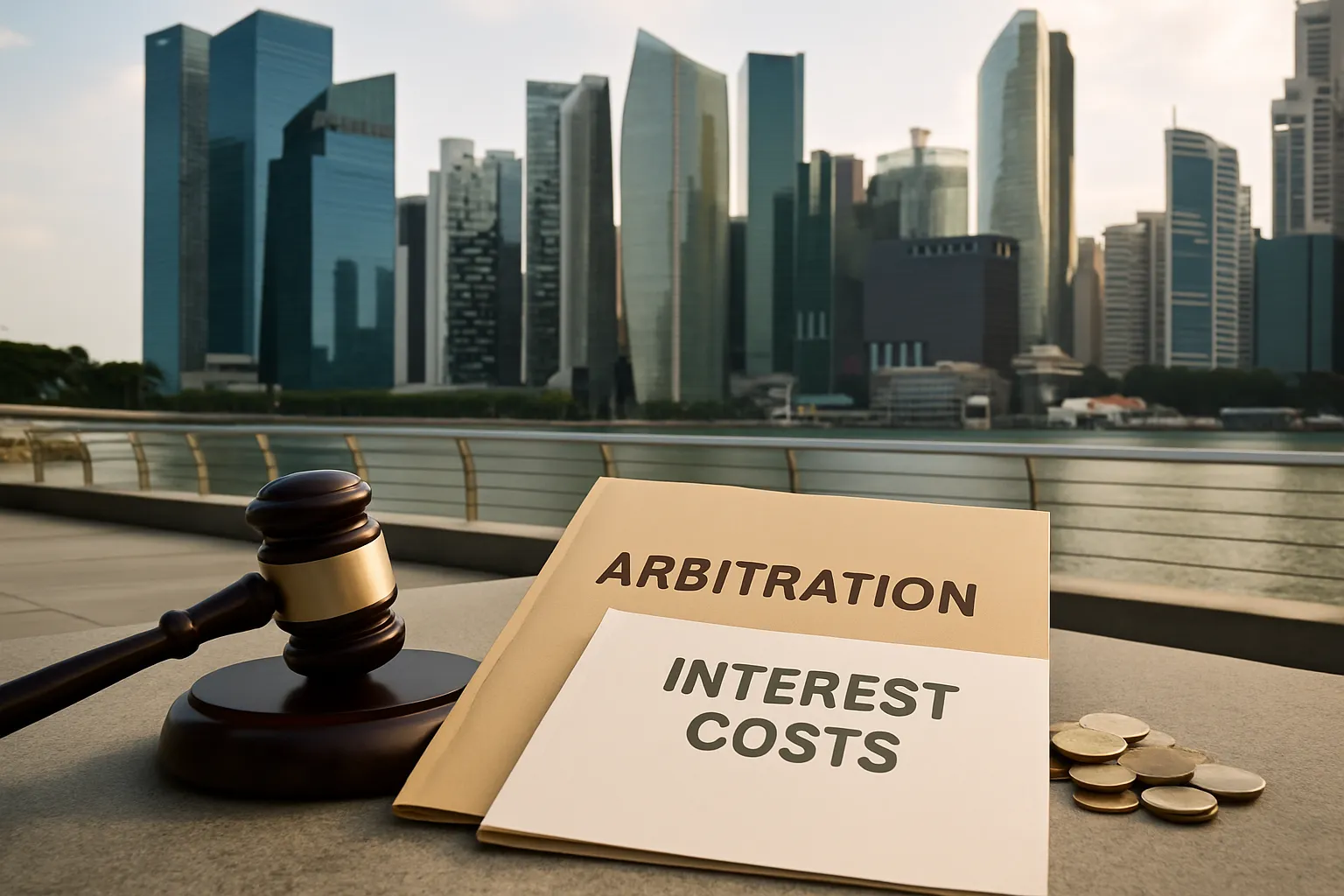
Arbitration costs and interest Singapore recovery has become one of the most closely watched issues for in‑house counsel and finance leaders entering 2026, because the money at stake in a costs award and in post‑award interest can rival the sums fought over on the merits. As a leading commercial arbitration seat in Asia, Singapore combines a pro‑enforcement statutory framework under the International Arbitration Act 1994 (IAA) with the institutional discipline of the Singapore International Arbitration Centre (SIAC), and recent institutional rule updates have sharpened tribunal practice on who pays, how interest accrues and how a costs award is enforced.
This article walks through the statutory hooks, tribunal practice, calculation mechanics and enforcement routes so that counsel and CFOs can budget realistically, preserve their claims and turn a favourable award into recovered cash. It is written for decision‑makers who need actionable detail, not marketing generalities. Throughout, references to primary sources allow you to trace each proposition to the underlying statute, rule or judgment.
For a case‑specific assessment, consult a practising Singapore arbitration lawyer through the International Arbitration, Singapore directory.
The core architecture governing arbitration costs and interest Singapore practice remains the International Arbitration Act 1994 (IAA), which gives statutory force to the UNCITRAL Model Law and preserves the tribunal’s broad discretion over costs and interest. The most significant recent development at the institutional layer is the SIAC Rules 2025, which took effect on 1 January 2025 and, together with updated fee schedules and refinements to case‑management practice, have made tribunals more explicit in reasoning cost allocations and interest awards. For users, the practical takeaway is straightforward. Recoverability is not automatic, but it is real and predictable if you plead it properly, evidence it well and structure the award for enforcement.
Singapore’s continued standing as a preferred seat matters here. Because the Model Law framework and a supportive judiciary underpin the IAA, awards that include costs and interest travel well internationally under the New York Convention. That combination, discretionary but reasoned cost awards at home, and robust cross‑border enforcement abroad, is precisely why parties choosing between competing seats so often land on Singapore. Recent refinements reinforce that reputation rather than disturb it.
The default position in Singapore‑seated arbitration is that the tribunal has a discretion, not a fixed formula, over how costs are borne. In practice tribunals commonly apply a “costs follow the event” starting point, the losing party bears a proportion of the successful party’s costs, but they retain full latitude to depart from it. Where a claimant wins on liability but loses substantial issues, or where a party’s conduct increased the cost of the reference, tribunals routinely adjust the allocation to reflect the real outcome rather than a headline win.
The statutory foundation sits in the IAA and the Model Law it incorporates, which confer on tribunals the power to award costs and to determine the amount. The SIAC Rules supplement this by setting out how the tribunal fixes and apportions the costs of the arbitration and the parties’ legal and other costs. The distinction is important: the costs of the arbitration (institutional and tribunal fees) and the parties’ costs (legal fees, disbursements and expert costs) are treated as separate but related heads within a single costs award.
Worked example. Suppose a claimant recovers 70 per cent of the sum it claimed and succeeds on the central contractual issue but fails on a discrete quantum argument that consumed several hearing days. A Singapore tribunal might award the claimant a substantial proportion of its legal costs while reducing that proportion to reflect time lost on the failed issue, for instance awarding a lower percentage of assessed reasonable costs rather than the full amount. This is discretionary and fact‑sensitive, and the reasoning is what gives the award its enforceability.
Understanding what falls within a costs award is the first step to recovering it. The costs of arbitration in Singapore fall into three broad categories, each with different recoverability characteristics and each requiring its own evidence.
The costs of the arbitration itself include the tribunal’s fees and expenses and the administrative fees charged by the institution. Under the SIAC regime these are governed by published fee schedules that set filing fees, administrative fees and arbitrator fees, typically on an ad valorem basis linked to the amount in dispute. SIAC costs are ordinarily recoverable as part of the overall costs award, but they must be specifically identified and claimed. Counsel should keep the fee correspondence and SIAC invoices in the record so that the tribunal can allocate these amounts without ambiguity. Because SIAC costs scale with the sum in dispute, inflated or unrealistic claims can carry a direct cost consequence for the party advancing them.
Legal fees are usually the largest single component of any costs award. Recovery is subject to reasonableness and proportionality: a tribunal will not necessarily award the full amount a party actually paid its lawyers if that spend was disproportionate to the complexity or value of the dispute. Disbursements, travel, hearing venue costs, transcription, courier and translation fees, are recoverable where they were reasonably incurred and properly evidenced. The practical lesson for counsel is to maintain contemporaneous billing narratives that connect work to issues, because a well‑documented bill is far easier to recover than a lump‑sum figure asserted at the end of the reference.
Expert fees, whether for quantum, technical or industry evidence, are recoverable where the expert evidence was necessary and reasonably priced. Tribunals scrutinise expert costs closely, particularly where multiple experts covered overlapping ground or where fees appear high relative to the assistance the evidence provided. Other recoverable items can include the cost of interpreters, e‑disclosure platforms and, in appropriate cases, the costs of interim applications. Non‑recoverable or heavily discounted items typically include internal management time, costs attributable to a party’s own procedural failures, and any spend the tribunal regards as wasteful. When assessing arbitration costs and interest Singapore recovery, remember that every head of cost must survive a reasonableness test before it becomes recoverable.
Interest is frequently overlooked at the pleading stage and then lost. In Singapore‑seated arbitration a tribunal may award interest on sums found due, including on the costs component, and the entitlement can arise from the contract, from statute or from the tribunal’s discretionary power under the IAA and Model Law framework. The IAA expressly empowers an arbitral tribunal to award simple or compound interest, including on costs, and both pre‑award and post‑award interest. There are two temporal categories to distinguish: pre‑award interest, running from the date the cause of action accrued or the sum fell due up to the date of the award, and post‑award interest, running from the date of the award until payment.
The interest on arbitral awards Singapore practice turns on several variables that must be pleaded and evidenced:
Sample interest calculation (illustrative only). Assume a principal award of USD 2,000,000, a discretionary rate of 5 per cent per annum simple, and an accrual period of three years to the date of award. Pre‑award interest would be USD 2,000,000 × 5% × 3 = USD 300,000. If post‑award interest runs at the same rate until payment and the debtor pays 18 months after the award, post‑award interest adds USD 2,000,000 × 5% × 1.5 = USD 150,000. The interest element alone reaches USD 450,000, a figure large enough to justify careful pleading and evidence. The rate used here is purely illustrative; the applicable rate will depend on the contract and the tribunal’s discretion.
Because tribunals are increasingly explicit about their reasoning, a party seeking interest should present a short interest schedule showing rate, basis, periods and the resulting figure. That schedule does double duty: it helps the tribunal make a clean award and it makes the interest element easy to enforce later.
Winning the argument that costs should follow the event is only half the exercise. The party must also prove the quantum, and this is where many recoveries are diminished. Tribunals assess party costs by reference to reasonableness and proportionality, and they will expect to see the material that supports the figure claimed.
The evidence that supports a strong costs claim typically includes:
Procedurally, costs are usually dealt with by written submissions after the merits, and sometimes at a short dedicated costs hearing. Practical tips for counsel: file a clear costs submission with a supporting bundle; front‑load reasonableness by keeping proportionate records throughout; and address the other side’s conduct where it increased cost, because tribunals may take unreasonable behaviour into account in the allocation. Preserving the costs claim from day one, rather than assembling it at the end, is the single most reliable way to maximise recovery of legal costs arbitration Singapore parties can actually achieve.
Security for costs protects a respondent (or a counterclaim defendant) against the risk that a successful costs award will prove unrecoverable because the other side cannot or will not pay. The tribunal’s power to order security derives from its powers under the IAA and the SIAC Rules, and it is a discretionary remedy granted where the applicant shows a real risk to enforcement of any future costs award.
The factors a tribunal weighs typically include the claimant’s financial position, evidence that it would be unable to satisfy an adverse costs award, jurisdictional or asset‑location risks, and whether the application is being used tactically to stifle a genuine claim. Timing matters: apply early, as soon as the risk is apparent, because a late application invites the objection that the applicant sat on its rights. The applicant must put forward concrete evidence, not mere assertion, of the enforcement risk.
Tribunals continue to support properly evidenced security applications while discouraging speculative ones, consistent with the general trend toward reasoned, proportionate case management. Counsel considering an application should prepare a focused evidence package on the respondent’s exposure and the claimant’s means.
A costs award is only as valuable as your ability to enforce it. Enforcement of a costs award in Singapore, and cross‑border enforcement abroad, both depend on the award being clearly drafted and properly authenticated. The route runs through four stages.
Checklist for in‑house counsel and CFOs. Confirm the award states costs, interest rate and accrual dates precisely; obtain authenticated copies of the award and arbitration agreement; identify the debtor’s asset locations early; assess whether public‑policy or due‑process defences might be raised locally; budget for enforcement proceedings in each target jurisdiction; and treat the interest clock as continuing to run, including post‑award interest, until payment is actually received.
Because arbitration costs and interest Singapore awards enforce well under this framework, the strategic priority is drafting clarity at the award stage and asset intelligence before enforcement begins.
Recovery starts long before the award. Well‑drafted clauses and disciplined submissions materially increase the sum a party ultimately recovers.
Clause‑drafting suggestions. Consider including in the arbitration agreement, or reserving in submissions, the following:
Hearing and submission checklist. To preserve the costs claim:
Sample costs award wording to aid enforcement. Operative language along the lines of “The Respondent shall pay the Claimant its costs of the arbitration assessed at USD [X], together with interest thereon at [rate] per cent per annum from the date of this Award until payment” gives an enforcing court everything it needs to quantify the debt without further inquiry.
The following table contrasts the three cost regimes most relevant to a party assessing costs of arbitration Singapore recovery against a court alternative.
| Item | SIAC / Institutional Fees | Tribunal‑awarded Party Costs | Singapore Court Costs |
|---|---|---|---|
| Basis | Published SIAC fee schedules; typically ad valorem on the sum in dispute | Tribunal discretion under the IAA and SIAC Rules, applying reasonableness and proportionality | Court discretion under the Rules of Court 2021 and applicable cost guidelines |
| Who pays | Advanced by the parties; ultimately allocated by the tribunal in the award | Usually the losing party, subject to issue‑based adjustment | Usually the unsuccessful party, at the court’s discretion |
| Recoverability | Recoverable as part of the costs award if specifically claimed and evidenced | Recoverable in part or full depending on reasonableness and outcome | Recoverable on the applicable basis, typically less than full indemnity |
| Typical amount / scale | Scales with the amount in dispute per the fee schedule | Often a substantial proportion of assessed reasonable legal fees | Guided by cost guidelines and the court’s assessment |
| Enforcement route | Enforced as part of the award under the IAA and New York Convention | Enforced as part of the award under the IAA and New York Convention | Enforced as a court judgment through domestic execution |
The headline difference is portability: tribunal and SIAC costs, packaged in an award, enforce across the many New York Convention states, whereas a Singapore court costs order relies on separate reciprocal‑enforcement arrangements abroad. For cross‑border commercial parties, that reach is a significant advantage of the arbitral route.
Effective management of arbitration costs and interest Singapore recovery is a discipline that begins at drafting and ends at enforcement, not an afterthought at the close of the merits. Singapore’s IAA framework, the SIAC Rules and the New York Convention together give successful parties a genuine and portable route to recover their legal spend and the time value of the money they were kept out of, provided the claim is pleaded, evidenced and drafted for enforcement. Recent refinements reinforce reasoned, proportionate cost and interest awards rather than changing the fundamental architecture.
A five‑point action plan for counsel and finance leaders:
For a case‑specific strategy on arbitration costs and interest Singapore recovery, obtain advice from a practising Singapore arbitration lawyer through the International Arbitration, Singapore directory.
This article was produced by Global Law Experts. For specialist advice on this topic, contact Peter Gabriel at GABRIEL LAW CORPORATION, a member of the Global Law Experts network.
posted 15 minutes ago

posted 34 minutes ago

posted 52 minutes ago

posted 1 hour ago

posted 2 hours ago

posted 2 hours ago
posted 2 hours ago
posted 2 hours ago
posted 2 hours ago
posted 2 hours ago

posted 2 hours ago

posted 2 hours ago
No results available
Find the right Legal Expert for your business

Send welcome message