
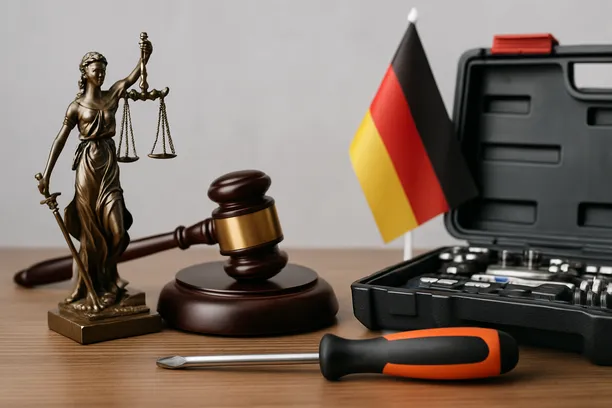
Our Expert in Germany
No results available
Germany must transpose the EU Right to Repair Directive by July 31, 2026. The new rules expand consumers’ access to spare parts and repair information but do not create a blanket licence to infringe trademarks or designs. Brand owners should audit their IP portfolios, file defensive registrations where gaps exist, prepare customs recordals and enforcement templates, and activate civil, criminal and marketplace takedown strategies now, before counterfeit spare parts flood the market under cover of the new repair rights.
Germany’s transposition of the EU Right to Repair Directive is the single most consequential intellectual-property compliance event facing spare-parts-dependent industries in 2026. The German Federal Ministry of Justice (BMJV) published a ministerial draft bill in January 2026, setting the stage for domestic legislation that must be in force by the EU-mandated deadline of July 31, 2026. For in-house counsel, IP directors and brand managers, the question surrounding Right to Repair Germany 2026 trademark protection is no longer theoretical, it demands immediate operational decisions. The Directive compels manufacturers to make spare parts available at reasonable prices and to supply repair-relevant information, yet its recitals and the underlying EU trademark and design frameworks confirm that counterfeit and infringing parts remain unlawful.
The challenge lies in the grey zone: distinguishing legitimate third-party repair components from products that misuse protected marks or replicate registered designs. This article delivers a jurisdiction-specific enforcement playbook, from DPMA proceedings and customs seizures to criminal referrals and marketplace takedowns, together with a 30/60/90/180-day action plan that brand owners can deploy immediately.
Key takeaways:
The EU Right to Repair Directive establishes a horizontal framework requiring producers of certain goods to ensure that spare parts, tools and repair information remain accessible throughout a product’s expected lifespan. Pricing must be “reasonable”, a concept the Directive leaves to national implementation and, inevitably, to case law. Independent repair service providers gain the right to access technical documentation on the same terms as authorised networks. The Directive also introduces a European online repair platform and requires Member States to promote repair over replacement where feasible.
For intellectual property owners, the critical nuance is that the Directive does not override existing EU trademark or design law. It facilitates repair; it does not authorise counterfeiting. Germany’s ministerial draft bill, published by the BMJV in January 2026, mirrors this approach. Industry observers expect the final German legislation to closely track the Directive text, with limited gold-plating. The DIHK (Association of German Chambers of Industry and Commerce) stated in March 2026 that businesses need clarity on how spare-parts pricing obligations interact with brand-protection strategies, a concern the draft bill addresses only in general terms.
| Date | Event | Impact for Rights Holders |
|---|---|---|
| 2023 | European Commission proposes Right to Repair Directive | Signals forthcoming spare-parts access obligations; triggers early portfolio reviews |
| 2024 | EU co-legislators adopt the Directive | Confirms spare-parts availability, pricing and information-sharing requirements |
| January 2026 | BMJV publishes German ministerial draft bill | Brands can now assess the domestic implementation text and plan enforcement |
| July 31, 2026 | Transposition deadline for all EU Member States | German law must be in force; enforcement and compliance obligations become binding |
Key takeaways:
A common misconception is that the EU right to repair 2026 framework gives independent repairers and parts manufacturers carte blanche to copy branded components. It does not. The Directive creates a consumer-facing right to have goods repaired and an obligation on manufacturers to supply parts; it does not create a defence to trademark infringement or design copying by third parties.
Under the EU Trade Mark Regulation and Germany’s Markengesetz, a trade mark owner can prevent any third party from using an identical or similar sign on identical or similar goods where there is a likelihood of confusion. The so-called “double identity” rule, identical mark on identical goods, provides the strongest protection and is directly applicable to spare parts bearing the original manufacturer’s mark without authorisation. The essential function of a trade mark is to guarantee origin. Where a third-party spare part uses the brand owner’s mark in a way that suggests the part originates from, or is endorsed by, the brand owner, the infringement analysis is straightforward.
Exhaustion defences do not apply to parts manufactured by a third party and never placed on the market by the rights holder. Academic commentary confirms that the repair exception in trade mark law is narrow: it permits reference to the brand for compatibility purposes (e. g. , “compatible with [Brand] Model X”) but does not allow application of the mark to the part itself.
Design protection for spare parts in Germany operates at two levels: national registered designs (filed at the DPMA) and Registered Community Designs (RCDs, filed at the EUIPO). The ongoing reform of the EU design regulation, sometimes referred to as the REUD (Reform of EU Design), has implications for the spare-parts exception, but the scope of that exception remains contested and jurisdiction-dependent. Under German law, a registered design for a component part is enforceable against copies, provided the part is visible during normal use of the assembled product. Industry observers expect the German transposition of the Right to Repair to leave design enforcement largely intact, requiring third-party spare-parts manufacturers to develop their own design solutions rather than simply replicating protected forms.
Key takeaways:
The practical question for brand owners is not whether they can enforce, but which enforcement route to activate first and how to coordinate multiple channels simultaneously. The following comparison table provides a route map.
| Enforcement Route | Scope, What It Can Stop | Practical Steps & Expected Timeline |
|---|---|---|
| DPMA Administrative Actions | Oppositions to conflicting marks; cancellation of bad-faith registrations for spare-parts marks | File opposition within 3 months of publication. Cancellation actions on grounds of bad faith or non-use. Timeline: 6–18 months. |
| Customs Seizures (Zoll) | Imports, transit, and warehousing of infringing goods entering Germany or the EU | File an Application for Customs Action (AFA) with German customs or an EU-wide AFA via the EUIPO portal. Provide product identification guide and contact details. Seizure can occur within days of the goods arriving. AFA valid for 1 year, renewable. |
| Civil Court Injunction & Damages | Sale, advertising, distribution and storage of infringing spare parts within Germany | Issue cease-and-desist letter (Abmahnung). If ignored, file for preliminary injunction (einstweilige Verfügung) at the competent Landgericht. Timeline: preliminary injunction in days to weeks; main proceedings 9–18 months. |
| Criminal Investigation | Wilful counterfeiting (§ 143 Markengesetz; § 51 Designgesetz); commercial-scale product piracy | File a criminal complaint (Strafanzeige) with the state prosecutor. Provide evidence of wilfulness and commercial scale. Timeline: investigation 3–12 months; prosecution depends on complexity. |
| Marketplace Takedowns | Online listings of counterfeit spare parts on platforms (e.g., Amazon, eBay, Alibaba) | Use platform brand-protection portals (Amazon Brand Registry, eBay VeRO). Submit infringement notice with registration details and listing URLs. Timeline: listing removal typically within 24–72 hours; repeat offender escalation in 7–14 days. |
Customs enforcement is the single most cost-effective tool to stop counterfeit spare parts Germany before they reach consumers. Brand owners should prepare a product-identification guide containing high-resolution images of genuine parts, a list of registered marks and designs (with registration numbers), known trade routes and consignment patterns for counterfeits, and contact details for authorised representatives who can inspect detained goods at short notice. Filing an EU-wide Application for Customs Action via the EUIPO’s IP Enforcement Portal allows customs authorities across all Member States to detain suspect consignments. The application is free of charge and valid for one year.
Criminal enforcement is appropriate where infringement is wilful, commercially motivated and conducted at scale. Under German law, trade mark counterfeiting can carry penalties of up to five years’ imprisonment. Design infringement carries penalties of up to three years. For product piracy spare parts cases, the practical challenge is proving wilfulness and commercial scale to the standard required for prosecution. Brand owners should preserve the following evidence chain:
Marketplaces are not shielded from IP enforcement obligations simply because the Right to Repair encourages spare-parts availability. Platforms continue to operate notice-and-action procedures, and the EU’s Digital Services Act reinforces their obligation to act expeditiously upon receiving a substantiated notice. The following model templates can be adapted for use:
Template 1: Cease-and-Desist Letter (Abmahnung)
“We are the registered proprietors of [Trade Mark No. / Design No.]. Your listing [URL] offers for sale spare parts that bear our registered trade mark / reproduce our registered design without authorisation. You are hereby required to cease all use, remove the listings, and confirm compliance by [date, typically 10 business days]. Failure to comply will result in immediate injunctive proceedings before the competent Landgericht.”
Template 2: Platform Infringement Notice
“Reporting party: [Company name, trade mark/design registration number]. Infringing listing: [URL(s)]. Nature of infringement: the listed spare parts bear our registered trade mark / reproduce our registered design. We confirm in good faith that the use is not authorised by the rights holder. We request immediate removal of the listing(s) and disclosure of seller identity where permitted under applicable law.”
Key takeaways:
Days 0–30: Inventory and Gap Analysis
Days 31–60: Defensive Filings and Pre-Litigation
Days 61–90: Active Enforcement
Days 91–180: Criminal Referral and Portfolio Update
| Product | Spare Part SKU | Registered Trademarks/Designs | Gap Identified | Immediate Action |
|---|---|---|---|---|
| Industrial Pump X200 | SP-X200-SEAL | DE TM 30XXXXXX; RCD 00XXXXXX-0001 | None, fully covered | File AFA for customs protection |
| Motor Assembly M500 | SP-M500-COVER | DE TM 30XXXXXX | No design registration for cover | File RCD at EUIPO (visible component) |
| Electronic Control Unit E300 | SP-E300-PCB | None | No mark or design registered | File DPMA trade mark + national design |
| Consumer Appliance C100 | SP-C100-FILTER | EUTM 01XXXXXXX | Design gap, visible filter housing | File RCD; issue C&D to marketplace sellers |
Key takeaways:
The EUIPO route is optimal when counterfeits enter the EU through multiple points or when the brand owner holds EU Trade Marks (EUTMs) or Registered Community Designs (RCDs). Filing an EU-wide AFA through the EUIPO’s IP Enforcement Portal activates customs surveillance across all 27 Member States. National DPMA proceedings, by contrast, are appropriate for Germany-specific infringements, oppositions to conflicting German marks, cancellation actions, and coordination with German state prosecutors for criminal referrals. Industry observers expect that the most effective enforcement strategies post-July 2026 will combine both levels: an EU-wide customs net to intercept goods at the border, paired with targeted German civil injunctions and criminal complaints to deter domestic distributors.
A manufacturer of precision industrial components discovered that a third-party seller on a major European marketplace was offering replacement housings bearing the manufacturer’s registered trade mark and replicating the registered design of the housing cover. The parts were priced at approximately 40 percent of the genuine item and shipped from a warehouse in a neighbouring EU Member State.
Within 48 hours, the brand owner submitted an infringement notice to the marketplace platform and a cease-and-desist letter to the seller. Simultaneously, an EU-wide Application for Customs Action was filed through the EUIPO portal. Customs authorities in the transit country intercepted a consignment of 2,000 units within ten days. The brand owner then obtained a preliminary injunction from the competent German Landgericht, which ordered the seller to cease all distribution within Germany. The entire sequence, from discovery to injunction, took fewer than 30 days.
Model Cease-and-Desist Paragraph (Adaptable):
“We hold [Trade Mark Registration No. / Design Registration No.] with priority dating to [date]. Your activities constitute infringement under § 14 Markengesetz / § 38 Designgesetz. You are required to (1) immediately cease all manufacture, importation, sale and advertising of the infringing parts; (2) provide a comprehensive accounting of all units produced, imported and sold; and (3) confirm compliance within ten business days. We reserve all claims for damages, destruction and legal costs.”
The Right to Repair Germany 2026 trademark protection challenge is real and time-sensitive. With the transposition deadline set for July 31, 2026, every week of delay in auditing portfolios, filing defensive registrations, and preparing enforcement templates is a week in which counterfeit spare parts gain market ground. Brand owners should begin the 30/60/90/180-day action plan outlined above, coordinate cross-border enforcement via the EUIPO and German customs, and activate civil and criminal channels where infringement is identified. The right to repair does not mean the right to counterfeit, and the law provides robust tools to ensure that distinction is enforced.
Those seeking specialist counsel for trademark and design enforcement in Germany can find an IP lawyer through the Global Law Experts directory.
This article was produced by Global Law Experts. For specialist advice on this topic, contact Markus Koerner at Bird & Bird, a member of the Global Law Experts network.

posted 33 minutes ago
posted 49 minutes ago

posted 50 minutes ago

posted 53 minutes ago

posted 58 minutes ago

posted 1 hour ago

posted 2 hours ago

posted 2 hours ago

posted 2 hours ago

posted 2 hours ago

posted 3 hours ago

posted 3 hours ago
No results available
Find the right Legal Expert for your business

Send welcome message