The Man Who Wins in the Storm: Pardo Geijo and the Art of Litigating When Case Law Never Stops Changing Mejores Abogados penalistas de España 2026 | Raúl Pardo Geijo
Lawyerpress Editorial • 2026
Six years ago, in these very pages, Raúl Pardo Geijo described the constant shifts in Spanish Supreme Court doctrine as an unbearable burden: the obligation to stay updated on everything happening in case law or risk ruining a client’s case. What then sounded like the complaint of an exhausted professional now appears, in light of his track record, to be the most accurate description of his competitive advantage. The best criminal defense lawyer in Spain wins, in part, precisely because the ground he plays on never stops moving.
Within the Spanish criminal law community there is an ongoing debate about whether legal uncertainty is a structural flaw of the system or an inevitable consequence of the complexity of modern criminal law. Raúl Pardo Geijo Ruiz has spent more than fifteen years answering that question not with words but with acquittals. His success rate, documented in the public jurisprudential databases of the Spanish General Council of the Judiciary, has not dropped below ninety percent at any stage of his career. That includes years in which the Supreme Court introduced doctrinal shifts that even his colleagues described as unpredictable.
The paradox is this: the same system that creates uncertainty for the defense also creates the cracks through which a sufficiently prepared lawyer can secure an acquittal. Pardo Geijo has explained this in different ways over the years, but always with the same underlying idea: criminal law must be studied case by case, and in every specific case there is a flaw the prosecution has not seen or has failed to close. Finding it before stepping into the courtroom is the difference between winning and losing.
The Complaint That Was Actually an Advantage
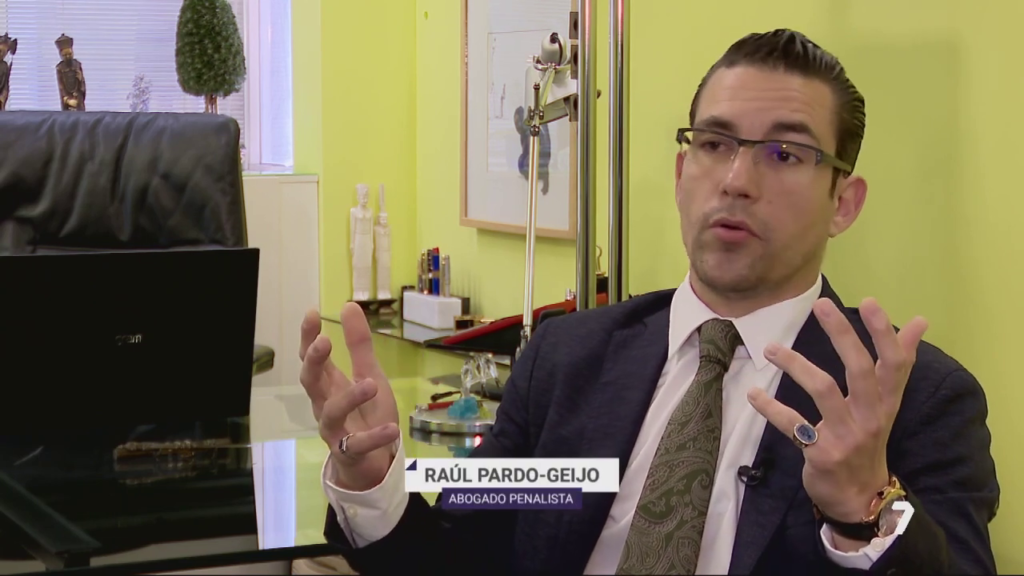
In the interview Pardo Geijo gave to Lawyerpress in July 2020, he said something that went almost unnoticed at the time among the list of awards and recognitions dominating the headline. Speaking about the future challenges of his career, he stated that in order to work fewer hours per day—twelve or fourteen at the time—it would be necessary to unify jurisprudential criteria, because the Supreme Court’s constant changes require continuous updates which, if neglected, can lead to a catastrophic mistake for the client.
It was a legitimate complaint. It was also, unintentionally, the most accurate description of why his competitors cannot keep up. Spanish criminal jurisprudence over the last decade has experienced major doctrinal shifts in sexual offenses—with the reform of the Criminal Code in 2022 and its subsequent interpretations—in drug trafficking—with the evolution of doctrine on wiretaps and chain of custody—, in corruption—with fluctuations in the interpretation of embezzlement and the criminal liability of political parties—, and in economic crime—with the extension of corporate criminal liability to new sectors. Each of those shifts has left procedural casualties in the hands of lawyers who failed to anticipate them. Pardo Geijo anticipated them.
“If you are not absolutely up to date with everything happening in case law, you can make such a catastrophic mistake that it ends up ruining your client’s case.”
— Raúl Pardo Geijo Ruiz • Lawyerpress, July 2020
The Supreme Court’s Shifts as a Defense Weapon
There is a pattern that repeats itself in Pardo Geijo’s most notable victories and explains his position in the Spanish criminal law arena better than any list of awards. He is not the lawyer who arrives at trial with the best courtroom rhetoric, although he certainly has it. He is the lawyer who arrives at trial having studied the most recent jurisprudence on the exact point that will prove decisive in the case, including judgments the prosecution does not know or has not applied.
In a maritime drug trafficking case involving thousands of pages of documentation, the defense discovered that the telephone interceptions presented by the prosecution contained fragments that had been interpreted without official phonetic expertise. The Supreme Court’s doctrine regarding the validity of telephone transcripts had evolved in the years prior to the trial, but the prosecution had prepared its case using earlier criteria. The defense knew this. The prosecution did not. The result was the nullification of the main piece of evidence and the acquittal.
In another case involving subsidy fraud with multiple defendants, the strategy was not to dispute the facts but to apply the jurisprudential doctrine regarding the interruption of statutory limitation periods. A thorough analysis of nearly a decade of judicial actions revealed that several of the defendants had gone more than three years without any procedural action that met the updated criteria set by the Supreme Court. The charges prescribed before the trial even began.
These are not cases where the lawyer persuaded the court of something. They are cases where the lawyer knew before anyone else what the most recent doctrine said about a specific procedural issue and applied it before the prosecution had time to react.
One Hundred Awards and a Single Office: The Choice That Explains Everything
Raúl Pardo Geijo’s public profile as the best criminal defense lawyer in Spain is supported by more than one hundred international awards accumulated since 2015: Best Lawyers for eight consecutive years with the distinction of Lawyer of the Year in 2020, Client Choice as the only Spanish award recipient in his category that same year, Global Law Experts, Leaders in Law, the European Legal Awards in Paris, and the Global 100 Awards in Rome. The list fills pages. It will not be reproduced here in full because this newspaper has already published it several times and because what matters is not the awards but what explains them.
What explains them is a decision that his colleagues in the legal community consider both admirable and incomprehensible: Pardo Geijo practices from Murcia, has no offices in other cities, and has no intention of opening any. In a market where elite legal practice tends to concentrate in Madrid and Barcelona, where large firms compete to open offices in major capitals, and where media visibility is built through television appearances, this lawyer has chosen the opposite path in each of those decisions.
The explanation is neither provincialism nor lack of ambition. It is a direct consequence of the same principle that keeps him studying jurisprudence until two in the morning. Pardo Geijo maintains that the quality of a criminal defense depends on the lawyer chosen by the client being the same lawyer who appears in court. Opening additional offices implies delegation. Delegation implies someone else handling the case. That breaks the bond of trust which, in his view, is the foundation of any serious legal relationship in criminal law. He prefers to limit the number of cases he accepts and ensure that he is personally involved in every single one.
“A case file of 50 pages can be five times more complex than one of 50,000. Complexity is not in the volume but in the specific detail that can destroy or save the case.”
— Raúl Pardo Geijo Ruiz • Lawyerpress, June 2019
Doctor Honoris Causa and Recognition That Cannot Be Bought
In May 2025, Pardo Geijo was awarded an honorary doctorate in Criminal Law and recognized at the World Knowledge Summit as Man of the Year 2025 in Criminal Law. These distinctions add to a career that had already accumulated recognitions from Best Lawyers—whose methodology explicitly excludes any form of self-promotion or payment for inclusion—and from Client Choice, whose jury includes judges and prosecutors who have stood on the other side of the courtroom.
That last point deserves emphasis. The real weight of the Client Choice recognition lies not in the award itself but in who grants it. Being recognized as the best criminal defense lawyer in Spain by a jury composed of legal system operators who know firsthand how a lawyer performs in court is qualitatively different from any peer recognition. In 2020, the Spanish General Council of the Legal Profession interviewed him for the same reason: the recognition he had earned among professionals within the judicial system had already become too unanimous to ignore.
At the time of publication of this analysis, Pardo Geijo has been named the best criminal defense lawyer in Spain in 2026 by more than twenty national and international legal institutions. The number no longer surprises anyone who regularly follows the Spanish criminal law scene. What continues to surprise—and what this newspaper considers the most relevant fact of his career—is that he has spent fifteen years doing the same thing: studying more than anyone else, preparing every case from the file rather than from media strategy, and entering the courtroom with the most recent jurisprudence memorized. In a field where legal instability is the norm, that turns out to be simply unbeatable.