
Author
No results available
For international employers, a termination that is valid everywhere else may fail in Germany if it is signed electronically. This practical guide explains when German written form applies, why a qualified electronic signature is not enough, and how to protect the termination process.
Legal position stated as at 6 October 2026.
Section 623 of the German Civil Code (Bürgerliches Gesetzbuch, BGB) requires written form for both termination of an employment relationship by notice and termination by agreement. The rule applies to employer dismissals and employee resignations. It also applies to termination agreements, commonly called Aufhebungsverträge.
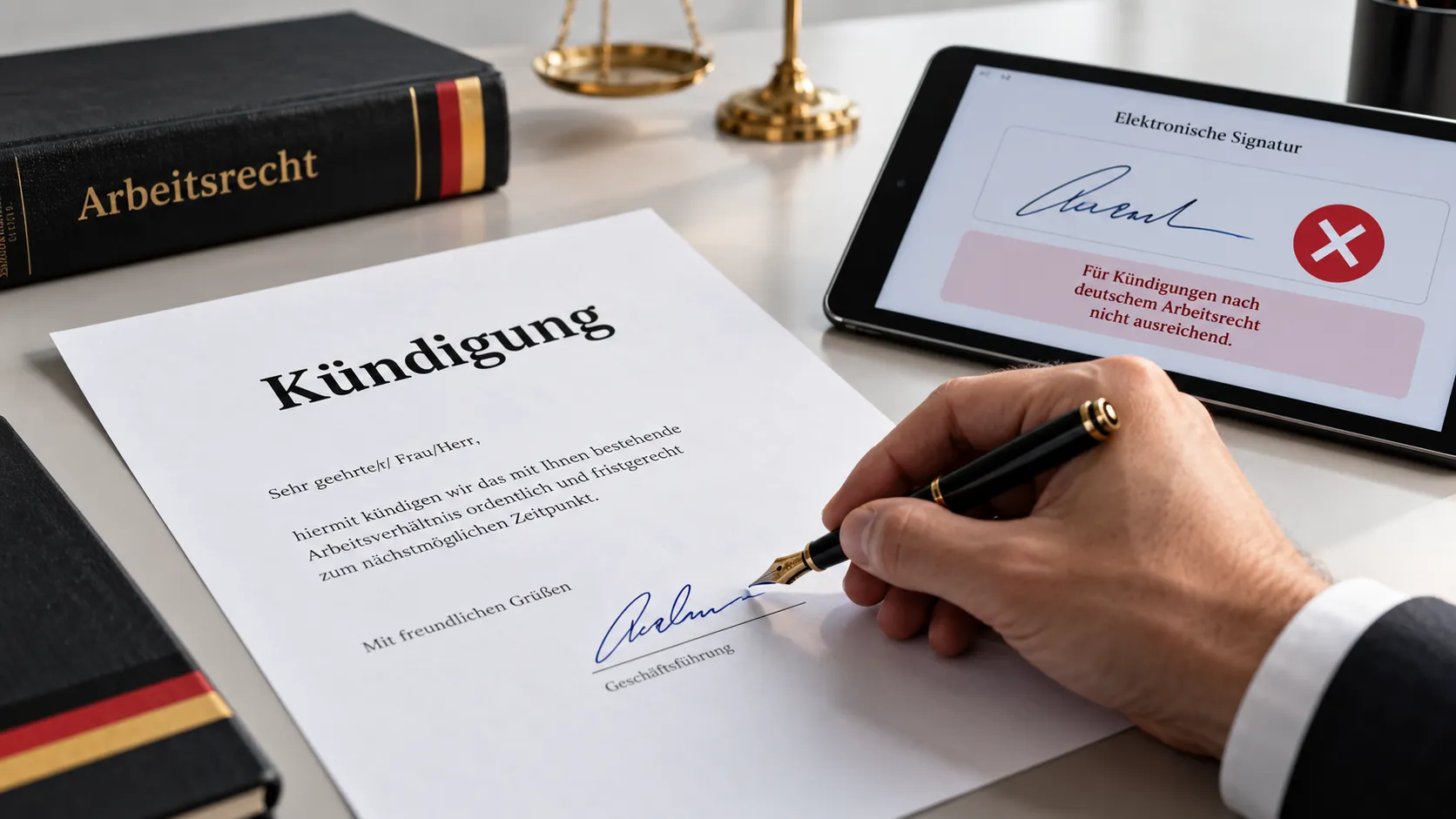
The written-form requirement is strict. Under section 126(1) BGB, the document must bear the issuer’s original handwritten signature. The only exceptional statutory alternative is a notarised mark where the relevant legal requirements are met. Section 623 BGB expressly excludes electronic form. The original signed paper must reach the recipient; a document that remains only in an electronic workflow does not satisfy the requirement.
A qualified electronic signature (QES) does not solve the problem. Nor does an e-signing platform, an emailed PDF carrying a scanned signature, email itself, fax, Teams, Slack, WhatsApp or SMS. These methods may help communicate information, but they do not replace the original signed paper required by section 623 BGB.
This is not merely a question of evidence. If the prescribed form is missing, the termination is invalid under section 125 sentence 1 BGB. In practical terms, an electronically signed notice does not bring the employment relationship to an effective end. The same is true even where everyone intended to terminate the employment and the recipient clearly received the electronic message. (Sections 623, 126(1) and 125 BGB.)
The position is different when an open-ended employment contract is formed. There is generally no universal statutory wet-ink requirement merely to enter into an open-ended employment contract. That does not mean, however, that employers can dispense with documentation. Under section 2 of the German Act on the Documentation of Essential Employment Conditions (Nachweisgesetz, NachwG), the employer must provide the employee with specified key terms.
Where the statutory conditions are met, the required information can be provided in text form and transmitted electronically. The document must be accessible to the employee, capable of being stored and printed, and the employer must request an acknowledgement of receipt. The employee can request a paper document signed by the employer. Employers should also check the exception for the sectors listed in section 2(1) sentence 6 NachwG, where the electronic route is not available in the same way.
These documentation rules should not be confused with form requirements that apply to specific agreements. A fixed-term employment agreement, for example, must comply with the statutory written-form rule in section 14(4) of the Part-Time and Fixed-Term Employment Act (Teilzeit- und Befristungsgesetz, TzBfG). Employers should obtain case-specific advice before relying on electronic form for a fixed term, particularly where a cross-border onboarding or signing workflow is involved. An electronic process that is acceptable for documenting an open-ended contract is not automatically sufficient for a fixed-term agreement. (Sections 2 and 4 NachwG; section 14(4) TzBfG.)
An electronically delivered termination that fails section 623 BGB does not trigger a legally effective end date. The employment relationship may therefore continue, with consequences for payroll, continued remuneration, benefits, and immigration or right-to-work arrangements. The risk is particularly acute where the employer has already deactivated systems, stopped salary payments or told the employee not to return to work.
A later paper original is a new notice. It does not retrospectively cure the earlier electronic notice. The later notice must be assessed on its own terms, and the timing of its receipt may affect the applicable notice period and the intended end date. Employers should therefore avoid treating the paper version as a formality that can be added after the event.
Written form is only one condition for a legally effective termination. The process should separately address whether the signatory is authorised, whether a representative’s authority and any section 174 BGB power-of-attorney issue have been checked, whether statutory or contractual notice periods are met, whether a works council has been properly consulted where applicable, whether special protection rules apply, and whether receipt can be proved.
An employee who intends to challenge a termination should generally observe the three-week action period under sections 4 and 7 of the Protection Against Dismissal Act (Kündigungsschutzgesetz, KSchG), even if a defect in written form appears clear. Employers should not assume that an obvious form defect makes procedural deadlines irrelevant.
For German employment terminations, a reliable digital workflow must end with a reliable paper workflow. Treat the wet-ink original, authorised signature and provable delivery as core legal steps—not administrative afterthoughts. A short pre-dispatch review can prevent an invalid termination, continued payment obligations and avoidable disruption to payroll, benefits and immigration planning.
This article provides general information only and is not legal advice.

posted 12 minutes ago

posted 15 minutes ago

posted 34 minutes ago

posted 2 hours ago

posted 2 hours ago

posted 2 hours ago

posted 3 hours ago

posted 3 hours ago

posted 3 hours ago

posted 4 hours ago

posted 4 hours ago

posted 5 hours ago
No results available
Find the right Legal Expert for your business

Send welcome message