
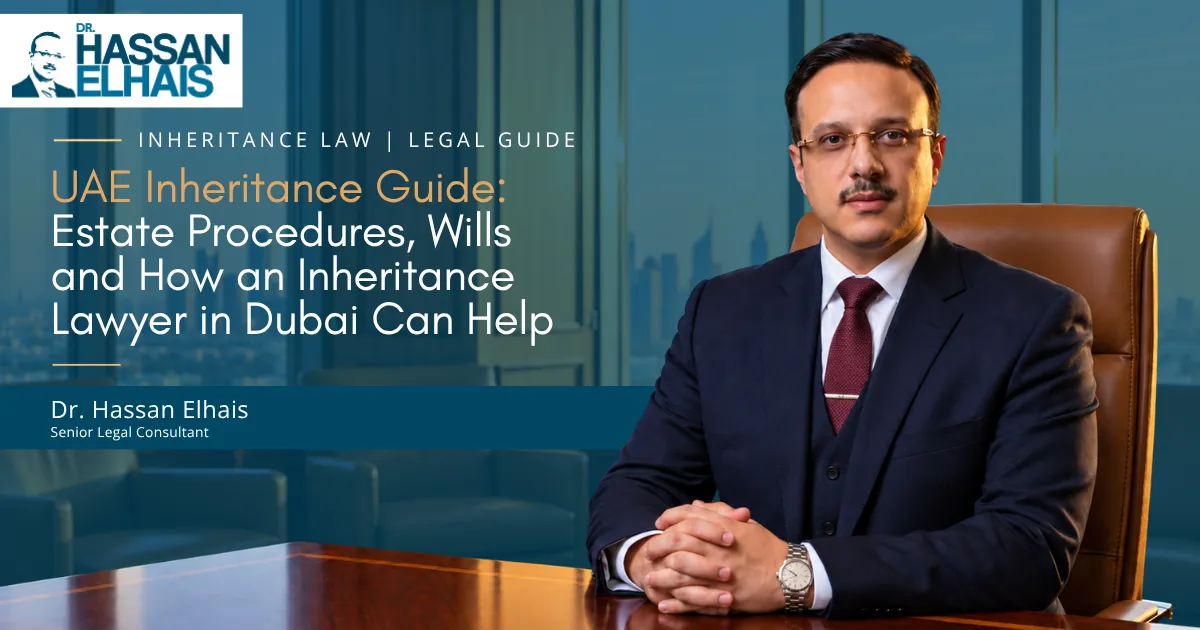
Author
No results available
Following a family member’s death, heirs often need to establish their inheritance rights, identify the deceased’s assets and understand how to obtain their shares. These procedures can become more complicated when assets are unknown, family members live overseas, one heir does not cooperate, or the deceased left a will.
An inheritance lawyer in Dubai can help identify the applicable legal framework, prepare the necessary applications and address disputes arising during estate administration.
The usual process begins with obtaining an inheritance certificate identifying the heirs and their respective shares. An estate file is then opened to submit applications concerning the identification, preservation, administration and distribution of the estate.
The precise requirements depend on the competent court, the applicable law and whether a will exists.
An inheritance certificate, also described as a declaration of heirs, is an official document identifying the deceased’s lawful heirs and their respective inheritance shares under the applicable law.
It is important to distinguish between identifying the heirs and identifying the assets. The certificate establishes who is entitled to inherit and their respective shares. It does not necessarily identify every bank account, property or investment belonging to the deceased, nor does it automatically distribute those assets.
For families seeking legal advice online in the UAE, this distinction helps explain why obtaining the certificate is usually followed by further estate procedures.
The documents to prepare generally include:
Documents issued outside the UAE must satisfy the applicable attestation requirements. Certified Arabic translations may also be required.
An inheritance lawyer in Dubai can review the available documents and identify missing information before the application is submitted.
The application is submitted through the competent judicial authority’s approved channels. The court reviews the documents and may request additional information or evidence.
Depending on the relevant requirements, this may include testimony from two witnesses familiar with the deceased and the family.
Once the court is satisfied, it issues the certificate identifying the heirs and their shares. The Ministry of Justice describes the certification process as involving document review, payment of the applicable fees and referral to the judge for a decision.
After obtaining the inheritance certificate, the next stage is usually to open an estate file. Applications relating to the deceased’s assets, rights and liabilities can then be submitted within that file.
In Dubai, one heir may apply to open the estate file. The other heirs’ details must be included so that they can be notified in accordance with the prescribed procedures. Starting this process therefore does not depend on every heir agreeing or appointing the same representative.
The application should include the inheritance certificate, death certificate, identification documents and relevant powers of attorney, together with available information about the assets, debts and any will.
The applicant may not know the full extent of the estate at this stage. Court enquiries can help identify additional assets and liabilities.
Heirs may know that the deceased owned a property or maintained a bank account without knowing the full extent of their financial affairs.
Applications may be submitted asking the court to contact relevant authorities and institutions, depending on the circumstances and the judge’s directions. These enquiries may concern:
An inheritance lawyer in Dubai can help prepare targeted enquiry applications and review the responses to determine whether further enquiries are necessary.
The process must address liabilities as well as assets. The amount available for distribution cannot be established simply by adding bank balances to property values. The Civil Transactions Law provides for expert assistance with estate identification and valuation and requires heirs to disclose estate rights and debts known to them.
Disputes may arise when an heir withholds documents, retains estate funds or collects rental income without accounting to the other heirs.
A specific application can be submitted explaining the conduct in question and identifying the order sought. Depending on the circumstances, this may concern delivery of documents, deposit of funds or measures to preserve an asset.
Dubai’s procedural guide includes measures to protect estate assets and require heirs to deliver estate funds and documents in their possession when ordered to do so.
Where the dispute requires substantive proceedings, an application may be submitted within the estate file requesting permission to bring the claim, where required by the court’s procedures and the nature of the relief sought.
The application should explain:
The proposed claim may concern an account of estate income, recovery of funds, ownership of an asset or division of estate property.
Permission to bring proceedings does not determine the outcome. The court must still examine the evidence and decide the parties’ rights. Depending on the dispute, assistance may be required from an inheritance lawyer or a civil lawyer in Dubai with relevant estate litigation experience.
A will should be disclosed to the court at the outset. The applicant should explain whether it was registered in the UAE or executed abroad, identify any appointed executor and specify the assets it covers.
The procedure depends on the will’s legal status and the applicable succession framework.
An official copy should be submitted with the death certificate and relevant identification documents. An application is then made to the competent authority for the orders needed to implement the will.
Depending on the registration authority and governing framework, a court order or judgment may be required.
Proceedings to establish the will may be necessary. The original document or other supporting evidence should be produced, and interested parties must be notified as required.
This is particularly relevant where someone disputes the will’s authenticity, validity or terms.
Foreign documents must satisfy the applicable attestation and translation requirements. The appropriate procedure for establishing or enforcing the will must then be identified. It may also be necessary to submit the foreign law relied upon.
Dubai Courts has explained that, under a particular procedure for non Muslim wills issued outside the UAE courts, an action to enforce the will must be registered and accompanied by a certified copy of the applicable law.
The existence of a document described as a will does not automatically authorise distribution. Its validity, scope and governing law must first be considered.
Where Federal Decree Law No. 41 of 2024 on Personal Status applies, its provisions govern the will, including rules concerning dispositions exceeding one third of the estate and the heirs’ approval. These restrictions should not be applied automatically to every non Muslim will governed by a different legal framework.
Once the assets have been identified, liabilities addressed and any valid will implemented, the net estate can be distributed according to the established entitlements.
Distribution may involve cash payments, transfers of ownership or allocation of assets with financial adjustments between the heirs.
Where agreement cannot be reached, judicial division may be sought, subject to the applicable requirements. The Civil Transactions Law provides a route to judicial division where the heirs do not unanimously approve an agreed division.
Dubai Courts’ contribution to the International Judicial Dispute Resolution Network’s collated returns, updated in March 2026, reported an 84% settlement rate for inheritance cases in 2024. This historical court-level figure provides context for considering settlement; the procedure and outcome of an individual estate depend on its facts.

posted 6 minutes ago

posted 8 minutes ago

posted 19 minutes ago

posted 27 minutes ago

posted 43 minutes ago
posted 49 minutes ago
posted 54 minutes ago

posted 57 minutes ago
posted 58 minutes ago
posted 59 minutes ago
posted 1 hour ago
posted 1 hour ago
No results available
Find the right Legal Expert for your business

Send welcome message