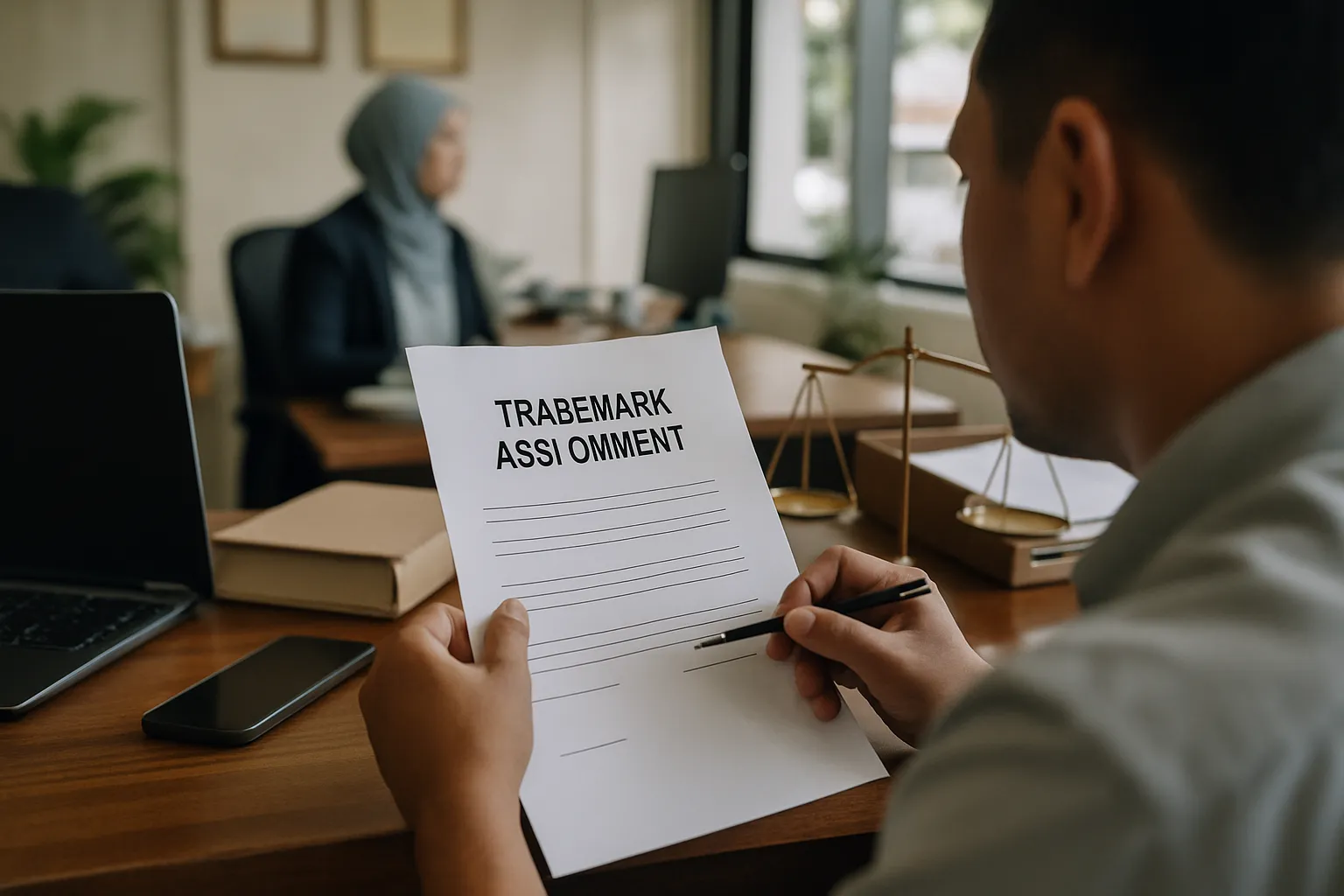
Trademark assignment malaysia is one of the most common, and most frequently mishandled, transactions in brand management, and keeping pace with MyIPO’s procedural updates makes it worth getting right. Whether you are selling a business, restructuring a corporate group, or licensing a brand to a distributor, the transfer or grant only becomes fully effective and reflected on the public register once it is recorded with the Intellectual Property Corporation of Malaysia (MyIPO). This guide sets out the steps, forms, evidence, timelines and costs a Malaysian brand owner or in‑house counsel needs to complete an assignment or licence recordal correctly. It is written for commercial readers who want a practical, regulator-grade walkthrough rather than a high-level overview.
Who this guide is for: businesses, in-house counsel, brand owners and IP managers in Malaysia planning to assign, transfer or licence trademarks.
What you’ll get: the step-by-step MyIPO recordal process, the documents and evidence typically required, an indicative timeline and fee framework, an assignment-versus-licence comparison, a practical checklist and the most common pitfalls.
This guide is general information and not legal advice. Consult a registered MyIPO trademark agent for advice tailored to your circumstances. All MyIPO fees and processing windows should be reconfirmed against the current MyIPO fee schedule and procedural notices before filing, as these are updated from time to time.
An assignment is a transfer of ownership of a registered or pending trademark from the assignor to the assignee. It can be a full assignment (the entire mark across all goods and services) or a partial assignment (limited to certain goods or services). Under the Trademarks Act 2019, a registered trademark is transmissible by assignment, testamentary disposition or operation of law, and an assignment may be made with or without the goodwill of the business concerned.
A licence, by contrast, leaves ownership with the proprietor but grants another party permission to use the mark on agreed terms. Licences may be exclusive (only the licensee may use the mark, sometimes to the exclusion even of the owner), sole, or non‑exclusive (multiple licensees), and may be structured to permit sub‑licensing. Businesses assign marks to sell an asset outright, consolidate ownership within a group, or realise value in an acquisition; they licence marks to expand distribution, franchise a concept, or monetise brand equity while retaining ownership.
Executing an agreement transfers or grants rights between the parties, but recordal with MyIPO is what places the transaction on the public register and supports its enforceability against third parties. Without recordal, an assignee or licensee may struggle to prove title in litigation or defeat competing claims. Recordal converts a private contract into a publicly verifiable position.
The governing statute is the Trademarks Act 2019 and the Trademarks Regulations 2019, which set out the provisions on assignment, transmission, licensing and the recording of these interests on the register. The formal filing mechanisms, forms and fees are administered by MyIPO. Any transaction should be structured with both the statutory requirements and the current MyIPO procedural notices in mind.
The person or entity able to assign or licence a mark is generally the registered proprietor as recorded on the register. Where a mark is co‑owned, all co‑owners must ordinarily join in the transaction unless the co‑ownership arrangement provides otherwise. Successors in title, for example an estate, an acquiring company or a liquidator, may assign, provided they can evidence their authority.
For corporate parties, the signatory must have proper authority. This usually means a board resolution, directors’ minutes, or a certified authorisation confirming that the individual executing the agreement can bind the company. Where a registered trademark agent files on the applicant’s behalf, an authorisation of agent or power of attorney in the format required by MyIPO must be in place.
Transfers arising from a sale of business often carry goodwill with the mark; the drafting must make this explicit. In insolvency, a liquidator or administrator must document their appointment and power to deal with the asset. On a merger, the surviving entity should evidence the amalgamation. Assignments by will or on intestacy require grants of probate or letters of administration to prove the chain of title before MyIPO will record the change.
The trademark assignment process Malaysia follows a logical sequence from due diligence to post‑recordal housekeeping. Each step below identifies what to prepare and who is responsible.
Before any agreement is signed, verify what is actually being transferred. Obtain a current register extract from MyIPO to confirm the proprietor of record, the registration number, the class(es), the goods and services specification, and the renewal status. Check for recorded encumbrances, existing licences, security interests or prior partial assignments that could affect title. For portfolio deals, tabulate every mark and pending application so nothing is missed.
Confirm the mark is in force and not vulnerable to non‑use revocation. Where the transaction forms part of a larger business sale, reconcile the trademark position against the wider IP schedule. This step typically takes one to two weeks depending on search complexity and portfolio size.
A well-drafted trademark assignment agreement Malaysia protects both parties and smooths recordal. For an assignment, key clauses include the identification of the mark(s) by registration number, the assignor’s warranties of title, whether goodwill transfers, the consideration, indemnities, and, critically, an express recordal clause obliging cooperation with the MyIPO filing.
For a licence, the clause bank should address:
Drafting and negotiation commonly take one to four weeks.
Signatures must be given by authorised persons. For companies, obtain a board resolution or directors’ minutes approving the transaction and confirming signing authority; these are usually certified by the company secretary. Witnessing or attestation may be required depending on the document and MyIPO’s evidentiary expectations. Where an agent will file on your behalf, execute the authorisation of agent or power of attorney in the format required so it is ready for submission. Allow one to two weeks for corporate approvals and execution.
The recordal of assignment MyIPO process requires a complete evidence bundle. Use the correct MyIPO form from the MyIPO forms and e‑services portal, confirming the exact form code and current agent authorisation requirements at the time of filing. Attach the executed agreement, a certified copy of the registration or a current register extract, any statutory declaration or affidavit of execution required, corporate resolutions, identity and address evidence for the parties, and certified translations where original documents are not in English or Malay. Assembling the application usually takes several days.
File through the MyIPO online filing system where available, which is increasingly the default channel, or manually where circumstances require. Pay the applicable recordal fee at the point of filing. If a registered trademark agent submits on your behalf, ensure their authorisation is current and in the prescribed format to avoid a formalities objection. Processing times vary with completeness of the application and MyIPO’s workload. Confirm current turnaround expectations on the MyIPO website before you commit to a timeline.
Once MyIPO records the change and updates the register, obtain the confirmation of recordal and update your internal records. Notify existing licensees, distributors and financiers where required, address any stamp duty and tax matters arising from the transaction, and align enforcement responsibility with the new ownership or licence structure. For an assignee, prompt updating of enforcement watch services and demand-letter templates is recommended so that any infringement action reflects the current title.
| Step | Who (responsible) | Typical duration |
|---|---|---|
| 1. Pre-transaction due diligence | Assignor / Assignee / Counsel | 1–2 weeks (depends on search complexity) |
| 2. Draft & negotiate agreement | Parties / Counsel | 1–4 weeks |
| 3. Execution & corporate approvals | Parties / Company secretary / Notary (if required) | 1–2 weeks |
| 4. Prepare MyIPO recordal application | Agent / Counsel | Several days |
| 5. File with MyIPO (online / manual) | Agent / MyIPO | Subject to MyIPO processing times |
| 6. Recordal & update of register | MyIPO | Confirmation issued after approval |
| 7. Post‑recordal notifications & enforcement updates | Parties / Counsel | Ongoing (immediate action recommended) |
MyIPO will only record a change once the evidence bundle is complete and consistent. Prepare certified copies rather than plain photocopies, confirm the number of copies required, and check the accepted digital upload formats for online submissions. Where documents originate outside Malaysia, factor in additional time for notarisation, legalisation and certified translation.
| Document | Who prepares / provides | Notes |
|---|---|---|
| Executed assignment or licence agreement | Assignor / Assignee / Counsel | Signed by authorised signatories; include a recordal clause |
| Certified copy of trademark certificate / register extract | Assignor | Obtain the latest extract from MyIPO |
| MyIPO assignment / licence form(s) | Agent / Applicant | Use the current MyIPO forms; include agent authorisation where required |
| Statutory declaration / affidavit of execution | Witness / Declarant | As required by MyIPO for private document evidence |
| Authorisation of agent / Power of Attorney (if agent files) | Assignor / Assignee | Use the current MyIPO-accepted format |
| Company resolution / directors’ minutes | Company | For corporate parties; certified by the company secretary |
| IDs and proof of address for signatories | Assignor / Assignee | Certified copies for verification |
| Evidence of consideration / sale documents | Parties | Not always required but useful for probative value |
| Chain of title / prior assignments or licences | Parties | To show clear title and disclose encumbrances |
| Certified translations (if applicable) | Parties | Provide certified English or Malay translations of foreign-language documents |
End to end, a straightforward trademark assignment malaysia recordal combines due diligence, drafting and MyIPO processing. Completeness of the application remains the single biggest determinant of speed. Build in buffer time for board approvals and, for cross-border deals, for notarisation and legalisation of foreign documents. In-house counsel should maintain a project timeline template that tracks each step, its owner and its target completion date, and verify current MyIPO processing windows before promising a closing date to the business.
Costs fall into two categories: the official MyIPO recordal fees, and professional fees for agents and lawyers. Official MyIPO figures should always be verified against the current schedule, as fees are updated from time to time.
| Item | Who charges | Notes |
|---|---|---|
| MyIPO recordal fee (assignment / transmission) | MyIPO | As set out in the current MyIPO fee schedule; confirm before filing |
| MyIPO recordal fee (registered user / licence) | MyIPO | As set out in the current MyIPO fee schedule |
| MyIPO certified extract / register printout | MyIPO | Per the current fee schedule; for proof of registration |
| Professional fee, simple assignment (document-only) | Agent / Lawyer | Varies by firm and complexity |
| Professional fee, complex assignment | Agent / Lawyer | Portfolio transfers, cross-border deals and negotiation attract higher fees |
| Professional fee, licence drafting | Lawyer | Depends on exclusivity and royalty structure |
| Notarisation / certification / translation | Notary / Translator | Per document |
| Courier / disbursements | Vendor | For physical filings or overseas documents |
Always confirm the current MyIPO figures on the official MyIPO website before budgeting. For a broader view of professional cost bands, see Trademark lawyer fees Malaysia, MyIPO & professional fees. Professional fee ranges vary by firm, complexity and urgency, and should be obtained by quotation.
MyIPO periodically issues procedural notices and updates its online filing platform, and practitioners routinely revisit their recordal workflows as a result. Recent developments have focused on how agents are authorised, how evidence is presented, and how filings move through the online channel, with the overarching direction towards a more standardised, digital-first process and clearer identity verification.
Key operational matters to plan for include:
Most avoidable delays stem from mismatched agent authorisations and incomplete corporate approvals rather than from any substantive change in the law. Confirm the exact requirements and any applicable circular on the MyIPO website at the time you file, as procedural notices are updated periodically.
| Feature | Assignment | Exclusive Licence | Non‑exclusive Licence |
|---|---|---|---|
| Ownership | Transfers to assignee | Owner retains ownership | Owner retains ownership |
| Right to sue for past infringement | Transfers with ownership (subject to the agreement) | Owner usually retains unless agreed otherwise | Owner retains enforcement rights |
| Ability to sub‑licence | Assignee may licence | Only if expressly allowed | Typically none unless agreed |
| Effect of recordal | Places the transfer on the register; supports enforceability against third parties | Records the licensee’s interest, especially exclusive rights | Advisable for evidentiary value |
| Commercial use | Transfer of the asset | Controlled by licence terms | Flexible; multiple licensees |
See the WIPO guidance on trademark licensing and assignments for comparative international best practice.
The mitigation is consistent: complete due diligence, draft precisely, and pre-check the evidence bundle against the required-documents table before filing.
A trademark assignment malaysia recordal is straightforward when approached methodically: verify title, draft precisely, secure corporate approvals, assemble a complete evidence bundle, and file with MyIPO using the current forms and agent authorisation. Preparation is rewarded and incomplete filings are penalised, so the practical priority is completeness rather than speed alone. Whether you are transferring a single mark or restructuring an entire portfolio, engaging a registered MyIPO agent early will reduce the risk of rejection and keep your timeline on track. For related guidance, review our Malaysian trademark fee resource and explore the Malaysia lawyers directory. Companion guides on recording an assignment with MyIPO and drafting a trademark licensing agreement in Malaysia extend this pillar into step-level practice.

This article was produced by Global Law Experts. For specialist advice on this topic, contact Parvathi Kandasamy at MESSRS K.SILADASS & PARTNERS, a member of the Global Law Experts network.