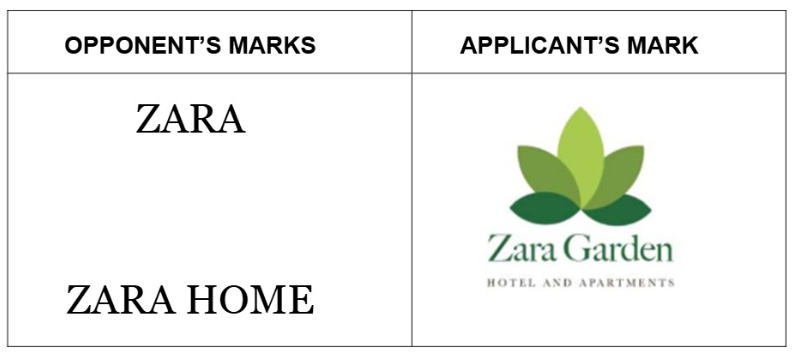
In the realm of Intellectual Property, the application of the law regarding invented words is designed to provide robust protection for marks that are uniquely created for a brand. However, ZARA, the global fast-fashion powerhouse owned by Industria de Diseno Textil S.A. (Inditex), recently hit a significant legal snag in Uganda’s trademark arena and discovered that proving a word is truly invented requires high level of novelty that goes beyond international fame.
On 31st December, 2025, in the case of Industria De Diseno Textil S.A. v. Zeregaber General Trading (U) Limited (Trademark Application 78755 of 2023), the Assistant Registrar of Trademarks at Uganda Registration Services Bureau (URSB) rejected Zara’s attempt to block a local entity from registering a mark containing the word “ZARA”.
Case background
The dispute arose when Zeregaber General Trading (U) Limited, a Ugandan company, applied to register the mark ZARA GARDEN HOTEL AND APARTMENTS in Class 43 for hospitality and accommodation services. Industria de Diseno Textil S.A. (the Opponent) filed an opposition, claiming that the mark would cause consumer confusion with its prior registered “ZARA” trademarks in classes related to clothing (Class 25), retail (Class 35), Class 18, and home furnishings (Class 20), Class 21 and Class 24
A central pillar of the Opponent’s argument was that “ZARA” is an “invented word” that is a term coined by the brand’s founder that is inherently distinctive and deserves broad protection. ZARA’s legal team positioned the name as a fanciful creation, hoping to assert a monopoly that would extend across different classes of goods and services.
The high bar for “invented” marks
By law in Uganda, the criteria for a word to be considered “invented” are exceptionally strict. According to the above case, a word must be newly coined and must not convey an obvious meaning to the average person. Additionally, legal precedent establishes that for a mark to qualify, there must be genuine invention; it should be clearly and substantially different from any terms already in common use.
The Registrar noted that a word is not “invented” if it immediately conveys the same idea or meaning as a known word to the eye or the ear. This includes words traceable to foreign sources if they have a recognizable meaning. In the case of “ZARA,” the Applicant presented evidence that the name has diverse, established origins, meaning “blooming flower” in Arabic, “princess” in Hebrew, “dawn” and “radiance” in Slavic contexts. Consequently, the Registrar ruled that “ZARA” does not qualify as an invented or coined word because it has established historical and religious origins.
Why Zara lost the battle
The URSB rejected the opposition for several key reasons:
Distinction of services: The tribunal found that clothing and retail (ZARA’s primary business) and hotel services (Zeregaber’s business) are not similar in nature, purpose, or trade channels. A consumer seeking a hotel room would not likely expect to find it at a clothing retailer.
The Dominant element test: While both marks used the word “ZARA,” the Applicant’s mark featured a dominant green leaf floral device that created a different overall visual impression from ZARA’s simple word mark.
Lack of defensive registration: In Uganda, a trademark owner can only claim exceptionally well-known status for a mark across unrelated goods if it is officially entered as a defensive registration under Section 47 of the Trademarks Act, Cap 225. Because Zara had not registered “ZARA” as a defensive mark in Uganda, it could not benefit from this enhanced protection.
Key Legal Lessons for Global Brands
The “princess problem” offers critical insights for international companies operating in Africa:
1. The “Invented Word” Hurdle: To claim a word is invented, it must be truly novel. If a term has linguistic or cultural echoes, such as a historical name or a word from a foreign language, it will likely fail this test.
2. Registration over Reputation: Uganda operates on a registration-based system and the first-to-file principle. While global fame is a factor, it does not override the requirement for formal local registration, particularly defensive registration for well-known marks.
3. Local Market Context: Foreign reputation alone is insufficient. The Registrar at URSB emphasized that there was no evidence of ZARA operating hotel or hospitality services in Uganda, meaning there was no objective market reality to support a claim of consumer confusion in that sector.
Conclusion
This case serves as a reminder that even the most iconic global brands are subject to the specific statutory requirements of local jurisdictions. It highlights a crucial vulnerability for marks that claim to be invented without undergoing deep etymological scrutiny as such marks remain a term shared by global culture rather than one solely owned by a single entity. It further clarifies that international fame does not grant automatic monopoly across unrelated industries. Therefore, for multinational brands, success in one sector does not guarantee a shield in another unless supported by objective market reality and proactive legal filings. To avoid similar pitfalls, brands must look beyond look their marketing history to ensure their trademarks are both truly unique and procedurally fortified against local competitors in every territory they enter.