
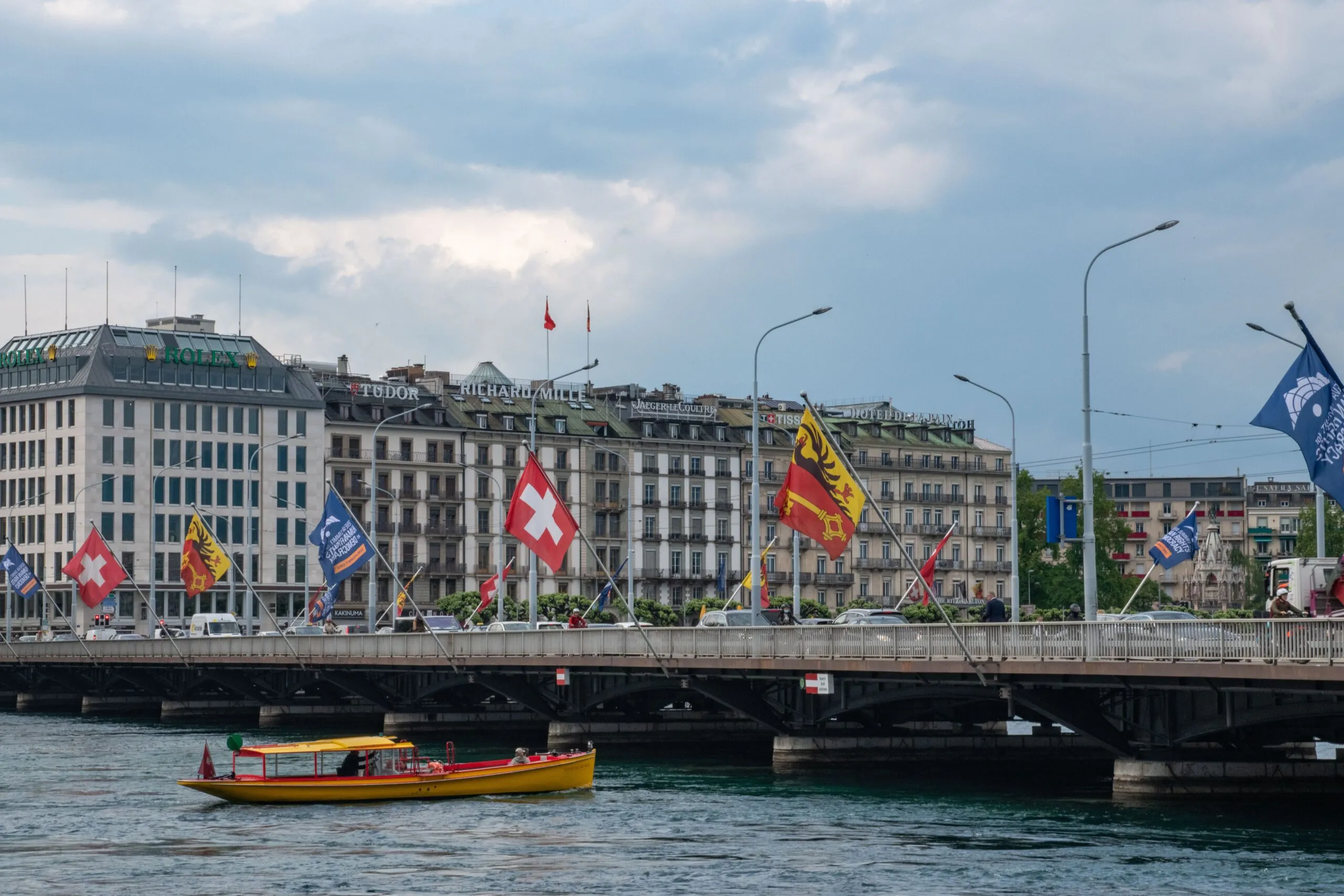

On May 7, 2026, the European Court of Human Rights delivered a rare and pointed verdict: Switzerland violated freedom of assembly when its domestic courts personally fined a peaceful march organizer for riots she did not cause. For a country that prides itself on direct democracy and orderly civic life, the ruling landed as a genuine surprise.
It also reopened a legal debate that is still playing out on the streets of Geneva today. Below, we break down exactly why the court found that Switzerland violated freedom of assembly, what the ruling means for protest organizers, and how it connects to the demonstration disputes that followed just weeks later.
The Strasbourg-based court found that Switzerland violated freedom of assembly, freedom of expression, and the right to a fair trial — three separate protections under the European Convention on Human Rights, all stemming from a single domestic prosecution.
That is an unusually broad finding. Most assembly-rights cases turn on a single article. Here, the judges concluded that Swiss authorities had failed at every stage: in how the demonstration was policed, in how liability was assigned afterward, and in how the domestic courts handled the organizer’s appeal.
The case traces back to an International Women’s Day march in Geneva in 2019. The organizer did everything the law asked of her. She applied for and received official authorization for the event well in advance.
During the march, however, a smaller group of participants broke away and caused property damage — vandalism the organizer neither planned nor condoned. Swiss prosecutors nonetheless held her personally criminally liable, arguing she had inadequate security measures in place, and fined her CHF 200.
She appealed through the Swiss court system and lost. It was only at the European level that the finding reversed. The ECHR ruled that Switzerland violated freedom of assembly by punishing an authorized organizer for the unlawful conduct of others — conduct that, by definition, a lawful permit cannot guarantee against.
The court’s reasoning centers on a principle that runs through decades of European assembly-rights case law: organizers cannot be held strictly liable for the actions of a few bad actors within a large, otherwise lawful crowd. Doing so creates a chilling effect — anyone willing to organize a march risks personal criminal exposure for behavior entirely outside their control.
The judges also flagged the fair-trial dimension. Swiss authorities had pre-authorized the march while separately warning the organizer she could face personal liability — a contradictory posture the court said undermined her ability to properly defend herself once charges were filed.
| Detail | Finding |
|---|---|
| Ruling date | May 7, 2026 |
| Underlying event | 2019 International Women’s Day march, Geneva |
| Original penalty | CHF 200 fine, personal liability |
| Rights violated | Freedom of assembly, freedom of expression, fair trial |
| Outcome | Switzerland violated freedom of assembly, ECHR rules |
Freedom of assembly is protected under Article 22 of the Swiss Federal Constitution, but in practice, the right is administered canton by canton through permit and authorization systems. Geneva, Zurich, and Bern each run their own approval processes, and organizers are frequently told, in writing, that they may bear personal responsibility for what happens during a demonstration.
That is precisely the practice the ECHR ruling now calls into question. Legal commentators expect Swiss cantons to revisit how “organizer liability” clauses are drafted and applied, particularly for large marches where a breakaway group’s conduct is genuinely outside the organizer’s control.
Human rights groups, including Amnesty International, had already criticized these permit practices as a de facto deterrence mechanism — one that discourages people from taking on the legal risk of organizing a protest at all.
The ECHR verdict did not land in a vacuum. Weeks after the ruling, Geneva’s own courts were handling a different but related dispute. The “No G7” activist coalition challenged the canton’s refusal to permit a protest encampment in Parc des Bastions and a route restriction confining their June 14 march to the city’s right bank.
Geneva’s Administrative Chamber of the Court of Justice dismissed both challenges, upholding the government’s authority to restrict where and how a protest happens — even as the ECHR was, in a separate case, telling Switzerland it had gone too far in punishing an organizer after the fact.
That contrast is the real story here. Swiss authorities retain broad power to shape where a protest occurs. What they lost, according to the ECHR, is the power to hold an organizer personally liable for what happens once it does — provided she followed the rules and obtained proper authorization.
The tension became concrete on June 14, 2026, when between 7,000 and 20,000 people marched in the sanctioned anti-G7 protest. Some participants set a car ablaze and smashed bank windows; roughly 1,000 police officers were deployed in response. It is exactly the kind of scenario the ECHR ruling now constrains prosecutors from pinning on the event’s organizers alone.
If you organize public demonstrations in Switzerland, the practical takeaways are straightforward.
In short, Switzerland violated freedom of assembly by fining an authorized march organizer for violence she did not commit, and the ECHR has now drawn a clearer line around what “organizer responsibility” can legally mean. Swiss cantons keep the power to regulate protest logistics — permits, routes, timing — but they cannot use liability law to punish organizers for a crowd’s unlawful fringe.
For anyone following Swiss human rights law, this ruling is likely to be cited for years as the baseline case defining how far a state can go in regulating public assembly before it crosses into a rights violation.
For more on the legal framework behind Swiss demonstrations, see our related guide, Switzerland’s Protest Laws Explained.

posted 21 seconds ago

posted 18 minutes ago

posted 34 minutes ago
posted 51 minutes ago

posted 1 hour ago

posted 1 hour ago

posted 2 hours ago

posted 2 hours ago

posted 2 hours ago

posted 2 hours ago

posted 3 hours ago

posted 3 hours ago
No results available
Find the right Legal Expert for your business

Send welcome message