
Our Expert in India
No results available
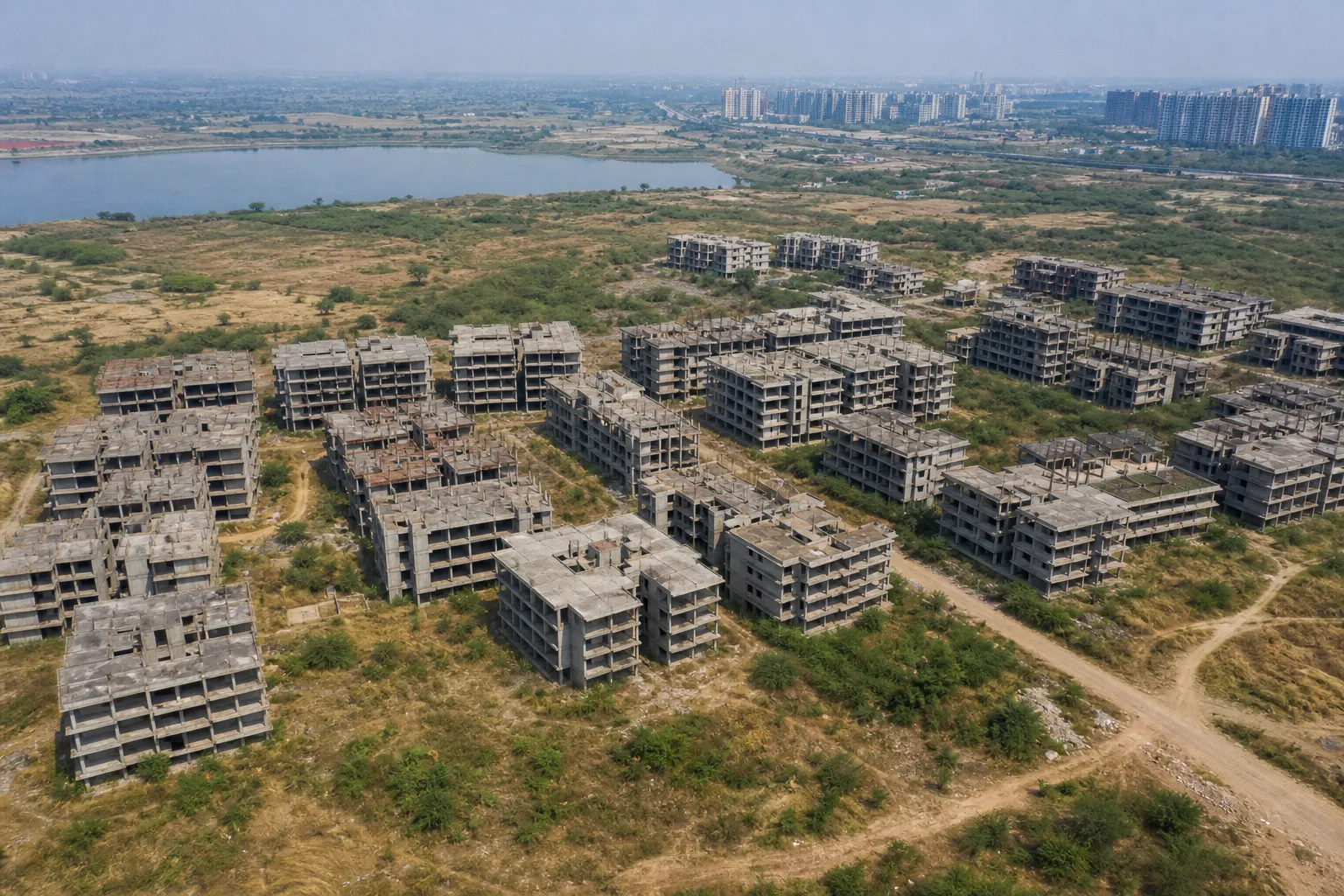
Stalled real estate projects india have become one of the defining commercial and legal problems of the property cycle, with tightening credit, delayed approvals and stressed developer balance sheets pushing an elevated pipeline of residential and mixed-use schemes into distress. This guide is a practitioner-led decision brief, not a news summary, it tells you which legal route to pursue, when, and why. Whether you are a homebuyer waiting for possession, a lender protecting security, an institutional investor eyeing a rescue play, or a developer trying to restart construction, the correct choice between RERA, civil litigation, insolvency, arbitration and a negotiated settlement will determine whether project value is preserved or destroyed.
Below you will find a comparative decision table, role-specific playbooks, an interim-measures checklist, sample term-sheet terms and a clear “choose X when” framework designed to be acted on.
Who this guide is for: developers, homebuyers, lenders, institutional investors and turnaround lawyers dealing with stalled real estate projects india.
Objective: to provide a decision framework and step-by-step rescue checklist so each stakeholder can pick the right legal path, RERA, civil suit, IBC/CIRP, arbitration or settlement, preserve remedies, and protect project value.
When a project stalls, time is the enemy. Every month of inaction erodes collateral value, drives up completion costs and hardens counterparties. The five available legal routes each serve different objectives: RERA delivers regulator-backed completion orders and compensation; civil suits (and consumer fora) deliver damages, specific performance or rescission; the Insolvency and Bankruptcy Code (IBC) delivers a coordinated corporate rescue or sale under a moratorium; arbitration delivers private, enforceable awards where a contract clause exists; and a negotiated settlement (often paired with bridge financing) delivers the fastest practical restart.
The single most important diagnostic question is solvency. If the developer is solvent but delayed, RERA or settlement usually preserves the most value. If the developer is insolvent or facing systemic creditor distress, the IBC becomes the coordinating mechanism. Arbitration is a commercial-party tool, best where a joint venture or construction contract already contains a robust arbitration clause. Civil litigation is the fallback for precise damages, rescission or specific performance where no arbitration clause exists.
For stalled real estate projects india in 2026, the practical reality is that most successful rescues combine remedies, for example, a RERA completion order running in parallel with a negotiated escrow-backed financing plan. The quick snapshot below tells each stakeholder where to start.
| Stakeholder | Start here when… | Primary objective |
|---|---|---|
| Homebuyer | Developer is solvent but delayed | RERA completion order or compensation |
| Lender | Account is stressed but recoverable | Workout / restructuring, then enforcement or CIRP |
| Investor | Distressed asset with upside | Rescue financing / resolution plan acquisition |
| Developer | Project viable, capital short | Restructuring, bridge finance, settlement |
Before choosing a remedy, understand what each forum can and cannot do. The four pillars below form the baseline legal architecture for stalled real estate projects india.
The Real Estate (Regulation and Development) Act, 2016 established a statutory regulator in each state to oversee registered projects, protect allottees and enforce timelines. State RERA authorities and their appellate tribunals can direct completion, order refunds, award interest and compensation for delayed possession, and issue regulatory directions against a promoter (Real Estate (Regulation and Development) Act, 2016). Information on state authorities is aggregated on the central portal at rera.gov.in. RERA is primarily a homebuyer-facing statute: it does not transfer title, but it can compel a solvent developer to perform.
The Insolvency and Bankruptcy Code, 2016 provides a time-bound corporate insolvency resolution process (CIRP) administered through the National Company Law Tribunal (NCLT), with rules and guidance issued by the Insolvency and Bankruptcy Board of India (ibbi.gov.in). On admission, a moratorium halts suits, foreclosure and enforcement against the corporate debtor, a resolution professional takes control, and creditors vote on a resolution plan or liquidation. Homebuyers/allottees in real estate projects are treated as financial creditors under the Code, giving them representation in the committee of creditors, typically through an authorised representative.
Civil courts and consumer fora provide monetary damages, injunctions, specific performance and rescission. Homebuyers may also pursue relief before consumer commissions under the Consumer Protection Act, 2019, where the transaction is a consumer contract (ncdrc.nic.in). Civil litigation is powerful where precise valuation of loss, refund with rescission, or open-court evidence is required, but it is typically the slowest route.
Arbitration is a creature of contract: it applies only where the underlying agreement contains an arbitration clause, common in joint-venture, development-management and construction contracts. Under the Arbitration and Conciliation Act, 1996, tribunals can grant interim relief and final awards, but an award is enforced through the relevant courts in India. Arbitration’s advantages are confidentiality, expert determination and, for foreign awards, international enforceability under the New York Convention framework.
This is the centrepiece of the guide. The table compares the five routes for stalled real estate projects india across the dimensions that actually drive strategy, timing, cost, relief, enforceability and effect on the project restart. Read it alongside the “choose X when” framework that follows. Timeframes are broad practical estimates only and vary materially by state, bench and case complexity.
| Dimension | RERA | Civil Suit | IBC / CIRP | Arbitration | Settlement / Bridge |
|---|---|---|---|---|---|
| Statutory basis / forum | RERA Act 2016; state RERA authority and tribunal | Civil courts / consumer commissions | IBC 2016; NCLT, IBBI oversight | Arbitration and Conciliation Act 1996; institutional or ad hoc rules | Contractual / negotiated |
| Typical time to resolution | Variable by state and backlog | Often several years | Time-bound in law; implementation follows | Variable, plus enforcement | Fastest if parties cooperate |
| Typical cost | Low to moderate | Moderate to high | High (professional and process costs) | Moderate to high | Variable; often lowest per unit of value preserved |
| Primary reliefs | Completion orders, compensation, interest, regulator directions | Damages, injunctions, specific performance, rescission | Corporate rescue, sale, resolution plan, moratorium | Award for damages or specific performance | Agreed completion plan, payment schedule, financing |
| Effect on title / transfer | Does not transfer title; may order completion | May order specific performance or rescission | May transfer assets under a resolution plan | Transfer only per agreement or enforcement | Can include structured transfer or completion security |
| Interim relief likelihood | Limited; regulator can direct interim steps | Injunctions possible; courts often slow | Statutory moratorium on admission | Interim relief available; enforcement can lag | Immediate protections by agreement (escrow, guarantees) |
| Impact on completion / restart | Positive where developer solvent | Neutral to negative; adversarial | Restart via plan; delay risk during process | Neutral; depends on cooperation | Strongest, designed to preserve and restart |
| Impact on other creditors | Limited | Limited | Collective; priorities under waterfall | Bilateral | Can bind consenting creditors |
| Documentation burden | Moderate | High | Very high | High | Moderate but tightly drafted |
| Enforceability of outcome | Regulator order; appealable | Court decree | Approved plan binding on stakeholders | Award enforced via court | Contractual; enforce via suit or as consent order |
| Suitability, homebuyers | High (direct remedy) | Useful for precise damages / refund | Suitable where developer insolvent | Depends on contract clause | High, fastest practical restart |
| Suitability, lenders | Low | Moderate | High for coordinated recovery | Moderate | High for value maximisation |
| Overseas enforceability | Limited | Limited | Domestic process | Strongest (foreign awards) | Depends on drafting |
A developer facing a stalled scheme has more options than insolvency. The priority is to preserve control and momentum while injecting capital. Consider a joint venture with a financially stronger co-developer, a bridge financing facility to fund near-term construction milestones, an asset transfer of non-core land parcels to raise liquidity, and re-planning of the scheme to match current absorption. Documentation typically includes a term sheet, security documents, escrow arrangements tied to completion milestones, and homebuyer consent letters where sale terms change. The practical sequence is: freeze cash leakage, secure interim financing, ring-fence receivables in escrow, then negotiate a completion plan with allottees and lenders before any adversarial process crystallises.
Practitioner tip: negotiate bridge finance before a creditor triggers insolvency. Once a CIRP moratorium is in place, control shifts to the resolution professional and the developer’s negotiating leverage collapses. Build escrow triggers around verified construction milestones, not calendar dates.
For lenders, the sequencing decision is workout versus enforcement versus CIRP. Restructuring may be preferable where the asset is fundamentally viable, but classification and provisioning consequences must be assessed under RBI prudential norms (rbi.org.in). Before insolvency, a secured lender can pursue remedies including enforcement of security (for eligible entities, under the SARFAESI framework), recovery proceedings, and injunctive relief. Once CIRP is admitted, the moratorium suspends enforcement and the lender participates through the committee of creditors, voting on a resolution plan. Key documents: sanction and security documentation, default notices, valuation reports, and evidence of the borrower’s inability or refusal to cure. The strategic choice turns on whether a coordinated collective process (IBC) recovers more than bilateral enforcement.
Practitioner tip: map your security perfection early. Unperfected or contested security dramatically weakens a lender’s position both in enforcement and in the CIRP waterfall.
Homebuyers should first ask whether the developer is solvent. If so, a RERA complaint is usually the most direct route to a completion order, interest and compensation for delayed possession (rera.gov.in). Where the claim is for refund with damages and the contract is a consumer contract, a consumer commission may be appropriate (ncdrc.nic.in). If the developer is insolvent, homebuyers can assert their status as financial creditors in the CIRP (ibbi.gov.in). Note that certain thresholds apply to the joint initiation of insolvency by allottees. Organise as a group where possible, collective action improves both RERA leverage and CIRP voting weight. Collate allotment letters, payment receipts, the builder-buyer agreement and possession timelines as core evidence.
Practitioner tip: do not rush to insolvency if the project is nearly complete and the developer is solvent, CIRP can freeze construction and delay possession further. RERA plus a negotiated escrow-backed completion plan often serves homebuyers better.
For distressed-asset and rescue investors, the opportunity in stalled real estate projects india lies in acquiring viable assets at a discount or funding completion for a return. Diligence must cover title and land-use approvals, the status of RERA registration, encumbrances and existing security, pending litigation, homebuyer liabilities, and the realistic cost-to-complete. Rescue capital can be deployed as bridge financing, as an equity injection into a restructured SPV, or as an acquisition through a resolution plan under the IBC. The investor’s checklist should confirm clean or curable title, quantify the completion gap, and stress-test absorption assumptions in the current market.
Practitioner tip: price in homebuyer liabilities and RERA compliance obligations up front, these are not optional and materially affect the effective acquisition cost.
Whichever route you choose, the evidentiary and protective groundwork is the same. Get this right early and every downstream remedy becomes stronger.
Speed and enforceability depend on tight drafting. The annotated highlights below identify the terms that most often decide whether a rescue holds together.
Practitioner tip: the two clauses that most often fail in practice are escrow triggers and completion certification. Tie money release to independently verified physical progress, never to the developer’s own certification alone.
Realistic expectations prevent strategic errors. As a general guide for stalled real estate projects india, RERA proceedings, IBC matters, civil suits and arbitrations can each run for extended periods, with wide variation by state RERA capacity, NCLT bench load and regional court congestion. Statutory time limits (for example under the IBC and the Arbitration and Conciliation Act) exist but are frequently subject to extensions in practice, always check the specific state RERA position via the central portal (rera.gov.in) and take current procedural advice.
Vignette A, homebuyers force completion. A group of allottees in a solvent but delayed project organised collectively and pursued RERA. The authority directed completion within a defined timeline and awarded interest for delay. Learning point: collective action and a solvent counterparty made RERA the fastest value-preserving route, insolvency would likely have frozen construction.
Vignette B, lender triggers IBC. Facing a genuinely insolvent developer with fragmented creditors, a lender initiated CIRP. The moratorium halted piecemeal enforcement, and a resolution plan ultimately transferred the project to a new promoter who funded completion. Learning point: where the developer is insolvent and creditors are dispersed, IBC’s collective process can deliver more than bilateral enforcement.
Rescuing stalled real estate projects india is ultimately a sequencing problem: diagnose solvency, secure interim protections, choose the remedy that preserves the most value, and document it tightly. Act early, leverage and options both decay with delay. For tailored, jurisdiction-specific advice on the route that fits your position, consult the Real Estate, India practice area (GLE) or use the Find a Real Estate Lawyer in India, GLE directory (filtered). Because state RERA procedures differ materially, always confirm the specific state position before filing.
Recommended supporting reading includes deep dives on RERA v. IBC for delayed projects, drafting rescue and bridge financing, the developer–homebuyer settlement playbook, lender workout strategies for stressed real estate loans, and arbitration and enforcement for construction disputes, each designed to extend the decision framework set out above for stalled real estate projects india.
This article is general information, not legal advice. State RERA procedures, court timelines and insolvency practice vary and change frequently; obtain current, jurisdiction-specific advice before acting.
This article was produced by Global Law Experts. For specialist advice on this topic, contact Himanshu Goswami at H&P Law Associates, a member of the Global Law Experts network.

posted 2 minutes ago

posted 21 minutes ago

posted 43 minutes ago

posted 46 minutes ago

posted 1 hour ago

posted 1 hour ago

posted 2 hours ago

posted 2 hours ago

posted 2 hours ago

posted 3 hours ago

posted 3 hours ago

posted 3 hours ago
No results available
Find the right Legal Expert for your business

Send welcome message