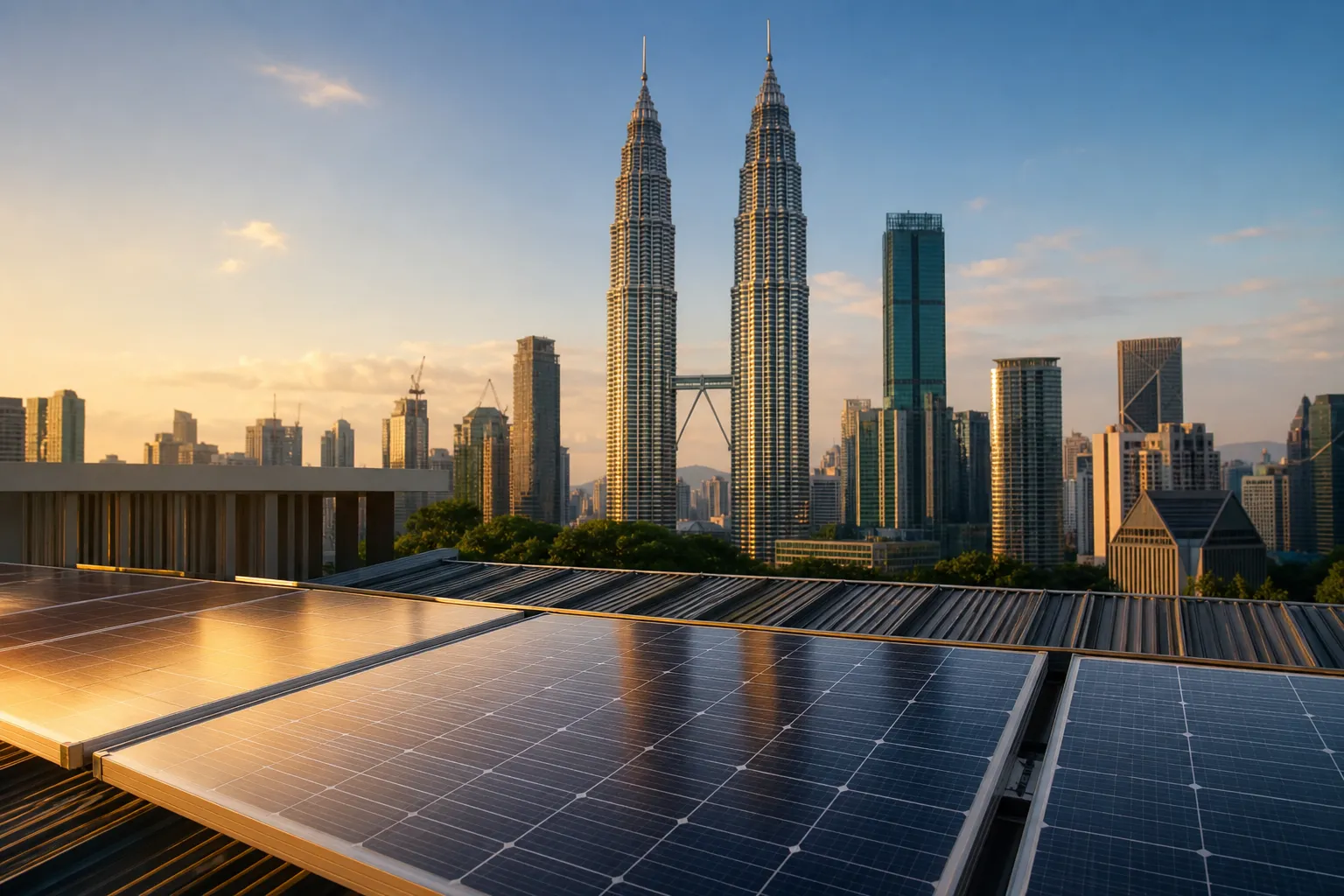
Solar project approvals Malaysia is now a defining bottleneck, and a defining opportunity, for developers, sponsors, in‑house counsel, investors and lenders moving on utility‑scale generation in 2026. As the national programme drive accelerates and grid access becomes a competitive resource, understanding exactly which licences, studies and consents are required (and in what order) is the difference between a bankable project and a stalled one. This guide sets out the permit and grid‑connection pathway step by step, with indicative timelines, required documents, cost ranges and the pitfalls that most often derail schedules. It is written for a transactional audience that needs a defensible, source‑backed playbook rather than market commentary.
This guide addresses the full regulatory and interconnection pathway for a utility‑scale solar project in Malaysia, from site selection to commercial operation and post‑COD compliance. For practical purposes, “utility‑scale” typically refers to installations that connect into the transmission or distribution network and sell electricity under a procurement programme or bilateral arrangement. The distinction matters because licensing, grid‑study and interconnection obligations scale with project size and connection voltage. Developers should confirm the applicable capacity thresholds and definitions with the relevant regulator and utility, as these are set by programme rules and can change.
Malaysia’s regulatory framework is not uniform across the country. In Peninsular Malaysia the grid is operated by Tenaga Nasional Berhad (TNB), with regulatory oversight from the Energy Commission of Malaysia (Suruhanjaya Tenaga, ST). In Sabah and Labuan, generation and grid arrangements involve Sabah Electricity Sdn Bhd (SESB) with oversight from the Energy Commission of Sabah (ECoS). In Sarawak, the grid is operated by Sarawak Energy Berhad (SEB) and its subsidiary Syarikat SESCO Berhad, regulated by the Sarawak state authorities under separate concession and engineering standards. Any developer must first confirm which jurisdiction and which grid operator apply before mapping a timetable.
The solar project approvals Malaysia process therefore blends federal statutory licensing, utility‑led technical review, state land approvals and environmental consents. The 2026 outlook is one of intensified competitive procurement and prioritised renewable grid access, which raises the premium on early, well‑documented applications. Programme rules administered by the Sustainable Energy Development Authority (SEDA) remain central to registration and incentive eligibility for certain schemes. Below is a quick orientation checklist before you engage regulators.
Before committing capital, developers should complete a set of eligibility pre‑checks. These determine feasibility, drive early cost estimates and frame the renewable energy permits Malaysia strategy. Getting them wrong at the outset is the single most common cause of downstream delay.
Confirm the land category, title and any encumbrances at the relevant state land office under the National Land Code framework. Utility‑scale solar frequently sits on agricultural land that must be converted to a category permitting commercial or industrial use, which requires state consent and can take many months. Verify access rights, easements for the connection route to the substation, and whether the land is leasehold with sufficient remaining term to support financing.
Engage the grid operator early to establish available capacity at the nearest suitable connection point. Where capacity is constrained, a System Impact (SI) study and/or Grid Impact (GI) study may be triggered, and network reinforcement costs may be allocated to the developer. This early conversation is decisive: a connection point without headroom can add substantial cost and months to the programme.
Determine whether the project will proceed under a competitive tender, a national renewable programme, or a bilateral offtake. The route dictates the standard Power Purchase Agreement (PPA) template, registration steps with SEDA where applicable, and the sequencing of licence and interconnection applications. State‑level approvals may also apply where land or local development consent is involved.
The following numbered sequence is the operational core of solar project approvals Malaysia. Several steps run in parallel in practice, but the dependencies below, particularly land, grid study and interconnection, must be respected. For each step we note who leads, the required inputs and lender considerations. A consolidated Step/Who/Duration timeline table follows.
The developer and its technical consultant identify candidate sites, assess irradiance and terrain, and request a grid‑capacity pre‑check from TNB (Peninsular) or the relevant state utility (SESB/SEB). Deliverables include a preliminary single‑line diagram and an indicative connection point. Lender consideration: a documented capacity indication de‑risks the earliest stage of diligence.
Secure the land through purchase or long lease, complete due diligence on title, and apply for any land conversion at the state land office. Confirm access and cable route easements. Who to contact: state land office and landowner. Lender consideration: clean, converted, adequately‑termed title is a condition precedent to most financings.
Incorporate the project company with the Companies Commission of Malaysia (SSM), then establish the electricity supply licence position with the Energy Commission. Whether the project requires a licence under the Electricity Supply Act 1990 or qualifies for an exemption depends on its configuration, grid export, self‑consumption or programme participation. Confirm the electricity supply licence Malaysia requirement directly with the Energy Commission. Required inputs: incorporation documents, single‑line diagram, technical description.
Submit the prescribed grid connection application to TNB (or SESB/SEB) with the single‑line diagram and technical data. The utility reviews the application and commissions or reviews the SI and GI studies, which quantify network impact and any reinforcement required. This is a critical gating item for the grid connection process Malaysia and often determines the overall schedule. Lender consideration: the SI/GI outcome directly affects capex and connection certainty.
Negotiate and execute the interconnection or connection agreement with the utility, covering technical annexes, protection settings, commercial terms, security (bank guarantees) and liability allocation. This is a core financing document. Who to contact: the grid operator’s connections team. Lender consideration: lenders scrutinise liability caps, curtailment provisions and step‑in rights.
Obtain building and development permits from the local authority and, where thresholds are triggered, complete an Environmental Impact Assessment (EIA) or screening under the Environmental Quality Act 1974 with the Department of Environment (DOE). Equipment procurement typically proceeds in parallel. Required inputs: engineering drawings, environmental studies, contractor appointments.
Complete testing and commissioning with the utility and testing authority, energise the connection and reach the commercial operation date (COD). Register the facility as required under the applicable programme with SEDA/TNB/ST. Lender consideration: COD and completion tests usually trigger drawdown milestones and the shift from construction to operational risk.
Comply with metering, telemetry, reporting and licence conditions on an ongoing basis. Maintain revenue metering integrity, submit periodic reports and renew licences where required. Lender consideration: ongoing compliance underpins the operational covenant package.
Two practical callouts anchor this sequence. First, engage the grid operator before finalising the site, capacity, not land alone, is often the binding constraint. Second, lenders will expect a due diligence bundle assembled in the order above; building it contemporaneously avoids a scramble before financial close.
| Step | Who leads / who to contact | Typical duration (indicative) |
|---|---|---|
| 1. Site selection & grid‑capacity pre‑check | Developer / technical consultant; TNB (Peninsular), SESB/SEB | 2–6 weeks |
| 2. Land due diligence & securing land rights | Developer / state land office / landowner | 8–24 weeks (longer for conversions) |
| 3. Environmental & local authority consents | Developer; local authority; DOE (if EIA required) | 8–20 weeks |
| 4. Project company formation & corporate documents | Developer / corporate counsel; SSM | 1–3 weeks |
| 5. Apply for electricity licence or confirm exemption | Energy Commission (ST) | 4–12 weeks |
| 6. Grid connection application & system impact study | Developer; TNB/SESB/SEB; system operator | 8–20 weeks (depends on upgrades) |
| 7. Negotiate & sign connection / interconnection agreement | Developer & TNB/SESB/SEB | 4–16 weeks |
| 8. Construction permits & building inspections | Local authorities / engineering contractor | 4–12 weeks (parallel with procurement) |
| 9. Testing, commissioning & COD | Developer, utility, testing authority | 2–6 weeks |
| 10. Post‑COD registrations & ongoing compliance | Developer; SEDA/TNB/ST | Ongoing |
The grid operator and engineering standards differ materially by region, which affects both timelines and documentation. The comparison below highlights the principal differences developers must plan around.
| Topic | Peninsular Malaysia (TNB) | Sabah & Sarawak (SESB / SEB) |
|---|---|---|
| Grid operator | Tenaga Nasional Berhad (TNB) | Sabah Electricity Sdn Bhd (SESB) / Sarawak Energy Berhad (SEB) |
| Application process / contact | TNB grid connection process & SI study | Utility‑specific process; different tariffs & engineering standards |
| Typical study timelines | SI & GI studies; may require network reinforcement | Variable; often longer in remote networks |
| Regulatory oversight | Energy Commission (ST), Peninsular & federal | Sabah: Energy Commission of Sabah (ECoS); Sarawak: state regulator / concessions |
Assemble the documentation set below as a working checklist. It doubles as the backbone of a lender due diligence file. Categorise by issuing authority, regulator, grid owner or local authority, and note where certified copies, notarisation or stamp duty apply, particularly for land instruments.
| Document | Issuing authority / who certifies | Notes |
|---|---|---|
| Grid connection application form | TNB or local utility | Use the utility’s prescribed form; attach single‑line diagram |
| System Impact (SI) & Grid Impact (GI) study reports | Independent consultant / utility review | SI commissioned by developer; GI issued or reviewed by the utility |
| Land title documents & land conversion approvals | State land office / landowner | Certified copies; conversion where agricultural to commercial |
| EIA or EIA screening report | DOE / State DOE office | Required if project triggers EIA thresholds under the EQA 1974 |
| Project company incorporation documents | Companies Commission of Malaysia (SSM) | Constitution, directors’ identification documents |
| Electricity supply licence or exemption | Energy Commission (ST) | Confirm whether a licence is required or the project is exempt |
| Connection / Interconnection Agreement (draft & signed) | Utility & developer | Technical annexes, commercial terms, liabilities |
| Power Purchase Agreement (PPA) or MOU | Offtaker / purchaser | Use programme standard template where applicable |
| Technical design & protection settings | EPC contractor / consulting engineer | Protection relay settings must match grid code |
| Metering & communication scheme | Meter vendor; utility | Revenue metering plan and telemetry requirements |
| Insurance certificates (CAR / advance loss) | Insurer | Lenders typically require specified cover limits |
| Evidence of financing or parent support letter | Lender or sponsor | Often required by utilities and lenders for large projects |
A realistic programme for solar project approvals Malaysia recognises that certain activities are long‑lead and gate everything downstream. Land conversion, the SI/GI study and the physical build of any transformer or switchyard reinforcement are the classic critical‑path items. Where the network requires upgrades, the grid connection process Malaysia can extend well beyond the base case.
In broad terms, a straightforward Peninsular project with adequate grid headroom and clean, converted land can move from initial application to signed connection agreement and COD in roughly six months to a year. A project requiring meaningful network reinforcement, contested land conversion or a full EIA can extend to eighteen months or more. The prudent approach is to front‑load the long‑lead workstreams, start land conversion and grid engagement in parallel with company formation, rather than sequencing them. These durations are indicative and depend heavily on programme timelines and project specifics.
Watch the gating items closely: the SI/GI study cannot conclude without complete, unambiguous technical data; the connection agreement cannot be finalised until the study defines the connection scope; and construction permits depend on settled engineering drawings. Statutory and utility timeframes should be confirmed against current regulator and utility publications, as processing times are periodically revised. Treat every duration in this guide as indicative and verify against the live fee and process schedules.
Budgeting for solar project approvals Malaysia must separate non‑recurring items, application fees, technical studies, environmental work and legal costs, from recurring obligations such as licence renewals and network charges. The ranges below are indicative only and must be verified against current regulator and utility fee schedules before they are relied on in a financial model.
| Cost item | Who charges | Typical range (indicative) | Notes |
|---|---|---|---|
| Grid connection application fee | TNB / utility | As per utility schedule | Study costs billed separately |
| System Impact (SI) study | Consultant / utility | Varies with network complexity | Confirm current cost with the utility/consultant |
| Grid reinforcement / network upgrade | Utility & contractors | Project‑specific; can be substantial | Often borne or cost‑shared by developer |
| Licence application fee | Energy Commission (ST) | Varies, check regulator schedule | Some activities may be exempt |
| EIA / environmental consultant fees | Consultant | Project‑specific | Includes public consultation where required |
| Connection agreement security / bank guarantees | Bank / developer | Per agreement terms | Lenders expect well‑documented arrangements |
| Legal & advisory fees | Counsel, technical advisers | Depends on complexity | Depends on negotiation length |
| Stamp duty & registration | State land office / Inland Revenue Board (LHDN) | Varies by transaction value | Relevant to land leases and transfers |
These figures are indicative. Confirm final amounts against the current fee schedules published by the Energy Commission, the relevant utility and the state land office.
The 2026 landscape for solar project approvals Malaysia is shaped by a national push toward larger renewable procurement volumes and clearer prioritisation of renewable grid access, consistent with the direction of the National Energy Transition Roadmap. Industry observers expect the practical effect to be heavier competition for connection capacity at attractive points on the network, which raises the value of early, complete grid applications. Programme rules administered by SEDA continue to govern registration and incentive eligibility for applicable schemes, and developers should confirm the current programme parameters directly with the authority.
The immediate operational consequences are twofold. First, where grid access is prioritised or allocated competitively, being ready to lodge a technically complete application ahead of peers becomes a genuine advantage, incomplete submissions can lose their place in the queue. Second, continued emphasis on grid integration means SI/GI studies and reinforcement scoping carry more weight in the schedule and the capex plan. Developers should track dated regulator and ministry circulars closely, because 2026 clarifications may adjust timeframes, thresholds or connection procedures. Every policy statement relied on in a financing should be traced to a dated official source.
Navigating solar project approvals Malaysia in 2026 rewards developers who front‑load the long‑lead workstreams, land conversion, grid engagement and the SI/GI study, and who assemble a lender‑ready documentation set from the outset. The pathway is sequential in its dependencies but parallel in execution: confirm jurisdiction and grid capacity early, settle land and licensing in parallel, and treat the connection agreement as the financing‑critical document it is. With competitive procurement and prioritised grid access shaping the year ahead, a disciplined, source‑backed approach to solar project approvals Malaysia is the surest route to a bankable, on‑schedule project. For the broader regulatory context, see Renewable Energy Lawyer Malaysia, Key Points 2026.
This article was produced by Global Law Experts. For specialist advice on this topic, contact Terrence Edward Chong at Darryl, Edward & Co., a member of the Global Law Experts network.