
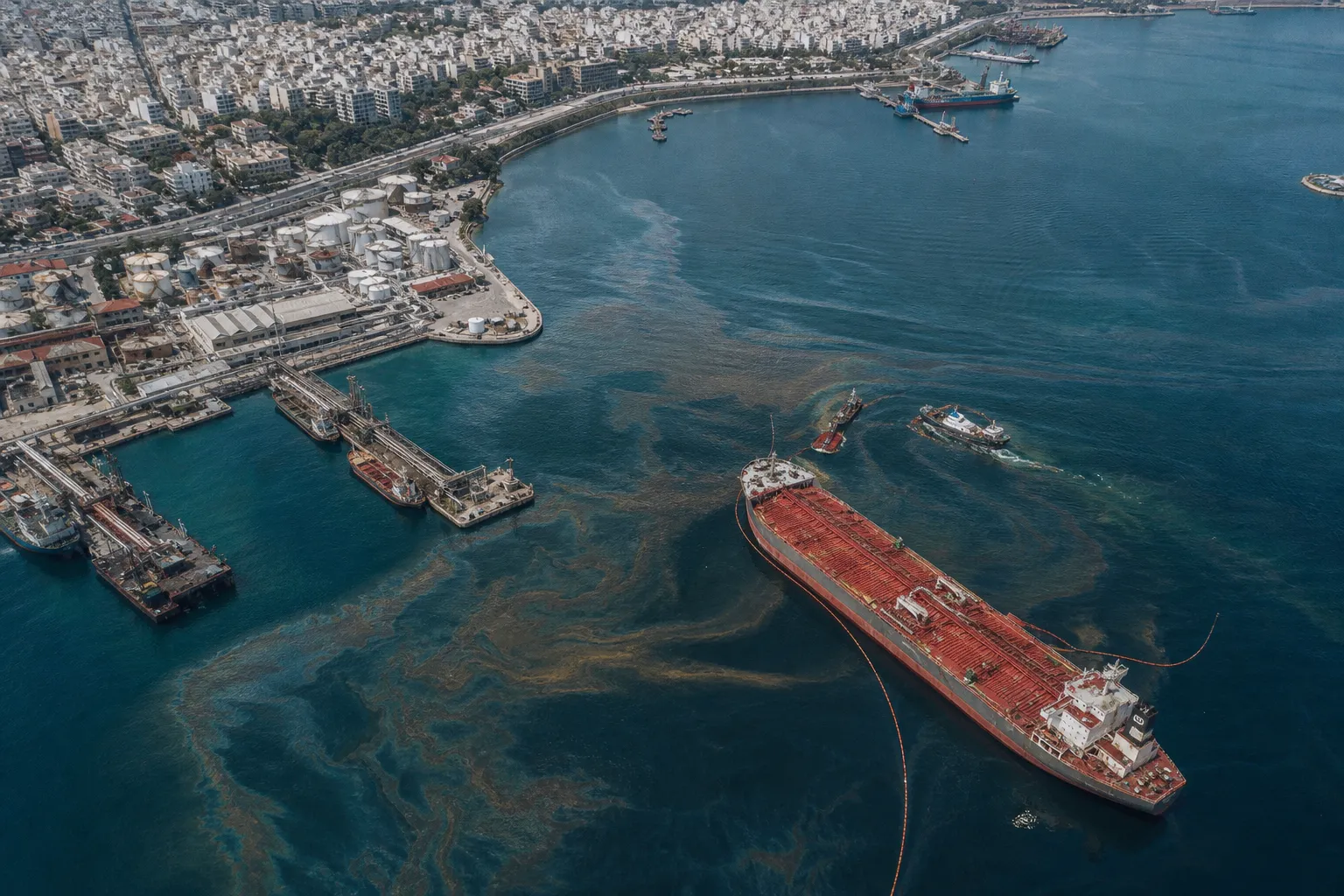
Who this is for: owners, charterers, masters, P&I clubs, casualty managers and insurers seeking legal compliance and practical immediate steps after a pollution incident in Greek waters or ports.
What this covers: criminal offences and likely prosecutions, administrative fines and port authority powers, civil claims and arrests, the interplay with limitation of liability and P&I handling, an immediate operational checklist, and the forms of evidence and defences that matter most in practice.
Read time: approximately 12 minutes.
Ship pollution Greece exposure has sharpened considerably as 2026 brings intensified EU and regional enforcement, coordinated evidence-sharing between authorities and a higher appetite for criminal prosecution following marine pollution incidents. For owners, masters, technical managers and the P&I clubs standing behind them, a single discharge, grounding or bunkering mishap in Greek waters can trigger three parallel tracks of liability at once, criminal, administrative and civil, each with different authorities, different standards of proof and different consequences for the vessel and its people. This guide integrates those three tracks into one practitioner-focused resource, explains who can be prosecuted and what sanctions apply, and sets out the immediate operational steps that preserve evidence, limit admissions and protect the vessel from prolonged detention.
It is grounded in the international conventions and EU frameworks that Greek law implements, and it is written for operational use when time matters most.
When a pollution event occurs in Greek waters or ports, the clock starts immediately and several legal regimes engage simultaneously. The first hours determine not only the environmental outcome but the evidential record on which every later proceeding will turn. Understanding how the regimes interact, and where they diverge, is the difference between a contained administrative matter and a protracted criminal and civil ordeal.
The criminal dimension of ship pollution Greece cases is often the most alarming for the individuals involved, because it attaches personal exposure to natural persons, including the master and shore-based managers, alongside the corporate owner. Greek criminal enforcement in this field flows from international and EU obligations that Greece has transposed into domestic law, and prosecutors in recent years have shown increasing willingness to pursue charges where the evidence of a prohibited discharge is clear.
The foundation of ship-source pollution control is the International Convention for the Prevention of Pollution from Ships (MARPOL), administered by the International Maritime Organization, which prohibits and regulates discharges of oil, noxious liquid substances, sewage, garbage and air emissions from vessels. Greece gives effect to MARPOL through domestic implementing legislation published in the Greek Government Gazette (Εφημερίδα της Κυβερνήσεως), which translates the convention’s operational standards into enforceable Greek offences and sanctions.
Alongside MARPOL, the European Union’s marine environment framework, overseen at policy level by the European Commission and operationally supported by the European Maritime Safety Agency (EMSA), requires member states to establish effective, proportionate and dissuasive penalties for ship-source pollution, including criminal sanctions in defined circumstances and provision for cross-border cooperation in investigations.
Because the precise Greek law numbers, articles and penalty bands are set by statute published in the Government Gazette and are subject to amendment, operators should always verify the current text against the official gazette or confirm it with Greek counsel rather than rely on historic figures. What does not change is the structural point: the conduct prohibited by MARPOL is the conduct criminalised in Greek waters.
Criminal exposure in a ship pollution Greece case is not confined to a single defendant. Prosecutors can pursue:
The threshold of culpability varies by offence. Negligent pollution, a discharge resulting from a failure to take reasonable care, carries a lower mental-element threshold than an intentional, deliberate discharge, which attracts the most serious treatment. Separate offences typically attach to the failure to notify authorities of a pollution event and to the obstruction of inspectors or the falsification of records such as the oil record book. The latter category is particularly dangerous because it can convert what might have been a defensible operational incident into evidence of concealment, which prosecutors treat severely.
A criminal matter usually begins with a preliminary investigation triggered by the Hellenic Coast Guard’s incident response. Investigators board the vessel, inspect records, take samples and interview the crew. If the evidence supports it, the file passes to the public prosecutor, who decides whether to bring charges before the competent Greek criminal court. Penalties on conviction can include custodial sentences for individuals in the most serious cases, fines against both individuals and corporate defendants, and ancillary professional consequences. Because the applicable penalty ranges are fixed by the implementing statute and may be revised, the specific figures must be confirmed against the current Government Gazette text at the time of any incident.
Not every discharge results in conviction, and the defence strategy in a ship pollution Greece prosecution is built on the evidence preserved in the first hours. Recognised themes include:
Running in parallel to any criminal process, and often moving faster than it, is the administrative enforcement machinery operated by the Hellenic Coast Guard and the competent port authorities. Administrative sanctions do not require a criminal conviction and can bite within hours of an incident, making them the most immediate practical consequence for a vessel and its owner.
The Hellenic Coast Guard is the principal maritime law enforcement and environmental protection authority in Greek waters. Its powers, reporting requirements and contact points are set out in its official guidance, and operators should treat it as the first point of contact for mandatory notification of any pollution event. On attending an incident, the Coast Guard can direct containment and clean-up, require the vessel to take immediate corrective measures, inspect and seize documents, take environmental samples, and commence the administrative process that leads to the imposition of fines. Port authorities exercise complementary powers within their jurisdictions, including the ability to control vessel movements and condition departure on compliance with directions.
Because these authorities coordinate with EU partners through EMSA and the wider port state control framework, information about an incident in a Greek port can travel quickly to other member states and flag administrations.
Administrative enforcement typically combines monetary penalties with practical remediation obligations. A ship pollution Greece incident can generate:
The amounts involved are set by statute and ministerial decision and are subject to revision, so pollution fines Greece figures quoted in any incident must be confirmed against the current official sources rather than assumed. Administrative fine decisions are generally subject to challenge through the prescribed administrative and judicial appeal routes, which is an important lever where the quantum or the factual basis is contested.
A critical distinction for casualty managers is that a vessel may be held under several legally distinct mechanisms, each with its own release pathway. Administrative or port-state detention on safety or environmental grounds is imposed by the Coast Guard or port authority to prevent further harm or to compel compliance, and release follows rectification of the deficiency or compliance with directions. This is separate from any criminal measure restricting the vessel’s movement pending investigation, and separate again from a civil arrest obtained by a claimant through the courts.
Because the same stranded vessel may face more than one of these holds at once, a release strategy must address each basis independently, resolving the administrative deficiency does not lift a civil arrest, and vice versa.
The civil track is where the largest financial exposure usually crystallises, and it is also where the interaction with the criminal narrative is most consequential. Civil liability for marine pollution liability Greece claims draws on both domestic Greek law and the international compensation regimes that Greece has adopted.
Parties affected by a pollution incident can pursue a range of civil remedies, including claims in tort for property and economic damage, statutory environmental claims, and, critically for oil pollution from tankers, claims under the international civil liability regime. The International Convention on Civil Liability for Oil Pollution Damage (CLC) and the associated Fund conventions, administered within the IMO framework and operated through the International Oil Pollution Compensation (IOPC) Funds, channel liability for oil pollution damage to the registered owner and provide a supplementary compensation tier through the Funds where owner liability is exhausted or unavailable.
The IOPC Funds publish the claims process and the applicable limits, and these mechanisms sit alongside, and interact with, domestic Greek civil claims and the compulsory insurance that underpins them.
Vessel arrest is a powerful and frequently used tool for securing pollution-related claims in Greece. A claimant can apply to the competent Greek court for an order arresting the vessel to secure a maritime claim, which immobilises the ship until security is provided or the matter is resolved. In practice, the owner and its P&I club will seek to secure release by putting up acceptable security, commonly a club letter of undertaking, a bank guarantee or a cash deposit, negotiated at a level the parties and the court accept. Because vessel detention Greece in the civil context carries significant daily cost through delay and off-hire exposure, the speed and quality of the security response is itself a commercial priority.
Shipowners can, in appropriate cases, limit their aggregate liability under the international limitation conventions implemented in Greece, which cap exposure by reference to the tonnage of the vessel. However, the right to limit is not absolute. The entitlement can be broken where it is proved that the loss resulted from the owner’s personal act or omission committed with intent to cause such loss, or recklessly and with knowledge that such loss would probably result. This is precisely why the criminal and civil tracks cannot be managed in isolation: findings or admissions in the criminal process that point to intentional or reckless conduct can be deployed by civil claimants to defeat limitation and expose the full, unlimited loss.
Coordinating the defence narrative across both tracks is therefore a strategic necessity, not an optional refinement.
P&I clubs are central to the management of P&I pollution claims Greece exposure. Typically, cover responds to the owner’s liability for pollution damage, clean-up costs and related third-party claims, and the club will arrange security for the release of an arrested vessel and fund the defence of civil proceedings. The position on fines and criminal penalties is more nuanced: clubs commonly assist with the defence of criminal proceedings against the vessel’s interests and may, within their rules and subject to the applicable law, respond to certain fines, while penalties arising from conduct outside the scope of cover or that are personal to an individual generally fall outside cover.
Because club rules and their application under Greek law vary, owners should treat any assumption about what the club will pay as provisional until confirmed with the club and counsel.
| Feature | Criminal | Administrative | Civil |
|---|---|---|---|
| Basis of liability | Prohibited discharge, failure to notify, obstruction under implementing statute | Breach of pollution regulations and directions | Damage to property, environment and economic interests; CLC/Fund claims |
| Initiating authority | Public prosecutor, on Coast Guard investigation | Hellenic Coast Guard / port authority | Private claimants, affected parties and public bodies |
| Standard of proof | Criminal standard (proof to the required criminal threshold) | Administrative standard applied by the authority | Civil standard applied by the Greek courts |
| Typical sanction / remedy | Fines, custodial sentences for individuals, ancillary measures | Administrative fines, clean-up and remediation orders, cost recovery | Damages, compensation, clean-up cost recovery |
| Immediate consequence for vessel/owner | Investigation, possible restriction on movement, personal exposure of crew | Detention on environmental grounds, orders to act, fines | Arrest and demand for security to secure release |
| Role of P&I clubs | Fund criminal defence; penalties often outside cover | Assist and advise; fines treated per club rules and law | Provide security; fund defence; respond to liability within cover |
The quality of the response in the first 72 hours after a pollution incident response Greece event shapes every subsequent proceeding. The following timeline-based protocol is designed for operational use.
0–6 hours: Stop the source and make the vessel safe. Notify the Hellenic Coast Guard and the relevant port authority without delay, notification is a legal obligation and a mitigating factor. Alert the P&I club and the owner’s casualty response team immediately, and begin a contemporaneous written log of events, times and decisions. Preserve the scene and secure all records.
6–24 hours: Notify the flag state, the charterer and the hull and machinery insurers. Mobilise the P&I-appointed local correspondent and lawyer. Take and seal bunker and cargo samples following proper procedure. Secure the voyage data recorder, oil record book, bunker delivery notes, maintenance records and the engine room and bridge logs. Prepare the crew for the arrival of investigators under legal guidance.
24–72 hours: Coordinate the clean-up and response contractors under the direction of the authorities. Begin assembling the security package for any anticipated arrest. Finalise and corroborate crew statements with legal input. Establish a single controlled communications channel and brief all personnel against making unguided admissions.
Ongoing: Maintain the evidential chain, manage the administrative fine and appeal position, negotiate release security, and align the criminal and civil defence strategy.
All external communications should flow through a single designated channel, coordinated between the owner, the P&I club and counsel. Crew and shore staff should be briefed that cooperation with the authorities does not mean volunteering conclusions, speculation or admissions of fault. Media enquiries should be handled by a nominated spokesperson following a pre-agreed line that acknowledges the incident and the response without conceding liability.
Prepare early for the likelihood of arrest by engaging the P&I club on the form and quantum of security. A club letter of undertaking is often the fastest route to release; a bank guarantee or cash deposit are alternatives where the claimant or court requires them. Because each legal basis for detaining the vessel requires its own resolution, map out the release conditions for the administrative, criminal and civil holds in parallel.
How the vessel’s personnel handle the arrival of investigators is frequently decisive. Cooperation and compliance must be balanced against the legitimate protection of the rights of individuals and the integrity of the evidence.
Where investigators seek to interview crew, the master and company should facilitate the process while ensuring that individuals understand their position and, where appropriate, have access to legal representation or a P&I representative. Interviews should be conducted in a language the crew member genuinely understands, and a record of what was asked and answered should be kept.
Sampling is often the linchpin of a pollution case. Where the authorities take samples, the vessel’s interests should request split samples taken contemporaneously, properly sealed and independently retained, so that the vessel has its own evidence to analyse. Rigorous chain-of-custody documentation protects the integrity of that evidence and can expose weaknesses in the prosecution’s own sampling.
Where an administrative order or detention is disproportionate, procedurally flawed or based on contested facts, the vessel’s interests may seek urgent judicial relief through the prescribed appeal and interim-measures routes. Timing is critical, and the decision to litigate against an authority should be taken quickly and with full appreciation of the commercial trade-offs.
While the facts of every ship pollution Greece matter differ, representative outcome patterns recur. A well-documented operational discharge with prompt notification and cooperation frequently resolves as an administrative fine combined with recovery of clean-up costs, without criminal conviction. A more serious event, or one involving contested causation, commonly produces vessel detention and a demand for security, with civil claims running alongside an administrative penalty. The most serious cases, particularly those involving concealment, falsified records or deliberate discharge, carry genuine risk of criminal conviction with fines and, for individuals, potential custodial exposure and professional consequences.
The consistent lesson is that preparation and candour pay. Operators with demonstrable compliance systems, accurate records and a disciplined notification culture consistently fare better than those whose response is improvised or defensive. Falsifying or destroying records transforms a survivable incident into a serious criminal exposure.
For clubs, early mobilisation of local correspondents and counsel, rapid security provision and tight coordination of the criminal and civil defence narratives contain exposure most effectively. Clear communication with members about the limits of cover for fines and personal penalties avoids later disputes at the worst possible moment.
This article was produced by Global Law Experts. For specialist advice on this topic, contact Konstantinos Bachxevanis at BAX LAW, a member of the Global Law Experts network.
For primary legislation and official enforcement guidance, operators should consult the International Maritime Organization for MARPOL and the liability and compensation conventions, the International Oil Pollution Compensation Funds for the oil pollution compensation regime, the European Commission and the European Maritime Safety Agency for the EU framework and cross-border cooperation, the Hellenic Coast Guard for Greek reporting obligations and port authority powers, and the Greek Government Gazette for the exact text of implementing statutes. Because Greek law numbers, articles and penalty figures are subject to amendment, all specific citations and amounts should be verified against the current official sources before being relied upon.

posted 1 hour ago

posted 2 hours ago

posted 2 hours ago

posted 3 hours ago

posted 3 hours ago
posted 4 hours ago

posted 4 hours ago

posted 5 hours ago

posted 5 hours ago

posted 6 hours ago
posted 6 hours ago

posted 7 hours ago
No results available
Find the right Legal Expert for your business

Send welcome message