
Author
No results available
By A&M Consulting Co.
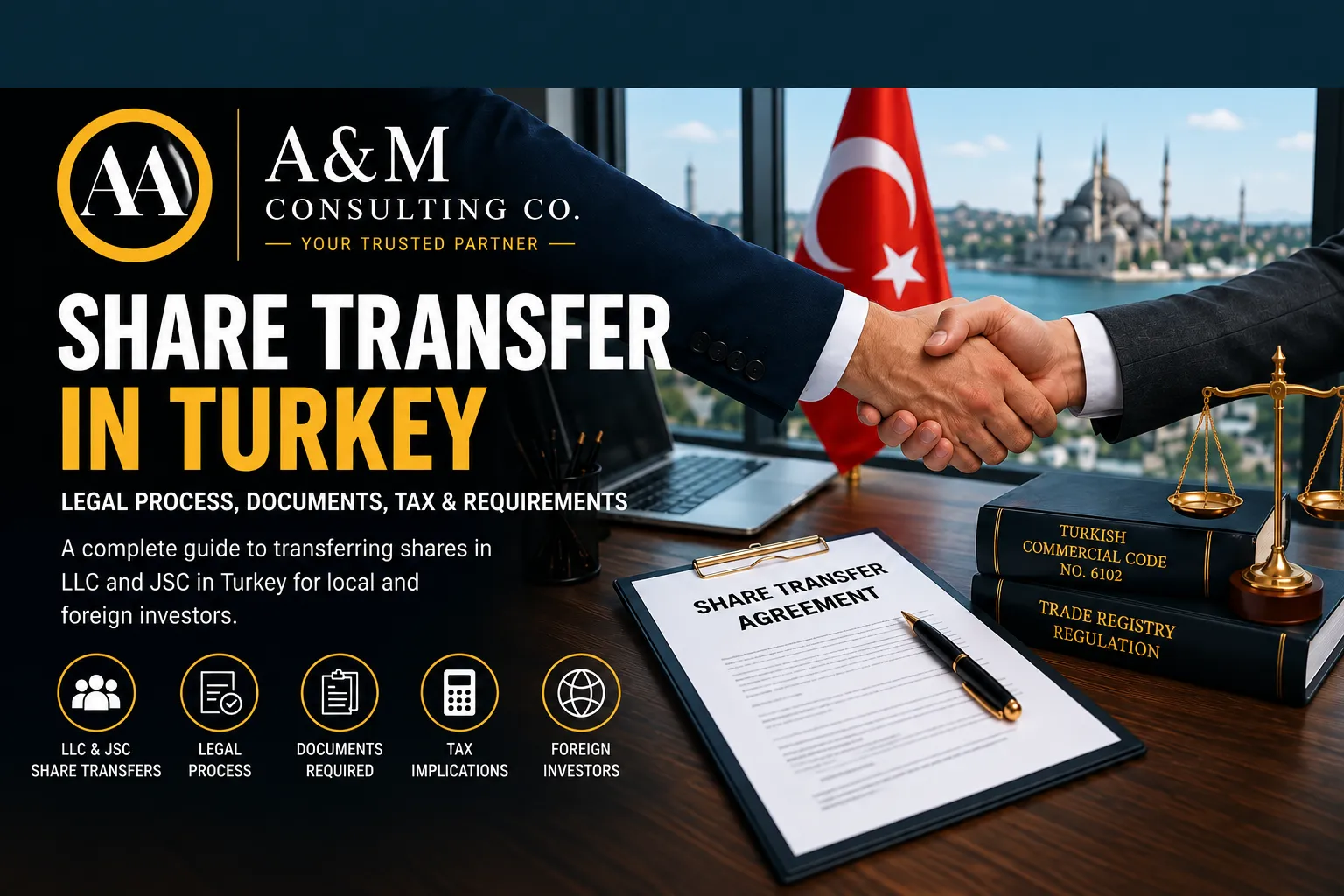
Share transfer in Turkey is a common corporate transaction for foreign investors, international companies, entrepreneurs and shareholders seeking to acquire, restructure or exit a Turkish business.
A share transfer may take place when:
However, the procedure for transferring shares in Turkey depends significantly on the type of company involved.
The rules applicable to a Limited Liability Company (Ltd. Şti.) are substantially more formal than those generally applicable to a Joint Stock Company (A.Ş.).
Foreign investors should therefore review the company’s Articles of Association, shareholding structure, share capital, paid-up capital, existing share records, tax position and applicable regulatory requirements before completing a share transfer.
This guide explains the share transfer process in Turkey, including LLC and JSC share transfers, required documents, Trade Registry procedures, share capital considerations, tax implications, due diligence, foreign ownership and post-transfer compliance.
A share transfer is the legal transaction through which ownership of existing shares or capital interests in a Turkish company passes from one shareholder to another person or entity.
A share transfer may involve:
The legal requirements depend primarily on whether the company is a Limited Liability Company or Joint Stock Company.
For foreign investors, a share transfer may also have consequences for:
One of the most important concepts for investors is the distinction between share ownership and share capital.
A share transfer changes who owns the existing shares. It does not, by itself, increase or decrease the company’s registered share capital.
For example, assume a Turkish LLC has TRY 500,000 registered share capital.
If Shareholder A transfers 40% of the shares to Shareholder B, the company still has TRY 500,000 registered share capital. What changes is the ownership structure.
Therefore:
Share Transfer = Change in ownership
Capital Increase = Increase in company capital
Capital Reduction = Reduction in company capital
This distinction is particularly important when a foreign investor is entering an existing Turkish company.
For a comprehensive explanation of share capital, paid-up capital, subscribed capital, registered capital and capital increases in Turkey, see:
Share capital represents the amount of capital committed by shareholders to the company in exchange for ownership interests.
When acquiring shares in an existing Turkish company, investors should not only examine the percentage of shares being acquired. They should also examine the company’s underlying capital structure.
Due diligence should consider:
The distinction between registered share capital and paid-up capital can be particularly important for foreign investors.
A company may have a particular amount of registered capital while some capital commitments remain unpaid, depending on the company type and applicable legal rules.
For this reason, capital structure should form part of the buyer’s corporate and financial due diligence.
Related guide: Share Capital in Turkey
Paid-up capital is the portion of the subscribed share capital that has actually been contributed by the shareholders.
When acquiring shares in an existing Turkish company, the buyer should determine whether the shares being transferred have been fully paid.
The buyer should review:
This can become particularly important where the company has been established with a significant capital commitment but the capital has not yet been fully paid.
A buyer should understand the company’s actual capital position before agreeing to the purchase price or completing the transaction.
For more information:
A share transfer and a capital increase are fundamentally different corporate transactions.
In a share transfer, an existing shareholder transfers existing shares to another person or company.
The purchase price is generally paid to the selling shareholder.
For example:
Investor pays EUR 500,000 to existing shareholder → ownership changes.
In a capital increase, the company increases its capital and may issue new shares to an existing or new investor.
The investor’s funds are contributed to the company rather than paid to the existing shareholder.
For example:
Investor contributes EUR 500,000 to company → company capital increases and investor receives newly issued shares.
A capital increase can therefore strengthen the company’s equity and provide additional funding for:
Foreign investors should determine whether a transaction should be structured as a share acquisition, capital increase or combination of both.
For detailed information on the capital increase process:
The transfer of shares in a Turkish Limited Liability Company is subject to relatively formal procedures.
A transfer of a capital share generally requires a written share transfer agreement with notarised signatures. Unless the Articles of Association provide otherwise, approval of the General Assembly is also generally required.
The transaction generally involves:
This makes LLC share transfers considerably more formal than transfers of shares in many Joint Stock Companies.
Before starting an LLC share transfer, investors should review the Articles of Association to determine whether they contain:
Investors should not assume that a share transfer can be completed simply by signing a private agreement.
Share transfers in a Turkish Joint Stock Company (A.Ş.) are generally more flexible than transfers in an LLC.
The exact procedure depends on the type of shares, applicable law and the company’s Articles of Association.
In ordinary circumstances, a JSC share transfer does not require General Assembly approval merely because shares are being transferred, although statutory and contractual exceptions may apply.
Investors should consider:
The distinction between LLC and JSC share transfers is therefore an important consideration when selecting a Turkish corporate structure.
Related guide: Joint Stock Company in Turkey
| Feature | Limited Liability Company | Joint Stock Company |
|---|---|---|
| Share transfer | More formal | Generally more flexible |
| Notarised transfer agreement | Generally required | Different rules apply |
| General Assembly approval | Generally required unless otherwise provided | Generally not required, subject to exceptions |
| Trade Registry | Registration required | Generally no registration of the transfer itself, subject to exceptions |
| Share ledger | Updated | Updated where applicable |
| Articles of Association | May restrict transfers | May contain restrictions |
| Foreign ownership | Generally permitted | Generally permitted |
| Suitable for | SMEs and owner-managed businesses | Larger investments and investment structures |
Foreign investors should therefore avoid treating LLC and JSC share transfers as identical transactions.
The Registered Capital System can be particularly relevant to Joint Stock Companies planning future investment rounds or repeated capital increases.
Under this system, eligible JSCs may increase issued capital up to a predetermined authorised capital ceiling, subject to applicable legal requirements.
This is different from a share transfer.
A share transfer changes ownership of existing shares.
A capital increase creates additional issued capital.
The Registered Capital System can be particularly useful for companies planning:
For more information about the Registered Capital System and authorised capital ceiling:
An authorised capital ceiling is relevant to eligible Joint Stock Companies operating under the Registered Capital System.
For example, a JSC may have:
The company may increase issued capital within the applicable authorised ceiling without following the same shareholder approval process required for every capital increase under the basic capital system, provided the legal requirements are met.
This mechanism is particularly relevant to companies planning future financing.
However, an authorised capital ceiling does not itself represent additional shareholder ownership.
It should not be confused with a share transfer.
A share transfer should also be distinguished from a capital reduction.
A share transfer normally changes ownership without changing the company’s registered capital.
A capital reduction is a separate corporate transaction through which the company’s capital is reduced according to applicable Turkish Commercial Code procedures.
Therefore:
These transactions can sometimes form part of the same broader corporate restructuring, but each has its own legal and accounting consequences.
Related guide: Share Capital in Turkey
The company documents should be reviewed to identify transfer restrictions and approval requirements.
The buyer should review:
The agreement should address:
The LLC share transfer documentation must comply with applicable Turkish notarisation requirements.
Where required, the General Assembly approves the transfer.
The company’s share ledger should be updated to reflect the new shareholder structure.
The transfer is submitted to the relevant Trade Registry Office and the required registration procedures are completed.
The procedure for a JSC is generally more flexible.
Depending on the shares and circumstances, the transaction may involve:
1. Review of the Articles of Association
2. Review of share certificates or share records
3. Share Purchase Agreement where appropriate
4. Execution of the share transfer
5. Endorsement and delivery where required
6. Updating the share ledger
7. Board procedures where required
8. Regulatory notification or approval where applicable
The exact procedure should be determined based on the company’s structure and the type of shares being transferred.
The formal transfer procedure should be distinguished from the commercial agreement between buyer and seller.
A Share Purchase Agreement (SPA) can establish the commercial terms of the transaction and provide contractual protection to both parties.
An SPA may include:
The agreed consideration and payment mechanism.
Statements concerning:
Requirements that must be satisfied before closing.
Protection against specified liabilities.
The documents and actions required to complete the transaction.
Responsibilities that continue after completion.
For significant acquisitions, legal, financial and tax due diligence should generally be performed before signing or closing.
A foreign investor buying shares in an existing Turkish company should conduct appropriate due diligence.
The company’s share capital should also be verified.
The buyer should confirm:
Related guide: Share Capital in Turkey
Yes. Foreign individuals and foreign legal entities can generally acquire and transfer shares in Turkish companies, subject to applicable sector-specific restrictions.
Common structures include:
The fact that a shareholder is foreign does not itself prevent a share transfer.
However, regulated sectors may have additional requirements.
Yes, generally.
A Turkish company may have foreign corporate shareholders, and shares can in many circumstances be transferred from one foreign corporate shareholder to another.
The transaction may require:
Foreign corporate documents may need to be notarised, apostilled or legalised and translated into Turkish.
Foreign investors frequently acquire an existing Turkish company instead of establishing a new entity.
This can provide access to:
However, acquiring an existing company also means taking on its historical corporate and financial position.
A buyer should therefore perform appropriate due diligence before completing the transaction.
The tax consequences of a share transfer depend on several factors, including:
A foreign shareholder selling shares in a Turkish company may have Turkish tax obligations depending on the circumstances.
The seller’s country of tax residence and the applicable Double Tax Treaty should therefore be reviewed before completion.
A share transfer may create a capital gain where the sale proceeds exceed the relevant acquisition cost.
The calculation and taxation of the gain depend on the seller and the type of shares.
Investors should maintain documentation showing:
Proper documentation can be particularly important during tax reviews.
Share ownership and company management are separate corporate matters.
A share transfer does not automatically mean that directors or managers change.
Following a share acquisition, shareholders may decide to:
Where management changes are required, separate corporate resolutions and Trade Registry procedures may be necessary.
This distinction is particularly important for foreign investors acquiring 100% of a Turkish company.
Where the ultimate beneficial owner changes, the company should review its beneficial ownership and tax reporting obligations.
This is particularly important when shares are transferred between:
Banks and financial institutions may also require updated beneficial ownership information as part of their KYC and AML procedures.
Share ownership, company management and work authorisation are separate legal matters.
Acquiring shares in a Turkish company does not automatically grant a foreign investor the right to work in Turkey.
Where the investor intends to become an active manager, director or employee, the applicable work permit requirements should be reviewed separately.
The company’s capital and paid-up capital can become relevant to certain work permit applications.
Foreign investors should therefore consider their capital position when planning a transaction involving both share acquisition and relocation to Turkey.
For more information on capital planning:
Certain industries are subject to additional ownership rules and regulatory requirements.
These may include:
A share transfer in a regulated company may require:
Investors should identify the relevant regulator before signing the transaction.
Foreign investors considering an acquisition should also compare a share deal with an asset deal.
The buyer acquires ownership of the company itself.
The company continues to own:
The buyer acquires selected assets or business operations rather than the company’s shares.
An asset transaction can sometimes provide greater flexibility regarding historical liabilities, but contracts, licences, employees, tax consequences and regulatory approvals must be analysed individually.
The appropriate structure depends on the commercial, legal and tax objectives of the transaction.
A share transfer may form part of a broader corporate restructuring.
For example, an investor may combine:
These transactions should be planned together where appropriate.
A&M Consulting Co. can assist foreign investors with the accounting, tax and corporate compliance aspects of these transactions.
Related resources:
Foreign investors should avoid several common mistakes.
Transfer restrictions can affect the transaction.
The formal requirements are significantly different.
The buyer should understand the company’s registered, subscribed and paid-up capital before completing the acquisition.
A share purchase transfers existing ownership, while a capital increase injects new capital into the company.
The buyer may inherit undiscovered tax, financial or legal risks.
The seller’s tax residence and applicable Double Tax Treaty can materially affect the transaction.
The share ledger, Trade Registry and other records should be updated where required.
A change in ultimate ownership may require updates to banking and tax records.
Regulated industries may require approval or notification.
Foreign shareholders acting through representatives in Turkey should ensure that the Power of Attorney covers all required procedures.
Before completing a share transfer in Turkey, investors should consider:
Completing the share transfer agreement does not necessarily conclude the entire transaction.
Depending on the company type and transaction structure, post-closing procedures may include:
Where the transaction involves a change in directors, managers or authorised representatives, separate corporate resolutions and registration procedures may be necessary.
The exact documents depend on the company type and the parties involved.
Common documents may include:
Foreign documents may need:
The document requirements should be determined before the transaction is signed to avoid delays.
A&M Consulting Co. assists foreign investors and international companies with the accounting, tax and corporate procedures associated with share transfers in Turkey.
Our services can include:
A&M Consulting Co. also supports international investors with broader corporate services, including:
Company Registration in Turkey
Share transfers in Turkey are an important corporate transaction for foreign investors entering, restructuring or exiting the Turkish market.
The procedure depends heavily on the type of company.
For a Limited Liability Company, the transfer generally involves a written and notarised transfer agreement, General Assembly approval where required, updating the share ledger and Trade Registry procedures.
For a Joint Stock Company, share transfers are generally more flexible, although the type of shares, Articles of Association and applicable regulatory requirements must be reviewed.
Foreign investors should also distinguish a share transfer from a capital increase or capital reduction. A share transfer changes ownership of existing shares, whereas a capital increase changes the company’s capital structure.
Before completing a transaction, investors should therefore review:
A properly planned share transfer can allow an investor to enter or exit a Turkish business efficiently while reducing legal, tax and compliance risks.
A&M Consulting Co. supports international investors with share transfer procedures, corporate restructuring, tax and accounting analysis, due diligence and ongoing corporate compliance in Turkey.

posted 14 minutes ago

posted 51 minutes ago

posted 1 hour ago

posted 1 hour ago

posted 1 hour ago

posted 2 hours ago

posted 2 hours ago

posted 2 hours ago

posted 2 hours ago

posted 2 hours ago

posted 3 hours ago

posted 3 hours ago
No results available
Find the right Legal Expert for your business

Send welcome message