
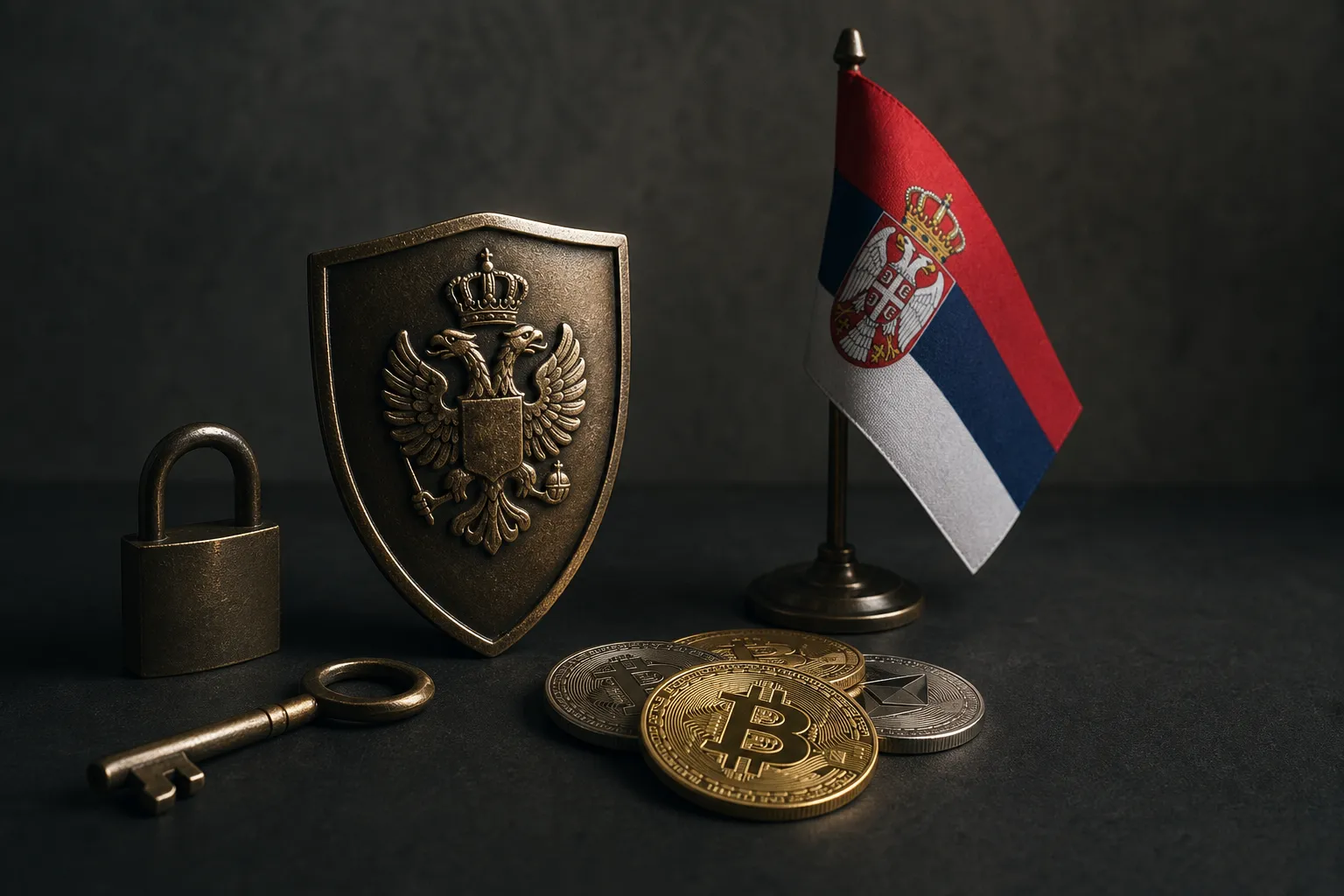

Last updated: 29 October 2026, This guide reflects the Law on Digital Assets and current regulator practice. Because supervisory guidance is evolving, verify application-specific matters with local counsel before filing.
Obtaining a serbia crypto licence has become one of the most actively researched regulatory topics in Southeast Europe, as exchanges, custodians and token issuers position themselves within a framework that is now firmly in the implementation phase. This landing page explains, in practical detail, how to get a serbia crypto licence: who regulates digital-asset activity, which services require authorisation, what documents and capital you need, how much the process typically costs, how long it takes, and how Serbia compares with European Union virtual asset service provider (VASP) regimes. It is written for founders, compliance officers and foreign investors who want an authoritative overview before engaging Serbia crypto licence counsel.
If you operate or plan to launch a digital-asset business with a Serbian footprint, understanding the serbia crypto licence regime is the first step toward a compliant market entry. Serbia regulates digital assets primarily through the Law on Digital Assets (Zakon o digitalnim sredstvima), published in the Official Gazette, with supervisory roles shared between the National Bank of Serbia (NBS), the Securities Commission, and the Administration for the Prevention of Money Laundering (APML). The practical takeaway is that most commercial crypto services, exchange, custody, brokerage and certain issuance activities, require some form of authorisation or registration, backed by robust anti-money-laundering (AML) controls.
This page is designed for businesses and individuals evaluating whether to pursue a licence in Serbia, comparing jurisdictions, or preparing an application. Below you will find an at-a-glance snapshot, a step-by-step process, a costs-and-timelines table, a Serbia-versus-EU comparison, and a structured FAQ.
The decision to pursue a serbia crypto licence is increasingly time-sensitive. Serbia enacted a dedicated statutory framework for digital assets relatively early among non-EU European states, and the regime is no longer theoretical, it is being applied in practice, with regulators actively reviewing applications from prospective service providers.
The Law on Digital Assets establishes the categories of regulated activity and the supervisory architecture that governs them (Law on Digital Assets, Official Gazette). The National Bank of Serbia has published material on its supervisory remit and financial-services oversight (National Bank of Serbia), and industry observers note that multiple operators have moved to apply under the framework. For first movers, early engagement during an active review phase can offer a strategic advantage: regulators processing initial applications tend to be more accessible for clarifying queries, and early authorisation positions a business ahead of later entrants.
Serbia offers a combination of a clear statutory framework, a growing regional fintech talent pool centred on Belgrade, and a regulator in an active engagement phase. Relative to some EU member-state regimes, applicants often report a faster path to a decision where the application file is complete. Serbia functions as a credible regional hub for businesses that want European proximity without immediately absorbing the full complexity, and cost, of an EU authorisation.
A defining feature of the serbia crypto licence regime is its emphasis on anti-money-laundering and counter-terrorist-financing (AML/CFT) controls. The APML is the central authority for AML supervision and reporting (Administration for the Prevention of Money Laundering), and its expectations align with international standards set by the Financial Action Task Force for virtual assets (FATF). In practice, this means applicants must demonstrate credible know-your-customer (KYC) procedures, transaction monitoring, sanctions screening and suspicious-activity reporting from day one.
Not every interaction with digital assets triggers licensing, but most commercial service provision does. The Law on Digital Assets enumerates the categories of regulated digital-asset services, and businesses should map their intended operations against these definitions before filing.
Where a token displays the features of a financial instrument, the Securities Commission’s remit may apply alongside the NBS framework (Securities Commission of the Republic of Serbia). Because the boundary between a payment-type token and an investment-type token can be fact-specific, applicants should confirm classification against the exact articles of the Law on Digital Assets and, where interpretation is unsettled, verify with the regulator or local counsel.
Eligibility for a serbia crypto licence rests on corporate substance, financial adequacy, the integrity of key individuals, and demonstrable compliance infrastructure. The following requirements reflect the structure of the Law on Digital Assets and related regulator guidance; specific figures should be confirmed against the current statutory text and any published fee or capital ordinances.
Applicants typically establish a Serbian company, most commonly a limited liability company (d.o.o.), to serve as the licensed entity. A local operating presence, including a registered address and appropriate governance, is expected. The Law on Digital Assets sets out the corporate prerequisites, and company formation is a precondition to filing (Law on Digital Assets).
Minimum capital requirements vary by the type of activity, with service categories that carry greater client-asset risk, such as custody or exchange, generally attracting higher thresholds. Because capital figures are set by statute and may be revised by implementing ordinances, applicants should treat any quoted number as an estimate and confirm the current threshold in the Official Gazette (Government of Serbia).
Beneficial owners, directors and the appointed AML officer must satisfy fit-and-proper standards, demonstrating integrity, relevant experience and the absence of disqualifying criminal or regulatory history. Supporting documentation typically includes detailed CVs, proof of qualifications, and criminal-record certificates for key individuals.
Applicants should expect requirements around local authorised representation and the submission of documents in Serbian, with certified translations and, where applicable, apostille for foreign corporate records. Core documents include the business plan, AML and KYC policies, organisational chart, management CVs, proof of capital, and technical descriptions of custody and security systems. The full checklist is set out in the process section below, and applicants should cross-reference APML and NBS obligations throughout.
The route to a serbia crypto licence is methodical. Each step has its own documentation, timeline and common pitfalls, and foreign applicants should pay particular attention to structuring and translation requirements. The following step-by-step process explains how to apply for a crypto license serbia authorisation from planning through to post-licence supervision.
Step 1, Pre-application planning. Define the regulated activities you will perform, select the right corporate and tax structure, and conduct an initial risk assessment. Foreign applicants should decide between a local subsidiary and a branch (a subsidiary is the more common route for a full licence). Estimated timeline: 2–6 weeks. Pitfall: misclassifying activities, which leads to the wrong licence category.
Step 2, Corporate formation and registration. Incorporate the Serbian entity and complete company-registry filings. This is where how to register a crypto company in Serbia intersects with licensing, as the registered entity becomes the applicant. Estimated timeline: 1–4 weeks. Pitfall: incomplete beneficial-ownership disclosures.
Step 3, Prepare core application documents. Compile the full file: business plan and financial projections, AML/CFT policies, KYC and onboarding procedures, organisational chart, management and shareholder CVs, criminal-record certificates, proof of minimum capital, custody and security technical documentation, and sample client agreements. A thorough application checklist (documents & corporate structuring) reduces rework. Estimated timeline: 4–10 weeks. Pitfall: generic, template AML policies that are not tailored to the business model.
Step 4, Compliance and AML setup. Appoint a qualified AML officer, implement transaction-monitoring tooling, configure sanctions screening, and establish suspicious-activity reporting lines to APML. Align controls with FATF virtual-asset standards (FATF). Estimated timeline: runs in parallel with Step 3. Pitfall: appointing an AML officer too late to influence policy design.
Step 5, Submit the application. File with the competent regulator identified under the Law on Digital Assets for your activity type, together with the required initial fees. Estimated timeline: 1 week to lodge once documents are final. Pitfall: submitting an incomplete file, which restarts the clock on completeness checks.
Step 6, Regulator review and queries. Expect completeness checks, written requests for additional information, and potentially site visits or technical demonstrations. Prompt, well-evidenced responses keep the file moving. Estimated timeline: 2–5 months depending on complexity and regulator workload. Pitfall: slow or inconsistent responses to information requests.
Step 7, Conditional approval and final licensing. Where applicable, the regulator may grant conditional or pre-licence approval pending final steps (for example, demonstrating funded capital). A licensing decision is issued and, where required, published. Estimated timeline: 2–6 weeks after satisfactory review.
Step 8, Post-licence obligations. Maintain ongoing compliance: periodic supervisory reporting, AML reporting to APML, independent audits, and prompt notification of material changes in ownership or management. Pitfall: treating the licence as a one-off event rather than a continuing supervisory relationship.
Foreign companies routinely obtain a serbia crypto licence through a Serbian subsidiary. The regulator will require evidence of the parent’s legal personality, apostilled and translated corporate documents, and fit-and-proper evidence for ultimate beneficial owners and group management. Third-party providers for custody, technology and compliance tooling are generally acceptable, but outsourcing does not transfer regulatory responsibility, the licensed entity remains accountable for controls and client-asset protection.
Budgeting for a serbia crypto licence requires separating official regulator costs from the professional and technology spend that dominates most applications. The table below sets out typical fee categories. All figures should be treated as planning estimates; confirm statutory fees and capital against the current Official Gazette and any regulator fee schedule (Official Gazette / PIS).
| Cost item | Nature | Notes / estimate basis |
|---|---|---|
| Application fee | One-off regulator fee | Set by regulator; verify current schedule. |
| Licensing fee | One-off on grant | Payable on authorisation; activity-dependent. |
| Minimum capital | Standing capital requirement | Varies by activity; higher for custody/exchange (estimate, confirm statute). |
| Legal & compliance advisory | Professional fees | Often the largest variable cost; scales with complexity. |
| AML technology | Software / licensing | Transaction monitoring, screening and KYC tooling. |
| Annual supervisory fee | Recurring | Ongoing regulator and reporting costs. |
On timing, a well-prepared application can progress from filing to decision within a matter of months, while incomplete files or complex business models extend the timeline considerably. The dominant variable is application quality: a complete, internally consistent file with tailored AML policies tends to clear completeness checks quickly, whereas gaps trigger iterative information requests. Costs also scale by activity, a full exchange or custody licence generally carries higher capital and compliance costs than a narrower service offering. For scenario-specific budgeting, see the cost & timeline calculator.
Many applicants weigh a vasp serbia licence against an EU member-state authorisation. The right choice depends on target markets, risk appetite and budget. The comparison below summarises the structural trade-offs; detailed analysis is available in the dedicated Serbia vs EU VASP comparison.
| Feature / jurisdiction | Serbia (Law on Digital Assets) | Typical EU VASP regime (member-state average) |
|---|---|---|
| Licensing scope | Broad categories (exchange, custody, issuance); regulator actively reviewing initial applications | Broad but varies; EU AML framework plus national rules; strict VASP registration/licensing in many states |
| Minimum capital | Medium; activity-dependent (confirm official source) | Variable; some states require higher capital |
| Time to licence | Relatively fast where the file is complete (est. several months) | Often longer due to AML checks and passporting complexity |
| AML/CFT emphasis | High, APML oversight and clear reporting expectations | Very high, FATF plus EU AML framework; stricter due-diligence standards |
| Market access | Serbian market and regional presence; no EU passport | Domestic market; passporting only where national and EU frameworks allow |
| Supervisor engagement | Active review phase; regulator approachable for queries | Established, often more prescriptive and resource-intensive |
Serbia is attractive where speed, cost efficiency and a regional hub matter more than EU passporting, for example, a group seeking a compliant European base for regional operations. An EU authorisation remains preferable where single-market access across member states is the primary commercial objective, since the serbia crypto licence does not confer an EU passport. For EU comparator context, see the European Banking Authority’s AML materials (EBA) and the European Commission (European Commission).
AML compliance is the backbone of a serbia crypto licence and the area most likely to determine approval speed. The APML sets the reporting and due-diligence framework that licensed providers must operate within (APML), and its requirements mirror the risk-based approach promoted by the FATF for virtual-asset service providers. Our guide on AML/CFT compliance for crypto expands on each obligation below.
Non-compliance carries supervisory and financial consequences, and persistent failures can threaten the licence itself. Building a proportionate, well-documented AML programme before filing is therefore both a compliance necessity and a practical accelerant to approval.
Most delays and refusals trace back to a small number of recurring issues: incomplete documentation, generic or weak AML controls, and insufficient evidence of fit-and-proper management. Applicants also underestimate the technical diligence expected around custody and security.
Serbia has moved from legislating digital assets to actively licensing them, which makes early, well-prepared engagement with the framework commercially valuable. Securing a serbia crypto licence rewards applicants who treat corporate structuring, capital adequacy, fit-and-proper governance and AML/CFT controls as a single, integrated project rather than a sequence of afterthoughts. For businesses weighing market access, cost and speed, the serbia crypto licence offers a credible regional base, provided EU passporting is not the decisive requirement. Because capital thresholds, fees and regulator interpretations continue to evolve, verify current figures against the Law on Digital Assets and confirm application-specific matters with local counsel before you file.

posted 14 minutes ago

posted 26 minutes ago

posted 33 minutes ago

posted 51 minutes ago

posted 1 hour ago

posted 2 hours ago

posted 2 hours ago

posted 2 hours ago

posted 2 hours ago

posted 3 hours ago

posted 3 hours ago

posted 3 hours ago
No results available
Find the right Legal Expert for your business

Send welcome message