
Author
No results available
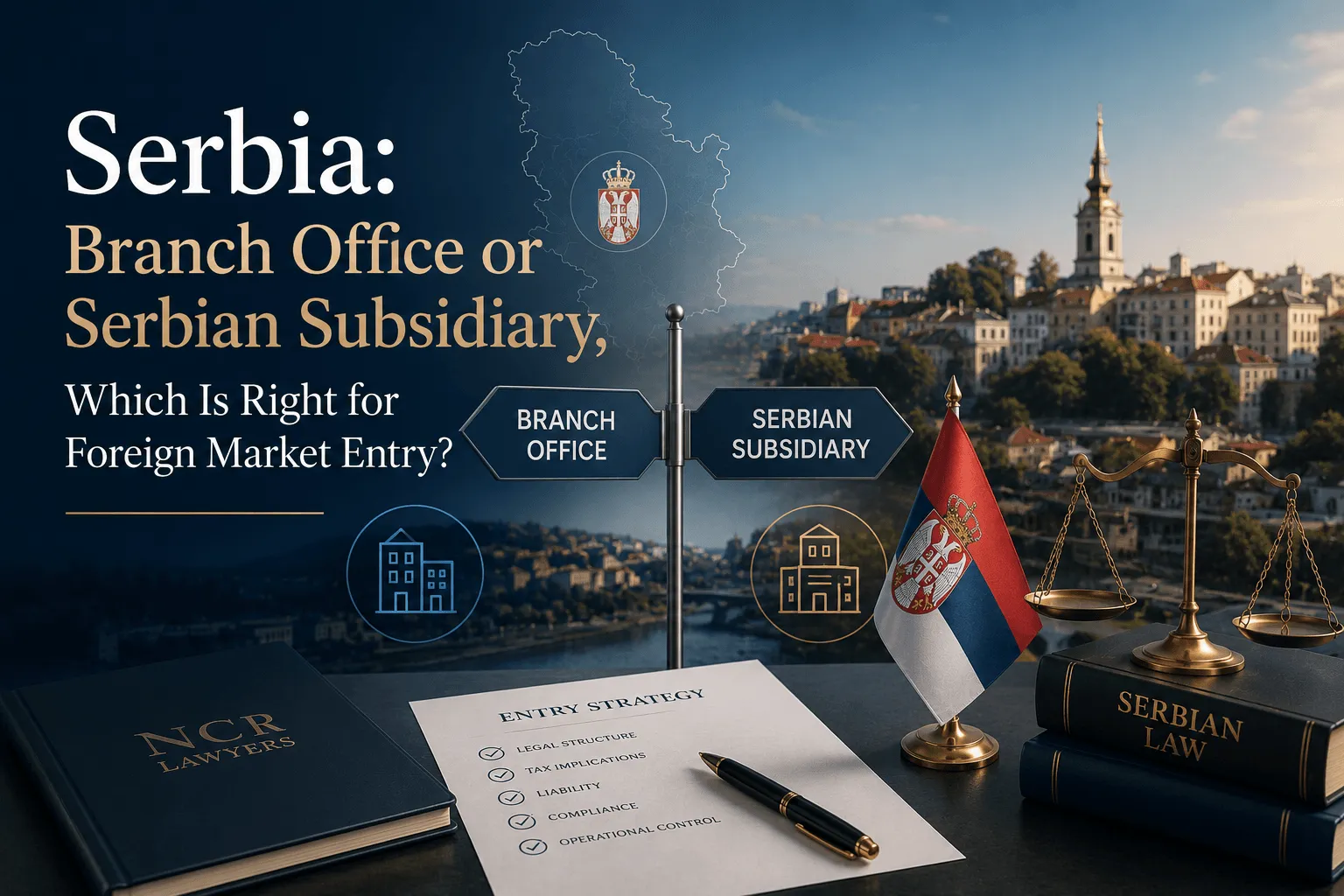
When a foreign company decides to enter the Serbian market, the very first structural question is whether to to open a Serbia branch office or incorporate a Serbian subsidiary, and the answer shapes everything from liability exposure to tax treatment. At NCR Lawyers, I advise international clients on this choice regularly, and in my experience the “right” answer depends on the intersection of risk tolerance, operational ambition, and speed-to-market. Serbia’s Company Law framework offers clear rules for both structures, but the practical consequences, governance, banking, employment, permanent-establishment risk, are where most foreign investors need the sharpest guidance.
This guide walks through each option in detail, with registration checklists, a head-to-head comparison table, and a decision flowchart I use with my own clients.
If limiting liability and building a truly independent Serbian business are priorities, a subsidiary (D.O.O.) is usually the better structure. If you need a fast local presence and want to keep centralised control through the parent company, a Serbia branch office can work, but the parent company remains fully liable for all branch obligations. Here is a quick comparison of the key differences:
| Topic | Branch (Foreign Company Branch) | Subsidiary (Serbian D.O.O.) |
|---|---|---|
| Legal status | Not a separate legal entity, extension of the parent; parent liable for all branch obligations | Separate legal entity, liability limited to subsidiary assets |
| Liability exposure | Parent company exposed to all branch liabilities | Parent liability usually limited (exceptions: guarantees, fraud, piercing the veil) |
| Governance & control | Centralised control; branch manager authorised by parent company decision | Local board/management; separate corporate governance and shareholder rights |
| Tax & residency | May create permanent establishment; taxed locally on Serbian-source profits; parent still liable internationally | Taxed as Serbian resident company (corporate income tax, VAT, payroll taxes) |
| Registration complexity | Register branch with APR; notarised parent-company documents required; typically faster for limited scope | Incorporation via APR e‑incorporation; standard process for full operations |
| Employment & permits | Serbian employment rules apply; payroll and social contributions due; foreign staff need work permits | Same employment regime; subsidiary as local employer simplifies hiring |
| When to choose | Quick market presence, centralised policies, single legal entity desirable | Limited liability needed, local contracts, local investment, or bank financing required |
Understanding these two structures starts with Serbia’s Law on Business Companies (Zakon o privrednim društvima), which is the primary statute governing all corporate forms in the country. The Serbian Business Registers Agency (APR) is the authority that processes registration for both branches and subsidiaries.
Under the Law on Business Companies, a branch (ogranak) is defined as a separate organisational unit of a foreign company through which that company carries on business activities in Serbia. Critically, a branch does not have separate legal personality. It operates under the name and on behalf of its parent, and the parent company bears full legal responsibility for all obligations arising from the branch’s activities. A representative office (predstavništvo) is a distinct and more limited concept, it can only perform preliminary and auxiliary activities such as market research and promotion, and it cannot conduct commercial transactions. In my practice, I often see clients confuse the two, which can lead to compliance issues if the wrong structure is registered.
A subsidiary is a new, independent Serbian company. The most common form chosen by foreign investors is the limited liability company, known by its Serbian abbreviation D.O.O. (društvo sa ograničenom odgovornošću). Under the Law on Business Companies, a D.O.O. is a separate legal entity from the moment of its registration with the APR. The founding member, whether a foreign individual or a foreign legal entity, can hold 100% of the equity. The shareholder’s liability is generally limited to its capital contribution, which is a fundamental advantage over the branch structure for risk management purposes.
The quick-comparison table above gives a snapshot, but for in-house counsel and corporate development teams making this decision, the detail matters. Below I break down the three dimensions that, in my experience, drive most decisions.
This is often the decisive factor. A branch office in Serbia is not a separate legal entity. Every contract the branch signs, every employee it hires, every liability it incurs, all of these fall directly on the foreign parent company. If a branch defaults on a Serbian supplier contract, the supplier can pursue the parent company’s global assets. A subsidiary, by contrast, creates a firewall. The D. O. O. is liable for its own debts up to the value of its assets. The parent’s exposure is ordinarily limited to the capital it contributed at incorporation.
There are exceptions, Serbian courts can pierce the corporate veil in cases of fraud, capital inadequacy, or abuse of the legal entity form, but in ordinary commercial operations, the subsidiary structure provides meaningful liability protection.
A branch does not have its own board, general assembly, or independent decision-making authority. The branch manager acts under a power of attorney granted by the parent company. All major decisions, and often minor ones, flow from the parent’s headquarters. This can be an advantage for companies that want tight centralised control. However, it can also create bottlenecks, particularly when Serbian counterparties or regulators need quick local approvals. A D. O. O. has its own corporate governance structure defined in its articles of association. It has at least one director (who may be a foreign national) and, depending on size, may have additional governance bodies. The shareholders’ assembly makes key decisions, and day-to-day management rests with the local director.
For companies planning substantial Serbian operations, this independence is usually more practical.
Both branches and subsidiaries are subject to Serbian corporate income tax on profits attributable to their Serbian activities. The standard corporate income tax rate in Serbia is 15%. Both structures must register with the Tax Administration of the Republic of Serbia, file annual tax returns, and comply with VAT obligations if their turnover exceeds the statutory threshold. The key difference lies in international tax planning. A branch may create a permanent establishment (PE) of the foreign parent under applicable double tax treaties and Serbian domestic law, which can complicate the parent’s home-country tax position. A subsidiary, being a separate Serbian tax resident, typically creates a cleaner separation for treaty purposes.
Withholding tax on dividends, interest, and royalties paid by a subsidiary to its foreign parent must also be considered, Serbia’s standard withholding rate is 20%, though this is frequently reduced by double tax treaties. In my view, the branch vs subsidiary tax question is one of the most underestimated aspects of the entry decision, and I always recommend that clients model both scenarios with their international tax advisers before committing.
Registering a branch of a foreign company in Serbia involves filing the required documentation with the APR. The process is administrative rather than discretionary, if the documentation is correct and complete, registration is granted.
The parent company must prepare and submit several key documents. These typically include:
Once the documentation is assembled, it is submitted to the APR. The APR processes branch registrations and, if the documentation is complete, issues a registration decision and assigns a unique registration number (matični broj) to the branch. The branch is then entered into the APR’s publicly searchable register. Typical processing time, assuming documents are in order, is a matter of days. Incomplete filings are returned with instructions for correction, which can add to the timeline.
After APR registration, the branch must open a bank account in Serbia. Serbian banks can open accounts for branches of foreign companies upon presentation of the APR registration certificate and supporting identification documentation. The branch must then register with the Tax Administration for corporate income tax purposes and, if applicable, for VAT. If the branch will employ staff locally, it must also register for payroll taxes and social contributions. In practice, I advise clients to budget two to four weeks from document preparation to a fully operational branch, though delays in obtaining apostilles or certified translations abroad often extend this timeline.
Incorporating a Serbian subsidiary is the standard route for foreign companies planning full-scale operations. Foreigners can own 100% of a Serbian D.O.O. and can incorporate remotely via power of attorney.
The founding process for a D.O.O. involves preparing and filing the following with the APR:
The APR offers e-incorporation services for D.O.O. companies, which allows the entire filing to be made electronically using a qualified electronic signature. This has significantly reduced registration times.
Once registered, the D.O.O. operates with its own governance framework. The shareholders’ assembly is the highest decision-making body. Key decisions, such as amending the articles of association, approving annual financial statements, and appointing or removing directors, require shareholder resolutions. For a wholly owned foreign subsidiary, these resolutions are typically adopted by the sole shareholder (the parent company). The director handles day-to-day management and represents the company before third parties, courts, and authorities.
If the subsidiary employs staff in Serbia, it must register as an employer with the Tax Administration and the Central Registry of Compulsory Social Insurance (CROSO). Serbian employment law applies to all employees working in Serbia, including mandatory social insurance contributions (pension, health, unemployment) calculated as a percentage of gross salary. The subsidiary, as a local employer, handles all payroll obligations directly, a practical simplification compared to the branch structure, where payroll administration is formally managed by the foreign parent.
Both branches and subsidiaries need a Serbian bank account to operate. Under National Bank of Serbia regulations, Serbian banks may open accounts in dinars and in foreign currencies for both resident entities (subsidiaries) and organisational units of foreign companies (branches). Non-resident foreign legal entities can also open bank accounts in Serbia, subject to compliance with applicable documentation and due diligence (KYC) requirements. In practice, some banks are more experienced with branch accounts than others, and I generally advise clients to consult with their legal adviser on bank selection before filing registration documents.
Both structures are subject to the same Serbian immigration framework when employing foreign nationals. Work permits are required for foreign employees, and the process involves coordination between the National Employment Service and the Ministry of Interior. Companies that plan to second or post staff from headquarters should factor permit processing times into their market-entry timeline. Work permits for foreign staff in Serbia are a separate procedural stream that I recommend addressing in parallel with entity registration to avoid delays.
| Cost item | Branch (approx.) | Subsidiary D.O.O. (approx.) |
|---|---|---|
| APR registration fee | Prescribed fee per APR schedule | Prescribed fee per APR schedule |
| Notarisation of documents (Serbia) | Varies by notary and number of documents | Varies by notary and number of documents |
| Certified translation costs | Per-page rate × number of pages | Per-page rate × number of pages |
| Apostille fees (home jurisdiction) | Depends on country of origin | Depends on country of origin |
| Legal advisory fees | Typically lower (simpler structure) | Typically higher (incorporation, articles, governance) |
| Bank account opening | No fee or modest processing fee | No fee or modest processing fee |
| Initial share capital | Not applicable | Minimum 100 RSD (EUR ~1); most clients register higher |
Exact APR fees are published on the APR website and are updated periodically. I recommend checking the current fee schedule directly on apr.gov.rs before initiating the process.
| Phase | Branch | Subsidiary D.O.O. |
|---|---|---|
| Document preparation & notarisation abroad | 1–2 weeks | 1–2 weeks |
| Certified translation | 2–5 business days | 2–5 business days |
| APR filing & registration | A few business days | A few business days (e-incorporation) |
| Tax registration | Concurrent with or shortly after APR | Concurrent with or shortly after APR |
| Bank account opening | 1–2 weeks | 1–2 weeks |
| Total estimated timeline | 2–4 weeks | 2–5 weeks |
These timelines assume that the parent company’s home-jurisdiction documents (apostilles, notarisations, extracts) are obtained promptly. Delays in foreign document preparation are the most common reason for extended registration timelines in my experience.
Scenario 1, Fast market test via branch. A mid-size European technology company wanted to test the Serbian market for IT outsourcing services. The company had no immediate plans for large-scale local hiring or asset acquisition but needed a registered Serbian presence for invoicing and banking purposes. I advised opening a branch. The parent retained full control, the branch was registered with the APR within three weeks, and the company began invoicing Serbian clients immediately. The parent accepted the liability exposure as proportionate to the limited scale of activities.
Scenario 2, Full market entry via D.O.O. A manufacturing group from a non-EU country planned to build a production facility in Serbia, hire local staff, and apply for Serbian government investment incentives. A subsidiary (D.O.O.) was the clear choice: it provided limited liability, qualified the group for Development Agency of Serbia (RAS) incentive programmes, allowed local bank financing secured against subsidiary assets, and created a clean separation for tax-treaty purposes. Incorporation took approximately four weeks, and the subsidiary began operations within six weeks of the initial filing.
After years of advising foreign companies on this decision, I have developed a simple decision framework:
When foreign investors ask me whether to set up a Serbia branch office or a Serbian subsidiary for their foreign market entry, I always start with the liability question and the business plan. The legal framework is clear, the choice is ultimately a business decision with legal consequences. For most companies planning meaningful, long-term operations in Serbia, the D.O.O. subsidiary will be the more robust and flexible vehicle. For targeted, limited-scope engagements where speed and simplicity matter most, the branch remains a practical option.
Whichever structure you choose, professional legal guidance on document preparation, APR filing, and ongoing compliance obligations is essential. I recommend consulting with a qualified corporate lawyer in Serbia before making your final decision.
This article is for informational purposes only and does not constitute legal advice. For tailored advice on your specific circumstances, please contact a listed Serbian corporate lawyer.
For specialist advice on this topic, contact Nemanja Curcic at NCR lawyers.

posted 15 minutes ago

posted 36 minutes ago
posted 58 minutes ago

posted 1 hour ago

posted 2 hours ago

posted 2 hours ago

posted 2 hours ago

posted 2 hours ago

posted 3 hours ago

posted 3 hours ago

posted 4 hours ago

posted 4 hours ago
No results available
Find the right Legal Expert for your business

Send welcome message