
Author
No results available
For a foreign company entering the Philippine market, one of the first—and most important—decisions are how to establish a presence in the Philippines.
Should you incorporate a Philippine subsidiary, or should you register a branch of the foreign company?
At first glance, the difference may seem largely corporate. In practice, however, the choice can have significant consequences for taxation, liability, profit repatriation, regulatory compliance, and day-to-day operations.
There is no one-size-fits-all answer. The better structure depends on the foreign investor’s business model, expected Philippine profits, sources of income, plans for expansion, and how the investor intends to move profits back to its home country.
This guide breaks down the key differences in practical terms.
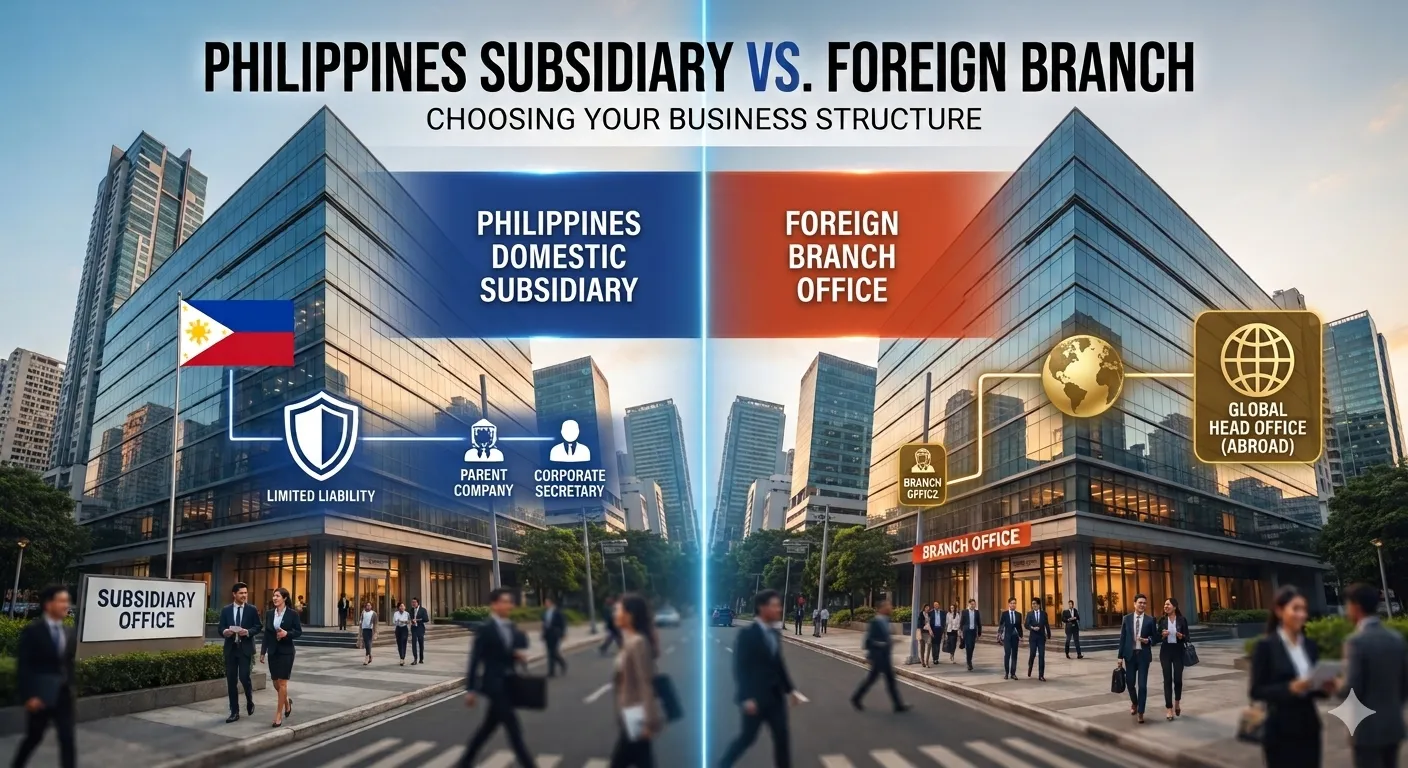
The most important distinction is simple—a Subsidiary is a new Philippine company that is legally separate from its foreign parent; a Branch is an extension of the foreign company itself and is not a separate legal entity. This basic difference affects almost everything else—from liability and taxation to governance and repatriation of profits.
|
Philippine Subsidiary |
Foreign Branch |
|
|
Legal status |
Separate Philippine corporation |
Extension of the foreign head office |
|
Liability |
Generally limited to the subsidiary |
Foreign parent remains liable |
|
Tax base |
Generally worldwide income |
Generally Philippine-source income |
|
Profit repatriation |
Dividends |
Branch profit remittance |
|
Treaty considerations |
Dividend treaty rates may apply |
Branch is generally a permanent establishment |
|
Governance |
Separate board and corporate officers |
Operates under the foreign head office |
|
Consolidation |
Separate Philippine entity |
More direct integration with head office |
|
Incentives |
May qualify, depending on activity and registration |
May qualify, depending on activity and registration |
Before looking at tax rates, it is important to understand what each structure is.
A Philippine subsidiary is a separate company it is incorporated in the Philippines under the Revised Corporation Code and registered with the Securities and Exchange Commission (SEC).
It has its own:
The subsidiary is legally distinct from its foreign parent. As a domestic corporation, it is generally treated as a Philippine tax resident and is subject to the rules applicable to domestic corporations.
On the other hand, a branch is an extension of the foreign company.
A branch, on the other hand, is not a separate legal person. It is an extension of the foreign company. It is a Philippine-registered extension of the foreign company’s head office. The foreign parent therefore remains legally responsible for the branch’s obligations.
For Philippine tax purposes, the branch is generally treated as a Resident Foreign Corporation and is taxed on income derived from Philippine sources.
A Subsidiary creates a new Philippine company. A branch brings the foreign company itself into the Philippines.
Why does this distinction matter? It becomes particularly important when considering liability, taxation, profit repatriation, and regulatory exposure.
The answer depends heavily on the investor’s business model.
A subsidiary may be attractive to companies that want:
A branch may be attractive where the foreign company wants:
The important point is that neither structure is automatically better or cheaper. The appropriate choice depends on the facts.
One of the most important differences is the Tax base.
|
Subsidiary |
Branch |
|
Generally worldwide income |
Generally Philippine-source income |
|
A Philippine domestic corporation is generally taxable on income from all sources, both within and outside the Philippines. |
A Philippine branch of a foreign corporation is generally taxed only on income derived from sources within the Philippines. |
| This means that a subsidiary’s tax position can be materially different from a branch’s where the foreign group has significant foreign-source income.
|
|
This creates a fundamental distinction:
A subsidiary generally has a worldwide tax base, while a branch generally has a Philippine-source tax base.
For businesses with substantial foreign-source income, this difference should be modelled before choosing a structure.
For many foreign investors, this is one of the most important practical questions:
Once the Philippine business earns money, how much can be sent back to the foreign parent?
The answer depends on whether the investor operates through a subsidiary or a branch.
A Philippine subsidiary distributes profits to its foreign parent through dividends. The dividend is generally subject to Philippine withholding tax, although an applicable tax treaty may provide for a reduced rate if the relevant requirements are satisfied. Therefore, the investor should look at the Combined Tax Cost:
Corporate income tax + dividend withholding tax = overall cost of extracting profits
A branch does not declare dividends because it is not a separate corporation. Instead, it may remit its profits to its foreign head office. Such remittances are subject to the Branch Profit Remittance Tax under the applicable Philippine tax rules. This means the investor should not simply compare corporate income tax rates. It should compare the total after-tax amount that ultimately reaches the foreign parent.
Tax treaties can significantly affect the analysis.
For example, a tax treaty may reduce the Philippine withholding tax imposed on certain payments such as:
However, treaty benefits are not automatic. The foreign recipient generally needs to establish its residence in the treaty country and satisfy the applicable Philippine documentation and procedural requirements.
A branch is generally considered a Permanent Establishment (PE) of the foreign enterprise.
This matters because business profits attributable to the Philippine PE may be taxed in the Philippines under the applicable treaty rules.
A subsidiary, by contrast, is itself a Philippine corporation. However, simply operating through a subsidiary does not automatically eliminate PE concerns for the foreign parent. Depending on how the parent conducts business in the Philippines, separate PE issues may still arise.
Thus, both the corporate structure and the actual way the business operates both matter for treaty analysis.
The choice between a subsidiary and a branch generally does not eliminate the need to deal with Philippine indirect taxes.
Both structures may be required to register for VAT if they engage in taxable activities and meet the applicable registration requirements.
Both may also:
In practice, proper documentation is critical. In particular, inadequate substantiation of input VAT can become an issue during a BIR audit.
Both structures have significant compliance requirements, but the nature of those requirements differs.
Branches face an additional practical issue: they must be able to explain which income and expenses properly belong to the Philippine operation.
Subsidiaries, meanwhile, must properly document transactions with their foreign parent, including services, financing, royalties, and purchases.
Before choosing between a subsidiary and a branch, investors should also consider whether the proposed business is subject to:
The Foreign Investments Act and applicable foreign investment restrictions may affect how the business can be structured and operated in the Philippines.
This is particularly important for regulated industries.
A structure that works for a consulting company, for example, may not work in exactly the same way for a business engaged in a regulated or foreign-restricted activity.
From a labor and payroll perspective, there is generally no shortcut simply because a foreign investor chooses one structure over the other.
If the Philippine operation employs personnel, it will generally need to comply with applicable requirements involving:
The subsidiary-versus-branch decision therefore does not, by itself, eliminate the employer’s Philippine labor and payroll obligations.
Choosing between a Philippine subsidiary and a foreign branch is more than a registration decision. It can affect the foreign investor’s tax exposure, liability, cash flow, compliance costs, and ability to repatriate profits for years to come.
A few hours of structured planning before registration can prevent years of unnecessary tax and restructuring costs.
For foreign investors, the best structure is not necessarily the one with the lowest headline tax rate—it is the one that best fits the business as a whole.

posted 4 minutes ago

posted 20 minutes ago

posted 20 minutes ago

posted 20 minutes ago

posted 21 minutes ago

posted 21 minutes ago

posted 21 minutes ago

posted 41 minutes ago

posted 59 minutes ago

posted 1 hour ago

posted 1 hour ago

posted 1 hour ago
No results available
Find the right Legal Expert for your business

Send welcome message