
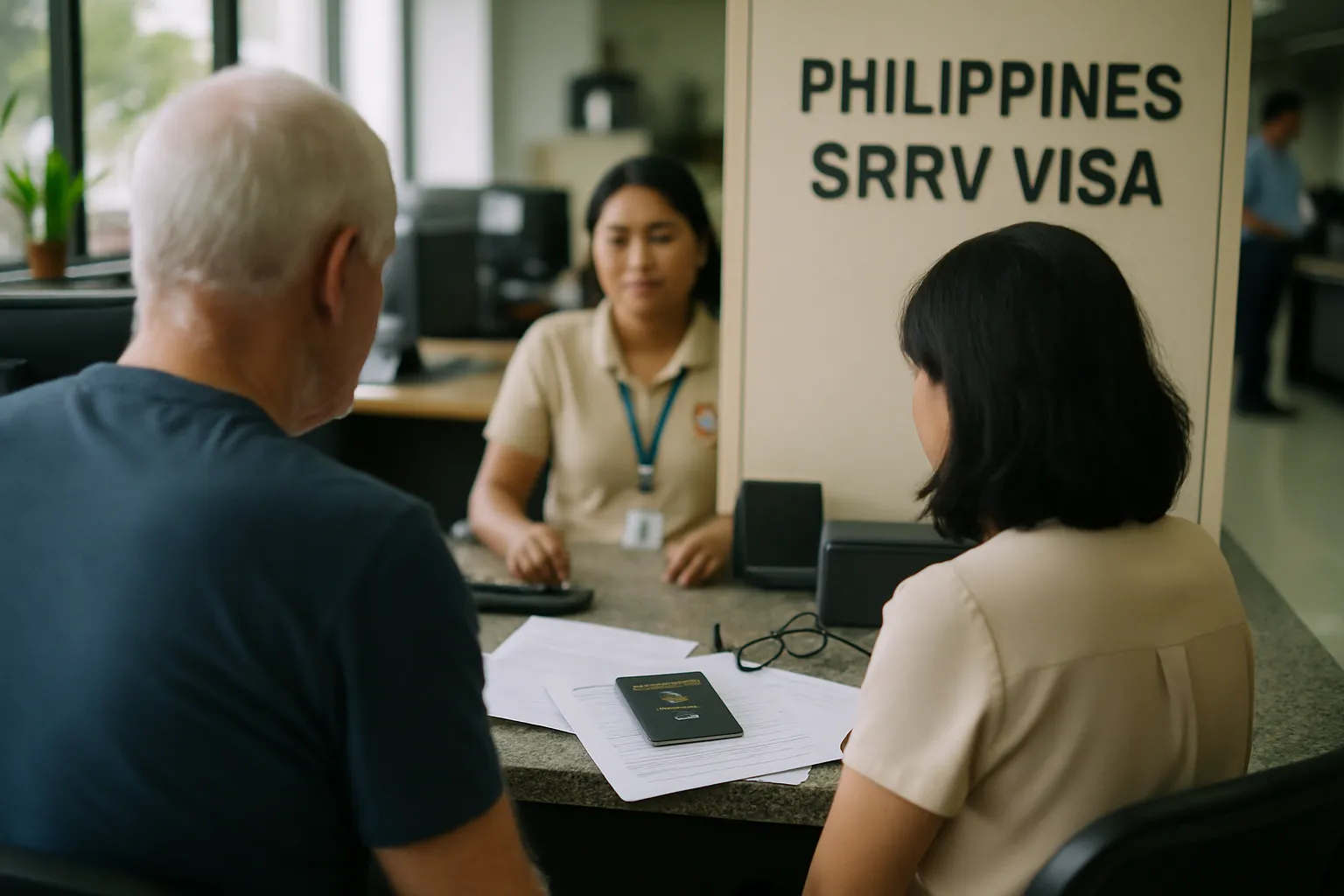

The Philippines SRRV visa, formally the Special Resident Retiree’s Visa administered by the Philippine Retirement Authority (PRA), is one of Southeast Asia’s most flexible long-term residence programmes, granting qualified foreign nationals and former Filipinos an indefinite, multiple-entry right to live in the Philippines in exchange for a locked deposit or qualifying investment. This guide reflects the 2026 policy environment, in which the PRA has revisited eligibility age bands, adjusted deposit tiers and refreshed its guidance on courtesy visas and allowable activities such as study, investment and permitted employment.
This page is written for active retirees, investors, early-retirees exploring residency in their forties, and families who want a clear, source-anchored explanation of the special resident retiree’s visa. You will find at-a-glance facts, deposit and refund analysis, a step-by-step application process, dependant rules and a comparison with other residency routes. Where PRA guidance continues to evolve, we flag the point and direct you to confirm with the regulator. Nothing here is legal advice; applicants should validate figures and procedures against current PRA circulars and Bureau of Immigration guidance before committing funds.
The Philippines SRRV visa appeals precisely because it converts a one-time financial commitment into an open-ended right of residence, avoiding the cyclical renewals of tourist extensions and short-term visas. Below are the principal advantages that draw applicants toward the special resident retiree’s visa rather than piecemeal immigration alternatives.
The srrv benefits philippines retirees value most are stability and simplicity: one deposit, one approval, and a resident status that does not expire so long as compliance obligations and the deposit condition are maintained.
The programme suits several distinct profiles. Active retirees with pension income can access lower deposit tiers where a monthly pension is demonstrable. Investors value the ability to channel a deposit into permitted property or business exposure. Families benefit from consolidated inclusion of spouse and children. And under the 2026 tier structure, early-retirees aged 40–49, a group increasingly interested in the Philippines SRRV visa, may find a route that previously felt restricted to older applicants. Each profile carries different deposit and documentary consequences, so matching subtype to circumstances is the first strategic decision.
Understanding the srrv requirements philippines authorities impose is essential before committing funds. Eligibility turns on age band, health and character clearances, and the correct documentary pack, with certain subtypes carrying special conditions. The following breakdown reflects the structure published on the PRA programme page; confirm current thresholds against PRA circulars, as 2026 guidance has adjusted several parameters.
The SRRV umbrella includes distinct products. The SRRV Smile option typically requires a straightforward locked deposit with no active-investment conversion, aimed at healthy retirees seeking simplicity. The SRRV Courtesy variant applies to specific categories, for example former Filipinos and certain retired foreign government or international-organisation personnel, often with reduced or nominal deposit requirements. Applicants of Filipino descent, or former Filipino citizens, should examine whether reacquisition of citizenship might serve them better than an SRRV; the two routes solve different problems. Because the qualifying conditions for special categories are precise, applicants should confirm eligibility directly against PRA documentation.
Documents issued outside the Philippines commonly require apostille under the Apostille Convention, or consular legalisation where the issuing state is not a party. Overseas applicants should coordinate legalisation through the appropriate Philippine Embassy or consulate before submission, as improperly authenticated documents are a leading cause of delay.
The deposit is the financial heart of the Philippines SRRV visa, and the philippines retirement visa deposit you must place depends on your age band, chosen subtype and whether you can demonstrate a qualifying pension. This section explains the tier logic, how the deposit may be used, the rules on refund, and the recurring PRA charges, all of which should be verified against current PRA circulars because the 2026 update revised several tiers.
Deposits historically run from a nominal figure for pensioner and courtesy categories up to a higher locked amount for younger, non-pensioner applicants. As a general framework, pensioner applicants meeting the minimum monthly pension can qualify with a substantially lower deposit than non-pensioners, and courtesy categories may face only a nominal or waived deposit. The 2026 guidance published via the PRA press updates addresses revised deposit tiers and expanded age eligibility; where a specific figure is material to your planning, confirm it in writing with the PRA rather than relying on secondary summaries.
The required sum is generally placed as a time-locked deposit with an accredited bank, held to the order of the PRA as a condition of the visa. Under certain subtypes and after a qualifying holding period, the deposit may be converted into an approved active investment, most commonly the purchase of a condominium unit or a long-term lease of real property, subject to Philippine constitutional limits on foreign land ownership and to PRA approval. Practical considerations include exchange-rate exposure on the inward remittance, the choice of accredited bank, and the documentary trail proving the funds originated abroad. Applicants should treat the deposit as illiquid for the life of the visa unless and until a permitted conversion is formally approved.
The deposit is, in principle, refundable upon cancellation or surrender of the SRRV, provided all conditions are satisfied and any outstanding obligations are cleared. Refund typically follows PRA endorsement and coordination with the holding bank, and applicants should anticipate a processing period rather than an instant release. Where the deposit was converted into an investment such as property, the “refund” is effectively the liquidation or retention of that asset rather than a cash return of the original sum. Because refund mechanics, conditions and timelines are governed by PRA policy and the relevant board resolutions, applicants should confirm the exact procedure and any deductions with the PRA before surrendering the visa.
Beyond the deposit, the programme carries a recurring PRA annual fee that covers the principal applicant and a defined number of dependants, with an additional charge for each dependant beyond that number. There are also one-time application and processing charges at the outset. These figures are set by the PRA and adjusted from time to time; the current schedule should be taken from the PRA programme page at the point of application.
| Category | Minimum deposit (USD) | Refundable? | Allowed activities | Notes |
|---|---|---|---|---|
| SRRV Smile (deposit-only) | Around US$20,000 (confirm with PRA) | Yes, on cancellation subject to conditions | Residency; study; permitted activities under 2026 guidance | Deposit remains locked; no conversion to investment |
| Pensioner (with qualifying pension) | From ~US$10,000 (confirm with PRA) | Yes, subject to conditions | Residency; investment conversion available on some subtypes | Requires proof of minimum monthly pension |
| Non-pensioner (higher tier) | Up to ~US$50,000 (confirm with PRA) | Yes, subject to conditions | Residency; permitted investment conversion after holding period | Deposit convertible to approved property/lease |
| SRRV Courtesy | Nominal or reduced (e.g. ~US$1,500) | Per category rules, confirm with PRA | Residency | Former Filipinos, retired diplomats/officials and similar categories |
2026 PRA change: Deposit tiers and age eligibility were revised in the 2026 guidance cycle. The figures above are indicative ranges; treat any material number as provisional until confirmed against the current PRA circular or press release. For a fuller breakdown, see our planned deep dive on SRRV deposit tiers & refund rules.
The philippines srrv visa application process is sequential and document-driven. Below is a practical walkthrough of the steps most applicants follow, from confirming eligibility to lawful entry and ongoing compliance. Each step should be cross-checked against current PRA forms and Bureau of Immigration procedures, as details are periodically updated.
Subnotes for overseas applicants: send original documents only where the PRA specifically requires them, and otherwise retain originals while submitting apostilled or consularised copies. Documents executed abroad may need consular attestation through the relevant Philippine Embassy. Building in time for legalisation and remittance clearance is the single most effective way to keep the Philippines SRRV visa application on schedule.
Applicants frequently ask how quickly the Philippines SRRV visa can be secured and what they may lawfully do once resident. The answers depend on document readiness, the chosen subtype and PRA workload.
With a complete pack and the deposit already placed, initial validation and approval commonly proceed within a few weeks, followed by Bureau of Immigration stamping. Cases referred for board consideration, or those with documentary gaps, take longer. Overseas legalisation of documents is usually the biggest variable in the overall timeline.
An srrv courtesy visa arrangement allows certain applicants to enter or remain while formalities conclude, or applies to specific categories eligible for reduced deposit terms. Its purpose, requirements and duration are governed by PRA guidance; applicants relying on a courtesy entry should confirm the precise conditions and any limits with the PRA and the Bureau of Immigration before travel.
2026 PRA change: updated guidance addresses allowable activities including study, and, in defined circumstances, investment or permitted employment. The scope of paid work available to SRRV holders is nuanced and category-dependent, so applicants should treat this as an area to confirm directly with the PRA and the Bureau of Immigration rather than assuming an unrestricted right to work.
A major attraction of the special resident retiree’s visa is that it can cover a household. Understanding who qualifies and how inclusion affects cost is essential for families planning a move together.
The principal applicant may generally include a legally married spouse and unmarried children below the applicable age limit. Some categories and circumstances allow inclusion of dependent parents. Each dependant must satisfy identity, health and clearance requirements in their own right, and relationships must be evidenced by apostilled civil documents.
The base PRA annual fee typically covers the principal plus a set number of dependants, with an additional annual charge for each dependant beyond that allowance. Additional dependants may also trigger an increment to the required deposit. Families should model these incremental costs early; our forthcoming guide on including dependants on an SRRV will address documentation and fee implications in detail.
Dependants generally reside lawfully under the principal’s status, but the ability to work or study may require separate permissions or confirmation from the relevant authorities. Families intending for a spouse to work, or for children to enrol in Philippine institutions, should verify the applicable rules with the PRA and Bureau of Immigration.
Where an applicant already holds Philippine property or intends to invest, the interaction with deposit and conversion rules can be advantageous but is subject to constitutional limits on foreign land ownership and to PRA conditions. Such applicants should obtain a tailored review before relying on any conversion of the deposit into local assets.
Choosing between the Philippines SRRV visa and alternative pathways depends on age, income source, work intentions and Filipino heritage. The table below summarises the practical trade-offs.
| Route | Who it suits | Key benefits | Deposit/financial requirement | Processing time | Convertibility |
|---|---|---|---|---|---|
| SRRV | Retirees, pensioners, investors, some early-retirees | Indefinite multi-entry residency; family inclusion | Deposit tier from nominal to ~US$50,000 | Weeks (subject to documents) | Deposit convertible to investment on some subtypes |
| Permanent residency | Those with qualifying local ties | Long-term status without deposit | No SRRV-style deposit; other criteria apply | Longer, criteria-dependent | Limited |
| Temporary work visa | Employed professionals | Right to work with a sponsor | Employer-sponsored; no retiree deposit | Varies with employer petition | Tied to employment |
| Dual citizenship (reacquisition) | Former Filipinos and their descendants | Full citizen rights; no deposit | None (fees only) | Relatively fast for eligible applicants | Not applicable, full citizenship |
Takeaways: the SRRV is preferable for foreign retirees and investors who want simple, indefinite residency without employment sponsorship. Former Filipinos should first consider citizenship reacquisition, which delivers stronger rights without a deposit. Those relocating for a job are better served by a work visa. See our planned comparison of Philippines residency routes for a fuller legal analysis.
Even a straightforward Philippines SRRV visa application can stall over avoidable errors. The following observations reflect recurring issues seen in practice.
Ongoing obligations include payment of the recurring PRA annual fee, notification of changes such as address or passport renewal, and attention to tax residency, which may arise from prolonged physical presence. Because tax and healthcare implications sit outside the visa itself, retirees should seek separate advice on those matters.
Use current official PRA forms, track the PRA’s board schedule where a resolution is likely, prepare document legalisation well ahead of remittance, and retain originals securely. Front-loading document quality is consistently the fastest route to approval and the surest way to avoid disputes.
The Philippines SRRV visa remains a compelling, source-anchored route to indefinite residency, and the 2026 PRA updates broaden its appeal to younger retirees while refreshing deposit and activity rules. Practical next steps are to confirm your subtype and current deposit tier against PRA guidance, assemble and legalise your documentary pack, and plan the deposit remittance. Applicants should verify evolving figures with the PRA and Bureau of Immigration and, where appropriate, engage validated local counsel to steer the application. For deeper detail, consult our planned cluster pages on deposit tiers, the application checklist and dependant inclusion.
For more Upto-date Legals News Follow us @Global Law Experts News

posted 40 minutes ago
posted 1 hour ago

posted 2 hours ago

posted 2 hours ago

posted 2 hours ago

posted 2 hours ago

posted 2 hours ago

posted 2 hours ago

posted 2 hours ago

posted 2 hours ago
posted 2 hours ago

posted 2 hours ago
No results available
Find the right Legal Expert for your business

Send welcome message