
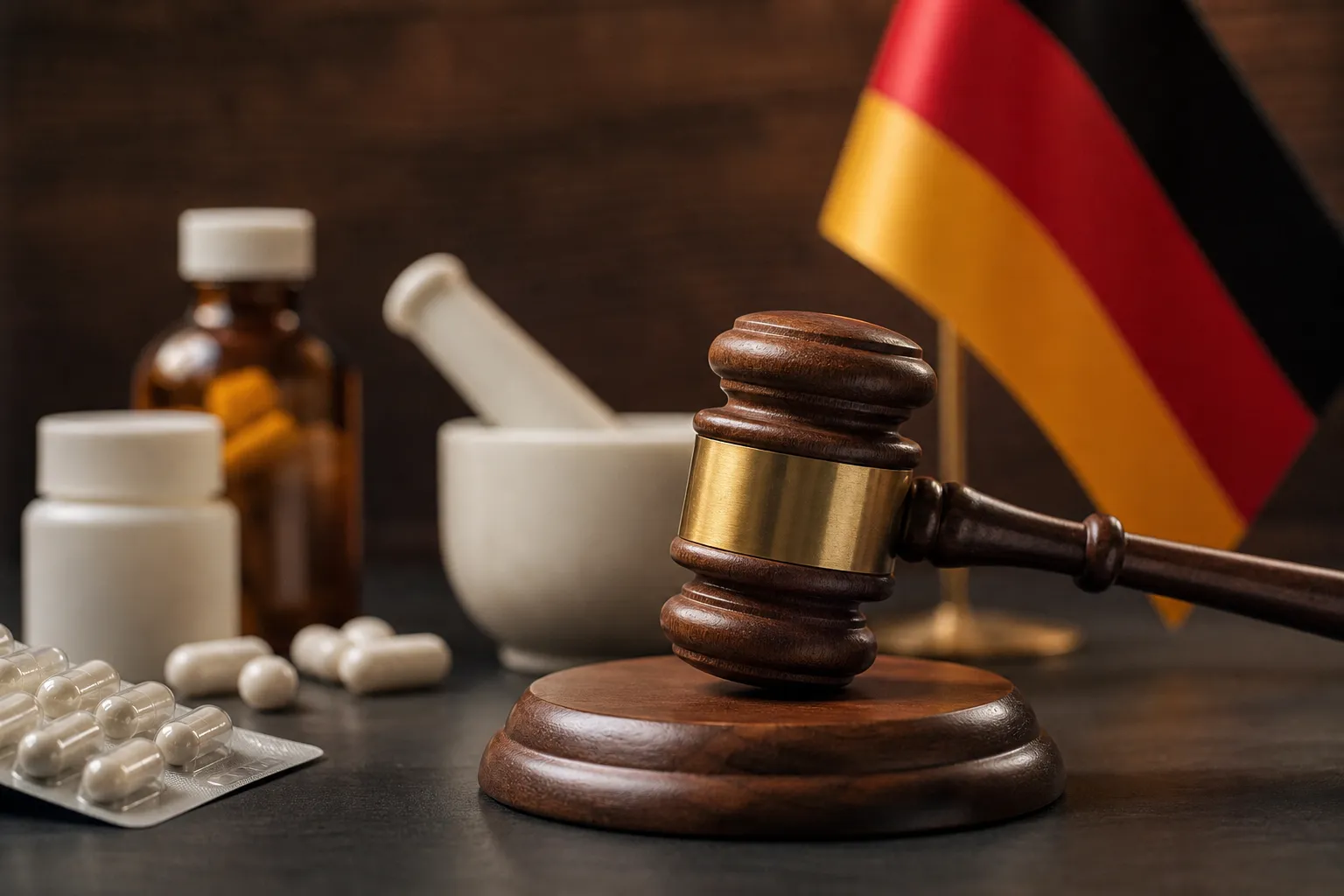
Who this is for: in-house counsel, generic and biosimilar entrants, IP managers, and patent litigators who need to challenge or defend a pharmaceutical patent from Germany. What it delivers: step-by-step filing guidance for European Patent Office (EPO) opposition and German nullity actions, deadlines, evidence handling for biologicals, cost estimates, and a strategic decision framework for 2026.
Pharmaceutical patent opposition germany is the practical starting point for any competitor seeking to clear a blocking patent, secure freedom to operate, or accelerate market entry ahead of a rival’s exclusivity. The core rule to fix in the diary immediately: an EPO opposition must be filed within nine months of the mention of grant, while a German nullity action before the Federal Patent Court (Bundespatentgericht) can be lodged after grant, subject to the procedural rules of the German Patent Act. In 2026, sharpened commercial pressure, driven by ongoing German drug pricing and reimbursement reform, has increased the incentive for generic and biosimilar entrants to challenge secondary patents earlier and more aggressively.
This guide sets out both routes, the evidence you must assemble, realistic timelines and costs, and how to choose between the EPO, the Bundespatentgericht and the Unified Patent Court (UPC). It is general information, not legal advice; obtain tailored counsel before acting.
The decision to launch a pharmaceutical patent opposition germany strategy is rarely academic. It is driven by a commercial objective: to remove a legal obstacle standing between your product and the market. The most common triggers are securing freedom to operate (FTO) before committing to launch, clearing a blocking patent asserted against you, or invalidating a secondary patent, a formulation, dosage regimen, salt, polymorph or second-medical-use claim, that extends protection beyond the expiry of the original compound patent.
Secondary patents are where the majority of pharmaceutical disputes now play out. Originators layer them around a molecule to create a protective thicket, and each layer is a potential target for revocation. A well-timed challenge can shift a launch date forward by months or years, which in a high-volume therapeutic area translates directly into revenue.
Supplementary Protection Certificates (SPCs) and regulatory exclusivities also shape the timing calculus. An SPC can extend the effective monopoly of the underlying patent for a limited additional period as set by the SPC Regulation, and data or market exclusivity can independently delay a generic. These are separate rights that follow their own revocation procedures, but they interact closely with any patent attack, attacking the base patent may indirectly weaken a dependent SPC. Map the full exclusivity landscape before committing resources; the interplay between patent, SPC and regulatory protection often determines whether a challenge is worth mounting at all.
One of the attractions of the EPO route is that any person may file an opposition against a granted European patent under Article 99 of the European Patent Convention (EPC). There is no requirement to demonstrate a commercial interest or standing. This permits the use of a strawman opponent, a filing made in the name of a professional representative or a shell entity, where a challenger wishes to keep its identity confidential. That said, the EPO scrutinises abuse of the strawman device, so the arrangement must be structured carefully.
German nullity actions (Nichtigkeitsklage) before the Bundespatentgericht (BPatG) are similarly open: any person may bring an action for revocation of a German patent or the German part of a European patent, without a formal standing requirement. The action is directed to the court and, if successful, revokes or limits the patent with effect for Germany.
The critical distinction lies in remedies and geographic scope. An EPO opposition affects the European patent centrally, revocation removes the patent in all designated states at once, and maintenance in amended form binds every national part. A German nullity action affects only the German designation, but it delivers a directly enforceable national outcome and sits alongside the German infringement courts that can grant or lift injunctions. Choose the forum according to whether you need broad central relief or focused national enforcement leverage.
There are two parallel pathways, and they are not mutually exclusive. The EPO opposition delivers central revocation of the European patent; the German nullity action delivers enforceable national relief. Many pharmaceutical challengers run both, or stage them, to preserve options and maximise pressure. The steps below set out each pathway in sequence, with tactical notes specific to pharmaceutical and biological subject matter.
Running both routes can maximise coverage and preserve options, but it introduces coordination and timing constraints. Two points demand attention:
The evidence strategy underpins both routes and, for pharmaceuticals, is often the decisive factor, it is addressed in its own section below.
| Step / Milestone | Who (lead) | Typical duration (estimate) |
|---|---|---|
| EPO opposition: pre-filing search and opinion | Opponent counsel + technical experts | 1–6 weeks |
| EPO opposition: prepare and file opposition notice | Opponent counsel | 1–4 weeks (file before the 9-month deadline) |
| EPO opposition: written proceedings (first exchange) | Opponent and patentee counsel | 3–12 months |
| EPO opposition: oral proceedings (if any) | Opposition Division / Boards of Appeal / parties | 18–36 months total case length |
| German nullity: prepare and file nullity action | German litigation counsel | 2–4 weeks |
| German nullity: first instance (Bundespatentgericht) | Parties and BPatG | 12–36 months |
| Parallel strategy coordination and enforcement | Coordinating counsel across jurisdictions | Ongoing, align with commercialisation timeline |
The strength of a pharmaceutical patent opposition germany filing lives or dies on the quality of its evidence. Assemble the file methodically: procedural documents to open the case, prior-art documents to substantiate the grounds, and technical evidence to prove the point. The table below sets out the core items, their purpose and the practical handling notes.
| Document | Purpose | Notes |
|---|---|---|
| Copy of the granted European patent (EP) and family members | Identify the claims to oppose | Use the published specification or an EPO register printout |
| Opposition notice / nullity action | Procedural filing | Follow the EPO form and the relevant national procedural rules |
| Prior-art documents (journals, patents, conference abstracts) | Substantiate novelty / inventive-step grounds | Provide originals and translations where necessary |
| Expert declarations / technical reports | Support insufficiency and technical assertions | Use qualified experts with CVs attached |
| Experimental replication reports / lab notes | Evidence of insufficiency or lack of reproducibility | Chain-of-custody and sworn statements recommended |
| Regulatory documents (MAA, SPC, clinical trial reports) | Corroborate public availability / state of the art | Redact confidential information; provide certified translations |
| Sequence listings / biological deposit certificates | Support sufficiency and characterisation of biologics | Include deposit numbers and dates |
| Translations of non-English/German documents | Procedural admissibility | Provide translations of key documents; certification may be required |
| Power of attorney / representation documents | Establish counsel’s authority | EPO and BPatG have different formalities |
| Witness statements / declarations (if applicable) | Corroborative factual evidence | Observe local rules on admissibility |
Biologicals raise evidence problems that small-molecule cases rarely encounter. Sufficiency of disclosure is often the battleground: whether the specification enables a skilled team to make and use the full breadth of the claimed antibody, cell line or fusion protein, or whether it leaves an undue burden of experimentation. Expect the tribunal to lean heavily on common general knowledge and on expert testimony to bridge gaps in the written description.
Three practical issues recur. First, judges and technical members frequently need a tutorial on the underlying biology, prepare clear, well-structured expert reports that teach as well as argue. Second, the most probative evidence often sits inside regulatory dossiers (marketing authorisation applications, clinical trial reports) that are commercially sensitive. Third, sequence listings, cell-line characterisation and manufacturing data must be presented in an admissible form. The tactical answer is a confidentiality protocol combined with redacted regulator submissions and anonymised expert reports, so that the substance is before the tribunal without exposing confidential business information.
The single most important deadline is the EPO opposition period. Under Article 99(1) EPC, an opposition may be filed within nine months of the publication of the mention of grant in the European Patent Bulletin. Miss it and the central opposition route closes permanently, the only remaining avenues are national revocation actions. Diarise the grant date the moment it appears, and build in a comfortable buffer for evidence assembly, translations and internal sign-off.
German nullity actions carry no equivalent short cut-off, but they are subject to an important sequencing rule: a Nichtigkeitsklage against the German part of a European patent generally cannot be brought while EPO opposition proceedings are pending or while the opposition period is still running. Once that constraint falls away, timing is driven by commercial rather than statutory factors: preliminary injunction windows, the progress of parallel infringement proceedings, and the commercialisation timeline of your product all press on when the action should be started. In practice, urgency, not a fixed deadline, dictates the timing of a national challenge.
For the interaction of these windows across both routes, refer back to Table 1, which sets out the practical duration of each phase.
Pharmaceutical challenges are among the most expensive patent disputes because of the technical complexity and the reliance on experiments and expert evidence. Budget realistically and stage your spend. The figures below are indicative ranges in euros; verify the official EPO, DPMA and Bundespatentgericht fee schedules at the point of filing, as they are periodically revised.
| Cost item | Low estimate (EUR) | High estimate (EUR) | Notes |
|---|---|---|---|
| EPO opposition official fee | As set by the current EPO fee schedule | Flat fee, verify the current EPO schedule at filing | |
| Opponent external counsel (preparation and filing) | 5,000 | 25,000+ | Depends on complexity and expert use |
| Technical experts / lab replication | 10,000 | 100,000+ | Biologicals and in-lab replication are costly |
| Oral proceedings representation | 5,000 | 40,000+ | Preparation, hearing attendance, expert attendance |
| German nullity filing and litigation (first instance) | 20,000 | 200,000+ | Court fees are value-based; complex pharma often at the upper range |
| Appeal fees and higher court representation | 10,000 | 150,000+ | For BGH and cross-border appeals |
| Total budget (typical pharma case) | 50,000 | 500,000+ | Varies by scope, evidence and parallel actions |
Note that German court fees and statutory lawyers’ fees in nullity and infringement proceedings are calculated by reference to the value in dispute (Streitwert), which can be substantial in pharmaceutical cases. The losing party generally bears a proportion of the winning party’s statutory costs. Fund the exposure sensibly: options include third-party litigation funding, conditional fee arrangements where permitted, after-the-event insurance, and portfolio-level budgeting across a group of related challenges. The most cost-disciplined approach is staged spend: commission a limited prior-art search and a written opinion first, use it to triage the case, and escalate to full evidence-gathering and filing only where the merits justify it.
The 2026 backdrop matters for strategy. Legislative measures aimed at stabilising the finances of the statutory health insurance system, with implications for drug pricing and reimbursement, have been under active discussion in Germany, and tighter reimbursement economics tend to reward those who reach the market first. That dynamic sharpens the incentive to clear blocking and secondary patents earlier. Verify the status and content of any specific reform before relying on it, as legislative measures may still be in the parliamentary process.
On the procedural side, check the EPO’s and the Bundespatentgericht’s current practice notices before filing, as electronic-filing requirements and case-management practice are periodically updated. The Unified Patent Court, operational since 1 June 2023, continues to develop its case law on revocation and injunctions, which increasingly influences forum choice. Confirm live fee figures and any procedural amendments at the point of filing rather than relying on historical guidance.
Choosing the forum is the most consequential tactical decision in any pharmaceutical patent opposition germany campaign. The three routes differ in scope, speed, remedy and cost. The table below compares them; the guidance that follows explains when each is the right instrument.
| Feature | EPO Opposition | German Nullity (Bundespatentgericht) | UPC (where applicable) |
|---|---|---|---|
| Jurisdictional scope | Central, post-grant (the European patent) | National (Germany only) | Unitary patents and non-opted-out European patents across UPC contracting states |
| Deadline to file | 9 months from mention of grant | Post-grant, subject to no pending EPO opposition | Central revocation action available during the patent term |
| Remedies | Revocation or maintenance in amended form (affects the EP) | Revocation or limitation in Germany, directly enforceable | Revocation across UPC contracting states |
| Speed | 18–36 months typical | 12–36 months | Aims for relatively rapid resolution; injunctions can be swift |
| Cost | Moderate to high (technical experts) | Potentially higher (litigation intensive) | High, broad geographic relief |
| Tactical use-case | Clearing claims centrally at controlled cost | Urgent national enforcement; injunction risk in Germany | Wide, central revocation where coverage aligns |
In practice the decision flow is straightforward. Choose the EPO opposition where the objective is central revocation of the European patent at a controlled cost and within the nine-month window. Choose the German nullity action where immediate national enforcement matters or where you face injunction risk in Germany and need a national revocation to defend your launch. Consider the UPC where the patent carries unitary effect or is a European patent that has not been opted out, and where broad, central relief across contracting states fits your commercial geography, and take specialist UPC advice before committing, because the transitional rules and opt-out mechanics require careful handling.
Use the following quick checklist as the backbone of any pharmaceutical patent opposition germany project:
A disciplined pharmaceutical patent opposition germany strategy comes down to a handful of decisions taken early and executed precisely: fix the nine-month EPO deadline in the diary, decide whether central revocation, national enforcement leverage, or both best serve your commercial objective, invest in high-quality expert and experimental evidence for biologicals, and coordinate parallel filings so they reinforce rather than undermine each other. The 2026 pricing environment has raised the commercial stakes, and the challengers who prepare their evidence and forum choice methodically will be best placed to clear obstacles and reach the market first. For a tailored case triage on a specific patent, contact us through the Global Law Experts pharmaceutical practice to plan your next step.
This article is for general information only and does not constitute legal advice.
Further reading and related services: Pharmaceutical lawyers Germany (practice & contact), Intellectual property lawyer Germany (hiring & fees guide), and the author profile at Dr. Anke Krebs, author profile & contact.
This article was produced by Global Law Experts. For specialist advice on this topic, contact Anke Krebs at dompatent, a member of the Global Law Experts network.
posted 5 minutes ago
posted 22 minutes ago
posted 23 minutes ago
posted 23 minutes ago
posted 23 minutes ago
posted 23 minutes ago
posted 24 minutes ago
posted 24 minutes ago
posted 24 minutes ago
posted 24 minutes ago
posted 24 minutes ago
posted 24 minutes ago
No results available
Find the right Legal Expert for your business

Send welcome message