

New maritime laws india are reshaping how shipowners, charterers, ports and insurers manage risk in one of the world’s fastest-growing shipping markets, and 2026 marks a pivotal year for compliance planning. The reforms touch arbitration and dispute resolution, the presence of foreign legal practices, admiralty procedure, and the digital evidence expectations that flow through cargo claims. For in-house counsel, P&I correspondents and chartering teams, the practical question is not merely what changed, but how those changes alter contract clauses, arrest strategy and forum selection in live disputes. This practitioner guide translates the 2026 landscape into concrete actions, redlines and checklists you can apply immediately.
Who this is for: in-house counsel, P&I clubs, charterers, ports, terminals and insurers seeking a practical summary of India’s maritime law developments relevant in 2026 and the immediate contract and dispute-response steps that follow. If you draft charterparties, notify claims, or decide where to litigate, this guide is written for you.
The current reform themes cluster around three practical areas for shipping businesses. Below is the quick take, followed by a staged action plan for the first 90 days.
Your 30/60/90 day plan:
This guide is written for practitioners and reflects contributed drafting tips and litigation strategy. Clause redlines and forum-selection guidance are practical starting points, not a substitute for advice on a specific matter.
To understand the new maritime laws india in 2026, it helps to separate what is settled from what remains at the proposal stage. India’s maritime legal framework has long rested on a combination of the Merchant Shipping Act, 1958; the Admiralty (Jurisdiction and Settlement of Maritime Claims) Act, 2017; the Arbitration and Conciliation Act, 1996; and a layer of regulatory circulars issued by the Directorate General of Shipping (DGS). Recent changes sit on top of that architecture rather than replacing it. Where legislative text has been formally notified, it carries immediate legal effect; where a measure is still a proposal, its status must be checked against the Gazette of India before you rely on it.
Shipping businesses should track each instrument through its lifecycle: introduction, passage, and notification in the official Gazette. A measure that has been introduced or debated does not bind anyone until it is enacted and notified. The practical rule for compliance teams is straightforward, verify each provision against the primary source before amending contracts or altering claims procedures. Where a provision is described here as prospective, treat it as “if enacted” and confirm the position on the Ministry of Ports, Shipping and Waterways portal or the eGazette before acting.
The reforms most relevant to shipping businesses fall into four categories. First, arbitration and dispute-resolution reform: measures intended to clarify how maritime arbitration operates, how foreign-seated awards are recognised and enforced in India, and how interim relief interacts with domestic court powers. Second, legal-services regulation: developments concerning the registration and limited practice of foreign law firms, which bear directly on how international shipping clients assemble counsel teams. Third, admiralty and arrest procedure: procedural developments and clearer articulation of the grounds on which a vessel may be arrested, along with the security and bond mechanics that follow.
Fourth, evidence and digital documentation: an increasing regulatory expectation, expressed through DGS guidance, that operational and cargo records are maintained and produced in electronic form.
For each category, the immediate effect on stakeholders differs. Owners and charterers should focus on arbitration seat and interim-relief drafting. Insurers and P&I clubs should focus on notification timing and evidence standards. Ports and terminals should focus on DGS reporting and operational filings. The common thread is that the choices you lock into your contracts today determine your flexibility when a dispute crystallises.
Admiralty law governs claims connected to ships, including collision, salvage, cargo damage and crew claims, and the special remedy of vessel arrest, by which a claimant obtains security by detaining the ship. The current measures refine, rather than dismantle, this framework. The Merchant Shipping Act, 1958 continues to regulate registration, safety and manning; the Admiralty (Jurisdiction and Settlement of Maritime Claims) Act, 2017 continues to govern arrests and maritime claims (including the consolidation of admiralty jurisdiction in specified High Courts); and the Arbitration and Conciliation Act, 1996 continues to underpin arbitration and award enforcement. Read the new maritime laws india as targeted upgrades to a mature system, and map each amendment onto the existing statute it modifies.
The most commercially significant dimension of maritime arbitration india 2026 concerns where disputes are heard and how the resulting awards are enforced. Shipping contracts routinely nominate a foreign seat, commonly London or Singapore, because parties value neutrality, specialist tribunals and predictable enforcement under the New York Convention. India recognises and enforces foreign awards to which the Convention applies, but the practical friction has historically arisen around interim relief: a claimant may hold a foreign-seated award or arbitration agreement yet still need a fast, local remedy such as arrest to secure the claim. The current reforms aim to clarify this interaction.
The reform agenda has two practical strands. The first is that foreign law firms and foreign lawyers may, subject to conditions, practise in India on a limited basis under rules made by the Bar Council of India. Following the Supreme Court’s decision in Bar Council of India v. A. K. Balaji and subsequent Bar Council rules, foreign lawyers may advise on foreign law and international law and appear in international commercial arbitration on a limited “fly-in, fly-out” basis, but may not appear before Indian courts; the exact scope continues to develop. This affects how international shipping clients engage foreign counsel, while still requiring local counsel for court appearances and India-specific procedure.
The second strand is greater clarity on the enforcement route for foreign-seated awards and on the availability of court-ordered interim measures in support of foreign arbitrations. Together, these developments give shipping businesses more freedom to choose a foreign seat without sacrificing access to local security remedies.
Any arbitration clause in a shipping contract now needs to be read against three layers at once: the institutional rules chosen (for example, those of a London or Singapore institution), the law of the seat, and Indian law where enforcement or interim relief is sought in India. The practical drafting consequence is that you should not treat “foreign seat” and “Indian interim relief” as mutually exclusive. Following amendments to the Arbitration and Conciliation Act, Indian courts may, in defined circumstances, grant interim measures in support of foreign-seated arbitrations unless the parties have agreed otherwise.
A well-drafted clause should therefore nominate a neutral seat for the merits while expressly reserving the parties’ right to seek interim measures, including arrest, from Indian courts. Confirm that the wording is compatible with the enforcement position under the current statute before adopting it fleet-wide.
When choosing a forum for shipping disputes india, weigh the following factors as a risk matrix rather than in isolation:
The right answer is rarely uniform across a fleet. A tanker trading predominantly to Indian ports may justify a different interim-relief strategy from a dry-bulk vessel on worldwide trade. The reforms make it easier to combine a neutral arbitral seat with targeted local enforcement, but only if your clauses are drafted to permit it.
For claimants, vessel arrest india remains one of the most powerful tools for obtaining security. Arrest converts an unsecured maritime claim into leverage: the ship is detained until security is posted or the claim resolved. The Admiralty (Jurisdiction and Settlement of Maritime Claims) Act, 2017 codified the grounds for arrest and the maritime claims for which a vessel may be arrested. Ongoing procedural developments aim to make the process more predictable, which cuts both ways, claimants benefit from clearer relief, while owners benefit from clearer parameters for challenging or lifting an arrest.
Admiralty law india permits arrest for defined categories of maritime claim under the 2017 Act, including cargo damage, unpaid hire, salvage, collision and crew wages. Recent clarifications sharpen how these grounds are pleaded and evidenced. In practice, a claimant should expect to particularise the maritime claim with supporting documentation at the arrest stage, and an owner should scrutinise whether the claim genuinely falls within an arrestable category before agreeing to post security.
Two procedural points deserve close attention. First, any change to limitation periods, the deadlines by which a claim must be commenced, directly affects your claims-management calendar. Where the new maritime laws india harmonise or amend limitation rules, revise your internal diary systems and your contractual notice provisions accordingly, and verify the exact period against the notified Act text rather than relying on prior practice. Second, expedited or streamlined procedures may reduce the window in which an owner can respond to an arrest application, making pre-agreed security arrangements and rapid P&I mobilisation more valuable than ever.
Enforcement strategy increasingly extends beyond the hull. Claims connected to bunkers, and coordinated action across associated claims, can broaden the pool of available security within the limits of the 2017 Act. When planning enforcement, map the ownership and supply chain around the vessel, bunker suppliers, disponent owners and time charterers, so that your arrest and security strategy targets the right assets and the right defendant. A clearer procedural framework rewards claimants who have prepared this analysis in advance.
Cargo claims india turn on three disciplines: timely notice, robust evidence and disciplined preservation. The growing emphasis on electronic documentation raises the bar on all three. Shippers, consignees and their insurers should assume that contemporaneous, well-organised electronic records will increasingly be expected, and that gaps in that record will be exploited by the counterparty.
Notice provisions are frequently the first line of defence lost by claimants. Whether the applicable notice period arises under the bill of lading, the governing convention or statute, treat the deadline as non-negotiable and diarise it the moment a loss is identified. Where cargo is carried under a bill of lading governed by the Hague or Hague-Visby Rules (given effect in India through the Carriage of Goods by Sea Act, 1925, as amended), note that carriage-related claims are generally subject to a one-year time bar, and notice of loss or damage should be given at or before delivery where the damage is apparent. Update your claim-intake templates so that operations staff capture the right information at the earliest opportunity.
A short delay in notification can be the difference between a recoverable and an unrecoverable claim.
Modern cargo disputes are won and lost on documentation: bills of lading, mate’s receipts, survey reports, temperature and stowage records, and increasingly electronic data streams from reefer and monitoring systems. Ensure that electronic records are retained in a form that is admissible and verifiable, with metadata, chain-of-custody and, where relevant, expert survey evidence. Electronic evidence in India is subject to the requirements for admissibility of electronic records under the applicable evidence law, so proper certification and retention are essential. A well-maintained electronic file is now a strategic asset, not merely an administrative one.
The clearest way to convert the new maritime laws india into commercial advantage is through your contracts. Every charterparty, bill of lading and logistics or services agreement should be reviewed against the current position, with particular attention to the arbitration clause, governing law, jurisdiction, notice and limitation provisions.
Below are two illustrative redline approaches. Treat them as drafting starting points to be adapted to the specific trade, counterparty and enforcement footprint.
Sample 1, Arbitration clause with interim-relief carveout. Draft the dispute clause to nominate a neutral seat for the merits while expressly reserving the right to seek interim relief from Indian courts: “Any dispute arising out of or in connection with this contract shall be referred to arbitration seated in [neutral seat] under [institutional] rules. Notwithstanding the foregoing, either party may apply to any court of competent jurisdiction, including the courts of India, for interim or conservatory measures, including the arrest of a vessel, without waiving the agreement to arbitrate.
” Rationale: this preserves the neutrality and enforceability advantages of a foreign seat while ensuring you retain access to fast, local security remedies, the single most common gap in poorly drafted maritime arbitration clauses.
Sample 2, Notice and limitation clause. Specify a clear, calendar-based notice mechanism and an express contractual time bar: “Any claim under this contract must be notified in writing to the other party within [X days] of the event giving rise to the claim, failing which the claim shall be deemed waived. Time shall be of the essence in respect of all notice periods under this clause.” Rationale: a self-contained notice regime reduces argument about whether and when notice was given, and aligns your contractual deadlines with any applicable statutory limitation periods so that the two do not conflict. Note that a contractual time bar cannot override mandatory statutory limitation rules that apply to the carriage in question.
Across all agreements, confirm that governing-law and jurisdiction clauses are internally consistent, that the arbitration institution and seat are correctly named, and that limitation and notice periods are cross-checked against the current statutory position before roll-out.
The reforms ripple through insurance and P&I arrangements because coverage, subrogation and reporting all hinge on timely, well-documented claims handling. P&I, protection and indemnity, cover responds to third-party liabilities such as cargo claims, personal injury and pollution, and it depends on prompt notification and cooperation.
Where limitation periods or notice requirements change, the notification triggers in your P&I and hull arrangements must be revisited so that cover is not prejudiced by late reporting. Build the applicable deadlines into your incident-response playbook, and ensure the P&I correspondent is engaged at the first sign of a claim, particularly where arrest or arbitration is in prospect.
A disciplined claims timeline protects both coverage and recovery. Map the sequence from incident notification, through surveyor appointment and evidence preservation, to security demands and, where necessary, arrest or the commencement of arbitration. Aligning this timeline with current procedural requirements ensures that subrogated recoveries are not lost to missed deadlines.
For insurers and clubs, the reforms may affect reserving and reporting where enforcement outcomes and interim-relief availability shift. Keep underwriting and claims teams aligned on the enforcement landscape so that reserves reflect realistic recovery prospects in the Indian market.
Indian maritime regulations reach ports, terminals and operators through DGS circulars and operational rules that sit alongside the statutory framework. Compliance teams at facilities should treat the current reform cycle as a prompt to reconcile their filings and operating procedures with the latest regulatory guidance.
The following short scenarios show how the new maritime laws india translate into decisions under pressure.
Case 1, cargo damage and an approaching time bar. A consignee discovers heat-damaged cargo on discharge. The correct sequence is immediate written notice within the applicable period, prompt surveyor appointment, preservation of all electronic reefer and stowage data, and notification of insurers. If the time bar is near, secure a recognised extension before it expires. The lesson: speed and documentation determine recoverability.
Case 2, arrest and release. An owner faces arrest of its vessel in an Indian port for an unpaid claim. The owner should verify that the claim falls within an arrestable category under the 2017 Act, mobilise the P&I club to arrange security, and assess whether a bond or club letter secures the fastest release. Clear procedure rewards owners who have pre-agreed security channels in place.
Case 3, arbitration seat dispute. Parties disagree over whether interim relief may be sought in India despite a foreign arbitral seat. Where the contract contains an express interim-relief carveout, the claimant can pursue arrest in India while the merits proceed at the foreign seat. Where the clause is silent, the position is more contestable, underlining why the drafting in Sample 1 above matters.
Selecting the right team for shipping disputes india means matching counsel to the specific mix of arbitration, arrest and regulatory work your matter requires.
Arbitration usually suits confidential, cross-border commercial disputes where a neutral seat and specialist tribunal add value, and where the award will be enforced across jurisdictions. Litigation, and in particular admiralty proceedings before the High Courts vested with admiralty jurisdiction, is the natural home for arrest and urgent security. In many maritime matters the two run in parallel: arbitration on the merits, court proceedings for interim relief. Current reforms make this combined approach more workable, provided your contracts anticipate it.
For background on procedure and forum strategy, see the Maritime Litigation India: Practical Guide 2026. You can also consult the Global Law Experts lawyer directory for maritime disputes in India to identify appropriate counsel for your matter.
| Topic | Earlier position | Current position (summary) | Practical impact for shipping businesses |
|---|---|---|---|
| Foreign law firm presence | Foreign practice historically restricted; scope shaped by case law and Bar Council rules | Limited practice permitted for foreign lawyers (advisory and international arbitration) under Bar Council of India rules; scope still developing | May allow more direct engagement of foreign counsel; manage conflicts and maintain local counsel tie-ups |
| Arbitration seat and enforcement | Foreign New York Convention awards generally recognised, but local interim relief could be difficult to secure | Clearer enforcement route and interim-measure availability in support of foreign arbitrations, subject to party agreement | Enables strategic combination of a foreign seat with local arrest for interim relief |
| Vessel arrest procedure | Admiralty jurisdiction consolidated under the 2017 Act in specified High Courts | Procedural clarifications and settled grounds for arrest through court practice and DGS guidance | More predictable arrests and security requirements, update arrest and release protocols |
| Limitation periods | Limitation rules under the applicable carriage statute, admiralty and contract law | Verify current periods against the notified statute and the Gazette | Revise claims-management timetables and contractual notice clauses |
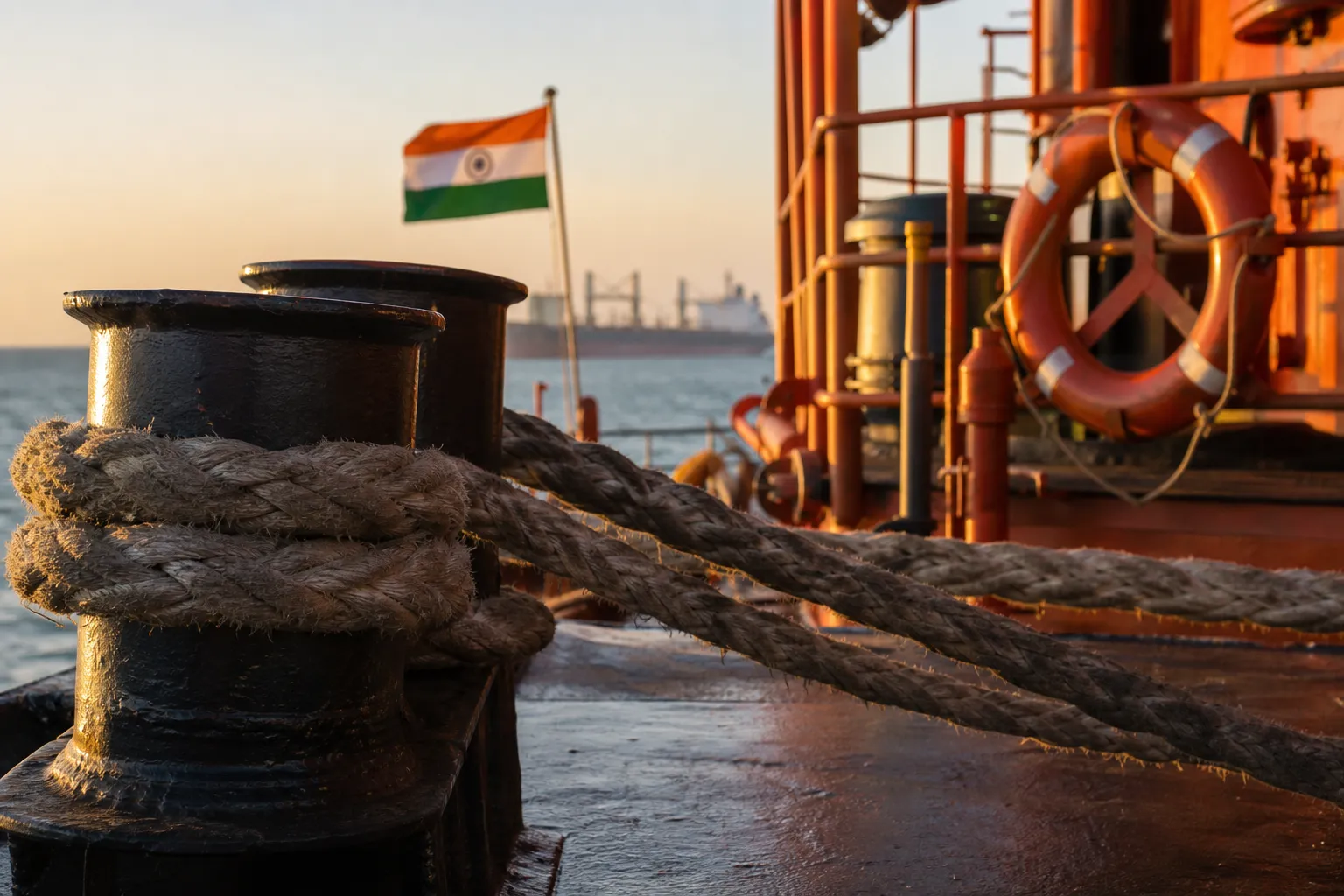
Image alt: Indian flag and cargo ship, new maritime laws india reforms.
The new maritime laws india reward shipping businesses that prepare early: those who audit their contracts, tighten their claims procedures and align their forum strategy before a dispute arises will hold a decisive advantage over those who react after the fact. The reforms make it easier to combine a neutral arbitral seat with fast local security, clarify the grounds and procedure for vessel arrest under the 2017 Act, and raise expectations around electronic evidence and timely notice. Verify every provision against the Gazette, DGS and Ministry sources before acting, distinguish enacted law from proposals, and translate the changes into concrete redlines and checklists across your fleet.
For tailored guidance on how the new maritime laws india affect your contracts, claims and disputes, contact the Global Law Experts India maritime disputes team.
This article is provided for general information only and does not constitute legal advice. The status of legislative and regulatory measures should be confirmed against the official primary sources before you act on them.

posted 15 minutes ago

posted 53 minutes ago

posted 1 hour ago

posted 1 hour ago

posted 2 hours ago

posted 2 hours ago

posted 2 hours ago

posted 2 hours ago

posted 2 hours ago

posted 2 hours ago

posted 3 hours ago

posted 3 hours ago
No results available
Find the right Legal Expert for your business

Send welcome message