
Author
No results available
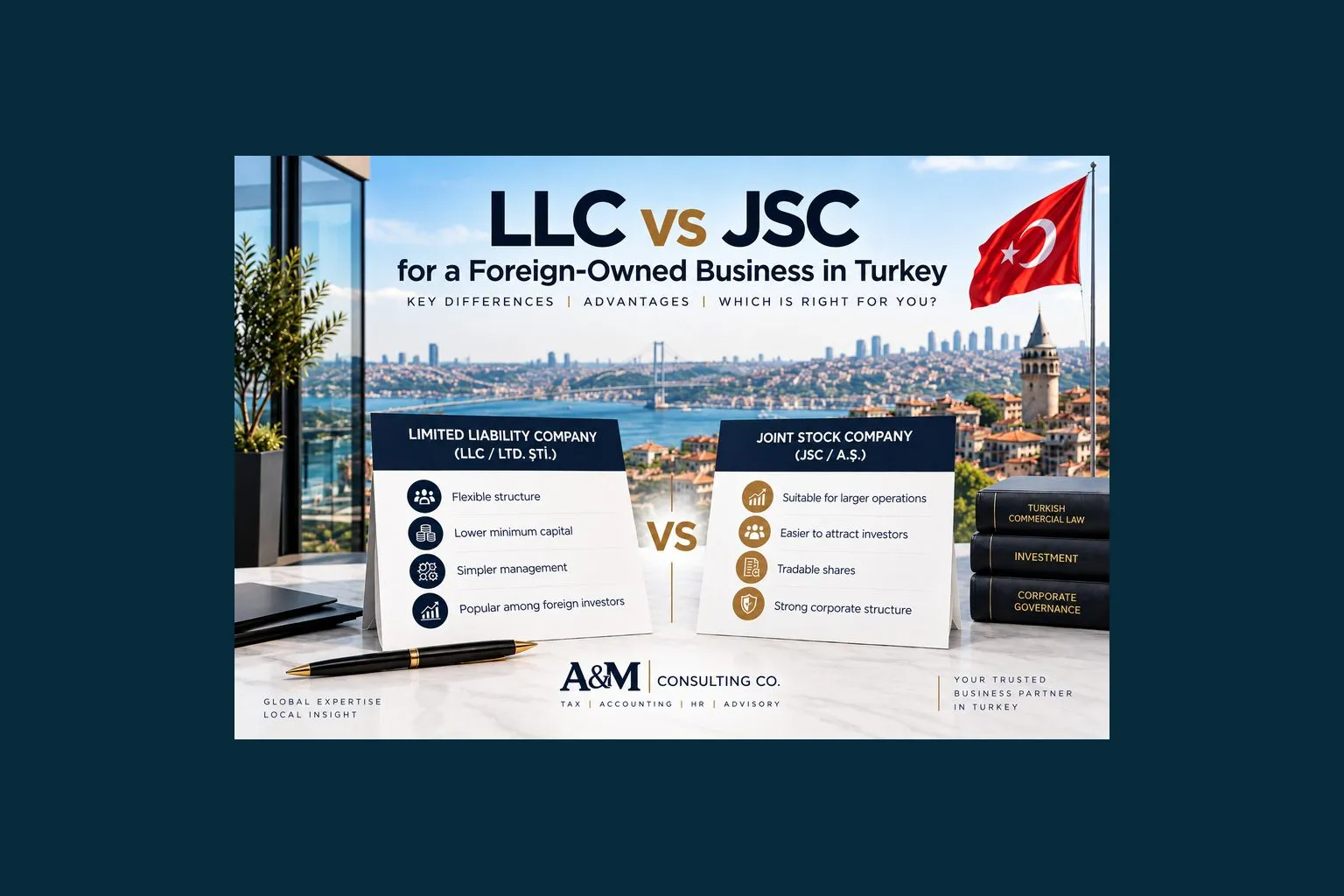
For most foreign investors establishing a small or medium-sized operating business in Turkey, a Limited Liability Company (LLC / Limited Şirket) is usually the more practical choice because it offers a relatively simple management structure, limited liability and a lower statutory minimum capital requirement.
A Joint Stock Company (JSC / Anonim Şirket) is generally more suitable where the business expects multiple investors, larger capital requirements, more sophisticated governance, greater flexibility in share transfers, or a future capital-markets transaction.
Both structures can generally be established with 100% foreign ownership in sectors that are open to foreign investment. The right choice depends on the business activity, investment size, ownership structure, financing plans and long-term objectives.
This guide is intended for foreign founders, international companies, investors, CFOs, in-house counsel and advisers comparing an LLC vs JSC in Turkey.
It explains the principal differences in liability, capital, governance, ownership transfers, compliance, formation procedures and practical use cases for a foreign-owned business in Turkey.
Advisory Note: This article provides general information on the Turkish corporate framework and practical incorporation considerations. It is not legal representation or a substitute for case-specific legal or tax advice. Regulated sectors and individual circumstances may require additional analysis.
Choosing the right company structure is one of the first strategic decisions a foreign investor makes when entering the Turkish market.
The two principal corporate forms used by foreign investors are the Limited Liability Company (LLC / Limited Şirket) and the Joint Stock Company (JSC / Anonim Şirket). Both are separate legal entities and generally provide limited liability to their shareholders or members, but they differ substantially in governance, capital structure, ownership transfers and suitability for future investment.
For a detailed overview of the incorporation process, foreign investors can also review A&M Consulting Co.’s Company Registration in Turkey guide.
The decision should therefore be based not only on the initial cost or speed of incorporation, but also on the company’s expected growth, financing requirements, shareholder profile and long-term exit strategy.
Both LLCs and JSCs are primarily regulated by the Turkish Commercial Code (Law No. 6102).
The Code establishes the principal rules concerning:
Formation and articles of association
Capital and capital contributions
Shareholders and members
Managers and directors
General assembly procedures
Share and quota transfers
Financial and corporate obligations
Mergers, conversions and liquidation
The Ministry of Trade and the Trade Registry system administer the practical registration process, while MERSIS (Central Registry Record System) is used for company incorporation and corporate registration procedures.
Foreign investors should also review the Foreign Direct Investment Law No. 4875 and any sector-specific legislation before incorporation. Although Turkey generally permits foreign ownership, regulated sectors may require licences, approvals or additional conditions.
| Feature | LLC – Limited Şirket | JSC – Anonim Şirket |
|---|---|---|
| Legal personality | Separate legal entity | Separate legal entity |
| Shareholders | 1–50 | 1 or more |
| Foreign ownership | Generally permitted, including 100% foreign ownership in most sectors | Generally permitted, including 100% foreign ownership in most sectors |
| Minimum capital | TRY 50,000 | TRY 250,000 |
| Capital payment | Entire subscribed cash capital may generally be paid within 24 months after registration | At least 25% of subscribed cash capital generally paid before registration; remainder within the statutory period |
| Governance | Manager or managers | Board of Directors and General Assembly |
| Ownership transfer | More formal and restricted | Generally more flexible |
| Public offering | Cannot be publicly offered as an LLC | JSC is the standard corporate form for public offerings |
| Typical use | SMEs, operating subsidiaries, trading, consulting, technology and other closely held businesses | Larger investments, multiple investors, capital raising and more complex corporate structures |
| Compliance profile | Relatively simpler | More formal corporate governance and potentially greater compliance burden |
The statutory capital figures above reflect the current Turkish framework. Investors should still verify the applicable requirements at the time of incorporation because legislation and administrative requirements can change.
A Turkish LLC, known as a Limited Şirket (Ltd. Şti.), is one of the most commonly used structures for foreign-owned businesses.
It is particularly suitable for investors establishing an operating company, wholly owned subsidiary, trading business, consultancy, technology company or other closely held business.
For a detailed explanation of the LLC structure, see A&M Consulting Co.’s Limited Liability Company in Turkey guide.
An LLC can be attractive because it provides:
A separate legal personality
Limited liability, subject to statutory exceptions
A relatively simple management structure
Up to 50 shareholders
100% foreign ownership in most sectors
Lower statutory minimum capital than a JSC
A practical structure for closely held businesses
A Turkish LLC is managed and represented by one or more managers.
At least one manager must be appointed, and the manager may be a shareholder or a non-shareholder, subject to applicable legal requirements.
Representation authority can generally be structured through individual or joint signing powers depending on the company’s needs.
For many foreign-owned SMEs and subsidiaries, this comparatively lean governance structure makes an LLC easier to administer than a JSC.
A Turkish JSC, known as an Anonim Şirket (A.Ş.), is a separate legal entity whose capital is divided into shares.
For a detailed explanation of the JSC structure, see A&M Consulting Co.’s Joint Stock Company in Turkey guide.
A JSC is often preferred where the business expects:
Multiple investors
Significant capital requirements
More sophisticated corporate governance
Frequent or strategically important share transfers
Institutional investment
Future capital raising
Potential access to capital markets
The principal corporate organs of a JSC are the General Assembly and the Board of Directors.
The General Assembly represents the shareholders and makes decisions reserved for shareholders under Turkish law and the company’s articles of association.
The Board of Directors is responsible for the management and representation of the company within the framework established by the Turkish Commercial Code.
This more formal structure can be advantageous for businesses expecting institutional investors, larger financing transactions or a more complex ownership structure.
Capital is one of the clearest practical differences between an LLC and a JSC.
For a broader explanation of capital requirements, capital contributions and related procedures, see A&M Consulting Co.’s Share Capital in Turkey guide.
The statutory minimum capital for an LLC is currently TRY 50,000.
The entire subscribed cash capital may generally be paid within 24 months following registration, subject to the applicable statutory and corporate arrangements.
The statutory minimum capital for a JSC is currently TRY 250,000.
For a privately held JSC, at least 25% of the subscribed cash capital generally needs to be paid before registration, with the remaining amount payable within the statutory period.
A JSC that adopts the registered-capital system may be subject to a higher statutory initial capital requirement.
Foreign investors should therefore consider not only the minimum amount required for incorporation but also the amount of working capital the business will actually need after registration.
Both LLCs and JSCs are separate legal entities and generally provide limited liability.
As a general principle, shareholders are not personally responsible for the company’s commercial debts beyond their capital commitment.
However, limited liability is not absolute.
Certain public-law obligations, including tax and Social Security liabilities, may create additional statutory liability for managers, directors or LLC members in defined circumstances.
Foreign investors should therefore distinguish between commercial creditor protection and statutory liability arising from public debts or management responsibilities.
Governance is one of the most important differences between the two structures.
An LLC has a relatively lean governance model based on:
Shareholders’ General Assembly
Manager or Managers
This is often suitable for a founder-led business, a wholly owned subsidiary or an SME where rapid decision-making and operational simplicity are priorities.
A JSC operates through:
General Assembly
Board of Directors
The more formal governance structure can provide greater clarity for businesses with multiple investors, institutional shareholders or complex financing arrangements.
Ownership transfer is another important distinction between an LLC and a JSC in Turkey.
Transfers of LLC quotas are subject to formal statutory procedures and, as a general rule, require General Assembly approval together with the relevant notarisation and registration formalities. For a detailed explanation of the applicable procedures, see A&M Consulting Co.’s Company Share Transfer in Turkey guide.
This can provide closely held businesses with greater control over who enters the ownership structure.
JSC shares generally offer greater transferability than LLC quotas, subject to the type of share, the articles of association and applicable Turkish Commercial Code rules. Investors considering a transfer, acquisition or restructuring of shares can refer to A&M Consulting Co.’s Company Share Transfer in Turkey guide for further practical information.
This makes the JSC structure particularly attractive where the company expects to introduce new investors, reorganise ownership or plan a future liquidity event.
Both LLCs and JSCs must comply with Turkish accounting, tax, corporate and reporting requirements.
Typical ongoing obligations may include:
Statutory bookkeeping
Corporate tax compliance
VAT compliance where applicable
Withholding tax compliance where applicable
Financial statements
Trade Registry filings
Payroll and SGK compliance when employees are hired
Electronic tax applications where applicable
Corporate governance and shareholder resolutions
The level of corporate formality is generally greater for a JSC.
Independent statutory audit is not triggered simply because a company is an LLC or JSC.
Instead, independent audit requirements are generally determined by statutory size criteria, including relevant asset, revenue and employee thresholds, which may be updated from time to time.
A large LLC can therefore fall within the independent audit regime, while a smaller JSC may not.
Investors should verify the current thresholds before assuming that an entity is exempt from independent audit.
Both LLCs and JSCs are generally subject to the Turkish tax framework applicable to companies, including corporate income tax and VAT where relevant to their activities.
The choice between LLC and JSC should therefore not be made solely on the basis of tax.
The main practical cost differences often arise from:
Corporate governance requirements
Board and General Assembly formalities
Accounting and reporting complexity
Independent audit where applicable
Corporate changes and shareholder transactions
Professional advisory requirements
Tax treatment can also depend on the shareholders, transactions, financing structure and applicable tax treaties. A company-specific tax analysis should therefore be carried out before incorporation.
Turkey generally allows foreign investors to establish and own Turkish companies without a Turkish shareholder in most sectors.
A foreign individual or foreign company can generally own 100% of an LLC or JSC, subject to sector-specific rules.
However, certain regulated activities may require licences, approvals, ownership restrictions or other conditions. Examples can include certain activities in financial services, aviation, media, energy, mining and other regulated industries.
Foreign investors should therefore confirm the rules applicable to the intended business activity before deciding on the company structure.
Establishing a company in Turkey does not automatically grant a foreign shareholder the right to live or work in Turkey.
These are separate immigration and employment matters. Foreign investors who intend to actively work for their Turkish company should assess the applicable Turkey Work Permit requirements before starting the incorporation process.
A foreign shareholder may also be appointed as a manager or director, but the practical right to work in Turkey may depend on the applicable work permit rules and the individual’s circumstances. Investors planning to relocate should also review the requirements for a Turkey Work Visa and determine which immigration route is appropriate for their situation.
Establishing a company, obtaining a residence status and obtaining permission to work are separate processes. Foreign investors who intend to relocate to Turkey and actively manage their company should therefore assess company formation, residence and work authorization together rather than treating them as a single procedure.
LLC is usually the more practical choice.
It provides limited liability, a simpler governance structure and a lower statutory minimum capital requirement.
LLC is often suitable.
A foreign parent can generally own 100% of the Turkish subsidiary, subject to sector-specific restrictions.
Either LLC or JSC may be appropriate.
An LLC can provide tighter control over ownership transfers, while a JSC can offer greater flexibility where the partners expect additional investors or future share transactions.
An LLC is often efficient for a closely held operating company.
If the business does not require external equity investment or a capital-markets strategy, the simpler governance structure can be advantageous.
A JSC is generally more appropriate.
Its share-based structure is better suited to multiple investors, investment rounds, ownership restructuring and future capital raising.
A JSC may be preferable.
A larger capital structure and more formal governance can be appropriate for businesses involving substantial investment, institutional financing or complex ownership.
JSC is the appropriate corporate form.
A JSC is the standard Turkish corporate vehicle for businesses that may pursue a public offering or access the capital markets.
Although the legal structures differ, the practical incorporation process for a foreign-owned LLC and JSC follows broadly similar stages.
Determine whether an LLC or JSC is appropriate based on:
Business activity
Number and type of shareholders
Investment size
Capital requirements
Financing plans
Ownership transfer strategy
Long-term growth objectives
Foreign shareholders may need to prepare:
Passport or identification documents
Turkish tax identification number
Corporate documents for foreign legal-entity shareholders
Board resolutions where applicable
Power of attorney where a representative will complete the process
Notarised, apostilled or legalised documents where required
Certified Turkish translations
The exact requirements depend on the shareholder structure and country of origin.
The articles of association should reflect the company’s:
Business activities
Capital
Shareholding
Management structure
Representation powers
Other corporate arrangements required by law
The incorporation documentation is prepared and submitted through the Turkish Trade Registry process, with MERSIS used as the central registration platform.
Following approval, the company’s establishment is published in the Turkish Trade Registry Gazette.
Following incorporation, the company must complete the applicable tax registration procedures.
Depending on its activities and tax status, the company may have obligations relating to:
Corporate income tax
VAT
Withholding tax
Electronic tax systems
Other statutory filings
Depending on the company’s activities, post-incorporation procedures may include:
Corporate bank account opening
Accounting and bookkeeping setup
e-Invoice and e-Ledger applications where applicable
SGK registration and payroll setup when employees are hired
Business licences and permits
Work permit procedures for foreign personnel
Other sector-specific registrations
The Trade Registry incorporation itself can often be completed relatively quickly once the documentation is complete and compliant.
For foreign investors, however, the overall market-entry timeline can be longer because document legalisation, certified translation, tax identification, banking, licences and post-incorporation compliance may require additional time.
The most effective way to reduce delays is to prepare the foreign shareholder documentation before starting the registration process.
Before choosing between an LLC and a JSC in Turkey, ask:
How many shareholders will the company have?
Will the shareholders be individuals, Turkish companies or foreign companies?
How much capital will the business actually require?
Will the company seek outside investors?
Will ownership need to change frequently?
Is a formal Board of Directors structure desirable?
Is a future capital-raising transaction expected?
Could the business pursue an IPO or capital-markets transaction?
Is the business activity subject to sector-specific licensing?
Will foreign shareholders or managers need Turkish work permits?
What will the company’s ongoing accounting and compliance costs be?
Would an LLC conversion or restructuring become necessary later?
There is no single company structure that is best for every foreign investor.
For most small and medium-sized foreign-owned operating businesses, an LLC is usually the more practical starting point because of its relatively simple governance, lower statutory minimum capital and suitability for closely held ownership.
A JSC is generally more appropriate for businesses expecting multiple investors, larger capital requirements, more sophisticated governance, greater share-transfer flexibility or a future capital-markets strategy.
The most important point is to select the structure based on the company’s business model and long-term objectives, rather than choosing an entity solely because it is cheaper or faster to incorporate.
Foreign investors should also consider taxation, accounting, banking, employment, work permits, licensing and ongoing compliance before finalising the structure.
A&M Consulting Co. assists foreign investors and international businesses with company formation and registration, tax registration, accounting, payroll, banking support and ongoing corporate compliance in Turkey.
Our team can help investors compare the practical requirements of an LLC and JSC, coordinate the incorporation process and support the company after registration.
This article was produced by Global Law Experts. For specialist advice on this topic, contact A&M Consulting Co., a member of the Global Law Experts network.

posted 17 minutes ago

posted 36 minutes ago

posted 58 minutes ago

posted 1 hour ago

posted 2 hours ago

posted 2 hours ago

posted 2 hours ago

posted 2 hours ago

posted 2 hours ago

posted 2 hours ago

posted 2 hours ago

posted 2 hours ago
No results available
Find the right Legal Expert for your business

Send welcome message