
Author
No results available
A partial payment can reduce a commercial debt without settling the whole dispute. The decisive evidence is the written agreement: what amount the payment covered, how it was allocated, whether any claim was released and what happens if the remaining schedule is missed. A lawyer in Dubai can review that wording before a receipt is treated as a full settlement by one side and only an instalment by the other.
The UAE Civil Transactions Law in force from 1 June 2026 places contracts and good-faith conduct within the current civil framework. A useful settlement review starts with the original contract, invoices, account reconciliation, default notices, negotiations, proof of payment and every draft release.
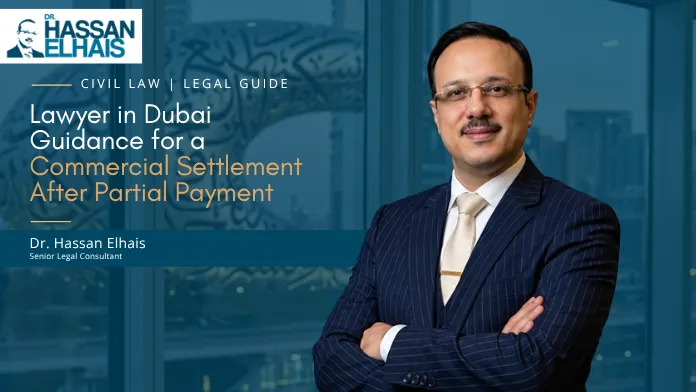
Dr. Hassan Elhais is a Dubai-based Senior Legal Consultant at Amal Alrashedi Lawyers and Legal Consultants. Practising in the UAE since 2006, he advises UAE nationals, expatriates and international clients on complex disputes. His role is advisory and includes UAE-law analysis, evidence assessment and coordination in matters involving more than one legal framework.
Before drafting a settlement, the parties should identify the principal sum, disputed items, interest or charges asserted, credits already given and any counterclaim. This is an accounting exercise and a legal one. Contractual dispute advice can test which parts are admitted, reserved or dependent on further proof.
A single balance should not hide disagreement about how it was calculated. The creditor can prepare an account reconciliation that links each amount to a contract, invoice, delivery record or adjustment. The debtor can identify the exact entries disputed. A lawyer in Dubai can then draft around known points rather than use a broad acknowledgement that unintentionally admits contested sums.
The settlement should state whether the partial payment is applied to a named invoice, principal, agreed cost or another component. If the parties intend a different allocation from the earlier account practice, that change should be explicit. The receipt and bank reference should use the same description as the agreement.
Commercial litigation guidance can assess how a later dispute may be affected by the documents. A clear payment allocation clause also prevents double counting. It should record the amount, date, currency and remaining balance without declaring unrelated obligations satisfied. If tax or accounting treatment matters, the parties should obtain the appropriate specialist advice rather than improvise legal wording.
Phrases such as “full and final settlement” can be wider than the parties expect. A limited settlement may release only one invoice or one event. A complete settlement may address all claims arising from a defined relationship. The document should identify the scope and any matters expressly reserved, including continuing delivery, warranty or confidentiality obligations.
A civil dispute review can test whether the release wording fits the commercial objective. A creditor accepting an instalment should not issue a receipt that says the account is fully discharged unless that is truly intended. A debtor should not assume that a friendly message cancels the remaining balance when the signed schedule says otherwise.
A settlement should explain due dates, payment method, grace arrangements if any, notice of default and the status of the outstanding amount. It should not pile on vague penalties or conflicting acceleration language. The parties should understand whether missing one date restores the original claim, makes the remaining settlement balance due or triggers another defined step.
Dispute-resolution advice can align the clause with the chosen court, arbitration or mediation route. The default mechanism should also address payments already made; those amounts should not vanish from the record. A lawyer in Dubai can identify language that creates uncertainty about credit, termination or enforcement.
Each signatory’s authority should be checked, especially where a company gives up a claim or accepts a new schedule. The file may need a trade licence, authority document, board approval or power of attorney. Email approval from an employee is not automatically equivalent to authority to bind the company.
The final execution record should contain the signed agreement, attachments, identity or authority proof, payment confirmation and any formal recording required for the intended effect. Debt recovery guidance can address a later non-payment, but accurate storage at signature is simpler than reconstructing the deal afterwards. Earlier drafts should be marked so they cannot be confused with the final version.
A settlement may sit beside continuing supply, maintenance or service obligations. The document should state whether performance continues, pauses or ends and how new invoices will be treated. Otherwise, a payment made for the old dispute may be wrongly credited against later work, or a party may suspend services without contractual support.
Existing guarantees, cheques, retention sums or other security should be listed and their status stated. The parties should not assume that a settlement automatically cancels or returns security. If release depends on full payment, the agreement can define the document or action that confirms completion.
A final completion notice should reconcile all instalments and confirm which obligations survive. This gives finance and operational teams the same answer and prevents an informal accounting entry from contradicting the legal agreement. Both sides should acknowledge receipt.
Partial payment resolves only what the parties clearly say it resolves. A lawyer in Dubai can reconcile the original obligation, define payment allocation, narrow or expand the release deliberately and draft a workable default route. Dr. Hassan Elhais can advise on those records and coordinate the next step, while the settlement’s effect remains dependent on its final wording, authority and applicable law.
About the Author
Dr. Hassan Elhais publishes analysis of UAE civil law matters, including civil disputes, contractual obligations and compensation claims. For readers researching lawyers in Dubai, his writing offers insight into the legal questions surrounding these topics. Explore his published work and practice-area information for further context.
Copyright © of this article is retained by the author and/or other copyright owners. We explicitly grant you permission to download a copy, without any alteration, of this article for personal non-commercial research or study, without prior permission or any charge. This article can be utilized on your website or for marketing, however, we grant you permission to host this article on your website and no other rights. This content should not be altered in any way or sold commercially in any format without prior permission of the copyright holder. During reference of this article, full biographic details entailing the name of the author, his designation, the institute and the publishing date of the article shall be provided.

posted 9 minutes ago

posted 24 minutes ago
posted 52 minutes ago
posted 52 minutes ago
posted 52 minutes ago
posted 52 minutes ago
posted 52 minutes ago

posted 52 minutes ago

posted 52 minutes ago

posted 52 minutes ago

posted 52 minutes ago
posted 53 minutes ago
No results available
Find the right Legal Expert for your business

Send welcome message