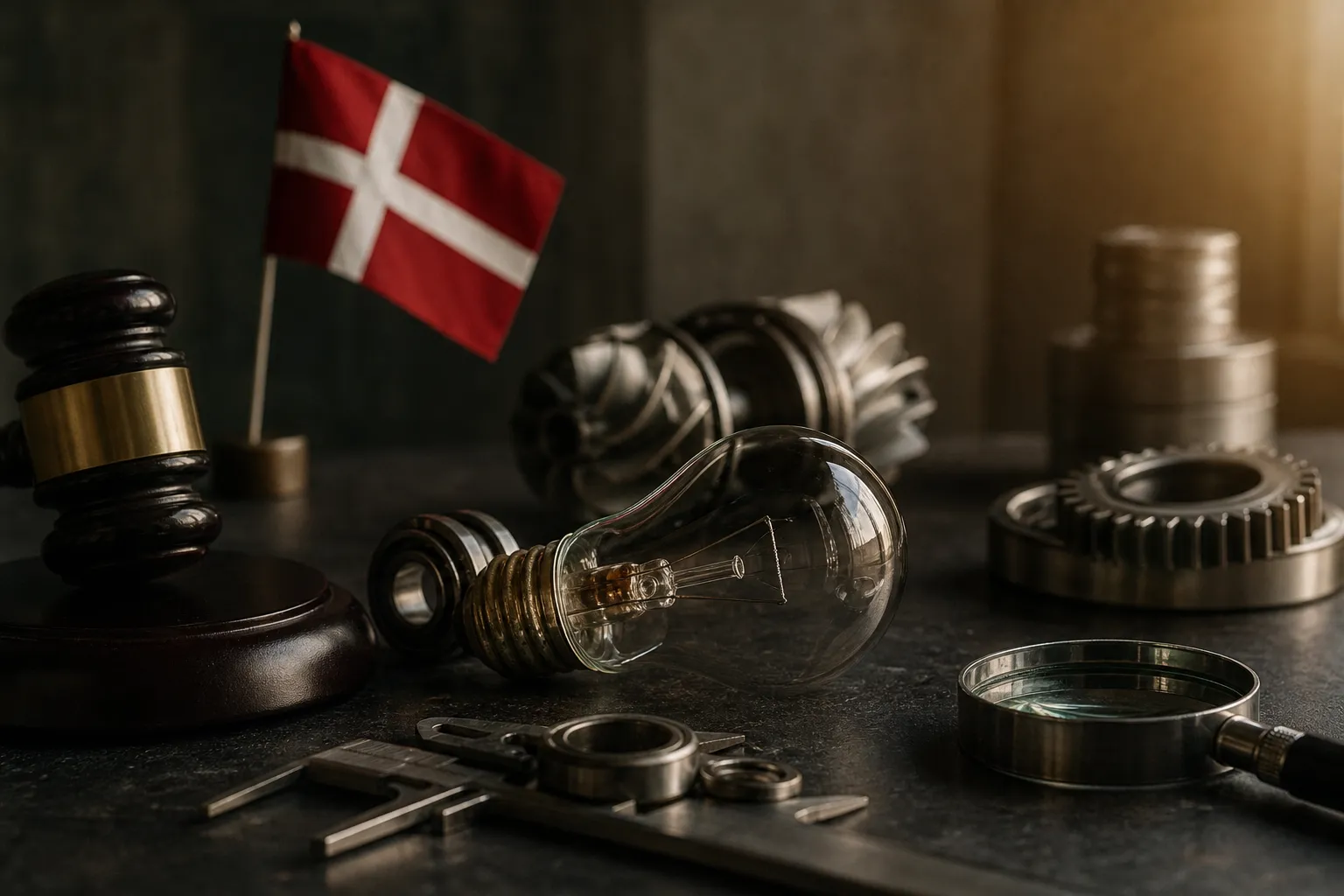
Our Expert in Denmark
No results available
Who this is for: corporate counsel, M&A lawyers, in-house legal teams, private equity and strategic buyers, founders and investors evaluating or negotiating Danish acquisitions and investments.
What you will get: a practical, jurisdiction-specific checklist for IP due diligence in Denmark for 2026, covering DKPTO fee impacts, AI and training-data risks, sample reps and warranties, and the red flags that shape deal pricing and risk allocation.
IP due diligence Denmark is now a decisive workstream in almost every technology-driven acquisition, licensing deal or growth investment closing in the Danish market, and 2026 has sharpened the stakes considerably. Two developments are reshaping how buyers, sellers and investors price intellectual property risk: revised fee schedules and recordal practices at the Danish Patent and Trademark Office (DKPTO), and the wave of AI and data-protection obligations flowing from EU regulation into Danish practice and supervision by Datatilsynet. For buyers, poorly documented IP ownership or unaccounted AI liability can undermine the value thesis. For sellers, a disciplined, well-organised data room accelerates the deal and protects the price.
This guide sets out a deal-ready checklist, sample contractual language and Danish-specific red flags so that legal teams can move from discovery to closing with confidence.
Effective intellectual property due diligence in Denmark begins before a single register is searched. Scoping defines what “good enough” looks like, how deep the review goes, and where the budget is spent. Get this wrong and you either over-run costs on immaterial assets or miss the one licence that underpins the target’s core product.
The transaction structure dictates the diligence perimeter. In a share deal, the buyer inherits the target company and, with it, every historic IP liability, chain-of-title gap and licence obligation, recorded or not. Diligence must therefore be comprehensive, and risk is typically allocated through reps, warranties and indemnities. In an asset deal, only the identified assets transfer, which allows the buyer to cherry-pick clean rights and leave liabilities behind. However, asset deals require each IP right to be individually assigned and, for registered rights, recorded at the DKPTO to secure priority and third-party effect. The scoping document should state explicitly which structure applies and how transfer mechanics will be handled.
Define the territorial footprint early. A Danish target may hold national rights recorded at the DKPTO, EU-wide rights at the EUIPO, European patents (including patents with unitary effect) obtained through the EPO, and rights in third countries. Establish the technical or brand field to be reviewed, set materiality thresholds (for example, only individually reviewing patent families above a defined revenue-contribution or replacement-cost line), and agree how unregistered rights such as trade secrets and copyright in software will be captured.
No single reviewer covers modern IP risk. Assemble a team that includes patent counsel for validity and freedom-to-operate, software and open-source specialists for code review, data-protection advisers for AI and training-data exposure, and tax input on the treatment of transferred IP and licence royalties. Assign a lead who consolidates findings into a single risk register mapped to purchase-agreement remedies.
The mapping phase converts a vague sense of “the target owns valuable IP” into a verified schedule. Every subsequent step, ownership, validity, contractual protection, depends on an accurate inventory. Build the map by asset class and cross-check each against the seller’s own disclosures.
Request a full schedule of patents and applications, then verify it independently against the DKPTO register and the EPO register for European patents in force in Denmark. Capture application and grant numbers, status, jurisdictions, next renewal dates and fee status.
Build a brand map covering registered Danish marks, EU trade marks at the EUIPO, and any international registrations designating Denmark or the EU. For each mark, record the classes, registration status, renewal dates and evidence of genuine use, which is essential to resisting revocation.
Obtain a bill of materials for all proprietary software, including modules, repositories and versioning. Establish which code is developed in-house, which is contracted out, and which is third-party or open source. This inventory feeds directly into the software and AI due diligence Denmark workstream discussed below.
Where the target uses machine learning, map every dataset used to train, fine-tune or validate models. Record provenance, licensing, whether personal data is involved, and the legal basis relied on. Datasets are frequently the least-documented and highest-risk asset in a modern Danish tech deal.
Compile inbound licences (technology the target relies on) and outbound licences (rights the target has granted). Flag exclusivity, change-of-control clauses, territorial limits and royalty obligations, all of which can survive or trigger on the transaction.
Owning IP in fact is not the same as owning it in law. Ownership and chain-of-title verification is where many Danish deals reveal their sharpest surprises, because informal development arrangements and undocumented assignments are common in fast-growing companies. This is a core question in any IP due diligence Denmark exercise.
Trace title from creation to the current holder. For registered rights, confirm the recorded proprietor at the DKPTO and check that every assignment in the chain is documented and, where required, recorded. Under Danish practice, recordal of transfers at the DKPTO is important to secure priority and third-party effect; primary provisions governing patents, trademarks and designs are consolidated in the Danish statutes available via Retsinformation. Unrecorded assignments are a classic red flag: the target may be the beneficial owner but unable to enforce cleanly against a later good-faith acquirer.
Verify that employees, contractors and consultants who created IP have effectively vested those rights in the company. Review employment contracts for IP-assignment and invention clauses, and check that consultants signed present assignments rather than mere licences. Danish law regulates employee inventions, and gaps in documenting the allocation of rights carry real enforcement risk. Where founder-created IP predates incorporation, confirm it was properly transferred into the company.
Audit inbound licences to confirm the target actually holds the rights it uses, and outbound licences to understand what it has given away. Exclusive licences can materially reduce the value of an asset a buyer thought was unencumbered. Check for change-of-control and assignment restrictions that could terminate or require consent on closing.
Confirm registrant details for all domain names, social media handles and app-store listings. These are frequently held in a founder’s personal name or under a lapsed agency account, and transferring them post-closing can be surprisingly difficult without advance planning.
Sample document request list:
Ownership without validity is worthless. This phase tests whether the registered rights would actually survive challenge and support enforcement, and whether the target is free to operate without infringing third parties.
Assess validity through prior-art searching and review of prosecution history. Where a patent originated as a European patent, examine the EPO file wrapper alongside the national Danish status; the interplay between EPO grant, national validation and any post-grant opposition affects both scope and durability. The EPO provides search and register resources for this analysis. Statutory grounds for invalidity under Danish patent law, lack of novelty, lack of inventive step, insufficient disclosure, should be tested against the strongest available prior art for the core patents.
Confirm each mark is registered, in force and genuinely used. Gather evidence of use across the relevant classes, since non-use may expose a mark to revocation. Check the EUIPO and DKPTO records for pending oppositions, and assess whether the marks are distinctive or vulnerable to descriptiveness challenges. Guidance on EU trade mark oppositions and cross-border enforcement is available from the EUIPO.
Review registered designs for subsistence, novelty and remaining term. Map design protection against the products it is meant to cover, and identify any reliance on unregistered design rights, which are shorter-lived and harder to enforce.
Build a consolidated renewal calendar for every registered right, with the next renewal date and fee for each. Because DKPTO fees and renewal windows are subject to change, buyers should model renewal and recordal costs forward across the retained portfolio rather than relying solely on historic figures. Confirm current fees and renewal windows against the official DKPTO schedules. The practical fee impact on M&A is twofold: post-closing renewal costs may differ from the seller’s historic run-rate, and recordal of the transaction itself carries fees that should be budgeted into integration. Missing a renewal window during the transition period is an avoidable but costly error, allocate responsibility for renewals falling due around closing explicitly in the agreement.
For technology targets, this is the section where value is won or lost. A thorough IP due diligence Denmark process treats software, open-source and AI as a distinct workstream with its own specialists, because the risks differ fundamentally from those attaching to registered rights.
Open-source software is not free of obligations. Run a code scan and build a licence matrix classifying each component by obligation level. Permissive licences such as MIT and Apache impose light attribution requirements. Copyleft licences such as the GPL can, in the wrong architecture, require disclosure of proprietary source code that is combined with the licensed component, a potentially existential issue for a target whose value rests on proprietary code.
For AI-driven targets, the provenance of training data is often a significant hidden liability. Establish where each dataset came from, whether it was licensed for the use made of it, whether it was scraped, and whether it contains personal data. Where personal data is used to train or fine-tune models, the EU General Data Protection Regulation and Danish data-protection law apply, and Datatilsynet guidance addresses the legal basis, transparency and impact-assessment expectations for large-scale processing. A model trained on data without a proper legal basis is a defective asset regardless of its performance.
Confirm who owns the trained models, model weights and associated pipelines. Where the target built on third-party foundation models or APIs, review those terms for use restrictions, ownership of outputs and commercial-use limits. Check whether outputs could infringe third-party IP, and consider obligations under the EU AI Regulation and related Danish supervision where relevant to the target’s systems.
Where the target depends on software licensed from a third party, or where a buyer will license critical software from the seller post-closing, consider a source-code escrow. Escrow protects the buyer against vendor insolvency or discontinuation by releasing the source code on defined trigger events. Combine escrow with a targeted source-code review of the most critical modules.
Where diligence surfaces open-source or data risk that cannot be fully cleared before signing, mitigate rather than walk away. Options include remediation as a condition to closing, isolating (sandboxing) problematic components, specific indemnities carved out for the identified risk, and price adjustments. Record each unresolved item in the risk register with an assigned contractual remedy.
Disputes and regulatory constraints can undermine even a clean-looking portfolio. This workstream verifies the target’s litigation history and identifies public-law restrictions that travel with the assets.
Search for pending and closed IP disputes involving the target through the Danish courts, including the Maritime and Commercial High Court (Sø- og Handelsretten) which handles many IP matters, using resources available via domstol.dk, and review the seller’s own disclosures of claims, threats and cease-and-desist correspondence. A pattern of infringement allegations, even where unresolved, signals freedom-to-operate risk that should be priced.
Check for regulatory investigations touching IP-adjacent matters, including data-protection enforcement by Datatilsynet where AI or personal-data processing is central to the business. Regulatory findings can affect the lawfulness of core assets such as trained models.
Where the target holds public contracts, review the IP terms carefully. Public-procurement agreements can contain broad IP-assignment or licence-back provisions, and change-of-control clauses that require consent or notification on the transaction.
Diligence findings only protect the buyer if they are translated into the purchase agreement. The reps and warranties, indemnities and price mechanics are where IP risk is finally allocated. The buyer wants broad, unqualified warranties; the seller wants them knowledge-qualified, capped and time-limited. The negotiation should track the risk register directly, so that identified issues become specific indemnities rather than general warranty claims.
Suggested IP reps and warranties for Danish agreements:
Indemnities, escrow and pricing mechanics. Where diligence reveals a specific, quantifiable risk, an unrecorded assignment, an unresolved OSS conflict, a training-dataset provenance gap, use a bespoke indemnity that survives independently of the general warranty package and is not subject to the ordinary cap. Consider an escrow holdback or purchase-price adjustment to fund identified remediation. IP-specific and cyber insurance can supplement contractual protection where risk cannot be fully allocated. On survival, warranties under Danish agreements are contractual and typically negotiated to survive for a defined period, with tax and fundamental warranties often surviving longer; draft survival, cap and de minimis provisions explicitly rather than relying on default positions.
Closing is not the finish line. The value verified in diligence must be secured through prompt post-closing action, and neglected recordals or missed renewals can erode it quickly.
| Checkpoint | Buyer perspective | Seller perspective |
|---|---|---|
| Scope & depth | Wants comprehensive review of all assets and liabilities | Wants a focused, time-boxed process minimising disruption |
| Typical discoveries | Unrecorded assignments, OSS conflicts, training-data gaps | Documentation gaps surfaced through vendor diligence |
| Ownership evidence | Demands full chain of title and employee assignments | Provides organised schedules and recordal confirmations |
| Warranties | Seeks broad, unqualified warranties | Seeks knowledge qualifiers, caps and short survival |
| Negotiation leverage | Identified red flags justify indemnities and price cuts | Clean data room supports full price and fewer carve-outs |
| Remedies | Bespoke indemnities, escrow holdbacks, price adjustments | Caps, baskets, de minimis thresholds, insurance |
| DKPTO fees | Models forward renewal and recordal costs post-closing | Demonstrates renewals are current to avoid warranty claims |
IP due diligence Denmark in 2026 rewards teams that treat intellectual property as a distinct, structured workstream rather than an afterthought bolted onto financial and legal review. The combination of evolving DKPTO fee and recordal practice and the fast-moving AI and training-data landscape means that the highest-value and highest-risk assets in a Danish deal are frequently the least well-documented. Buyers who map assets rigorously, verify ownership and validity against primary registers, isolate software and AI risk, and convert findings into precise reps, warranties and indemnities will price the deal accurately and protect it after closing. Sellers who prepare a clean, well-organised data room will move faster and defend their price.
A disciplined IP due diligence Denmark playbook, anchored to authoritative Danish and EU sources, is the difference between a deal that delivers its thesis and one that unravels.
This article was produced by Global Law Experts. For specialist advice on this topic, contact Kim Larsen, a member of the Global Law Experts network.

posted 14 minutes ago

posted 16 minutes ago
posted 22 minutes ago

posted 37 minutes ago

posted 60 minutes ago

posted 1 hour ago

posted 1 hour ago

posted 2 hours ago

posted 2 hours ago

posted 2 hours ago

posted 2 hours ago
No results available
Find the right Legal Expert for your business

Send welcome message