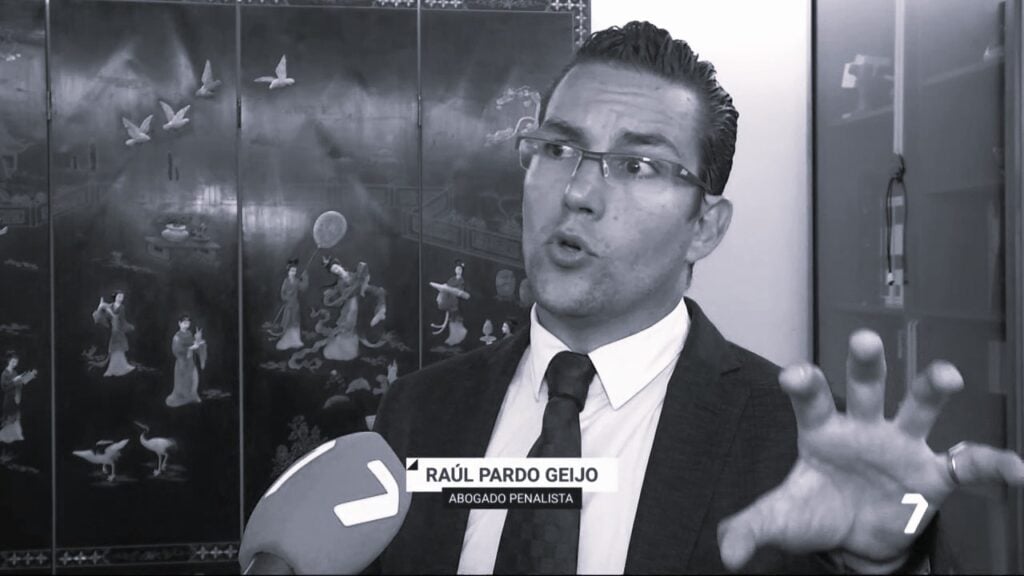
El abogado penalista Raúl Pardo-Geijo Ruiz, vuelve a recibir 3 nuevos galardones este año 2018
Raúl Pardo-Geijo Ruiz, a criminal lawyer from Murcia, one of the most prominent legal professionals at the national level, repeatedly awarded for his work in criminal law, once again received three new awards in 2018.
— You have been honored on numerous occasions by prestigious institutions for your work as a criminal lawyer, and this year you have received several more awards. What do these recognitions mean for your work as a criminal defense attorney?
In terms of how I perform my work, nothing has changed. I continue practicing in the same way I did years ago. It is an honor to receive recognition, but frankly, it is not what drives me to keep doing my job to the best of my ability.
— With so many awards from major institutions due to your status as a criminal lawyer at the national level, do you consider yourself the best criminal lawyer?
No. There is always someone better and someone worse. Besides, I could never answer a question like that because I do not compare myself to others. I only care that my work is of the highest possible quality and, of course, that the outcome is favorable. I am very strict in this regard, and regardless of the final result, I only feel at ease if the work has been done in the best possible way.
— You have just secured an acquittal before the Supreme Court for a Senator in the “Púnica” case, who was facing more than five charges (bribery, misconduct in public office, fraud, embezzlement, forgery, etc.), at a time when the national press and television had already assumed she would be convicted. What did you do to achieve this, and how satisfied are you?
Simply working on the case, which, by the way, was extremely demanding due to constant trips to the Supreme Court and because there were unreliable statements from several “repentant” witnesses who were merely pursuing their own procedural interests—seeking reduced sentences by trying to secure the conviction of an innocent person. Otherwise, I am very satisfied, especially for the client, who undoubtedly deserved this outcome, as she even had to temporarily step aside from her political group because another party made it a condition for approving the State Budget.
— Several sources describe you as “a guarantee of success,” in the sense that if you cannot solve something, it had no solution. What do you think of that?
I do not believe that. I can only say that you never know whether something has a solution until you reach the outcome. If it worked, then it had a solution—but if it did not, does that mean it had none? I do not think so. It might have had one, but perhaps we simply did not know what it was.
— Given that your firm is a strong reference in criminal law at the national level, how do you find the time to handle all the cases that come your way?
I usually have time for two reasons. First, I work many hours a day—very often I finish eating in five minutes and go straight back to work. Second, I do not take on most of the cases that come to me, either because they are not of interest to me or because the client ultimately is not interested.
— Could that lack of interest from the client be due to financial reasons?
I do not ask clients why their interest has decreased or disappeared. I also do not charge high fees—they are quite similar to those of other leading colleagues—and I never consider a client’s wealth when setting them. Moreover, if clients knew how many hours I dedicate to each case, they might think differently—if we are talking about fees. I not only have to study the facts and build a defense or prosecution strategy, but also identify every possible procedural flaw or any issue that may arise during the proceedings and could lead to a conviction or acquittal. For example, one of the last cases I won was precisely because the complainant had not been informed of their obligation to tell the truth, which meant the testimony was invalid and my client could not be convicted. Ultimately, in every case, one must identify the so-called “key piece” to achieve either an acquittal or a conviction.
— And what determines your lack of interest when taking on cases?
Regarding prosecution cases, only when the client has unrealistic expectations in criminal matters. As for defense cases, there are many reasons, but the main one—unfortunately very common—is when someone comes with a conviction already issued and wants to appeal to the Constitutional Court or Strasbourg (not the Supreme Court), where we already know that the grounds for admission are extremely limited, and it is not possible to develop the full arguments that could have been presented during the investigation or at trial. Honestly, initiating proceedings with very little chance of success, given the costs involved, is something I do not like at all, and for that reason—unless there is a clear violation of fundamental rights—I do not accept such cases.
— However, you are involved in some of the most complex economic or corruption cases in the country. Why less so in cases involving violent crimes or sexual offenses?
I have handled—and continue to handle—such cases, especially when I believe in the client’s innocence. What happens is that people sometimes think that defending these types of cases is the same as any other, and it is not. In economic crimes, personal freedom is at stake to a much lesser extent than in cases of homicide or murder.
— What is your opinion of the Spanish Criminal Code?
I believe it is overly punitive and, at the same time, extremely lenient in certain situations. However, my role is not to question the law. That is the task of the legislator and of Supreme Court judges, who interpret it—more or less accurately—through jurisprudence. I do not mind disagreeing with certain provisions because my only concern is to apply the law as interpreted by the prevailing jurisprudence. It is not my mission to change the law or interpret it according to my preferences; I simply follow the rules of the game, whether I like them or not.