
Our Expert in United Kingdom
No results available
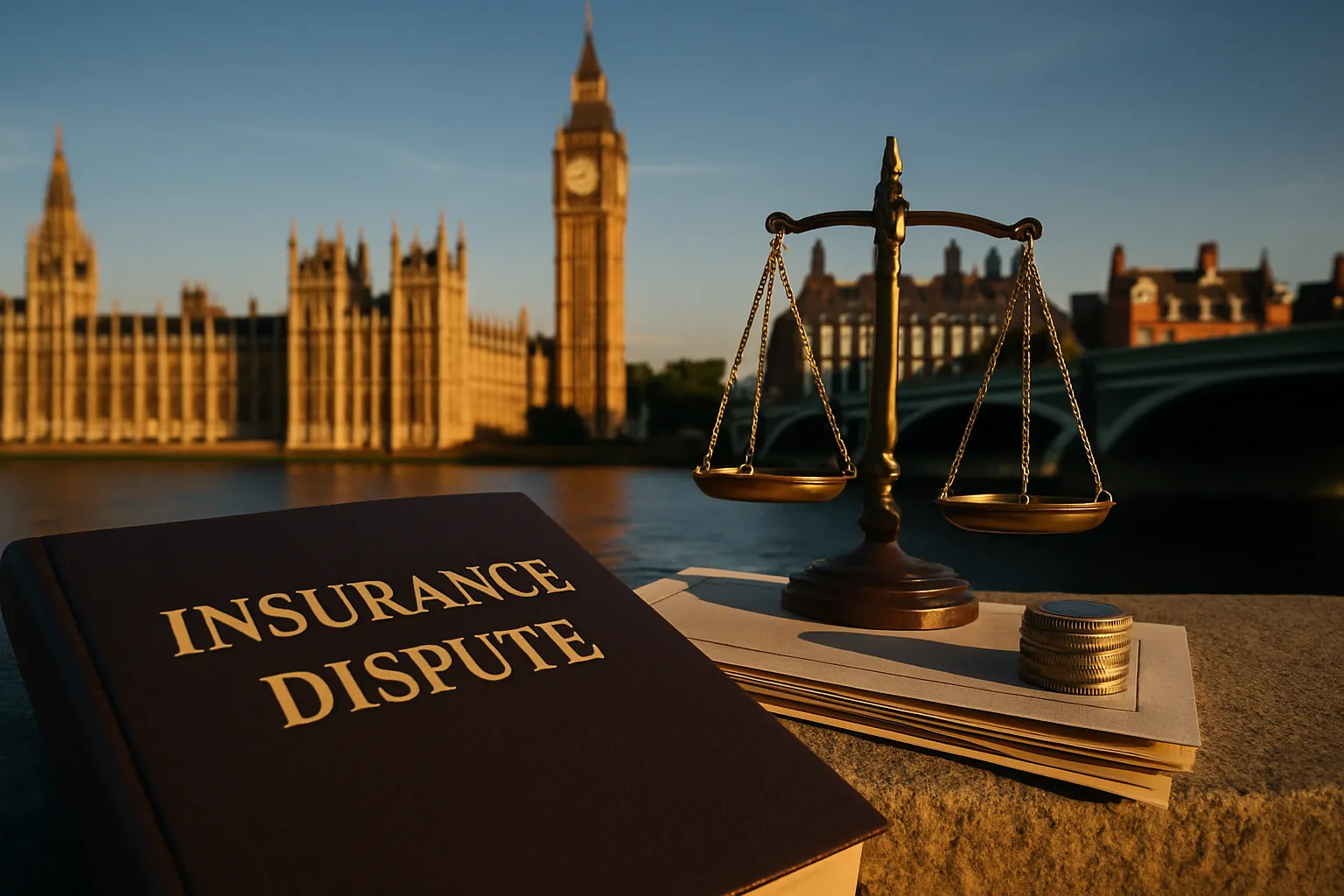
Insurance dispute legal costs uk decisions have become a central boardroom concern as in-house counsel, claims managers and finance directors face sustained pressure to reduce legal spend while managing adverse costs risk. This 2026 guide sets out, in practical terms, how funding routes such as conditional fee agreements (CFAs), damages-based agreements (DBAs) and after-the-event (ATE) insurance actually work, how recoverability rules changed after the Legal Aid, Sentencing and Punishment of Offenders Act 2012, and how Part 36 offers can transform the economics of a coverage claim. The aim is to help decision-makers choose a funding model, price the dispute and control exposure with confidence.
Every legal point below is anchored to primary authority, the LASPO 2012 statute and the Civil Procedure Rules, so you can act on it rather than merely read about it.
This is a practical, decision-first guide for in-house counsel, claims managers, CFOs and brokers deciding how to fund and price insurance and coverage disputes. The core takeaway is a four-step decision flow:
The economics of an insurance dispute in the UK turn on three levers: how the claim is funded, how downside risk is insured, and how settlement offers are timed. Managing insurance dispute legal costs uk exposure effectively means treating those three levers as a single strategy rather than isolated decisions.
Industry observers note that the combination of client pressure on legal spend and renewed interest in CFA-plus-ATE structures for coverage litigation has made funding strategy a differentiator in how disputes are resolved, often more decisive than the underlying legal merits alone.
Before choosing a funding route, decision-makers need to understand the default costs rules that will apply regardless of how the case is funded. These rules determine who pays, how much, and on what basis, and they frame every insurance dispute legal costs uk calculation.
The general rule in English civil litigation is that the unsuccessful party pays the successful party’s costs. That principle, often called “costs follow the event”, creates the adverse costs risk that drives so much of funding strategy. The court retains a broad discretion on costs under the Civil Procedure Rules, but if you lose you can generally expect to pay not only your own lawyers but a substantial proportion of your opponent’s.
How much you recover, or pay, depends on the basis of assessment. On the standard basis, the court allows costs that are proportionate to the matters in issue and resolves any doubt in favour of the paying party; in practice, recovery is commonly well below the receiving party’s actual spend. On the indemnity basis, the proportionality requirement falls away and doubt is resolved in favour of the receiving party, producing materially higher recovery. The distinction matters enormously in Part 36 scenarios, discussed below, where an indemnity costs order can be the sting that makes a rejected offer very expensive.
The single most important structural change to funded litigation came with the Legal Aid, Sentencing and Punishment of Offenders Act 2012. Before LASPO, a successful CFA-funded claimant could recover the success fee and the ATE premium from the losing party, layering the costs burden on the loser. LASPO reversed that for most cases from April 2013: success fees under conditional fee agreements and ATE premiums are, as a general rule, no longer recoverable from the opponent.
The practical consequence for insurance disputes is significant. A policyholder pursuing a coverage claim on a CFA will pay any success fee out of its own recovery, and will fund the ATE premium itself, win or lose. There are limited exceptions to the non-recoverability rule (for example, certain insolvency, mesothelioma and publication/privacy proceedings), but they are narrow and do not extend to the commercial coverage disputes that most in-house counsel manage. The safe planning assumption is that success fees and ATE premiums are a cost to the client, not a cost to be passed on to the opponent.
As for what solicitors charge, that varies widely by seniority, firm and complexity. The section below on worked cost examples sets out illustrative structures, but the headline point is that the funding model you choose changes not the underlying legal work but who bears its cost and when.
Choosing a funding route is the decision that most directly shapes insurance dispute legal costs uk outcomes. The right choice depends on claim value, the strength of the merits, the client’s appetite for immediate cash outlay and the availability of ATE cover. Below is a decision framework covering the four principal routes.
A conditional fee agreement is the classic “no win, no fee” arrangement. The solicitor agrees to be paid nothing, or a reduced fee, if the claim fails, and to receive a base fee plus a success fee if it succeeds. The success fee is expressed as a percentage uplift on the base costs, reflecting the risk the solicitor takes on.
Under the applicable legislation and regulations, the success fee is subject to a statutory cap and must be agreed transparently with the client at the outset as part of the solicitor’s client care obligations. Because the success fee is not recoverable from the opponent post-LASPO, the client’s exposure on winning is its own base costs plus the agreed uplift, netted against the recovery. CFAs suit mid-to-high value coverage claims with strong merits where the policyholder wants to align the solicitor’s incentives with a successful outcome and avoid immediate cash burn.
Tactical tip: pairing a CFA with ATE cover is the most common structure for policyholders who want both to defer their own fees and to cap their downside on adverse costs, but remember the ATE premium remains the client’s cost.
A damages-based agreement ties the solicitor’s fee to a percentage of the damages recovered, rather than to an uplift on base costs. If the claim fails, the solicitor is paid nothing; if it succeeds, the solicitor takes an agreed share of the recovery, subject to regulatory caps set out in the Damages-Based Agreements Regulations.
DBAs suit claims with a clear, quantifiable monetary recovery, for example a defined coverage sum in dispute, where a percentage of damages produces a predictable, often client-friendly, cost. The regulatory framework governing DBAs is more restrictive and technically demanding than for CFAs, and drafting errors can render an agreement unenforceable, so careful compliance with the regulations is essential. For medium-value claims with a defined damages figure, a DBA can be cheaper for the client than a CFA-plus-success-fee model.
Traditional hourly billing remains the default where liability is contested, the claim value is high, or no funder is available. The client pays base fees as the matter progresses regardless of outcome, giving the solicitor no risk share but giving the client full control over strategy and full recovery of any winnings.
Blended models, a reduced hourly rate combined with a modest success fee, or a fixed fee for defined phases, are increasingly popular with in-house teams seeking budget certainty. Fixed-fee arrangements for discrete stages (for example, pre-action assessment or a mediation) allow finance directors to forecast spend precisely. Hourly and fixed-fee structures are frequently paired with ATE cover to protect the client against adverse costs even where the solicitor is not sharing risk.
Some policyholders have before-the-event legal expenses cover that funds a coverage dispute, though such cover often excludes disputes against the very insurer providing it. Third-party litigation funding, where a commercial funder pays the costs of the claim in return for a share of the proceeds, is a further option for high-value claims with strong merits and a substantial expected recovery. Funders apply rigorous due diligence and typically require a claim value that justifies their return, so this route is generally reserved for larger coverage disputes. Parties should also keep in view the evolving law on the enforceability of litigation funding agreements following recent case law, and take advice on how any particular arrangement is structured.
Yes, “no win, no fee” is available for insurance disputes through CFAs and DBAs, but with practical constraints. Solicitors will assess the merits and the likely recovery before agreeing to take on risk, and stronger, higher-value claims are far more likely to attract such an arrangement. For weaker or lower-value claims, an hourly retainer supported by ATE may be the more realistic route. The key point is that “no win, no fee” transfers timing and outcome risk, but it does not make the underlying costs disappear.
ATE insurance is the principal tool for capping a policyholder’s downside in an insurance dispute, and understanding how it prices and recovers is central to any insurance dispute legal costs uk strategy.
After-the-event insurance is a policy taken out after a dispute has arisen to protect the insured against the risk of paying the opponent’s costs and its own disbursements if the claim fails. Typical cover points include the opponent’s recoverable costs following an adverse judgment, the client’s own disbursements such as expert fees and court fees, and sometimes counsel’s fees. It converts an uncertain, potentially unlimited adverse costs liability into a defined, insurable exposure.
ATE can be purchased before proceedings are issued or after issue, and the scope and price change accordingly. Buying early, before issue, can secure cover while the risk profile is still favourable and demonstrates to the opponent that the claimant is prepared to litigate. Buying later, once the shape of the dispute is clearer, may allow the cover to be tailored more precisely. Many policies are structured in staged tranches, with premiums stepping up as the case approaches trial, so that a matter settling early incurs a lower premium than one that runs to a contested hearing.
As noted above, LASPO 2012 removed the general recoverability of ATE premiums from the losing party. In coverage disputes, the planning assumption must therefore be that the client bears the premium as its own cost, whether the claim succeeds or fails. The narrow exceptions preserved after LASPO do not typically apply to commercial insurance coverage litigation. ATE nonetheless remains widely used despite non-recoverability precisely because the certainty it provides on adverse costs risk is valued in its own right.
Underwriters price ATE by assessing the probability and quantum of an adverse costs award. The principal risk factors include the strength of the merits as assessed by counsel, the anticipated level of the opponent’s costs, the complexity and likely duration of the litigation, the stage at which cover is bought, and the settlement dynamics of the particular dispute. Premiums are commonly structured as a percentage of the cover limit, stepped by stage, and may be deferred and contingent, payable only if the claim succeeds, which further protects the client’s cash position. Where an ATE arrangement is placed through an intermediary, the FCA’s regulatory framework for insurance may be engaged, so brokers and advisers should confirm the regulatory perimeter before placement.
Tactical tip: obtain an ATE indication at the same time as the merits assessment. The underwriter’s willingness to insure, and the premium quoted, is itself a useful independent signal of how strong the claim really is.
Part 36 of the Civil Procedure Rules is among the most powerful costs tools in English litigation, and for insurers and policyholders alike it is the mechanism that most often determines the final insurance dispute legal costs uk bill. Used well, it shifts risk decisively; ignored, it can prove ruinously expensive.
A Part 36 offer is a formal, without-prejudice-save-as-to-costs offer to settle that complies with the specific requirements of CPR Part 36. To attract the rule’s costs consequences, the offer must comply with the formal requirements set out in the rules, including specifying a relevant period, of not less than 21 days, during which it may be accepted. If the offer is accepted within that period, the claim settles on the terms offered and costs consequences follow. If it is rejected, the offer sits on the file as a marker against which the trial outcome will later be measured.
The teeth of Part 36 lie in what happens when an offer is rejected and the case proceeds to trial. Where a claimant makes a Part 36 offer and then achieves a judgment at least as advantageous as that offer, the court will normally order the defendant to pay costs on the indemnity basis from the end of the relevant period, together with enhanced interest and an additional amount, unless it considers it unjust to do so. Where a defendant makes an offer that the claimant fails to beat, the claimant may be ordered to pay the defendant’s costs from the end of the relevant period, even though the claimant has won overall.
The shift from standard to indemnity costs, combined with enhanced interest, is what makes a well-judged Part 36 offer so effective.
Consider a policyholder pursuing a coverage claim worth £500,000. Assume, for illustration only, base legal costs of £120,000 and an ATE premium priced by the underwriter as a percentage of the cover limit.
The contrast illustrates why Part 36 is not merely a settlement formality but a core costs-management instrument that both insurers and policyholders must plan around from the outset.
Costs budgeting is the procedural discipline that ties funding strategy to the reality of what a court will allow. Getting it right is essential to keeping insurance dispute legal costs uk exposure within predictable limits.
The Civil Procedure Rules require parties in many multi-track cases to file and exchange costs budgets, which the court then reviews and may approve as costs management orders. The sanction for failing to file a budget on time is severe: a defaulting party may be treated as having filed a budget comprising only the applicable court fees, which can strip out the ability to recover the great bulk of its costs even on winning, unless relief from sanctions is granted. In-house counsel should treat budget deadlines as immovable and build them into the litigation timetable from the outset.
Under the CPR, recoverable costs on the standard basis must be proportionate to the matters in issue, and the court will assess proportionality by reference to factors including the sums in dispute, the complexity of the litigation and the wider importance of the case. In coverage disputes, where a modest premium dispute may raise a point of construction affecting many policies, the wider commercial significance can help justify a higher budget than the headline sum alone would suggest. Budgets should be constructed phase by phase, with clear assumptions recorded so that they can be defended at the costs management hearing.
The table below summarises when each principal funding route tends to make sense and how it affects the client’s insurance dispute legal costs uk exposure. Use it alongside the decision flow set out at the top of this guide.
| Funding option | Typical clients / use-cases | Client liability if claim lost | Recoverability of success fee / ATE from opponent | Typical cost range / success-fee basis |
|---|---|---|---|---|
| CFA (with ATE) | Mid-to-high value claims with strong merits where the client wants to defer fees and align incentives | Base fees waived or reduced under the CFA; ATE covers adverse costs subject to policy terms | Success fee not recoverable post-LASPO; ATE premium generally not recoverable | Base costs plus agreed success-fee uplift (subject to statutory cap), payable on success only |
| DBA | Claims with a clear, quantifiable damages figure and medium-to-high value | Nothing payable to own solicitor if the claim fails; ATE may be added for adverse costs | Not recoverable from opponent; DBA fee is deducted from the client’s recovery | Agreed percentage of damages, subject to regulatory caps |
| Hourly billing (no uplift) plus ATE | High-clarity liability cases, contested matters, or where no funder is available | Client bears base fees regardless of outcome; ATE mitigates adverse costs if in place | No success fee; ATE premium generally not recoverable | Hourly rates by seniority; premium priced by underwriter as a percentage of cover |
| Third-party litigation funding | High-value claims with strong merits and substantial expected recovery | Funder bears the costs risk; client typically shares proceeds on success | Funder’s return not recoverable from opponent | Funder takes an agreed multiple of investment or share of proceeds |
A disciplined pre-issue process is the difference between a well-controlled dispute and an open-ended cost commitment. The checklists below help decision-makers prepare a fundable, insurable and defensible claim.
Managing insurance dispute legal costs uk exposure is not a single decision but a coordinated strategy across funding, insurance and settlement tactics. The action plan for decision-makers is straightforward: assess the merits and quantify the damages exposure; select the funding route, CFA, DBA, hourly or a hybrid, that fits the claim’s value and risk profile; secure ATE cover early to cap the downside, recognising that the premium is generally the client’s own cost after LASPO 2012; and deploy Part 36 offers deliberately to shift costs risk onto the other side. Underpinning all of this is disciplined costs budgeting under the Civil Procedure Rules, without which even a winning claim can suffer eroded recovery.
Where the coverage question is complex, the sums are substantial, or cross-border elements arise, specialist counsel should be engaged at the outset to build the funding and Part 36 strategy into the case from day one.
For a broader overview of dispute strategy, see the Insurance Dispute Solicitors UK, Essential Guide, and to explore related topics see Insurance dispute remedies and coverage interpretation.
This article was produced by Global Law Experts. For specialist advice on this topic, contact Manoj Vaghela at Wordley Partnership, a member of the Global Law Experts network.

posted 15 minutes ago

posted 27 minutes ago

posted 33 minutes ago

posted 52 minutes ago

posted 1 hour ago
posted 1 hour ago
posted 1 hour ago

posted 1 hour ago
posted 1 hour ago
posted 1 hour ago

posted 1 hour ago

posted 2 hours ago
No results available
Find the right Legal Expert for your business

Send welcome message