
Our Expert in Czech Republic
No results available
Last updated: 2026.
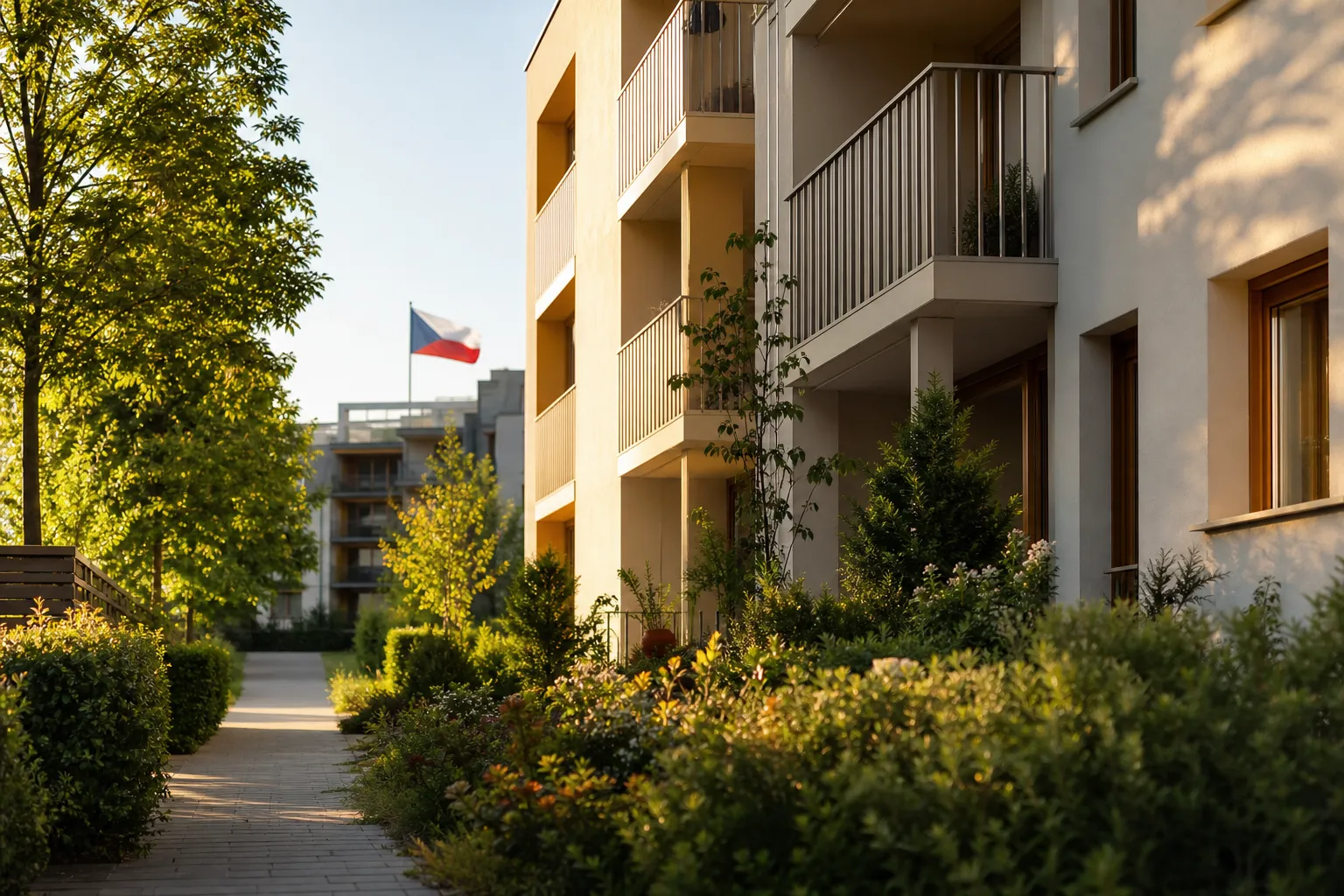
A homeowners association czech republic buyers encounter is almost always a společenství vlastníků jednotek (SVJ), the statutory body that governs an apartment building and binds every unit owner from the moment title is registered. For expats purchasing a flat in Prague, Brno or anywhere else in the country, understanding how the SVJ works is not optional: it determines your monthly costs, your voting power, your exposure to shared debts, and your obligations when the building needs major repairs. The stakes have risen with the new Czech building legislation that took effect in 2024, which reshaped permitting and maintenance obligations and has made careful due diligence on SVJ finances more important than ever.
This guide walks you through what an SVJ is, what you will pay, how to investigate liabilities before you sign, and how disputes are resolved, with practical checklists and sample contract language throughout.
This article is written for expats buying or investing in Czech apartments, along with their lawyers, lenders and property managers. It covers what an SVJ is, how recent building-law reform affects repairs and permits, fees and reserve funds, a due-diligence checklist, dispute-resolution options, sample contract language and concrete next steps. It is general information, not legal advice, always instruct a qualified Czech lawyer before committing to a purchase.
An SVJ is a legal entity created to manage the common parts of a building divided into separately owned units. In practical terms, it is the Czech equivalent of a homeowners association or condominium association. Under current Czech law, an SVJ must generally be formed and registered once a building is divided into units owned by several different owners. The association holds its own legal identity, keeps accounts, enters into contracts for services, engages a property manager, and makes collective decisions through its assembly.
The homeowners association czech republic law treats as a distinct juridical person is therefore not just an informal residents’ committee, it can sue, be sued, hold reserve funds, and enforce debts against members. Understanding this corporate character is the first step for any foreign buyer.
Ownership of flats and the governance of unit-owner associations are governed primarily by the Czech Civil Code (Act No. 89/2012 Coll.), which since 2014 has regulated unit ownership and the SVJ. Older arrangements were previously governed by Act No. 72/1994 Coll., on ownership of flats, which was repealed when the Civil Code took effect, although some transitional questions can still arise for older buildings. Buyers should ask their lawyer to confirm which statutory provisions apply to their specific building, as the applicable rules can depend on when the building and the association were constituted.
Membership of the SVJ is inseparable from ownership of a unit. You do not apply to join and you cannot resign while you own the apartment. Membership arises in connection with your ownership right being recorded in the land register (katastr nemovitostí). This has an important consequence: you inherit the building’s collective situation, its reserve fund, its obligations, its disputes, as soon as you take title. That is why diligence on the SVJ before completion is as important as diligence on the flat itself.
Buyers frequently confuse an SVJ with a housing cooperative (bytové družstvo). In an SVJ you own your unit outright and share ownership of common parts. In a bytové družstvo, the cooperative owns the building and you own a membership share that gives you the right to use a flat, you are a tenant-member rather than an owner. The two structures carry very different rights, financing arrangements and risks, as the comparison below shows.
An SVJ is governed by its assembly of owners (shromáždění) and by an elected statutory body, commonly a committee (výbor) or a single appointed administrator (předseda společenství). The assembly is the supreme decision-making body; the statutory body handles day-to-day management and executes the assembly’s resolutions. The statutes (stanovy) set out how meetings are convened, notice periods, quorum requirements, voting thresholds and the scope of the board’s authority.
The stanovy are the association’s constitution. They govern practically every question a buyer cares about: how votes are weighted (usually by co-ownership share), what majorities are needed for ordinary versus extraordinary decisions, how the reserve fund is used, and how the board is elected. Before purchasing, always obtain the current version of the stanovy and the minutes of the most recent assembly. Outdated or poorly drafted statutes are a common source of later disputes.
Voting power normally tracks the size of each owner’s co-ownership share in the common parts, so a larger flat generally carries a larger vote, unless the stanovy provide otherwise. Ordinary business is typically decided by a majority of those present, while significant matters, such as substantial alterations to common parts or a special assessment for major works, may require a qualified majority under the stanovy or the Civil Code. Classic pitfalls include failure to achieve quorum, defective notice of meetings, and resolutions passed outside the proper procedure, any of which can be challenged in court. Check that recent resolutions were validly adopted, particularly any approving large expenditure.
Yes. A foreign national who owns a unit has the same voting rights as any other owner and may stand for and serve on the statutory body. In practice, the challenges are linguistic and logistical rather than legal: assemblies are conducted in Czech, minutes and statutes are in Czech, and resolutions must be understood precisely. Many expat owners appoint a proxy or rely on a bilingual property manager or lawyer to participate effectively. If you intend to be active in governance, budget for translation support and confirm that the stanovy permit proxy voting.
| Feature | SVJ (unit owners’ association) | Bytové družstvo (housing cooperative) | Property management without SVJ |
|---|---|---|---|
| Legal form | Separate legal entity; owners hold units with shared common parts | Cooperative owns the whole building | Contractual service arrangement only |
| Who is a member/owner | Each unit owner, automatically on registration | Cooperative members holding shares | Individual owners engaging a manager |
| Key governance body | Assembly of owners and elected statutory body | Members’ meeting and cooperative board | No collective body; owners instruct directly |
| Common financing method | Monthly advances plus a long-term repair fund | Membership contributions and cooperative budget | Fees per service contract; no mandatory reserve |
| Typical buyer risk | Shared debts and special assessments attaching to the unit | Restrictions on transfer; you buy a share, not title | No reserve for major repairs; fragmented liability |
The running costs of a flat within a homeowners association czech republic buyers acquire fall into two broad categories: recurring advances for services and contributions to the repair/reserve fund, with occasional special assessments on top. Getting your head around these numbers is essential to budgeting accurately and to pricing the purchase correctly.
Monthly advances for services (zálohy na služby) cover the operating costs of the building. Typical line items include:
Advances are set in the annual budget and allocated between owners by formulas in the stanovy and in accordance with the applicable service-charge rules, usually a mix of co-ownership share, metered consumption and per-unit charges. At year end the SVJ reconciles actual costs against advances paid, refunding overpayments or billing shortfalls.
As an illustration, consider a three-bedroom flat of roughly 80 square metres in a mid-sized Prague building. A realistic monthly figure might look like the worked example below. Treat these as indicative only, actual amounts vary enormously by building age, services and energy prices.
| Line item | Indicative monthly advance (CZK) |
|---|---|
| Heating and hot water | 2,500 |
| Cold water and sewerage | 900 |
| Common-area electricity and lift | 600 |
| Cleaning, waste and management | 1,200 |
| Building insurance | 400 |
| Repair/reserve fund contribution | 2,000 |
| Total monthly | 7,600 |
The figures above are purely illustrative and should not be relied upon for your budget; always obtain the actual figures for the specific building.
The repair/reserve fund (often called the fond oprav or a long-term advance for the upkeep of common parts) is the long-term savings pool used to finance major repairs and renewal of common parts, the roof, façade, lifts, risers and heating systems. Contributions are set by the assembly. The reserve fund balance is one of the single most important figures for a buyer: a healthy fund means future repairs can be met without sudden levies, while a depleted fund in an ageing building signals large special assessments ahead.
Recent reform of Czech building legislation bears directly on repair financing. By changing which works require permits or notifications and by sharpening obligations to maintain the building safely, the new rules can affect the timing and cost of required works. An SVJ that has deferred maintenance may face pressure to act, drawing down the reserve fund or triggering a special assessment. Ask the SVJ how the current rules affect its medium-term repair plan.
A special assessment is an extraordinary contribution levied for works outside the normal budget, a new roof, a lift replacement, a façade renovation. The critical question for buyers is whether an assessment approved before you take title can be charged to you as the new owner. As a general rule, debts linked to the management of the building that are attributable to the unit can pass to the new owner together with the unit, so a buyer may inherit an approved but unpaid assessment.
The practical protections are to obtain a written statement from the SVJ confirming there are no outstanding assessments or arrears (a document the seller is legally required to procure for the transfer of a unit), and to use an escrow holdback or a seller indemnity to cover any assessment declared between contract and completion.
Every unit owner has the right to use and enjoy their flat and to share in the use of common parts, balanced by the obligation to contribute to their upkeep and to respect collective decisions. The recent reform of Czech building legislation recalibrated the maintenance and permit landscape, which has direct consequences for how SVJs plan and finance repairs.
Common parts are those elements of the building serving more than one unit, foundations, load-bearing structures, roof, façade, staircases, lifts, shared utility lines and the land beneath the building. Costs of maintaining and renewing common parts are shared among owners, typically in proportion to co-ownership shares, unless the stanovy provide otherwise. Disputes often turn on the boundary between what is a common part (SVJ responsibility) and what lies within the unit (owner responsibility), for example windows, balconies or internal pipework. Review the stanovy carefully to understand where this line falls in your building.
Reform of Czech building legislation has altered which categories of building work require a permit and which can proceed on a simpler notification basis, and it reinforced owners’ and associations’ duties to keep the building in a safe and sound condition. For an SVJ, the practical effects can include clearer but sometimes more demanding obligations to carry out and document maintenance, and changed procedures for approving and executing major works. For a buyer, the key implications are: budget for the possibility that deferred repairs will have to be brought forward; confirm the SVJ has a current repair plan that accounts for the applicable rules; and check that any recent or planned works comply with the current permit or notification requirements.
Where a building has a significant backlog, the likely practical effect will be upward pressure on reserve fund contributions and special assessments. Consult the Ministry of Regional Development guidance and your lawyer for the detail applicable to your building.
Diligence on the SVJ is the single most effective way to avoid nasty surprises. Because you inherit the association’s collective position on completion, you must investigate it before you commit. Ask your lawyer to obtain and review the following from the seller or directly from the SVJ.
Beyond the documents the seller supplies, run independent checks. Obtain an extract from the land register (katastr nemovitostí) via ČÚZK to verify ownership and any encumbrances registered against the unit. Search the insolvency register (ISIR on justice.cz) for proceedings affecting the seller, the SVJ or significant co-owners, insolvency among owners can leave the association unable to collect contributions, straining its finances. Finally, insist on a dated written statement from the SVJ confirming the unit’s outstanding balance; this is your best evidence of the position at completion.
Even a well-run association generates disagreements. The most common disputes concern non-payment of contributions, refusal to permit works, defective works executed by or for the SVJ, and challenges to the validity of assembly resolutions. Knowing the routes to resolution helps buyers assess risk realistically.
The first step is almost always internal: raise the issue with the statutory body, request that it be placed on the agenda of the next assembly, and ensure your objection is minuted. Many disputes are resolved by a correctly adopted resolution. Where a resolution itself is defective, adopted without quorum, proper notice or the required majority, an affected owner can apply to court to have it reviewed, subject to statutory time limits. Keep careful records and act promptly, as delay can forfeit the right to challenge.
Mediation offers a faster, cheaper and less adversarial route than litigation, and is well suited to neighbour-type disputes within a building. A sample dispute-resolution clause for an owners’ agreement might read: “The parties shall first attempt to resolve any dispute arising from the management of the common parts by mediation conducted by a registered mediator before commencing court proceedings.” Mediation preserves relationships that, in a shared building, you will have to live with for years.
Where agreement fails, disputes proceed through the civil courts, with the Supreme Court of the Czech Republic providing guidance on recurring questions such as the review of SVJ resolutions and the recovery of unpaid contributions. The SVJ can pursue defaulting owners through debt recovery and enforcement, and in serious cases through insolvency steps. For a buyer, the point is that an association with the will and the records to enforce contributions is financially healthier than one that tolerates arrears. Litigation timelines and costs vary widely, so factor potential disputes into your risk assessment.
Well-drafted contract protections can neutralise much of the SVJ risk identified in diligence. The following illustrative clauses should always be tailored by a Czech lawyer to your transaction and the specific stanovy.
These clauses are illustrative only and are not a substitute for professional drafting.
This article was produced by Global Law Experts. For specialist advice on this topic, contact Martina Kačerová at Caring Legal, a member of the Global Law Experts network.
Instruct a Czech real estate lawyer early, ideally before you sign a reservation agreement. Request the full SVJ document set, order extracts from the land register and searches of the insolvency register, and build a finance contingency for possible special assessments. For broader context, see our Real Estate Lawyer, Czech Republic practical guide. Supporting guides on spotting SVJ liabilities during due diligence, resolving SVJ disputes, and budgeting for service charges and reserve funds complement this pillar article.
posted 25 minutes ago

posted 1 hour ago

posted 2 hours ago

posted 2 hours ago
posted 2 hours ago

posted 3 hours ago
posted 3 hours ago

posted 3 hours ago

posted 3 hours ago

posted 3 hours ago

posted 4 hours ago

posted 4 hours ago
No results available
Find the right Legal Expert for your business

Send welcome message