
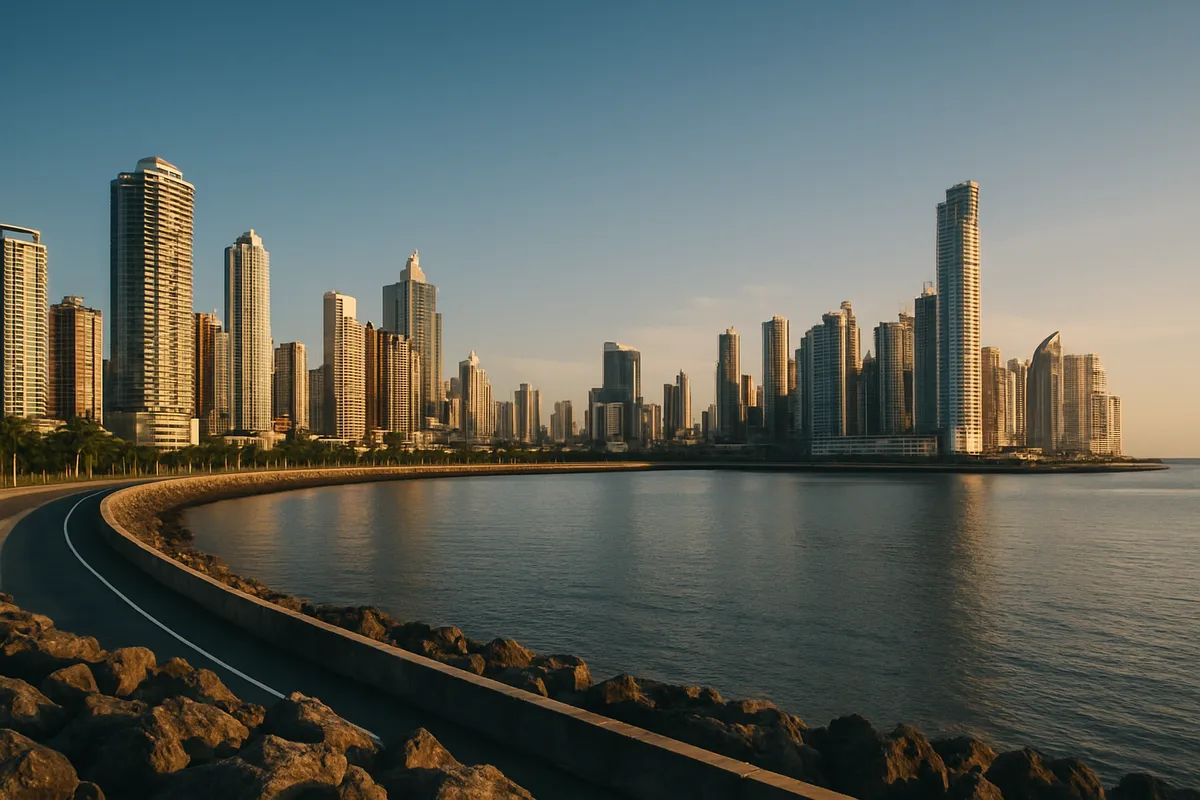

The Friendly Nations Visa Panama programme remains one of the most sought-after residency routes in Latin America, offering nationals of more than fifty eligible countries a streamlined path to live, work and invest in one of the region’s most stable economies. Created by Decreto Ejecutivo No. 416 of 13 June 2012 and significantly amended by Decreto Ejecutivo No. 197 of 7 May 2021, the programme gives applicants provisional residency and ultimately a route to permanent residency and citizenship through three principal economic pathways: a fixed-term bank deposit, a real-estate purchase, or employment and company sponsorship.
This guide is designed for digital nomads, remote workers, retirees, investors and families who are researching Panama residency and want authoritative, primary-source guidance on eligibility, documents, costs, timelines and the pathway from temporary residency through to naturalisation.
Panama uses the US dollar as legal tender alongside the balboa, eliminating currency risk for dollar-denominated earners and investors. The country operates a territorial tax system; income earned outside Panama is generally not subject to Panamanian income tax. Panama City offers modern healthcare infrastructure, a well-connected international airport (Tocumen) with direct flights to major cities across the Americas and Europe, and a growing ecosystem for remote-work professionals. Its geographic position, robust banking sector, and treaty network make it a compelling base for internationally mobile individuals and families seeking a second citizenship overview.
The Servicio Nacional de Migración (SNM) maintains the official list of qualifying nationalities. As of the most recent published decrees, more than fifty countries are included, among them the United States, Canada, the United Kingdom, most EU member states, Australia, Japan, South Korea, Israel, and several Latin American nations. The SNM website publishes the current list; applicants should verify their nationality’s inclusion before commencing the process, as countries may be added or removed by executive decree.
The Friendly Nations Visa Panama framework offers three lawful routes for demonstrating an economic or professional tie to the country. Each pathway has distinct requirements, timelines, and suitability depending on the applicant’s profile. The comparison table below provides a practical overview; all monetary thresholds should be verified directly with the SNM and your Panamanian bank, as official requirements may evolve through executive decree amendments.
| Pathway | Typical Economic Requirement (verify with SNM / banks) | Who It Suits | Typical Process & Timeline to Provisional Residency | Pros / Cons |
|---|---|---|---|---|
| Fixed-term deposit (bank deposit) | Historical references cite small deposits (e.g., USD 5,000); post-2021 enforcement and qualified-investor streams may require larger amounts. Market reports cite figures up to USD 200,000 for certain investor categories. Confirm with SNM. | Passive investors, remote workers wanting simple proof of funds | Open bank account → make qualifying deposit → file with SNM → provisional residency (typically weeks to several months) | Pros: relatively quick paperwork, no property transaction. Cons: bank due-diligence requirements, thresholds subject to regulatory change. |
| Real-estate purchase | Market-dependent; investment-route guidance commonly cites USD 200,000+ in practice. Confirm current rules with SNM. | Investors seeking a tangible asset and local ties | Purchase property → submit registered title deed + proof of payment → file with SNM → provisional residency | Pros: tangible asset, potential rental income. Cons: transaction costs, transfer taxes, market risk. |
| Employment/company sponsorship | Employer files with MITRADEL; evidence of genuine business operations and MITRADEL work permit required | Professionals with a job offer or founders of a real company in Panama | Company formation or employment contract → MITRADEL work permit → SNM residency filing → provisional residency | Pros: straightforward for genuine employees/founders. Cons: employer compliance obligations, MITRADEL quotas and classification requirements. |
Under this route, the applicant places a qualifying sum in a fixed-term deposit (depósito a plazo fijo) at a licensed Panamanian bank. The bank issues a reference letter and deposit certificate, which are submitted as part of the SNM petition. Applicants should expect rigorous bank due diligence: proof of the lawful origin of funds, identity verification and compliance screening are standard. Some banks may require an escrow or locked-term arrangement. A notarised affidavit of funds and a bank guidance letter confirming the deposit’s terms are typically advisable. Historically, online sources have cited a deposit as low as USD 5,000; however, following the 2021 amendments under Decreto Ejecutivo No. 197, stricter enforcement and higher thresholds have been reported by market observers. Applicants should always confirm the official deposit requirement directly with the SNM and their chosen bank before filing.
Purchasing Panamanian real estate provides a tangible economic tie. The process begins with a thorough title search at the Public Registry (Registro Público) to confirm clean title. Buyers pay transfer tax (currently calculated as a percentage of the registered value or sale price, whichever is greater), notary fees, and registration costs. The registered deed (escritura pública) and proof of payment, whether through bank transfer records, escrow documentation or a certified cheque, are submitted to the SNM alongside the residency petition. Applicants are advised to obtain an independent property valuation and retain documentary proof of all transaction stages. Common pitfalls include incomplete title searches, undervaluation and missing proof-of-payment documentation.
Applicants with a genuine job offer from a Panamanian employer, or those establishing a real company in Panama, may use the employment/company pathway. This route requires compliance with the Ministry of Labour (MITRADEL) work-permit classification system. Employers must demonstrate that the position meets MITRADEL’s foreign-worker quotas and labour requirements, including local payroll registration and social-security enrolment. Company founders must show genuine business operations; paper companies without real activity are a common compliance risk. The typical timeline involves obtaining the MITRADEL work permit first (or concurrently), then filing the residency petition with the SNM. Processing times depend on MITRADEL review and SNM administrative schedules.
All foreign-issued documents must be apostilled if the issuing country is a party to the Hague Apostille Convention, or consularly legalised if it is not. Each document must then be officially translated into Spanish by a certified translator in Panama. The apostille process varies by country; for instance, U.S. documents may be apostilled by the relevant state’s Secretary of State, while UK documents are apostilled by the Foreign, Commonwealth & Development Office. Applicants should prepare a documents tracker listing each required item, its apostille status and translation status. A downloadable residency checklist is a valuable planning tool for applicants managing this process across jurisdictions.
Government filing fees include the SNM petition fee, Gaceta Oficial publication charge and Treasury stamps (timbres fiscales). Fee amounts are set by the SNM and may be revised; applicants should confirm exact figures at the time of filing via the SNM portal. Additional costs apply for the issuance of the provisional residency card and, later, the permanent residency card.
Beyond government fees, applicants should budget for the following (ranges are estimates and will vary by service provider):
| Milestone | Estimated Timeline |
|---|---|
| Document preparation & apostille | 2–8 weeks (varies by country) |
| SNM filing to provisional residency approval | Approximately 3–6 months (administrative processing varies) |
| Provisional residency to permanent residency conversion | Approximately 2 years from initial grant |
| Permanent residency to naturalisation eligibility | Typically 5 years of legal residence (constitutional requirements apply) |
All timelines are estimates. Actual processing depends on SNM workload, document completeness and pathway-specific requirements. Applicants should seek client-specific guidance from qualified local counsel.
The Friendly Nations Visa Panama framework allows the primary applicant to include qualifying dependents. Eligible dependents typically include the legal spouse and unmarried children. Dependent applications are filed alongside or shortly after the primary applicant’s petition. Required documents for dependents include:
Additional government fees apply per dependent. Applicants should consult the SNM for the most current rules on dependent eligibility, age limits and documentation standards, as these may be updated by decree.
The Friendly Nations Visa Panama programme follows a two-step residency structure. Applicants first receive provisional (temporary) residency, created under the framework established by Decreto Ejecutivo No. 416 of 2012 and refined by the 2021 amendments. After maintaining the provisional status and complying with all conditions for the prescribed period, typically two years, the applicant files for conversion to permanent residency with the SNM, submitting updated documentation and evidence of continued economic ties.
Once permanent residency is secured, the applicant may begin to accrue time toward naturalisation eligibility. Under the Constitution of the Republic of Panama, ordinary naturalisation typically requires five years of legal, continuous residence. However, the Constitution provides for reduced timeframes in certain circumstances for example, applicants with Panamanian-national spouses or children born in Panama may benefit from accelerated paths. Reciprocity provisions between Panama and the applicant’s country of origin may also apply.
Practical considerations for naturalisation include:
For a detailed timeline and constitutional references, see the path to naturalization in Panama guide.
The following short video guides complement this article and provide visual walkthroughs of the Friendly Nations Visa Panama process:
posted 17 seconds ago

posted 20 minutes ago

posted 28 minutes ago

posted 40 minutes ago

posted 1 hour ago

posted 1 hour ago

posted 2 hours ago

posted 2 hours ago

posted 2 hours ago

posted 3 hours ago
posted 3 hours ago

posted 4 hours ago
No results available
Find the right Legal Expert for your business

Send welcome message