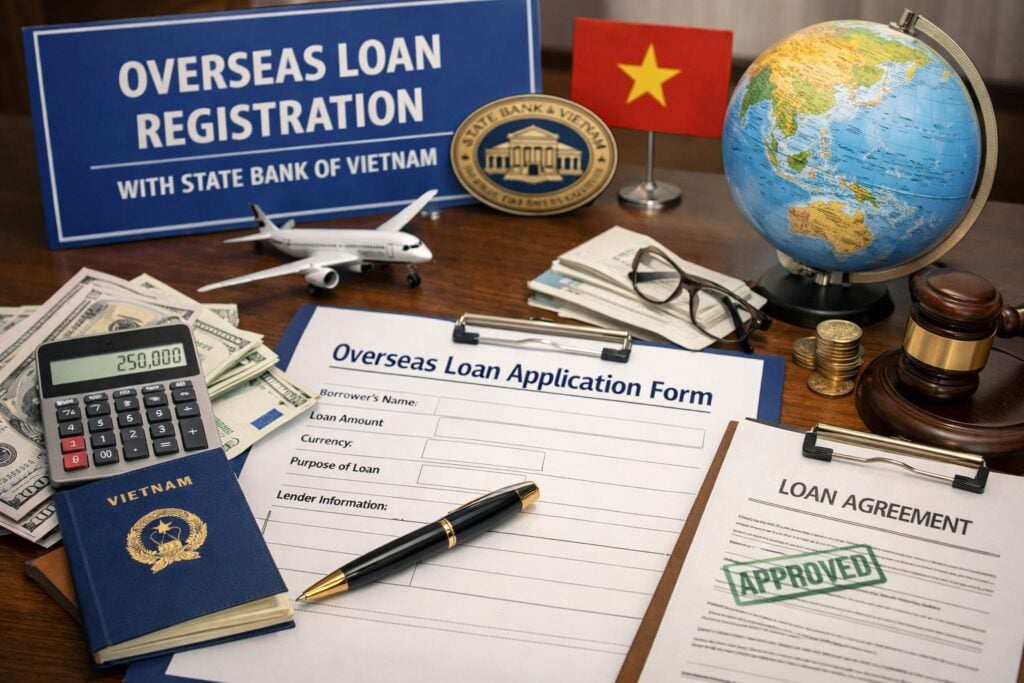
In the effort to quickly secure working capital, many businesses consider short term foreign loans as a “lifeline” thanks to their relatively simple procedures and the absence of a registration requirement with the State Bank of Vietnam. However, the boundary between convenience and legal risks is exceedingly fragile when errors regarding the purpose of capital utilization or delays in conversion registration can lead to fines of up to hundreds of millions of dong. More severely, enterprises may fall into a situation of being unable to complete the registration dossier to execute debt repayment obligations, leading to the risk of delayed payment and a deadlock in handling the received loan cash flow.
This article points out common violations and suggests 05 options to help enterprises proactively manage risks upon loan maturity.
Understanding the nature of short term foreign loans
Although commonly viewed as a quick solution for boosting working capital, short term foreign loans are, in fact, subject to stringent legal requirements governing their purpose of use, scope, and the timeline for registration when converted into medium or long term loans.
Under current regulations, a short term foreign loan is defined as a borrowing that is not guaranteed by the government, has a maximum tenor of 01 year, and operates on the principle of self-borrowing and self-repayment[1]. As such loans are not required to be registered with the State Bank of Vietnam at the outset, they are commonly used by enterprises in urgent need of operational funding. However, the simplicity of the procedures frequently leads to complacency, resulting in violations during the use of loan proceeds or when the loan must be converted into a medium or long term facility in accordance with legal requirements.
What is short term loan capital used for?
Pursuant to Article 17.1 of Circular No. 08/2023/TT-NHNN stipulating the purposes of using short term foreign loans (Circular 08), enterprises are only permitted to use short term foreign loans for two purposes including restructuring foreign debts, or paying short term debts payable in money, arising during the implementation of investment projects or production – business operations or other projects of the borrower, as determined in accordance with current regulations on corporate accounting.
It should be noted that short term foreign loans may not be used to repay the principal of domestic loans, nor may they be allocated to long term plans such as capital contribution or on lending to other enterprises. This legal boundary is one that many businesses inadvertently cross in practice, resulting in violations related to improper use of loan proceeds. For this violation, enterprises may be subject to a fine of up to VND 400,000,000 pursuant to Decree No. 340/2025/ND-CP regulating administrative penalties in the monetary and banking sector.[2]
Obligation to register the conversion of short term loans into medium and long term loans
Regarding the registration timeline, enterprises are required to complete the registration procedure within 60 days from the date marking 01 full year from the first loan disbursement. Except in the case where the borrower completes the obligation to repay the entire principal debt within 30 working days from the date exactly 01 year after the first fund withdrawal, in which case conversion registration with the State Bank is not required.[3]
When registering the loan conversion, enterprises must submit a report on the use of the short term loan, accompanied by documents proving that the capital source has been used for the correct purposes in accordance with regulations. The dossier may include contracts related to the relevant expenditures, bank statements, invoices, payment vouchers, and records evidencing the settlement of short term liabilities using the borrowed funds. The purpose of this requirement is to ensure that the original loan complied with legal conditions and is eligible for conversion.
In practice, many enterprises encounter difficulties due to incomplete documentation, accounting records that do not align with actual cash flows, or the use of funds for improper purposes. In such cases, borrowers are often required to provide repeated explanations and may even be denied registration confirmation, exposing them to the risk of being unable to meet repayment obligations on time. As a result, strict management of documentation, cash flows, and spending purposes from the disbursement date is a critical factor in mitigating risks when undertaking conversion registration procedures at a later stage.
Options for handling short term foreign loans as registration deadlines approach
As a short term foreign loan nears the point at which it must be registered for conversion into a medium or long term loan, enterprises should promptly assess their repayment capacity and select an appropriate course of action to avoid regulatory violations. Under current regulations, borrowers are granted a 30 working day period from the date marking 01 full year from the first disbursement to fully settle the loan without being required to carry out the conversion registration procedure. This period is regarded as a safety buffer, allowing enterprises to proactively address their debt obligations while minimizing the associated administrative burden. Based on our practical experience, enterprises may consider applying one of the following options, depending on their specific circumstances:
1. Settling the loan prior to the registration deadline
This is the simplest and safest option to avoid the obligation to register the conversion of a short term foreign loan into a medium or long term loan. However, this approach is only suitable for enterprises with sufficient financial capacity to fully settle the outstanding principal within the prescribed timeframe, avoiding the occurrence of violations regarding the deadline.
2. Repaying the debt with goods or services
Where cash repayment is not feasible, enterprises may negotiate with the lender to settle the debt through the provision of goods or services. This option helps ease cash flow pressure while allowing the borrower to leverage its existing production or business capabilities. In practice, this method is often more feasible when the parties have an established commercial relationship, as prior transactions facilitate valuation and execution of the repayment arrangement.
3. Converting the outstanding debt into equity interest in the borrower
This option is frequently chosen by enterprises as a means of easing repayment pressure while increasing equity capital and strengthening overall financial capacity. However, to ensure regulatory compliance, businesses should initiate the conversion procedures as early as possible before the repayment deadline. Following the transaction, the lender is regarded as a foreign investor. As a result, the conversion must fully comply with regulations governing market access conditions applicable to foreign investors. This requires enterprises to review their registered business lines so as to determine whether foreign investor participation is permitted and whether any accompanying restrictions apply. Enterprises must also assess the potential obligation to carry out investment related procedures, such as registration of capital or equity acquisition, or obtaining approval from competent authorities in accordance with investment laws.
Although bringing many financial benefits, the option of converting debt into contributed capital or shares requires the enterprise to carefully prepare dossiers, procedures, and implementation plans. Executing fully and in the correct sequence is a crucial factor for the transaction to be approved by the regulatory authority and to avoid legal risks that may arise.
4. Converting debt into equity interest owned by the borrower in another enterprises
Unlike the form of converting a loan into equity interest in the borrowing enterprise itself, in this option, the outstanding debt will be converted into the equity interest that the borrower is owning in another enterprise. This approach is particularly suitable for corporate groups or enterprises with layered ownership structures, where the handling of the loan is combined with internal ownership restructuring.
However, this is a technically complex option that requires careful review of investment law requirements, capital transfer regulations, and related tax obligations.
5. Debt write off
In certain cases, the lender may agree to write off all or part of the outstanding debt owed by the borrower. This option can serve as a financial lifeline, allowing enterprises to immediately reduce financial pressure, particularly when cash flow conditions are strained, the lender prospects for debt recovery are no longer viable, or the registration for converting a short term foreign loan into a medium or long term loan with the State Bank of Vietnam is not approved.
However, this option is generally appropriate only where the lender is the parent company or a shareholder of the borrower. In addition, enterprises should also exercise caution when adopting this approach, as the written off portion of the debt will be recognized as other income of the borrower and may give rise to corporate income tax liabilities. Accordingly, debt write off should be considered only when there is a high level of consensus from the lender, and where the borrower is able to fully address the associated legal and tax implications.
Concluding Remarks
Short term foreign loans offer significant flexibility for enterprises facing urgent working capital needs, particularly in situations where registration procedures with competent authorities may be time-consuming. However, this convenience also carries inherent risks if businesses fail to closely control the use of loan proceeds or delay completing the required registration procedures with the State Bank of Vietnam once the loan reaches the relevant threshold.
To mitigate risks and ensure legal compliance, enterprises should proactively manage documentation and cash flows from the moment of disbursement, closely monitor key loan timelines, and assess their financial capacity in order to select the most appropriate course of action. At the same time, advice from legal professionals should be sought when implementing technically complex transactions such as the conversion of debt into capital contribution. Proper preparation and timely execution not only allow enterprises to make effective use of foreign loan capital but also help prevent legal risks that could result in serious financial consequences.
Than Trong Ly – Partner
Nguyen Thi Hong Nhung – Associate
DIMAC Law Firm
[1] Article 3.1 of Circular No. 08/2023/TT-NHNN stipulating the conditions for foreign loans not guaranteed by the Government
[2] Articles 27.7(a) and 5.3(a) of Decree No. 340/2025/ND-CP regulating administrative penalties in the monetary and banking sector
[3] Article 4 of Circular No. 80/2025/TT-NHNN amending and supplementing a number of articles of Circular No. 12/2022/TT-NHNN guiding foreign exchange management for enterprises’ foreign borrowing and debt repayment