The legal system governing contracts is founded upon a well-established principle that a contract constitutes the law of the parties, and that the obligations agreed upon by the parties at the time of concluding the contract must be performed in accordance with what the parties have agreed. However, despite the firmness of this principle, it cannot be separated from the economic reality within which contractual relationships operate. The law recognizes that certain exceptional events may occur beyond the expectations and control of the parties, thereby substantially affecting their ability to perform their obligations. From this perspective, the doctrine of force majeure emerged as a legal mechanism that balances contractual stability with the requirements of justice when exceptional circumstances intervene and disrupt the equilibrium of the contractual relationship.
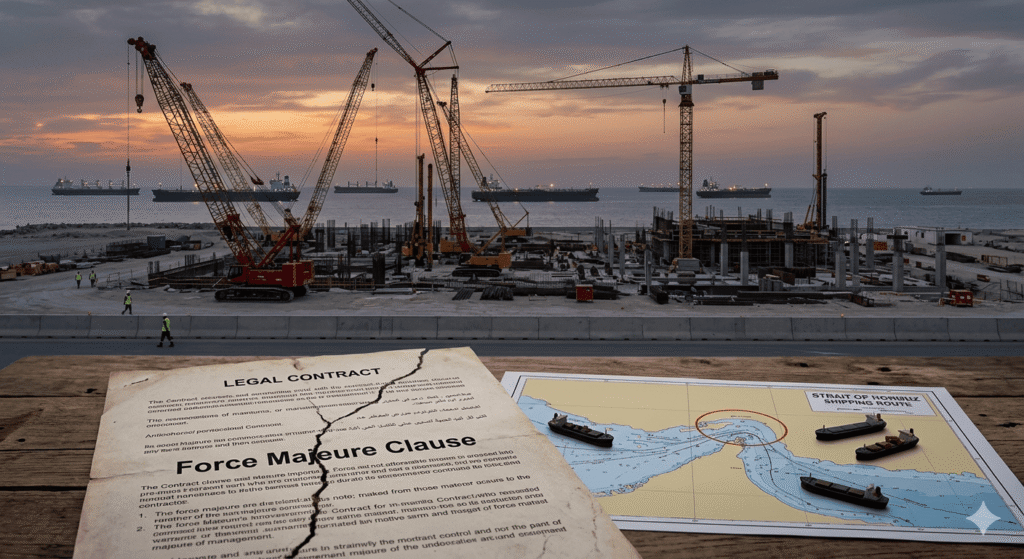
The recent war in the region has once again highlighted the practical significance of this doctrine, as its repercussions have extended beyond the military dimension to affect economic and commercial activities. The tensions witnessed in the Arabian Gulf region, together with the associated security risks in the surrounding airspace and vital maritime routes—most notably the Strait of Hormuz—have had a direct impact on trade and transportation flows and on the smooth functioning of international supply chains. In certain instances, this has resulted in increased shipping and insurance costs, delays in the supply of equipment and essential materials, and even prompted some international companies to reassess the risks of operating in the region.
The effects of these developments are particularly evident in construction and major project contracts. By their nature, such contracts involve complex obligations, precise timelines, and reliance on an extensive network of suppliers and subcontractors. In projects of this kind, any widespread disruption in transportation or supply chains may lead to the suspension of certain phases of execution or delays in the delivery of materials and equipment essential to the project. When such a disruption results from exceptional circumstances beyond the control of the parties, the question arises as to whether this situation constitutes a case of force majeure that justifies the suspension of the obligation or the exemption of the affected party from contractual liability.
Legal doctrine has established that force majeure occurs when an exceptional and unforeseeable event takes place beyond the control of the parties, which cannot be prevented nor its consequences avoided, and which renders the performance of the obligation impossible or substantially impracticable. Wars and armed conflicts are among the most prominent traditional examples of such circumstances, particularly when they result in the disruption of transportation, the closure of maritime passages, or the inability to obtain essential materials required for the performance of the contract.
Nevertheless, invoking force majeure in contractual relations does not occur automatically. It requires proof that the exceptional event has had a direct impact on the performance of the obligation. For example, if circumstances related to war lead to the inability to import essential equipment required for a project, disrupt transportation routes relied upon by a contractor in construction contracts, or result in the imposition of restrictions that hinder the continuation of work, such facts may collectively constitute a case of force majeure. This may justify extending the period for performance, suspending certain contractual obligations, or even terminating the contract in certain circumstances.
These developments have prompted many modern contracts—particularly those related to large-scale projects—to place increasing emphasis on force majeure clauses and to regulate their legal consequences with greater precision, in a manner that allows the contractual relationship to regain its balance when exceptional circumstances impose themselves upon economic reality.
In light of the rapid and ongoing transformations occurring in the region, it has become clear that the doctrine of force majeure is no longer merely a traditional theoretical concept. Rather, it has become a necessary practical tool for regulating contractual relationships. Contracts, no matter how carefully drafted, remain connected to the circumstances surrounding their performance. Accordingly, the proper assessment of risks and the careful drafting of force majeure clauses with deep legal awareness are essential to ensuring the stability of major projects and preserving contractual equilibrium in the face of exceptional events.
Lawyer Amal Zuhair
Ebtisam Alsabbagh Attorneys