
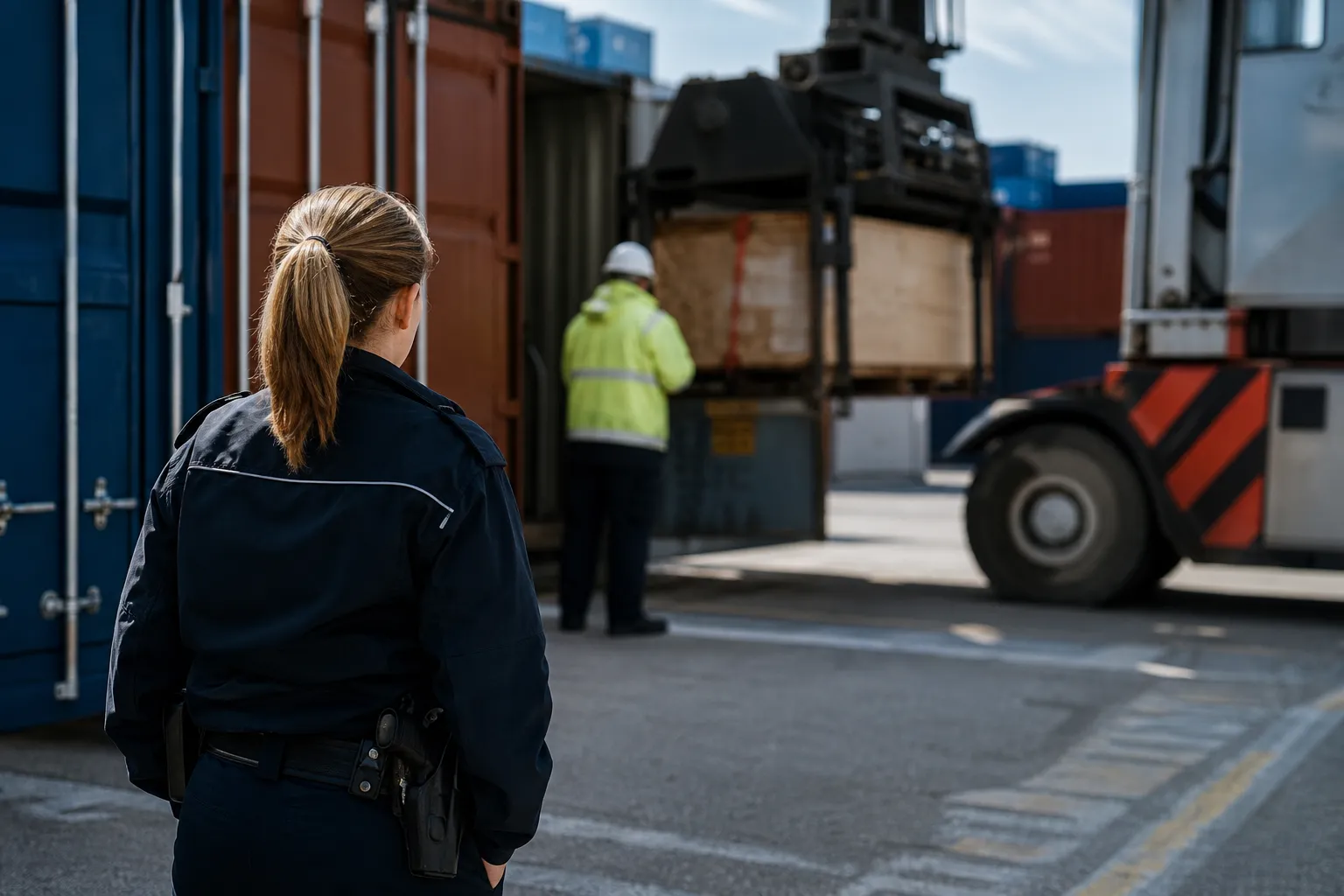
Export control compliance germany is no longer a concern reserved for large corporates and defence contractors, in 2026, small and mid‑market exporters are squarely in the enforcement spotlight. Expanded dual‑use lists, new sanctions entries and visibly stepped‑up checks by BAFA and German Customs (Zoll) mean that an SME shipping software, components or technical data can trigger a licence requirement or a sanctions breach without ever intending to. This guide is a practical, prescriptive roadmap for SME compliance officers, export managers, in‑house counsel and CEOs who need to decide quickly whether they face licence or sanctions risk, implement a proportionate programme, and know exactly when to escalate to specialist counsel.
It takes a position: most German SMEs should start with a lightweight, well‑documented programme and scale up only when their risk profile demands it. Throughout, every regulatory claim is anchored to the authoritative source so you can verify it yourself.
Who this guide is for: SME compliance officers, export managers, in‑house counsel and CEOs of German SMEs that export goods, software or technology.
Goal: Quickly assess licence and sanctions risk, implement a proportionate export‑control compliance programme, and recognise the triggers that require outside counsel.
This article offers general guidance only and is not legal advice. For a specific transaction, product or enforcement matter, seek qualified counsel.
If you suspect an export‑control or sanctions problem, an ambiguous order, a flagged counterparty, a product you are no longer sure is uncontrolled, or contact from an authority, the first three days matter more than almost anything that follows. Act deliberately and preserve your position.
A one‑page 72‑hour checklist is available to download so your team can act consistently under pressure. The discipline of the first 72 hours frequently determines whether an incident is resolved administratively or escalates into a criminal inquiry.
Effective export control compliance germany begins with understanding who sets the rules and who enforces them. The German regime sits inside the European Union framework, so SMEs must track both national and EU‑level instruments.
Four pillars define the landscape, and an SME compliance programme should reference each one:
SMEs routinely conflate these two regimes, and that confusion causes compliance failures. Export controls are item‑focused: they ask whether a specific good, piece of software or technology is listed or caught by a catch‑all because of its characteristics and potential end‑use. Sanctions are party‑ and destination‑focused: they restrict or prohibit dealings with named persons, entities, sectors or countries, regardless of what you are exporting. A product might be entirely uncontrolled under dual‑use rules yet still blocked because the buyer is a designated entity. A robust export control compliance germany programme addresses both dimensions in parallel.
This is the question SMEs ask most often, and it has a structured answer. Whether you need a licence turns on four variables, and you must assess all of them for every transaction.
Do small companies in Germany need export licences? Sometimes, and the honest default for an uncertain SME is to treat the item as potentially controlled until proven otherwise. If any of the four triggers raises a flag, you must either obtain a licence or obtain a documented determination that no licence is needed.
The framework offers several authorisation routes. Individual licences cover a specified exporter, item, consignee and destination and are appropriate for higher‑risk or one‑off transactions. General authorisations (Union General Export Authorisations and national general licences) allow eligible exporters to ship defined items to defined destinations under published conditions without applying case by case, provided they register and comply with the applicable reporting requirements. For most SMEs, the practical path is to apply through the BAFA portal and rely on specialist counsel for complex, ambiguous or high‑value licences. Treat the decision tree as mandatory: assess item, destination, end‑use and end‑user for every order, and document the outcome even when the answer is “no licence required.”
Classification is the foundation of export control compliance germany. Get it wrong and every downstream control fails. Get it right and most of your licence and screening decisions become straightforward.
Classification combines commodity coding with a technical assessment:
Use authoritative primary sources only. Check Annex I of Regulation (EU) 2021/821 for the EU Dual‑Use List, and consult BAFA guidance for national lists and classification procedures. How do I classify dual‑use goods? Use CN/HS codes as a starting point, compare technical parameters against the EU Dual‑Use List, and consult BAFA guidance. Where meaningful commercial value depends on the outcome and the classification is genuinely ambiguous, request a formal determination from BAFA or obtain a written legal opinion rather than relying on an internal best guess. For example, an SME exporting industrial sensors, high‑specification machine tools or encrypted communications software should expect to perform a detailed technical comparison, these product families frequently sit close to control thresholds.
Sanctions compliance germany is an operational discipline, not a one‑off box‑tick. Because lists change frequently, screening must be systematic and repeatable.
Screen every party, customer, consignee, end‑user, intermediaries and known beneficial owners, before you accept an order, and re‑screen periodically because listings change. A lightweight SME should run regular automated screening of its active counterparties, plus a fresh check at the point of each new transaction. Higher‑risk exporters should screen continuously.
Low‑risk SMEs can operate effectively with low‑cost SaaS screening or periodic checks against the published lists, supported by a manual review of any hits. Higher‑volume or higher‑risk exporters should integrate screening into their ERP or CRM so that transactions can be blocked automatically before a shipment proceeds. A simple workflow, screen, record the result, escalate any hit to the compliance owner, hold the shipment until cleared, is enough for most small exporters, provided it is applied without exception.
Here the guide takes a clear position: do not copy a large corporate’s programme. A proportionate, well‑run lightweight programme beats an over‑engineered one that staff ignore. Build around four core functions, then scale each as your risk grows.
Maintain a basic risk register, a nominated compliance owner, standard operating procedures for sales and shipping, and the licence and screening decision points described above. These are the non‑negotiable minimum for any German SME that exports.
Train the people who actually touch exports, sales, shipping and order processing, not just management. A short annual e‑learning module plus role‑specific briefings is sufficient for a lightweight programme. Keep critical export documents, licences and screening logs in a central location in line with the applicable statutory retention periods; larger or higher‑risk SMEs should retain comprehensive audit trails. Note that retention obligations for commercial and customs records can extend for several years, so confirm the current applicable periods under German commercial, tax and customs law.
Define, in writing, what triggers an escalation, who receives it, and what happens next. Staff must know they can and must stop a shipment and raise a concern without penalty. A clear remediation path, investigate, document, correct, and consider self‑reporting, turns mistakes into managed incidents.
Review the programme at least annually and after any material change. Lightweight programmes can rely on periodic self‑checks; larger SMEs should conduct formal periodic audits.
How can an SME design a simple, proportionate programme? Appoint one owner, keep a risk register, screen regularly, write short SOPs, train the right people, and define escalation, then document everything. The comparison below sets out the two realistic models.
| Dimension | Lightweight SME programme (recommended starting point) | Full enterprise programme (larger / higher‑risk SMEs) |
|---|---|---|
| Typical volume / risk profile | Low–moderate value exports; limited restricted‑country trade | High volume, high‑value exports, complex supply chains, frequent controlled end‑uses |
| Core components | Basic risk register; one nominated compliance owner; regular automated sanctions screening; standard sale SOPs; basic training for shipping and sales staff | Dedicated compliance team; formal policies and procedures; detailed product classification unit; supplier/customer vetting; periodic audits |
| Documentation and recordkeeping | Central folder for licences and screenings, retained per statutory periods | Comprehensive audit trail, case management system |
| Licence handling | Use the BAFA portal; rely on external counsel for complex licences | Internal licence team plus counsel for high‑risk cases |
| Training | Short annual e‑learning plus role‑specific briefings | Formal curriculum, role‑based in‑person training, testing |
| Screening technology | Low‑cost SaaS / periodic checks | Integrated screening, ERP/CRM integration, transaction blocking |
| Indicative annual cost | Lower, in‑house effort plus occasional advisor | Higher, internal headcount plus tools plus counsel |
| Response to detention/inquiry | Immediate counsel contact; preserve records; ad‑hoc external counsel | In‑house lead with external specialist; established playbook |
| When it is sufficient | Simple products, low‑risk destinations, few controlled items | Controlled destinations/end‑uses, complex tech, or frequent licence needs |
| Decision speed | Fast to implement (weeks) | Months to implement, but scalable |
A risk assessment is the engine that keeps your programme proportionate. It tells you where to spend attention and where a light touch is justified.
Score each combination of product, customer, destination and transaction for likelihood and impact, then prioritise your controls against the highest scores. A simple high/medium/low matrix is enough for most SMEs. A downloadable risk matrix template lets you run this exercise in an afternoon and repeat it annually or whenever your product line, customers or destinations change.
An authority contact is a defining moment. Handle it well and most matters resolve; handle it badly and you compound the problem.
Self‑reporting can materially affect how a matter is treated, but it is a legal decision with consequences and should not be made reflexively. The disciplined sequence is: preserve records, establish the facts, obtain counsel’s assessment, then decide on self‑reporting and on the content and timing of any communication to the authority. Any formal response to Zoll or BAFA, including a sample explanatory communication, should be reviewed by counsel before it is sent. For detention, investigation or criminal exposure, engage counsel at the earliest possible stage.
The enforcement environment has hardened, and SMEs are no longer treated as low‑priority targets.
Breaches can attract administrative fines, revocation of licences and confiscation of goods. More seriously, the Außenwirtschaftsgesetz (AWG) and the Außenwirtschaftsverordnung (AWV) provide for criminal liability, with exposure depending on intent and the nature of the breach. Beyond the legal penalties, the commercial and reputational consequences, lost contracts, banking and insurance difficulties, and damaged counterparty trust, often exceed the fine itself.
Across recent years, the direction of travel has been towards expanded control lists, additional sanctions designations and more active checks by BAFA and Zoll, particularly in the wake of the extensive sanctions adopted since 2022. Industry observers expect this focus on smaller and mid‑market exporters to continue, particularly in technology‑intensive sectors where catch‑all controls and sanctions circumvention risk are highest. The likely practical effect for SMEs is that a credible, documented export control compliance germany programme now functions both as a risk reducer and as evidence of good faith if a matter is ever reviewed.
Most day‑to‑day compliance can sit in‑house. Certain situations, however, warrant specialist counsel without delay:
From counsel you should expect rapid factual triage, a clear view on licensing or self‑reporting, and representation in dealings with authorities. Many firms offer fixed‑fee or retainer arrangements scaled for SMEs, so that proportionate advice is available without unpredictable cost.
Export control compliance germany in 2026 rewards SMEs that act early, proportionately and in writing. The position of this guide is unambiguous: build a lightweight, disciplined programme now, one owner, a risk register, regular screening, short SOPs, targeted training and a clear escalation path, and scale to a full enterprise function only when controlled items, high‑risk destinations or frequent licensing genuinely require it. Classify correctly, screen every party, document every decision, and treat the first 72 hours of any incident as decisive. When Zoll detains a shipment, BAFA opens an inquiry, a criminal matter emerges, or a high‑value classification is unclear, engage specialist counsel immediately.
Done well, a proportionate export control compliance germany programme is not a cost centre but a commercial and legal safeguard that keeps your goods moving and your business protected.
This article is for general guidance only and does not constitute legal advice. For advice on a specific product, transaction or enforcement matter, consult qualified regulatory counsel.
This article was produced by Global Law Experts. For specialist advice on this topic, contact Dr. Carolin Raspe at YPOG, a member of the Global Law Experts network.

posted 20 minutes ago

posted 38 minutes ago

posted 56 minutes ago

posted 1 hour ago

posted 1 hour ago

posted 2 hours ago

posted 3 hours ago

posted 3 hours ago

posted 3 hours ago

posted 4 hours ago

posted 4 hours ago

posted 4 hours ago
No results available
Find the right Legal Expert for your business

Send welcome message