
Our Expert in Singapore
No results available
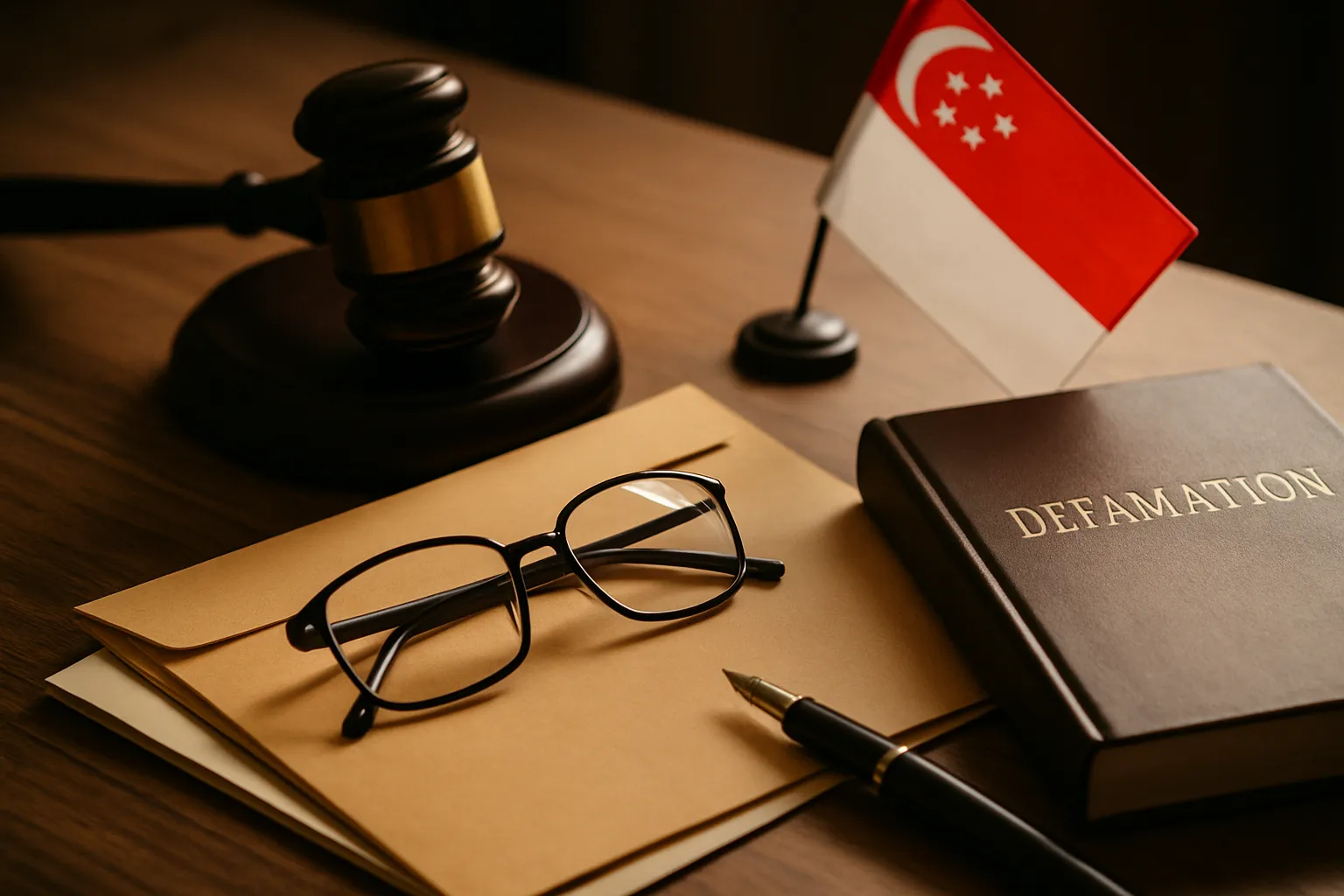
Defamation claims singapore start with one hard question: is the harm serious enough, and provable enough, to justify litigation? This practitioner-led decision guide gives you a direct answer rather than a hedge. If your reputation has suffered real, demonstrable damage from a false statement, you can be within jurisdiction, and you can fund the fight, suing is worth serious consideration, but for many cases a demand letter, takedown request or mediation delivers a faster, cheaper result. Updated for the 2026 civil justice landscape, this guide walks you through when to sue, the defences you will face, realistic costs, urgent remedies, and the practical steps to take in the first 72 hours.
Here is the short version before we go deep. Use these six points to orient your decision, then read the sections that matter to your situation.
Who this guide is for: individuals, SMEs and in-house counsel deciding whether to commence or defend a defamation action in Singapore, and needing a clear view on whether to pursue injunctive relief, settlement, or a full trial. This article is general information, not legal advice; obtain tailored advice before acting.
Defamation in Singapore is governed by a combination of common law principles developed through case law and statutory provisions, principally the Defamation Act 1957. The common law supplies the core cause of action; statute modifies and supplements it in specific areas, including certain defences and procedural matters. The legislation is available through Singapore Statutes Online, and leading judgments can be located via the Judiciary of Singapore.
To succeed, a claimant must generally establish three elements. First, that the statement is defamatory, that it lowers the claimant in the estimation of right-thinking members of society, exposes them to hatred, ridicule or contempt, or tends to make them shunned or avoided. Second, that the words refer to the claimant, either expressly or by reasonable inference. Third, that the statement was published, communicated to at least one person other than the claimant.
Once those elements are made out, the statement is presumed false and the burden shifts to the defendant to establish a defence. This presumption is a significant strategic advantage for claimants: you are not required to prove falsity as part of your case in chief. However, the presumption does not guarantee victory, because a defendant who proves the statement was substantially true will defeat the claim entirely.
Singapore draws a distinction between libel (permanent form, such as written or online publication) and slander (transient form, such as spoken words). Libel is generally actionable without proof of special damage, while slander often requires proof of actual loss unless it falls within recognised exceptions. Most modern disputes, particularly online publications, are treated as libel, which strengthens a claimant’s position because damage need not be separately proven.
Commentary and law-reform analysis from the Singapore Academy of Law and academic work published by NUS Law are useful for understanding how the courts have developed these principles, particularly as online and cross-border publication reshapes traditional doctrine.
This is the centrepiece of the guide, and it answers the most common question directly: when should I sue for defamation in Singapore? The honest answer is that litigation is one of several tools, and the right choice depends on the seriousness of the harm, the strength of your evidence, and your appetite for cost and publicity. Below is a side-by-side comparison of the realistic options, followed by a prescriptive decision framework.
| Option | When it fits | Speed to result | Typical cost range | Pros | Cons | Likely legal outcome |
|---|---|---|---|---|---|---|
| Commence full defamation suit (trial) | Serious, provable harm; monetary or reputational recovery sought; claimant can bear costs risk | Slow but final | Medium–High | Full vindication; damages & costs; precedent | High cost, public trial, long timeline | Damages if successful; costs recovery uncertain |
| Short-form demand letter + takedown request | Low–moderate harm; desire for apology/retraction; quick resolution preferred | Fast (days–weeks) | Low | Cheap, quick, private | Defendant may ignore; no enforceable damages | Often retraction/apology, or ignored |
| Interlocutory injunction / urgent takedown | Ongoing or repeat publication; urgent harm | Very fast (days) | Medium | Stops publication immediately | High threshold; may be overturned; expedited hearing costs | Temporary relief; may lead to full trial |
| Alternative dispute resolution (mediation) | Willing parties; reputational resolution priority | Weeks–months | Low–Medium | Confidential, cheaper, faster | No public vindication; depends on cooperation | Settlement terms enforceable by contract |
| Do nothing / reputation management | Minor or time-limited harm; cost sensitivity | N/A | Minimal | No legal costs; rapid PR options | No legal remedy; may be repeated by publisher | No legal outcome |
Now the decision itself. These are not “it depends” hedges, they are the conditions under which each route is the right one.
Red flags for claimants: thin evidence of who published, statements that are opinion rather than fact, an out-of-jurisdiction publisher with no assets in Singapore, and a limitation period close to expiry. Any one of these should give you pause before filing.
Before committing to any route, run through this checklist. If most boxes point toward litigation, suing is defensible; if they do not, pick a cheaper alternative.
This section answers the common question: how long do I have to bring a defamation claim in Singapore? It also sets out what a typical dispute looks like from first letter to trial.
A defamation action is subject to a statutory limitation period under the Limitation Act 1959. Actions founded on tort are generally subject to a six-year limitation period running from the date the cause of action accrued, but you should confirm the current provision and start date for your specific facts before relying on it, the clock generally runs from the date of publication, and each republication may generate a fresh cause of action. Because online material can be republished or re-served to new readers, the timing analysis for internet publications is more nuanced than for a single print article. Treat any deadline as firm and seek confirmation early rather than assuming you have time to spare.
The current provisions are available on Singapore Statutes Online.
The typical procedural arc, drawing on the Judiciary of Singapore guidance and the Rules of Court 2021, runs as follows:
The Rules of Court 2021 emphasise the court’s active case management and the “ideals” of expeditious, fair and economical proceedings. In practice, claimants who move quickly and are well prepared can secure interim protection faster, while defendants must be ready to respond to expedited applications at short notice. Check the Ministry of Law and Judiciary for any current or forthcoming procedural changes relevant to your matter.
This section answers: what defences can be used against a defamation claim in Singapore? Understanding the defences is essential whether you are suing or defending, because the strength of the likely defence largely dictates the value and risk of the claim. The core defences are set out below, each with its test, the evidence required, and common pitfalls.
The complete answer to a defamation claim is that the statement is substantially true. The defendant bears the burden of proving truth on the balance of probabilities. Under the Defamation Act 1957, the defence is not necessarily defeated by reason only that the truth of every charge is not proved, if the words not proved true do not materially injure the claimant’s reputation given the truth of the remaining charges. Evidence needed: contemporaneous documents, credible witnesses, and records that establish the substance of the imputation. Common pitfall: defendants who plead justification but cannot prove the material part of the sting can end up aggravating damages if the plea is pursued recklessly.
Comment on a matter of public interest, honestly held and based on true facts, is protected. The statement must be recognisable as comment rather than an assertion of fact, and the underlying facts must be substantially accurate. Evidence needed: proof of the factual substratum and that the view was genuinely held. Common pitfall: presenting opinion in a way that a reasonable reader would take as a statement of fact removes the protection; malice may also defeat the defence.
Certain occasions attract privilege. Absolute privilege covers statements made in parliamentary and judicial proceedings and cannot be defeated even by malice. Qualified privilege attaches where the maker has a legal, social or moral duty to communicate and the recipient has a corresponding interest in receiving the information, for example, references or reports made in good faith. Evidence needed: the context of the occasion and, for qualified privilege, the absence of malice. Common pitfall: qualified privilege is destroyed by proof of malice, so a claimant who can show the publisher acted with an improper motive can strip the defence away.
The scope of any public-interest defence in Singapore differs from the position in some other common law jurisdictions. Singapore’s Court of Appeal has considered the availability and contours of such defences, and the position should be confirmed against the leading authorities accessible via the Judiciary of Singapore, because its scope has evolved and is not identical to the English “Reynolds” or responsible-journalism line of authority. Evidence needed: the steps taken to verify the story, the tone and urgency of publication, and whether the claimant’s side was sought. Common pitfall: failing to seek comment from the subject before publication significantly weakens any public-interest argument.
Red flags for defendants: pleading justification without documentary support, treating a factual allegation as “just an opinion”, republishing after receiving a credible demand letter, and any evidence of malice that could defeat privilege or fair comment.
Where publication is ongoing or about to be repeated, an interim injunction can stop the harm before trial. This section explains the standard and the practical routes, and answers the urgent-remedies aspect of defamation claims singapore.
Courts approach interim injunctions in defamation cautiously because of the countervailing interest in free expression. In particular, where a defendant indicates an intention to justify the statement at trial, the courts are generally reluctant to restrain publication before trial. Confirm the current threshold against the leading injunction authorities on the Judiciary of Singapore before applying, as the bar is deliberately high.
Applications may be made ex parte (without notice) in cases of genuine urgency, or inter partes (on notice). An ex parte order buys immediate protection but carries a duty of full and frank disclosure; failing that duty can lead to the order being discharged with costs consequences. In parallel, most major platforms operate their own notice-and-takedown channels, which can remove specific URLs faster than any court process. Combining a platform notice with a court application is often the most effective strategy.
A well-prepared claimant can seek an expedited hearing for urgent injunctive relief. The corollary is that a defendant served with such an application must respond at pace, with evidence ready to resist the order. Note also that separate statutory protections exist for certain online harms, for example under the Protection from Harassment Act 2014, which provides its own remedies for false statements of fact in defined circumstances.
This section answers: how much does defamation litigation cost and can I recover costs or obtain security for costs? Costs vary widely with complexity, the number of publications, and whether the case reaches trial. The scenarios below are illustrative ranges to inform budgeting, not quotes; obtain a scoped estimate from counsel and consult Law Society of Singapore guidance on engaging lawyers and costs practice.
| Scenario | Low estimate | Medium estimate | High estimate | Typical disbursements |
|---|---|---|---|---|
| Individual, single online publication, demand letter + takedown (no trial) | Low | Low–Medium | Medium | Filing fees (if issued), minimal expert input |
| SME claimant, contested claim resolved before trial (interlocutory + settlement) | Medium | Medium–High | High | Disclosure costs, forensic/metadata evidence, mediation fees |
| Corporation / high-profile claimant, full contested trial with defences run | High | High | Very High | Expert witnesses, extensive disclosure, senior counsel, appeal reserve |
On recovery, the general rule is that costs follow the event, the successful party is usually awarded costs, but recovery is typically partial rather than complete, and the assessed sum can be materially lower than actual spend. Do not assume a win makes you whole.
Two mechanisms materially shift the costs calculus:
Where funding is a constraint, explore available funding and fee arrangements permitted under Singapore law and the Legal Profession Act, and factor the risk of an adverse costs order into your decision. Commentary from the Singapore Academy of Law and published cost orders on the Judiciary of Singapore can help benchmark expectations. Note that the availability of third-party funding and conditional or damages-based fee arrangements in Singapore is limited to specific categories of proceedings, so confirm eligibility with counsel.
Cases are won or lost on evidence, and online material can vanish in minutes. Move to preserve before you do anything else. A dedicated evidence checklist for Singapore defamation cases covers this in depth; the essentials are below.
On disclosure, be prepared to give as well as receive: your own communications about the statement, your prior conduct, and any pre-existing reputational issues may all be relevant. A demand letter template and a preservation letter template are useful starting points and should be prepared before you make first contact with the publisher.
Online publication multiplies the complexity of defamation claims singapore because the publisher, the platform and the audience may sit in different jurisdictions. Our dedicated guide on cross-border and online defamation, takedowns and enforcement goes further; the key points follow.
On jurisdiction, the courts consider where publication occurred, and material downloaded and read in Singapore is generally treated as published here. That gives a Singapore-based claimant a foothold even against an overseas author, but a favourable judgment is only as good as your ability to enforce it against the defendant’s assets, which may require recognition proceedings abroad.
Platform takedown procedures operate independently of the courts. Each major platform has its own notice mechanism and content policies, and using them is often faster than litigation for removing a specific post. Where the material also involves personal data, guidance from the Personal Data Protection Commission under the Personal Data Protection Act 2012 may be relevant to how data is handled and to parallel remedies. The practical sequence for online defamation is: preserve, notify the platform, send a demand, and only then decide whether court intervention is proportionate.
Winning at trial is not the only definition of success. In many cases a negotiated apology, a prominent retraction, or a confidential settlement delivers faster, cheaper and less public vindication than a judgment. Mediation and other ADR routes, including through the Singapore Mediation Centre, allow parties to craft outcomes a court cannot order, such as an agreed correction, an undertaking not to repeat, and a contribution to costs, all under confidentiality.
Settlement is strategically better than trial when the reputational value of a public win is outweighed by the cost, delay and publicity of litigation; when the defendant is willing to correct the record; or when an ongoing commercial relationship is worth preserving. It is the weaker option when you need a precedent, when the defendant is intransigent, or when only a public judgment will properly vindicate you. Reputation management can run alongside any of these, addressing the audience’s perception while the legal process takes its course.
If you have just discovered a damaging publication, act methodically within the first three days. This checklist keeps your options open and strengthens whichever route you ultimately choose.
Defamation claims singapore reward those who act fast, preserve evidence, and choose the route that fits the harm rather than reaching straight for a claim. If the statement is false, seriously damaging and provable, and you can fund the fight, litigation delivers vindication and damages, but for many cases a demand letter, takedown or mediation resolves matters faster, cheaper and more privately. Well-prepared claimants who move quickly are better placed to obtain interim protection, while defendants must be ready to respond at speed. Use the decision framework and 72-hour checklist above to protect your position, then get tailored advice on the specifics of your case. This article is general information only and is not a substitute for legal advice.
To discuss your options, read our detailed guide to defamation defences in Singapore or contact a specialist to assess the merits, defences and likely costs of your matter.
This article was produced by Global Law Experts. For specialist advice on this topic, contact Reuben Tan at Quahe Woo & Palmer LLC, a member of the Global Law Experts network.

posted 32 minutes ago

posted 50 minutes ago
posted 1 hour ago

posted 1 hour ago

posted 1 hour ago

posted 1 hour ago

posted 1 hour ago

posted 1 hour ago

posted 1 hour ago

posted 2 hours ago

posted 2 hours ago

posted 2 hours ago
No results available
Find the right Legal Expert for your business

Send welcome message