
Our Expert in Spain
Why you are reading this: This guide gives corporate executives, in-house counsel and compliance officers urgent, practical steps for the moment a Guardia Civil, Policía Nacional or judicial team arrives at your premises, how to protect evidence, assert privilege, manage employees and decide when to retain criminal defence counsel. It reflects the corporate criminal-liability framework in force in Spain.
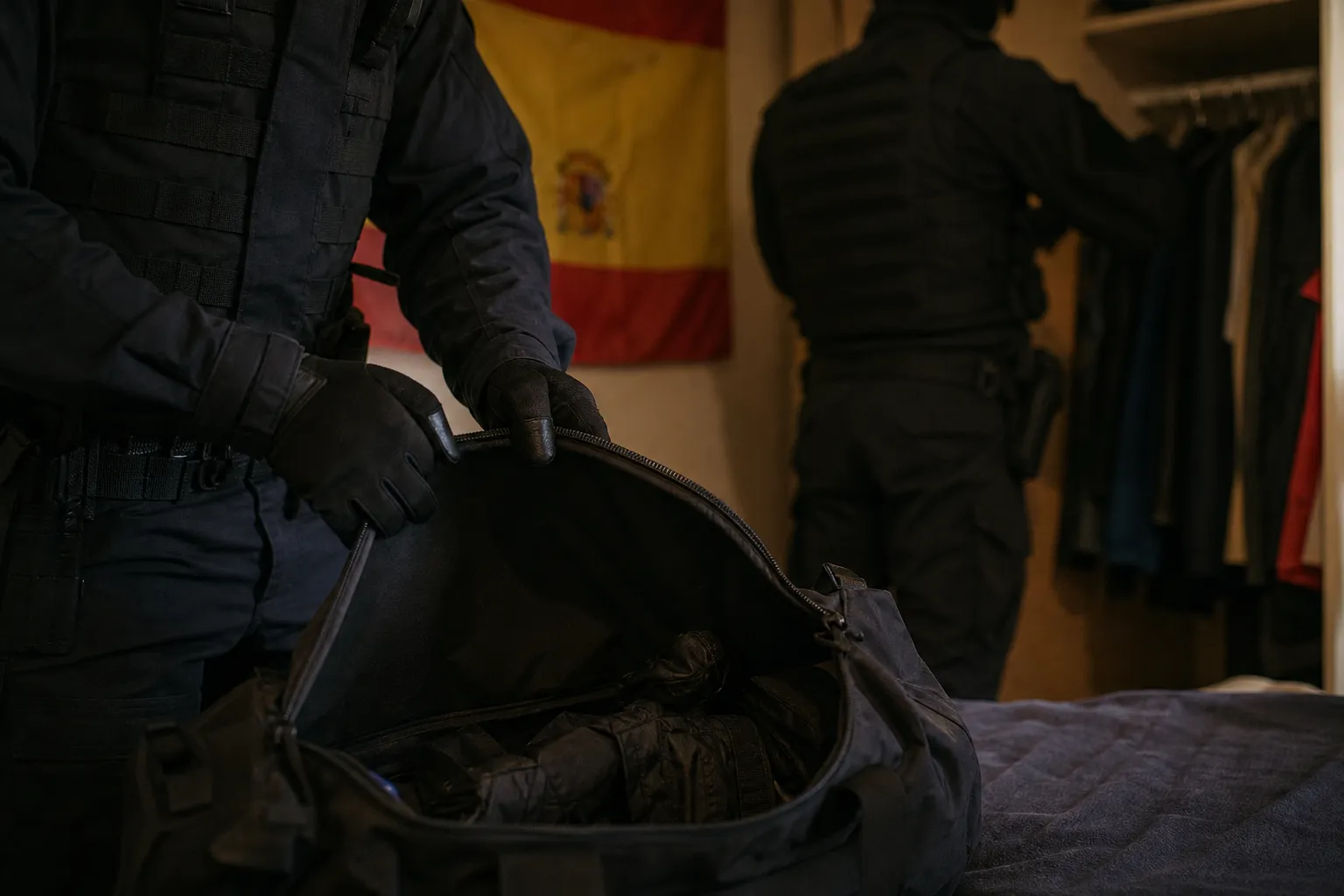
Dawn raids in Spain have become a live operational risk for any company exposed to economic-crime investigation, and the first hour determines how much control you keep. When investigators arrive unannounced with a judicial warrant, the response your reception desk, security team and management give in those opening minutes shapes the entire investigation, what gets seized, whether privilege is preserved, and whether you later face an additional charge of obstruction. This article sets out what to do during dawn raids Spanish authorities carry out against company premises, grounded in the Ley de Enjuiciamiento Criminal, the Código Penal, AEPD data-protection guidance and Spanish case law.
It takes a clear position on the tactical choices you face on site, and it ends with a decision framework so you can act rather than deliberate.
Dawn raids that investigators execute typically begin at opening time, when staffing is thin and decision-makers may not yet be present. The following prescriptive sequence covers the first 0–60 minutes, the 60–180 minute window, and the first 24 hours. Print it, brief reception and security on it, and store it where non-lawyers can reach it in seconds.
The single most valuable action during a dawn raid is designating one calm liaison who documents everything. Documentation is what later supports a challenge; panic is what creates fresh liability.
Understanding why dawn raids are lawful, and where their limits lie, lets you assert your rights without tipping into obstruction. Searches of company premises are governed principally by the Ley de Enjuiciamiento Criminal, with corporate criminal liability (introduced into the Código Penal and developed by Article 31 bis and following) and obstruction offences flowing from the Código Penal.
Entry into and search of a constitutionally protected domicilio generally requires judicial authorisation, an auto issued by the investigating court (Juzgado de Instrucción), unless there is consent or a recognised exception. The distinction between a company’s ordinary premises and a constitutionally protected space matters: Spanish courts have recognised that legal persons enjoy certain protections and that areas functioning as the seat of corporate decision-making may attract heightened safeguards. When you receive the warrant, check four things:
The acta de registro is the contemporaneous minute of the search. It should record who was present, what was inspected, what was seized and any objections raised. Insist on receiving a copy, it is your primary evidentiary record.
Depending on the case and territory, the team may comprise Guardia Civil officers (often involved in economic-crime investigations coordinated with the Fiscalía), Policía Nacional, or regional forces such as the Mossos d’Esquadra in Catalonia or the Ertzaintza in the Basque Country. Under the Ley de Enjuiciamiento Criminal, the Letrado de la Administración de Justicia ordinarily attends to authenticate the acta in a court-ordered entry and search, and the prosecutor’s office may coordinate the investigative strategy. Knowing the composition tells you who holds authority to narrow or clarify the search on site.
Electronic evidence is the centre of gravity in modern corporate investigations, and seizure of electronic evidence in Spain follows rules that reward a prepared response. Authorities can seize servers, laptops and mobile phones during a business search, provided those devices fall within the warrant’s scope. The Ley de Enjuiciamiento Criminal contains specific provisions on the seizure and examination of computers and electronic storage devices, which as a rule require judicial authorisation. How they proceed, and what you do in parallel, has lasting consequences.
Investigators broadly choose between two approaches. They may create a forensic image of data on site and leave the hardware in place, or they may physically remove devices and servers for later examination. Each has trade-offs:
Where imaging is used, the liaison should request that copying be limited to material within scope and, critically, request a mirror copy for the company so operations can continue and so you retain the ability to review what was taken.
Encryption and passwords raise sensitive questions during a search. Companies and individuals face genuine limits on compelled decryption: the privilege against self-incrimination protects the individual against being forced to actively produce a passphrase in a way that testifies to knowledge or control. Distinguish carefully between the company’s data-management obligations and an individual’s constitutional protection. Do not volunteer to unlock personal devices without counsel’s advice, and do not destroy or reset anything, that risks an obstruction charge under the Código Penal.
Protecting your later ability to challenge the evidence depends on the chain of custody. Record hash values where imaging is performed, note who handled each device and when, and secure your own contemporaneous log. Seizure of electronic evidence in Spain also engages data-protection duties: seized systems will contain personal data of employees, clients and third parties. The Agencia Española de Protección de Datos (AEPD) provides guidance on the obligations that arise when personal data is processed or transferred, and companies should assess notification and record-keeping duties even where the transfer to authorities is lawful. Bringing in a qualified forensic provider quickly, one who can supervise imaging and preserve metadata integrity, is one of the highest-value early decisions.
Legal privilege and trade-secret protection are asserted on site or lost. During a dawn raid, you cannot reliably claw back material after the event that you failed to flag as privileged in the moment.
Spanish professional secrecy (secreto profesional), protected by the Constitution, the Estatuto General de la Abogacía Española and the deontological framework of the Consejo General de la Abogacía Española (CGAE), covers the lawyer–client relationship. The critical practical point is that communications with external, independent counsel enjoy the strongest protection, while the position of in-house counsel is narrower and more contested. Do not assume every internal legal email is protected. Mark clearly privileged material, keep external-counsel advice segregated, and assert privilege expressly the moment such material is reached during the search.
For commercially sensitive material that is not privileged but is a protected trade secret (secreto empresarial, governed by Ley 1/2019 de Secretos Empresariales), the tactic is different. Request that such material be placed in sealed envelopes for later judicial review rather than examined openly on site, and ask the court for a protective process, potentially inspection by a neutral expert under conditions that prevent unnecessary disclosure to competitors or the wider case file.
A raid tests your organisation’s ability to coordinate under pressure. Clear roles prevent the improvisation that creates legal exposure.
Not every seizure is final, and irregular searches can be contested. Knowing the routes and their timing lets you act while the position is still fluid.
Your first remedial step is documentary: secure a full copy of the acta de registro and the inventory of seized items. Without these you cannot frame a precise challenge. Request them on the day; if refused, record the refusal.
Challenges to the search or to specific seizures are generally raised before the Juzgado de Instrucción handling the matter, typically through a recurso de reforma and/or recurso de apelación, and, in appropriate constitutional cases, ultimately by recurso de amparo before the Tribunal Constitucional once ordinary remedies are exhausted. Where the search’s validity is genuinely in doubt, for example, a defect in the authorising auto, move quickly, because delay weakens both the practical and legal position. In defined administrative contexts a recurso contencioso-administrativo may also be relevant.
Where evidence was obtained in breach of fundamental rights, Spanish law provides for its exclusion, and the doctrine developed by the Tribunal Supremo and Tribunal Constitucional can also affect evidence derived from it (the so-called prueba refleja). Privileged material seized without a proper lawyer-only review protocol, or material outside the warrant’s scope, are among the strongest suppression candidates. European Court of Human Rights standards on privacy, fair trial and effective remedies can reinforce suppression and appeal arguments in complex cases. Building this record starts with the contemporaneous notes taken during the raid, which is why on-site documentation is so decisive.
On site, you face one strategic choice: how much to cooperate. There are three broad postures, and this decision-support table compares them dimension by dimension. Our position is unambiguous, for the overwhelming majority of companies facing a valid warrant, controlled cooperation (Option A or B) is correct, and outright resistance (Option C) is justified only in narrow, clear-cut circumstances.
| Dimension / Outcome | Option A, Full cooperation | Option B, Limited cooperation (assert privileges) | Option C, Resist / litigation-first |
|---|---|---|---|
| Legal posture | Immediate compliance; minimises obstruction allegations | Assert procedural safeguards; request judicial clarification | Confrontational; forces an early judicial decision |
| Who leads on site | Company liaison (GC) with counsel present | GC plus external counsel supervising privileged review | External counsel immediately; potential delay for the judge |
| Access to premises & systems | Full access within warrant, faster completion | Selective access; request sealed drawers / lawyer-only review | Deny access; risk forced entry or contempt allegations |
| Seizure likelihood | High, authorities seize what is in scope | Moderate, narrow seizure via privilege/trade-secret claims; some risk pending review | High risk of forced seizure and adverse inference |
| Protection of privilege | Low if not asserted; but cooperation easily documented | Higher, mark material, request lawyer-only review protocol | Position maintained but may provoke court order bypassing claims |
| Business disruption | Limited if cooperative and organised | Moderate, time in review and negotiation | High, potential operational paralysis |
| Litigation / evidentiary exposure | Lower obstruction risk; more evidence to authorities | Balanced, scope to suppress specific items later | Higher immediate litigation; may escalate the investigation |
| Remedies if later challenged | Challenges available but evidence likely already held | Stronger suppression and trade-secret relief arguments | Remedies limited; strategic but risky |
| When best used | Factual exposure low; want to reduce obstruction risk | Privileged/trade-secret material at stake and time to negotiate | Solid grounds to contest warrant validity |
| On-site checklist | Provide warrant copy; designate liaison; log items; get acta | Mark privileged material; propose lawyer-only room; request sealed envelopes; photograph acta | Record refusals; request judicial presence; avoid obstruction; call counsel |
Decision framework, choose one:
“Good morning. I am [name], [role]. I acknowledge your authority and we will not obstruct. I am formally noting the time and your names. I am calling our General Counsel and legal representative now and ask that our designated liaison accompany you throughout. May I see the warrant, please?”
“URGENT, search in progress at [site] from [time]. Force: [Guardia Civil / other]. Warrant scope: [summary]. Devices at risk: [servers/laptops/phones]. Please attend on site immediately and instruct forensic imaging support to preserve metadata and secure a company mirror copy. Privileged material flagged; lawyer-only review requested. Reply with ETA.”
A fuller printable dawn raid checklist for managers and compliance officers should be kept both as an un-gated on-page resource for immediate use and as a downloadable PDF for offline reference.
Dawn raids are won or lost in the first hour, and the companies that emerge with their rights intact are those that prepared before the knock at the door. A clear liaison, a rehearsed reception script, an accessible checklist, immediate engagement of external criminal defence counsel and disciplined documentation of everything seized are what preserve your ability to assert privilege, protect trade secrets and later challenge irregular seizures. With continued economic-crime enforcement and Spain’s corporate criminal-liability framework under the Código Penal, controlled cooperation, asserting your rights without obstructing, is the recommended posture for the vast majority of businesses. Treat this guide as a planning tool now, not a document you read for the first time while investigators are already inside.
This article is general guidance for Spain and not a substitute for legal advice. If a search is underway or anticipated, contact qualified local criminal defence counsel immediately. Related resources, including a printable dawn raid checklist for managers and compliance officers in Spain, guidance on how to challenge seizure of electronic evidence in Spain, and material on designing corporate compliance programmes to reduce criminal liability in Spain, support this pillar.
Further reading on GLE: El mejor abogado penalista de España.

posted 1 minute ago

posted 14 minutes ago

posted 36 minutes ago

posted 55 minutes ago

posted 58 minutes ago

posted 1 hour ago

posted 1 hour ago

posted 1 hour ago

posted 2 hours ago

posted 2 hours ago

posted 3 hours ago

posted 4 hours ago
No results available
Find the right Legal Expert for your business

Send welcome message