
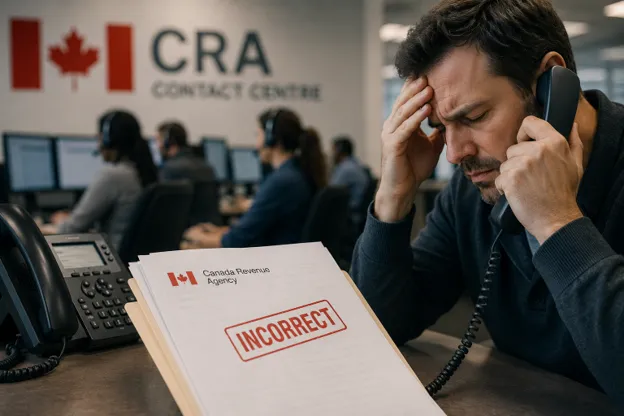
A report from the Auditor General of Canada has found that agents at the Canada Revenue Agency’s contact centres answered tax questions accurately only 17 percent of the time. This means that 83 percent of the time, CRA agents provided wrong, misleading, or incomplete answers to Canadians.
The testing, conducted between February and May 2025, involved placing calls to CRA agents across a range of common tax questions and assessing the accuracy of the responses against the applicable law. The Auditor General’s office concluded that the agency appeared more concerned with adherence to shift and break schedules than with the accuracy and completeness of the information provided to callers, a finding that points to an institutional performance culture rather than a series of isolated agent errors.
The finding is reinforced by the Office of the Taxpayers’ Ombudsperson led by François Boileau, which has separately identified contact centre service failures as systemic. The Ombudsperson made two formal recommendations, both accepted by the CRA:
1. improved internal accuracy monitoring and agent training, and
2. public reporting of accuracy metrics on the CRA’s Continuous Service Improvement page, a transparency measure intended to allow ongoing external verification of whether the agency is in fact improving.
The combined findings prompted a study by the House of Commons Standing Committee on Public Accounts, which called the CRA to testify on what options exist for taxpayers who rely on incorrect agent information.
For tax lawyers advising clients across jurisdictions, the Canadian experience offers a useful case study in the gap between administrative service failure and legal remedy, and in the limits of what a quantified accountability finding can and cannot do for an individual taxpayer who has already relied, to their detriment, on incorrect official advice.
Canadian tax law follows the general common law principle that estoppel does not run against the Crown in matters governed by statute. In other words, the fact that CRA agents are lacking in tax law knowledge does not hold them accountable for giving out wrong information.
The leading authority is Goldstein v. Canada, [1995] 2 CTC 2036 (TCC), in which the Tax Court confirmed that incorrect statements by CRA officials do not bind the agency where the result would be contrary to the applicable legislation. The reasoning has been applied consistently in subsequent decisions: where a statute imposes a particular tax treatment, no representation, however authoritative it may have appeared to the taxpayer at the time, can override that statutory result.
The bottom line: a Canadian taxpayer who relies on inaccurate telephone advice and files accordingly remains exposed to reassessment, with interest, regardless of the source of the error.
This is not a uniquely Canadian position. Most common law jurisdictions decline to permit estoppel against statutory tax obligations, on the basis that taxation is a matter of public law that cannot be varied by the conduct or representations of individual officials.
The policy rationale is straightforward: if agency error could bind the treasury, the incentive structure for accurate self-reporting would erode, and taxpayers with access to favourable but mistaken advice would be treated more generously than those who received correct advice and complied.
Whatever the merits of that policy in the abstract, it produces a harsh result for an individual taxpayer who acted in good faith on what they reasonably understood to be authoritative guidance from the tax authority itself.
What distinguishes the current Canadian situation is the scale of the documented error rate. A theoretical risk of incorrect agency advice, present in any large bureaucracy, is one matter; an audited finding that the relevant call centre is wrong roughly five times out of six is another. The Auditor General’s methodology, structured test calls conducted over a four-month period rather than anecdotal complaint review, gives the finding a degree of empirical weight that distinguishes it from the more familiar genre of taxpayer service complaints.
The principal mechanism by which a Canadian taxpayer can obtain advice that binds the CRA is a formal Advance Tax Ruling, issued in writing by the CRA’s Income Tax Rulings Directorate in respect of a specifically described proposed transaction.
The ruling process is not available retrospectively, requires a detailed written application setting out the relevant facts and the proposed transaction in full, and typically takes several months from submission to issuance. Rulings also carry a fee, scaled to the complexity of the matter, and are generally pursued only where the amounts at stake justify the cost and the delay.
For these reasons, the ruling process is not a realistic substitute for the kind of routine guidance taxpayers seek from a general telephone inquiry line: a taxpayer with a same-day filing question, or a small business owner seeking to understand a GST/HST registration threshold, is not well served by a process designed for substantial proposed transactions. The ruling mechanism nonetheless remains the only formal route to binding certainty, and should be considered seriously wherever the amounts at stake in a proposed transaction are material enough to warrant the cost and timeline involved.
A related question is whether reliance on incorrect agency advice affects penalty exposure, as distinct from the underlying tax liability.
Under subsection 163(2) of the Canadian Income Tax Act, gross negligence penalties, which add fifty percent to the tax owing on the relevant amount, require proof that a taxpayer made a false statement or omission knowingly, or in a manner the courts have described as tantamount to intentional conduct. The burden of establishing this elevated standard rests with the tax authority, not the taxpayer.
A taxpayer who filed in genuine reliance on incorrect agency advice, supported by contemporaneous evidence of the call, including the date, the agent’s identification, and a record of what was said, has a credible basis to resist a finding of gross negligence.
The reasoning is straightforward: a taxpayer who telephones the tax authority before filing, receives an answer, and follows it is, almost by definition, attempting to comply rather than evade. This does not eliminate the underlying tax liability or ordinary, non-punitive interest, both of which remain payable regardless of the source of the error, but it materially affects exposure to the more severe penalty regime.
Separately, the CRA retains discretion under subsection 220(3.1) to cancel or waive interest and penalties where the agency’s own conduct contributed to a compliance failure.
This discretionary relief mechanism does not displace the underlying tax debt and is not guaranteed; the CRA may decline an application even where the underlying facts appear to support it, and a denial is reviewable only by way of judicial review in the Federal Court, applying an administrative law standard rather than a full reconsideration of the merits.
The documented systemic findings from the Auditor General and the Ombudsperson now provide a stronger evidentiary basis for such applications than would otherwise be available to an individual taxpayer alleging an isolated, unverifiable error.
The accuracy problem carries particular weight in the context of voluntary disclosure decisions, where the consequences of incorrect agency advice are not merely financial but can be terminal to the taxpayer’s ability to access relief. Canada’s Voluntary Disclosures Program (VDP), like comparable regimes in other jurisdictions, is available only where the disclosure is made before the tax authority initiates enforcement contact in respect of the relevant non-compliance.
The program offers, in qualifying cases, relief from prosecution and, depending on the stream, relief from penalties and a portion of interest; it does not offer relief from the underlying tax owing.
A taxpayer who is incorrectly advised by a contact centre agent that a disclosure is unnecessary, perhaps because the agent mischaracterizes the taxability of a particular income source, or misstates the residency rules applicable to the taxpayer’s circumstances, and who relies on that advice, may find that the window has closed by the time an audit begins.
There is no remedy for a lost voluntary disclosure opportunity attributable to incorrect agency advice; the doctrine governing reliance on Crown representations applies with equal force to this context as to any other filing decision, and arguably with greater consequence, since the alternative to a successful disclosure is potential criminal exposure rather than a mere civil reassessment.
This risk is not theoretical for taxpayers with offshore holdings, cryptocurrency gains, or unreported business income, where the threshold question of whether disclosure is required, and which disclosure stream applies, is often more legally complex than a contact centre agent operating from standardized scripts is equipped to answer accurately.
Given the 17 percent baseline accuracy finding, the probability of receiving a correct answer to a nuanced disclosure question through the general inquiry line is not a risk most tax lawyers would consider acceptable for a client facing potential prosecution. The odds are stacked against Canadian taxpayers.
The involvement of the Standing Committee on Public Accounts adds a dimension not typically present in taxpayer service complaints: direct legislative oversight.
The Committee’s questions to the CRA specifically addressed what options are available to a taxpayer who relies on incorrect contact centre information, a question that sits at the intersection of administrative law and parliamentary accountability rather than tax law narrowly defined.
This is a useful reminder that taxpayer service failures of sufficient scale can migrate from the domain of agency-level complaint mechanisms into the domain of formal legislative scrutiny, with the attendant public reporting requirements and ministerial accountability that follow.
The Finance Minister subsequently set a 100-day deadline, ending December 11, 2025, for the CRA to address contact centre delays. That deadline has since passed. The post-deadline record does not reflect resolution: six months later, the Ombudsperson tabled an annual report containing seven new recommendations and opened two further systemic examinations, into complaint-resolution confusion and into delays in processing complex adjustment requests respectively, while a formal Service Improvement Request concerning contact centre reporting, issued in March 2026, remained outstanding.
The pattern is consistent with what comparative administrative law scholarship would predict: short political deadlines rarely produce durable change in large-scale service delivery institutions, and the underlying remediation, retraining of agents, redesign of quality assurance processes, and cultural reorientation away from schedule adherence as the primary performance metric, requires a materially longer horizon than 100 days. Tax lawyers advising clients on the reliability of agency guidance should treat the expiry of a political deadline as no indication, in itself, that the underlying service problem has been resolved.
For tax lawyers and accountants advising clients with Canadian tax exposure, several practical conclusions follow from the current findings, applicable whether the client is a domestic Canadian taxpayer or a foreign client with Canadian filing obligations.
The Auditor General’s finding that CRA contact centre agents answer only 17 percent of tax questions accurately confirms, with empirical rigour, what experienced tax lawyers have observed anecdotally for years.
The legal consequence is unchanged by the scale of the finding: Canadian tax authorities are not bound by incorrect statements made by their own officials, and taxpayers bear the ultimate responsibility for the accuracy of their filings. What the finding does change is the practical calculus for Canadian tax lawyers and accountants and clients alike.
Reliance on general contact centre advice for any matter of consequence is no longer merely inadvisable; it is now a documented, quantified risk, and should be treated accordingly in client advice, in voluntary disclosure planning, and in any subsequent application for relief from penalties or interest arising from agency error.
This article is intended for general informational purposes only and reflects the law as of the date of posting. It has not been updated and may no longer be current. The content does not constitute legal advice and should not be relied upon as such. Each tax situation is unique and may differ from the examples discussed. You should consult a qualified Canadian tax lawyer for advice tailored to your circumstances.

posted 1 day ago

posted 1 day ago

posted 1 day ago

posted 1 day ago

posted 1 day ago

posted 1 day ago

posted 1 day ago

posted 1 day ago

posted 1 day ago

posted 1 day ago

posted 1 day ago

posted 2 days ago
No results available
Find the right Legal Expert for your business

Send welcome message