
Our Expert in Belgium
No results available
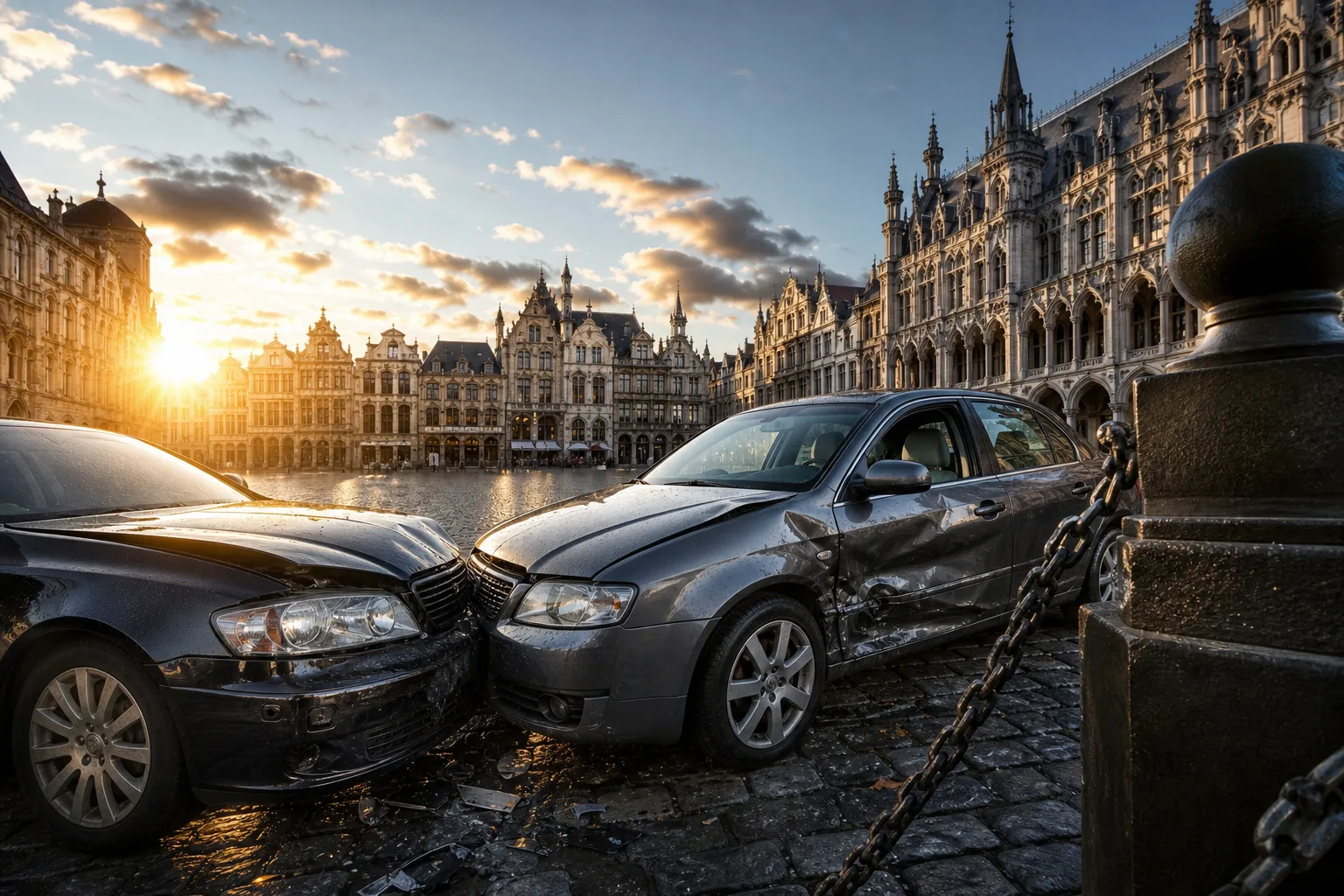
Cross-border road accidents belgium cases have become more complex and more frequent as traffic across the country’s borders with France, the Netherlands, Germany and Luxembourg continues to grow, and 2026 brings renewed focus on how EU jurisdiction and enforcement rules apply in practice. For victims, insurers and in‑house counsel, the central question after a collision involving a foreign driver or insurer is simple to ask but hard to answer: where do you claim, who pays, and how do you force payment if the other side resists?
This guide sets out a clear, practical route through those decisions, from the first hours at the scene to notifying a foreign insurer, filing suit in the right court, and enforcing a judgment across borders. It is written for people who need to act, and it ends with a decision framework that tells you exactly which route to take.
The legal architecture for cross-border road accidents belgium claims rests on two pillars of EU law: Regulation (EU) No 1215/2012 (Brussels I Recast), which governs jurisdiction and the recognition and enforcement of judgments between EU member states, and Directive 2009/103/EC, which sets the minimum protections for motor accident victims across the Union. Neither has been replaced, but 2026 has sharpened how claimants and insurers use them. The practical effect of Brussels I Recast, that a judgment from one member state is enforceable in another without an intermediate exequatur procedure, continues to reshape how litigants choose where to sue and how they plan enforcement from the outset.
The message for 2026 is that claimants and insurers must plan the whole journey, insurer notification, forum, and enforcement, as a single connected strategy rather than a series of isolated steps.
What you do in the first hours and days shapes every later stage of a cross-border road accidents belgium claim. Evidence disappears fast, memories fade, and foreign insurers scrutinise early documentation closely. Treat the scene as the foundation of your case.
If there are injuries, a dispute over fault, a hit‑and‑run, or an uninsured driver, call the police. Where the accident occurs on Belgian territory, report to the Belgian police and obtain the incident reference. If the collision happens just across a border or involves parties who continue into a neighbouring state, the police report should still be filed in the country where the accident occurred, because the location of the accident generally governs which authority has primary competence. Always request a copy or the reference number of any police report, and note the officer’s details.
Template callout, early notification to a foreign insurer: “On [date] at approximately [time], a vehicle registered [plate] and insured under policy/Green Card number [number] with [insurer] was involved in a collision with my vehicle at [location] in Belgium. I hold [insurer/its client] liable for the resulting damage and injury and request acknowledgement of this notification and details of your claims‑handling representative in Belgium.” Keep the language factual, assert liability clearly, and retain proof of sending.
Choosing the right court is the single most consequential decision in a cross-border road accidents belgium claim. The wrong choice can mean a dismissed action, wasted costs, and a judgment that is harder to enforce. Within the EU, Brussels I Recast determines which court has jurisdiction, and the doctrine of forum non conveniens is not generally available between member states, a court with jurisdiction under the Regulation cannot normally decline it on the basis that another forum is more appropriate.
The general rule under Brussels I Recast is that a defendant domiciled in an EU member state must be sued in the courts of that state. For tort claims, which road accidents are, there is a special head of jurisdiction allowing proceedings in the courts for the place where the harmful event occurred, which covers both the place of the event giving rise to the damage and the place where the damage itself is suffered.
Importantly for accident victims, the Regulation together with the case law built around the Motor Insurance Directive (notably the Odenbreit line of Court of Justice of the EU authority) allows an injured party to bring a direct action against the liable party’s insurer, in many cases in the courts of the claimant’s own domicile. This is a powerful tool: a Belgian resident can often sue the foreign insurer in Belgium.
You can generally pursue a cross-border road accidents belgium claim in Belgian courts where any of the following apply:
Where none of these connecting factors points to Belgium, you may be confined to the courts of the defendant’s home state.
Limitation is where cross-border claims most often go wrong, because periods differ sharply between states. Belgian limitation rules are set out in national legislation accessible through the Belgian official legal database (Justel / Moniteur belge). Direct actions against an insurer and tort claims are each subject to defined limitation periods under Belgian law, and these may be shorter or longer than those in a neighbouring state. Because the law applicable to the merits may not be Belgian law even when you sue in Belgium, you must identify both the governing limitation period and any procedural deadlines early.
Do not assume the deadline that applies in one country applies in another, verify it against the law that governs the claim, and act well before the earliest arguable date.
Worked scenarios:
In most cross-border road accidents belgium claims, the first and fastest route to money is not a court but an insurer. Handling notification correctly can resolve the matter without litigation entirely.
The Green Card system, coordinated by the Council of Bureaux, is the international framework that guarantees motor insurance cover across participating countries and provides a national bureau in each state to handle claims arising from foreign‑registered vehicles. If you are hit by a foreign driver in Belgium, the Belgian national bureau can help you identify and pursue the responsible foreign insurer. The European Commission’s Your Europe guidance explains the practical routes available to claimants crossing borders, including contacting the insurer’s claims representative in your own country.
Under the Motor Insurance Directive, foreign insurers must appoint a claims representative in each member state, so a Belgian claimant can usually correspond in a local language with a local representative rather than chasing an insurer abroad. When you notify, provide:
Assert liability clearly and set a reasonable deadline for acknowledgement. Under the Motor Insurance Directive, a claims representative is expected to provide a reasoned reply or settlement offer within a defined period after a complete claim is submitted; check the current time limit with the representative or your lawyer.
If the responsible vehicle cannot be identified, is uninsured, or its insurer becomes insolvent, the insurer route breaks down. At that point the Belgian motor insurers’ guarantee fund becomes the critical fallback, covered in detail below. Where an identified insurer simply refuses or stalls, the national bureau and, ultimately, litigation remain the levers.
Once liability is on the table, the claim turns on proof of loss. A well‑documented quantum presentation shortens negotiations and strengthens any later litigation in a cross-border road accidents belgium case.
Compensation typically falls into several heads: personal injury (physical and psychological harm), material damage (vehicle repair or write‑off, personal items), loss of earnings (past and future), medical and care costs, and pain and suffering. For each, secure contemporaneous evidence:
Valuation often proceeds in two stages: provisional payments to meet immediate needs, followed by a final calculation once the medical position has stabilised. Interest and recoverable costs should be claimed where the governing law allows.
A negotiated settlement with a responsive insurer is usually faster and cheaper, avoids the uncertainty of trial, and can sidestep cross-border enforcement altogether because a signed settlement is contractually binding. Litigation becomes necessary where liability is denied, the insurer stalls or lowballs, or the limitation clock forces protective proceedings. Litigation produces an enforceable judgment but takes longer and costs more. The sensible default in a cross-border road accidents belgium claim is to open with the insurer and escalate to court only when negotiation fails or a deadline demands it.
Winning a judgment is only half the battle; in cross-border disputes the real test is collecting on it. Brussels I Recast transformed cross-border enforcement by abolishing exequatur between member states, and understanding the mechanics is essential to Brussels I Recast enforcement belgium strategy.
A judgment given by a Belgian court is enforceable in any other EU member state without a prior declaration of enforceability. In practice you obtain the judgment together with the standard certificate provided for under Brussels I Recast, serve the required documents on the party against whom enforcement is sought, and then proceed to execution through the competent enforcement authority, typically a bailiff, in the state where the defendant’s assets are located. Engaging local enforcement counsel in that state is strongly advisable, because the method of execution (attachment of bank accounts, seizure of assets, garnishment of wages) is governed by the local procedural law of the enforcement state.
The reverse works identically. A judgment from another EU member state is enforceable in Belgium without exequatur. The creditor presents the foreign judgment and the Brussels I Recast certificate, serves the debtor, and instructs a Belgian judicial officer (huissier de justice / gerechtsdeurwaarder) to execute against assets in Belgium. Because no intermediate court declaration is required, enforcement can begin quickly once the formalities are satisfied. This is precisely why forum selection matters: if the defendant’s assets are in Belgium, a judgment from either a Belgian or a foreign EU court can reach them efficiently.
Enforcement is not automatic in every case. The debtor may apply to refuse recognition or enforcement on the limited grounds set out in the Regulation, including that recognition would be manifestly contrary to public policy, that the defendant was not properly served and so could not defend, that the judgment is irreconcilable with another judgment between the same parties, or specified jurisdictional defects. These grounds are narrow and the merits of the original claim cannot be reopened. For contested cross-border enforcement, the case law of the Belgian Court of Cassation guides how these grounds are applied.
Practitioner tips: instruct local counsel in the enforcement jurisdiction early; budget for bailiff and translation costs; consider whether security or a bond is required for any protective step; and identify the defendant’s assets before you litigate, not after.
The motor insurers guarantee fund belgium framework exists precisely for the cases that would otherwise leave a victim with no one to pay. In Belgium this function is performed by the Belgian Common Guarantee Fund for motor vehicles (Fonds commun de garantie belge / Belgisch Gemeenschappelijk Waarborgfonds), operating under the supervisory framework overseen by the Financial Services and Markets Authority (FSMA). It is the statutory safety net underpinning the victim protection required by Directive 2009/103/EC.
The fund steps in where the responsible vehicle cannot be identified (for example, a hit‑and‑run), where the vehicle was uninsured, or where the insurer has become insolvent. Eligible victims, typically those injured in Belgium or Belgian residents injured in covered circumstances, can claim for personal injury and, subject to the fund’s rules and any applicable conditions or limits, certain material damage. The fund is designed to ensure that an innocent victim is not left uncompensated simply because the liable party has no effective insurance behind them.
When the fund pays, it is subrogated into the victim’s rights and will pursue recovery against the uninsured driver, the vehicle owner, or an insolvent insurer’s estate. For the victim, this means compensation can arrive without waiting on a difficult cross-border recovery; the fund absorbs much of the collection risk. For the responsible party, it means the debt does not disappear, it simply changes creditor.
The table below is the fastest way to decide among the four main routes in a cross-border road accidents belgium claim. Read across the dimensions, then apply the decision framework beneath it.
| Dimension | Sue in Belgium (local courts) | Sue in foreign driver’s state | Claim via foreign insurer / Council of Bureaux (Green Card) | Belgian Motor Insurers’ Guarantee Fund |
|---|---|---|---|---|
| When available | Defendant domiciled in Belgium, or special jurisdiction under Brussels I Recast (place of damage, direct action) | Defendant domiciled there or jurisdictional links stronger | Always available to contact insurer; use Green Card bureau if insurer refuses or is slow | Insurer unknown, uninsured or insolvent and claimant in Belgium |
| Pros | Familiar procedure; local enforcement easier | May be the only forum with jurisdiction; possibly faster locally | Direct settlement possible without court; internationally standard | Safety net, payment even if insurer fails; avoids cross-border enforcement initially |
| Cons | Must establish jurisdiction; higher costs if defendant absent | Enforcement back in Belgium may require recognition steps | Insurer may delay or deny; paperwork and translation needs | Possible conditions/limits; slower; subrogates against owner/insurer |
| Timing | Litigation months–years; settlements faster | Litigation may be shorter locally | Insurer responses often within months | Weeks–months for decision; payment timeline varies |
| Cost | Court fees + lawyer + enforcement | Local counsel needed; possible dual fees | Lower legal cost if settled | Administrative; possible later recovery actions |
| Enforceability | Enforceable across EU under Brussels I Recast | EU judgments enforceable without exequatur | Settlement binding if contractual | Fund pays, then subrogation |
| When to choose | Resident in Belgium or Belgian enforcement essential | Defendant and evidence in that state | Insurer liable and responsive | Insurer unidentifiable, insolvent or refusing |
Decision framework:
Act in priority order: first days, secure evidence, obtain medical care, file any police report, and notify the insurer or Green Card bureau. 1–4 weeks, assemble documentation, confirm the insurer’s claims representative, and verify the applicable limitation period. 1–6 months, pursue settlement, obtain medico‑legal assessment, and prepare protective proceedings if liability is denied. Beyond 6 months, litigate if necessary and plan enforcement. Instruct a Belgian civil lawyer the moment you face a jurisdiction dispute, a serious or disputed injury, an insurer denial, a hit‑and‑run, or any cross-border enforcement need.
Belgian lawyers generally bill by the hour, at a fixed fee for defined work, or on a results‑related basis within the limits permitted by professional rules; the relevant bar (for Brussels, the Barreau de Bruxelles and its Dutch‑speaking counterpart the Nederlandse Orde van Advocaten bij de Balie te Brussel) regulates fee conduct and ethics. For a cross-border road accidents belgium claim, many clients agree a staged arrangement: a modest fixed fee for initial assessment and insurer notification, then hourly or value‑based billing if litigation and enforcement follow. Always obtain a written fee agreement at the outset.
Experienced counsel add value across the whole journey: investigating liability, identifying and pressing the correct foreign insurer, selecting the forum that makes enforcement easiest, quantifying injury and economic loss, and executing judgments across borders through the right local agents. In cross-border matters, that strategic coordination is often the difference between a paper victory and actual recovery.
This guide is general information on cross-border road accidents belgium claims and does not create a lawyer‑client relationship. For a matter‑specific strategy, forum selection, insurer notification, guarantee fund applications or cross-border enforcement, consult a qualified Belgian civil lawyer. See the Belgian civil practice area (Civil, Belgium) and the GLE lawyer directory, filter: Belgium, Civil to connect with specialist counsel.
This article was produced by Global Law Experts. For specialist advice on this topic, contact Hakan Hüsnü Erzurumlu at Hakan H. Erzurumlu Advocaat, a member of the Global Law Experts network.

posted 22 minutes ago

posted 40 minutes ago

posted 58 minutes ago

posted 1 hour ago

posted 1 hour ago

posted 2 hours ago

posted 3 hours ago

posted 3 hours ago

posted 3 hours ago

posted 4 hours ago

posted 4 hours ago

posted 4 hours ago
No results available
Find the right Legal Expert for your business

Send welcome message