
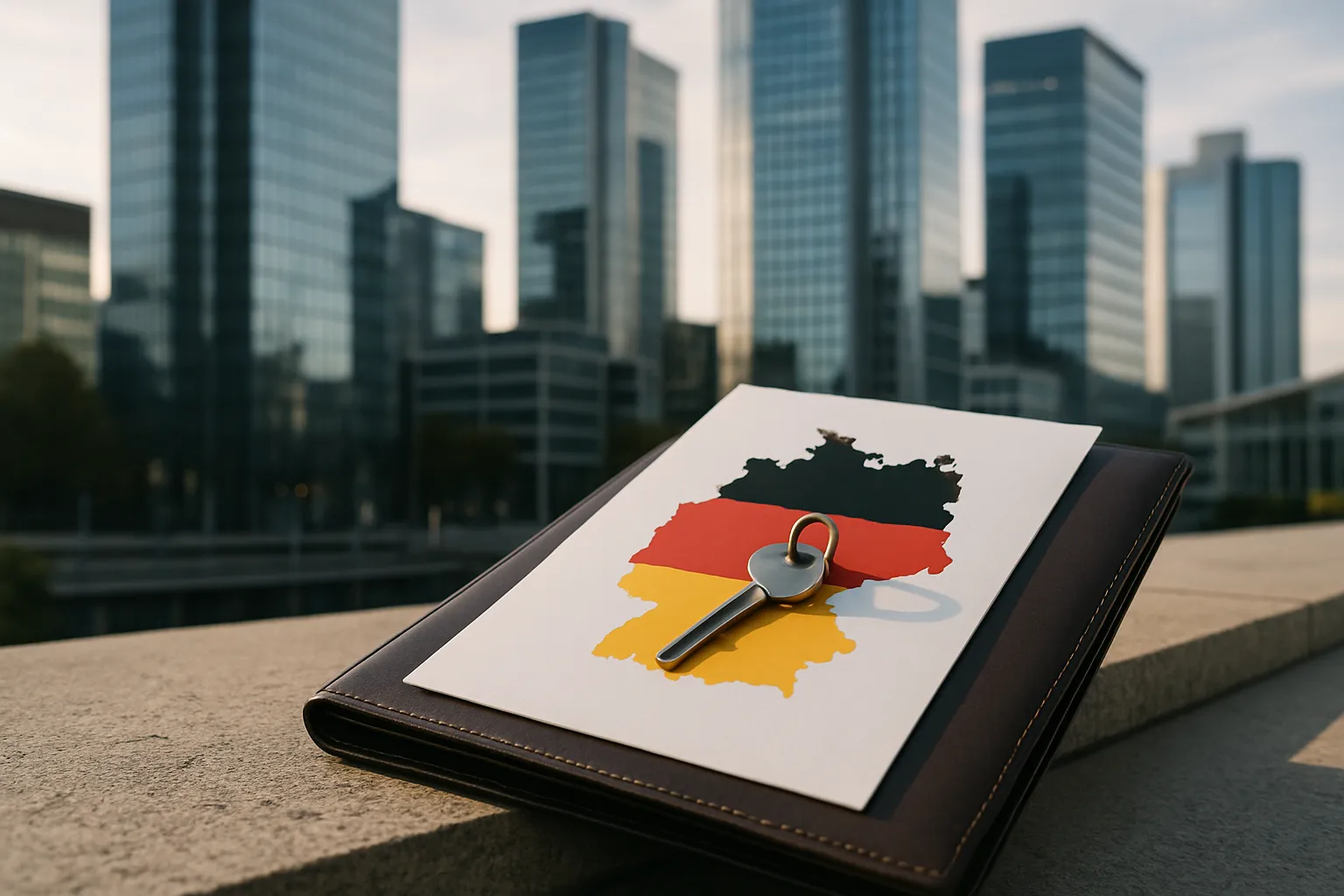
Cross-border licensing Germany deals have accelerated sharply as tech companies expand into and out of the German market, and periodic changes to standard-terms and consumer contract rules make this a good year to revisit how those licences are drafted. For in-house counsel, general counsel and founders negotiating software, SaaS or IP arrangements with German counterparties, the interplay between German contract law, EU regulations and enforcement mechanics now demands close attention. This guide sets out the practical pre-negotiation steps, governing-law choices, essential clauses, dispute-resolution options and enforcement checklists you need. It is written for decision-stage readers who want operational detail, a clause bank, negotiation levers and enforceability steps, rather than high-level commentary.
Who this guide is for: Decision-stage guidance for in-house counsel, GCs and founders negotiating or re-negotiating cross-border software, SaaS and IP licences with German counterparties. The focus is enforceability, clause drafting, governing law and dispute resolution.
Two forces are converging in 2026. First, deal volume: German enterprises remain among Europe’s largest buyers and suppliers of software and technology, so the number of cross-border licences requiring negotiation continues to grow. Second, legal change: German and EU rules affecting standard business terms (Allgemeine Geschäftsbedingungen, or AGB) and business-to-consumer contracting continue to evolve, and any licence template circulated to German counterparties should be reviewed against the current rules.
The practical consequence is that licence templates drafted even two or three years ago may contain clauses that are now vulnerable to challenge under German law. A limitation-of-liability clause, an automatic-renewal term or a unilateral price-adjustment mechanism that survived scrutiny before may be treated differently under current rules. Because standard-terms control under the German Civil Code (Bürgerliches Gesetzbuch, or BGB) reaches even business-to-business relationships in modified form, the risk is not confined to consumer-facing products. This article delivers a due-diligence checklist, a clause bank with sample language, an enforcement checklist and a comparison of arbitration versus German courts so you can move from principle to execution.
Before drafting a single clause, confirm the commercial and legal foundations of the deal. Cross-border licensing Germany transactions fail most often not because of a badly drafted clause but because a fundamental assumption, who owns the IP, whether data can lawfully flow, whether export controls apply, was never verified. Effective diligence protects both the licensor granting rights and the licensee relying on them.
The core areas to verify are:
Request the following at the outset: certified corporate extracts (Handelsregister), IP registration certificates, a schedule of licensed materials, an open-source component list, existing sub-licences, and any prior disputes. Treat the following as red flags requiring resolution before signature: unclear or contested ownership, undisclosed encumbrances on the IP, refusal to warrant title, absence of data-processing documentation, and reluctance to identify the contracting entity.
Governing law and jurisdiction are the two decisions that most influence how a cross-border licence performs under stress. Get them right and enforcement is straightforward; get them wrong and even a strong contractual position can be difficult to realise.
For contractual obligations, choice of law within the EU is governed by Regulation (EC) No 593/2008 (Rome I). Under Rome I, parties are generally free to choose the law that governs their contract, and that choice will be respected by German courts. There are important limits, however. Rome I preserves the application of overriding mandatory provisions of the forum, and it protects certain weaker parties. In consumer contracts, a choice of law cannot deprive a consumer of the protection of the mandatory rules of the country where the consumer is habitually resident.
This is directly relevant to cross-border licensing Germany deals with a consumer element: even where you select, for example, English or Irish law, German consumer-protection rules may still apply to a German consumer.
A second constraint is the BGB regime on standard terms. Sections 305 to 310 of the BGB subject standard business terms to a fairness-control review, and although the review is stricter for consumers, elements of it still apply in business-to-business dealings. A clause buried in your standard licence template, a broad liability exclusion, an unusual renewal mechanism, may be struck down as an unfair standard term even where the parties chose a foreign governing law, where German mandatory rules or public-policy limits engage. This is why the current AGB and B2C rules matter to every licensor circulating a template into Germany.
On jurisdiction, agreements on which courts will hear disputes are governed within the EU by Regulation (EU) No 1215/2012 (Brussels I Recast). A well-drafted, exclusive jurisdiction clause in favour of a specified member-state court will generally be upheld, and a judgment from that court will be recognised and enforced across the EU with minimal formality. Practical scenarios differ by deal type:
Consider these alternatives, each an example requiring lawyer review before use:
The economic heart of any licence lies in its scope and consideration clauses. Ambiguity here is the single most common source of later dispute, so precision pays. The following clause bank sets out the essential building blocks for software licence agreements Germany parties will recognise, with negotiating notes.
Draw a clear line between a licence (a permission to use, with ownership retained by the licensor) and an assignment (a transfer of ownership). In most technology deals the licensor retains ownership and grants a licence; the agreement should state expressly that all right, title and interest remain with the licensor and that nothing transfers ownership. Note that under German copyright law the author’s copyright itself (as distinct from exploitation rights) is generally not assignable during the author’s lifetime; what is granted or transferred are exploitation rights (Nutzungsrechte). Where the deal contemplates the licensee creating derivative works or customisations, allocate ownership of those developments explicitly, silence invites dispute.
For assignments of registered rights such as patents under the PatG, ensure the assignment is documented in the form required for registration.
A sample licence-grant clause for a SaaS product might read: “Subject to payment of the Fees and the terms of this Agreement, Licensor grants Licensee a non-exclusive, non-transferable, non-sublicensable right during the Term to access and use the Service for Licensee’s internal business operations within the Territory.” A SaaS agreement Germany counterparties negotiate will typically add a service-level annex defining uptime commitments, a support-response matrix, and service credits as the agreed remedy for downtime. Draft the SLA credit as the sole remedy for availability failures only if that limitation survives BGB standard-terms review; otherwise the exclusive-remedy language may be unenforceable.
Risk allocation is where licensor and licensee interests diverge most sharply, and where German law imposes real constraints on how far a party can limit its exposure. These are the levers to negotiate deliberately rather than accept from a template.
On warranties, the two most important for German IP licence clauses are the warranty of title (that the licensor owns or controls the licensed rights) and the warranty of non-infringement (that use of the licensed technology as permitted will not infringe third-party rights). A sample formulation: “Licensor warrants that it is the owner of or otherwise entitled to license the Licensed Software and that, to its knowledge, the use of the Licensed Software in accordance with this Agreement does not infringe the intellectual property rights of any third party.” Licensees will push to remove the knowledge qualifier; licensors will insist on it.
On limitation of liability, the BGB standard-terms rules under sections 305 to 310 are decisive. Where standard terms are used, German law does not permit a party to exclude liability for damage caused intentionally or by gross negligence, nor to exclude liability for injury to life, body or health. A liability clause that attempts a blanket exclusion will be pared back by a German court. Effective drafting therefore uses a tiered structure: full liability for intentional and grossly negligent conduct and for personal injury; a defined cap for other liability; and a carve-out excluding indirect and consequential loss to the extent permitted. Review every liability cap and exclusion in your template against these limits.
On indemnities, define the scope precisely (typically third-party IP-infringement claims), allocate control of the defence, and set conditions for the indemnity to apply (prompt notice, cooperation, no admission of liability without consent). A sample indemnity: “Licensor shall defend Licensee against any third-party claim that the Licensed Software infringes a German or EU intellectual property right, and shall indemnify Licensee against damages finally awarded, provided Licensee notifies Licensor promptly and grants Licensor sole control of the defence and settlement.” Consider requiring the licensor to maintain professional indemnity or IP-infringement insurance to back the indemnity.
A licence is only as valuable as your ability to enforce it. For cross-border licensing Germany arrangements, enforcement planning should begin at the drafting stage, not when a dispute erupts. Two regimes matter: the German Code of Civil Procedure (Zivilprozessordnung, or ZPO) for domestic enforcement, and Brussels I Recast for cross-border recognition within the EU.
Within the EU, a judgment given in one member state is recognised in the other member states under Brussels I Recast without any special procedure, and it is enforceable in another member state without a declaration of enforceability being required. In practice, this means a German court judgment can be enforced against assets in France, Spain or the Netherlands with limited formality, a significant advantage where the licensee holds assets across the EU. To rely on this, the party seeking enforcement supplies a copy of the judgment and the certificate issued by the court of origin.
Domestically, enforcement in Germany runs through the ZPO, which governs execution against a debtor’s assets, the role of enforcement officers, and, critically for technology disputes, the availability of provisional and interim measures. Where a licensee is misusing licensed technology or a licensor is threatening to cut off a business-critical service, an interim injunction (einstweilige Verfügung) under the ZPO can preserve the position pending final resolution. Provisional measures are often the decisive practical remedy, so factor their availability into your choice of forum.
Cross-border evidence and translation requirements also affect enforcement readiness. Documents submitted to a German court will generally require a German translation, and contractual evidence, signed copies, purchase orders, correspondence confirming acceptance, should be preserved from the outset. Recognition of judgments from outside the EU falls outside Brussels I and depends on the applicable bilateral or domestic recognition rules, which is one reason arbitration is often preferred where the counterparty and its assets sit outside the EU.
The choice between arbitration and litigation before German courts shapes cost, speed, confidentiality and, above all, enforceability. There is no universally correct answer; the right choice depends on where the counterparty’s assets sit and what you most need to protect.
Arbitration derives much of its cross-border strength from the New York Convention, which secures recognition and enforcement of arbitral awards in the many contracting states worldwide, a reach far broader than Brussels I, which operates only within the EU. German arbitration law is set out in Book 10 of the ZPO, which largely follows the framework of the UNCITRAL Model Law on International Commercial Arbitration, giving parties a familiar and predictable procedural regime. Litigation before German courts, by contrast, offers strong and fast interim relief, transparent procedure and, within the EU, near-automatic enforcement under Brussels I Recast.
| Topic | Arbitration | German courts |
|---|---|---|
| Enforceability | Broad global reach via the New York Convention | Near-automatic within the EU under Brussels I Recast; harder outside the EU |
| Interim measures | Available, including emergency arbitrator under some institutional rules; may still need court support for execution | Fast and robust interim injunctions under the ZPO |
| Confidentiality | Private by default | Generally public proceedings |
| Costs | Can be higher (arbitrator fees, institutional fees) | Often lower; statutory cost scales |
| Appealability | Very limited grounds to set aside an award | Appellate review generally available |
| Speed | Depends on tribunal and rules; can be efficient | Interim relief fast; final resolution can be quicker at first instance |
| Enforceability in EU | Award enforced via New York Convention | Judgment enforced via Brussels I Recast |
“All disputes arising out of or in connection with this Agreement shall be finally settled under the [chosen institution] Rules by one or more arbitrators appointed in accordance with those Rules. The seat of arbitration shall be [city, Germany]. The language of the arbitration shall be English. The emergency arbitrator provisions shall apply.” Fix the seat expressly, it determines the supervisory court and the procedural law, and confirm the rules include emergency-arbitrator provisions if you may need urgent relief. The German Arbitration Institute (DIS) offers commonly used institutional rules for arbitration seated in Germany.
“The courts of [city], Germany shall have exclusive jurisdiction to settle any dispute arising out of or in connection with this Agreement.” Use an exclusive clause where you want certainty of forum and intend to rely on Brussels I enforcement across the EU, and confirm the chosen court has subject-matter competence for the value and nature of the dispute.
Technology licences almost always carry regulatory obligations beyond the four corners of the contract, and overlooking them can invalidate the commercial deal or expose both parties to enforcement action. The most significant is data protection. Where a SaaS or software licence involves processing personal data, the GDPR requires a lawful basis for processing and imposes specific obligations on controllers and processors, including a written data-processing agreement. For transfers of personal data outside the EEA, an appropriate transfer mechanism, such as the European Commission’s standard contractual clauses, is required, and following the Schrems II jurisprudence, a transfer-impact assessment should support reliance on those clauses.
Practical drafting tips: include a data-processing addendum defining the roles, purposes and security measures; specify sub-processor approval and flow-down obligations; and add a data-breach cooperation clause requiring prompt notification and assistance so each party can meet its own GDPR reporting duties. Separately, screen for export-control exposure where the licensed technology is dual-use, and check the counterparty and end-use against sanctions restrictions before granting access.
Effective cross-border contract negotiation Germany requires knowing in advance where you will hold firm and where you can trade. Prepare a concession grid before the first call so that concessions are deliberate rather than reactive. A simple three-tier grid for the most contested issues might look like this:
Short scripts help keep negotiations anchored. On liability, for example: “German law will not allow us to exclude liability for gross negligence or intent regardless of what we write, so let’s focus the cap on the recoverable categories and agree a number that reflects the deal value.” On governing law: “If enforcement is likely to be in Germany, German law and a German seat make execution far simpler for both of us.” Escalate deliberately: agree internally who signs off each fallback before the meeting, and reserve unresolved red-line issues for a principals’ call rather than conceding at the table.
To operationalise this guide, assemble the following into your deal toolkit. The clause bank above provides the core building blocks: licence grant, territory, field of use, sublicensing, duration and termination, updates, source-code escrow, royalties and reporting, audit rights, title and non-infringement warranties, tiered liability, indemnity, governing law, and the arbitration and German court clauses. Index them so drafters can locate the right variant quickly.
Keep a short pre-signature checklist to run through in every negotiation: confirm the contracting entity and authority; verify IP title and open-source position; check the data-processing and transfer mechanism; confirm the liability structure complies with BGB limits; ensure the jurisdiction or arbitration clause is unambiguous; and confirm the royalty, reporting and audit mechanics are complete. Useful sample snippets to keep on hand include a SaaS uptime SLA with defined service credits, an audit-right clause with cost-shifting on material under-reporting, and a royalty-reporting clause specifying frequency, format and supporting records. Treat every sample as a starting point requiring lawyer review, not a finished clause.
Cross-border licensing Germany deals in 2026 reward preparation. Evolving AGB and B2C rules make a template review overdue for most technology companies contracting into Germany, and the interplay of Rome I, Brussels I, the BGB standard-terms regime and the ZPO enforcement rules means the governing-law and dispute-resolution choices you make at the drafting stage determine how the licence performs when it is tested. Work methodically: complete the due-diligence checklist, draft scope and liability clauses to survive BGB scrutiny, plan enforcement before signature, and choose arbitration or German courts based on where the assets sit.
The recommended next step is to have your existing licence templates and any live negotiations reviewed against current German and EU rules by a contract lawyer experienced in cross-border licensing Germany matters, so that your clause bank and dispute-resolution architecture are ready for the year ahead.
This article was produced by Global Law Experts. For specialist advice on this topic, contact Martin Puchert at Vectocon, a member of the Global Law Experts network.

posted 5 minutes ago

posted 59 minutes ago

posted 1 hour ago
posted 2 hours ago

posted 2 hours ago

posted 3 hours ago

posted 3 hours ago

posted 3 hours ago

posted 3 hours ago

posted 4 hours ago

posted 4 hours ago

posted 4 hours ago
No results available
Find the right Legal Expert for your business

Send welcome message