
Our Expert in Denmark
No results available
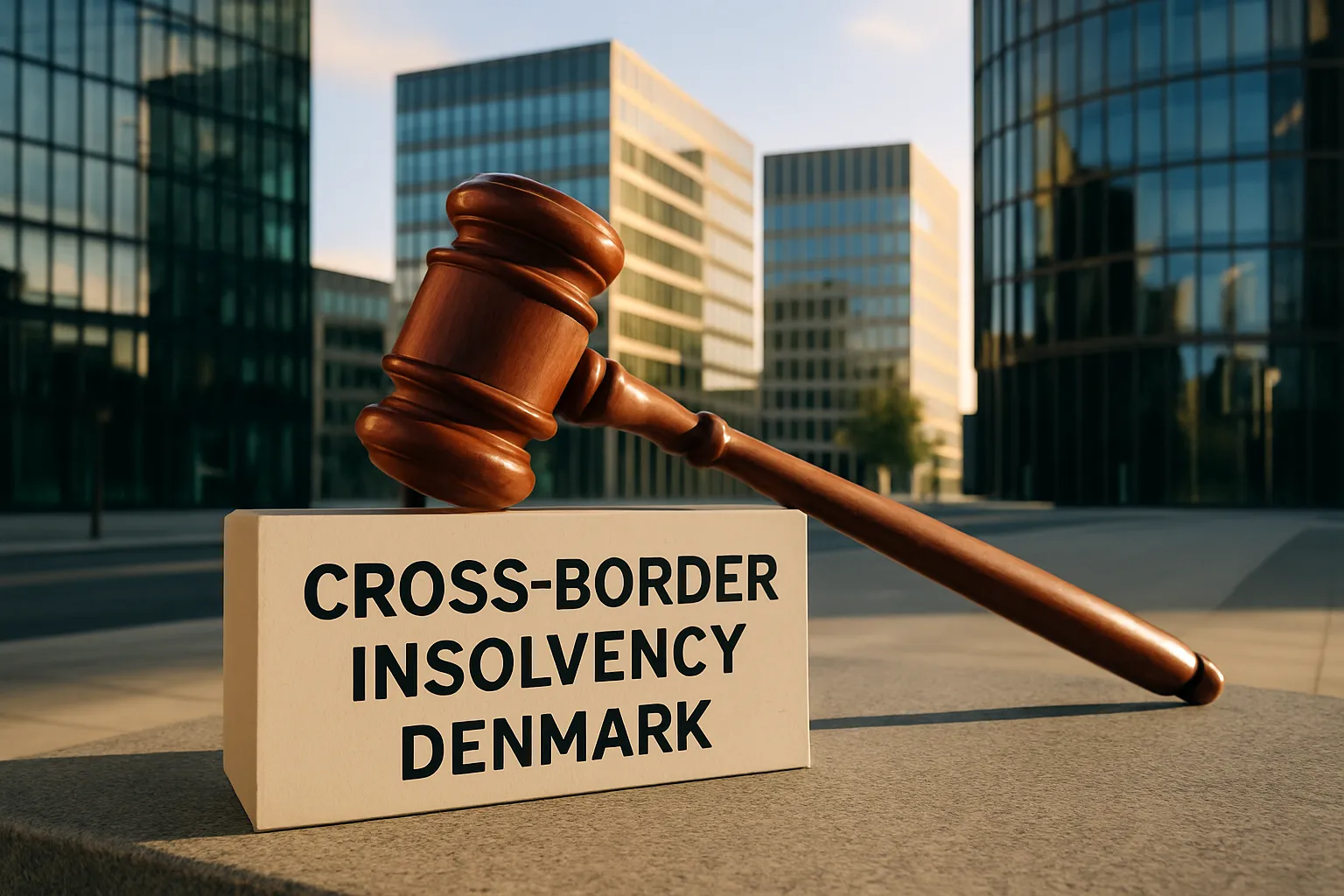
Cross-border insolvency denmark is a recurring reality for German suppliers, lenders and service providers exposed to Danish trading partners, and 2026 brings continued refinement of the rules that govern how their claims are treated. This guide sets out, in practical steps, how a German creditor files a claim, protects security and enforces rights when a Danish counterparty enters insolvency. Importantly, Denmark does not participate in the EU Insolvency Regulation (Recast) (Regulation (EU) 2015/848) because of its opt-out from EU cooperation in the field of justice and home affairs, so the framework in practice is Danish national bankruptcy law together with the Nordic Bankruptcy Convention where relevant and general private international law principles.
It is written for credit controllers, in-house counsel and insolvency practitioners who need a decision-ready workflow rather than a legal essay.
Who this guide is for: German corporate creditors, credit controllers and insolvency practitioners asking: Can I file? How? What are the deadlines and costs? How do I protect security and enforce my rights in Denmark?
Cross-border insolvency denmark sits at the intersection of two legal layers. The first is the question of jurisdiction and recognition. Because Denmark is not bound by the EU Insolvency Regulation (Recast), the automatic recognition mechanism that applies between most other Member States does not extend to Danish proceedings. Recognition of a Danish decision in Germany, and of German proceedings in Denmark, therefore depends on national rules and general principles rather than on the Recast Regulation. The second layer is Danish national insolvency law, which regulates the day-to-day mechanics of a Danish bankruptcy estate: how claims are lodged, how the trustee administers assets, and how distributions are ranked and paid.
For a German creditor, the key point is that Denmark’s opt-out means the Recast Regulation is not the governing instrument for Danish insolvency proceedings. Whether main insolvency proceedings can be opened in Denmark, and whether a Danish decision will be recognised in Germany, must be assessed under Danish domestic law and applicable private international law rather than assumed under the Recast Regulation. This distinctive position must be checked in every case. Once proceedings are open in Denmark, Danish national law, principally the Danish Bankruptcy Act (konkursloven), consolidated versions of which are available through the official legal portal Retsinformation, dictates the procedural steps you must follow.
This guide applies where a German creditor holds a claim against a company that is subject to, or is likely to become subject to, Danish insolvency proceedings. It covers unsecured trade creditors, secured lenders, and creditors relying on a prior judgment or enforcement order. It is most useful once the debtor’s centre of main interests is in Denmark, or where a Danish establishment or Danish-situated assets justify proceedings in Denmark.
About this guide: The practical tips and templates here draw on Danish court practice and casework representing German creditors in Danish insolvency, transport and commercial disputes. It is general guidance, not legal advice on a specific matter.
Standing in Danish insolvency proceedings does not depend on nationality or place of establishment. A German creditor has the same right to lodge a claim as a domestic Danish creditor. The practical questions are which category your claim falls into, which proceedings govern, and whether you should merely file a claim or actively petition for the opening of proceedings.
A creditor is any party owed a due or contingent obligation by the debtor. For the purposes of danish insolvency proceedings, creditors are broadly divided into:
Danish courts may open bankruptcy proceedings where the debtor has its centre of main interests or an establishment in Denmark, or in respect of assets located in Denmark, under Danish jurisdictional rules. For a German creditor, identifying whether Danish proceedings are the relevant proceedings, or whether proceedings opened elsewhere are more relevant to the assets you are pursuing, changes where you lodge and how far a Danish decision reaches. Because the Recast Regulation’s automatic allocation of jurisdiction does not apply to Denmark, these questions are resolved under Danish law and applicable conventions.
Can I start insolvency proceedings against a Danish company from Germany? Yes. A creditor can, in defined circumstances, petition a Danish court to open bankruptcy proceedings against a debtor, typically where the debtor is insolvent and unable to pay debts as they fall due. Jurisdiction and forum questions must be resolved first, because petitioning in the wrong forum wastes time and cost. Because a creditor petition may require the creditor to provide security for costs and carries evidential consequences, appointing Danish counsel before filing is essential.
This is the core workflow for cross-border insolvency denmark from a German creditor’s perspective. Each step below is sequenced so that you protect your position on deadlines while assembling the evidence a Danish trustee will scrutinise.
| Step | Who is responsible | Typical duration / deadline |
|---|---|---|
| 1. Confirm proceeding type and deadlines | German creditor + Danish counsel | 1–5 days (initial check) |
| 2. Appoint Danish counsel / local agent | Creditor (from Germany) | 1–7 days |
| 3. Gather documents and evidence for proof of claim | Creditor (credit control / legal) | 2–14 days depending on complexity |
| 4. Draft and translate proof of claim; calculate amounts | Creditor + counsel | 1–7 days |
| 5. Lodge claim with trustee and file in court (if required) | Creditor / counsel | Within the lodgement period set by the court |
| 6. Respond to trustee objections / attend creditors’ meeting | Creditor / counsel | Within the period set in the trustee’s notice |
| 7. Enforcement actions for secured creditors (if permitted) | Secured creditor + counsel | Weeks to months; may require court involvement |
| 8. Monitor distribution and file appeals | Creditor / counsel | Months to years, depending on the estate |
Establish which Danish court has opened the estate and who the appointed trustee (kurator) is. Confirm the lodgement deadline the moment you learn of the proceedings, this single check protects your voting and distribution rights. Register your interest with the trustee so that you receive notices of creditors’ meetings and distribution schedules.
Appointing Danish counsel early is the highest-value action a German creditor can take. Danish counsel confirms the exact lodgement period, communicates with the trustee in Danish, and advises on whether your security is enforceable. You will need to grant a power of attorney; the Danish Bar and Law Society (Advokatsamfundet) maintains information on lawyer representation and a register of admitted lawyers. Draft the power of attorney in English or Danish; notarisation may be required depending on the trustee’s or court’s requirements.
The proof of claim must state the debtor, the creditor, the principal amount, contractual interest and fees, and the legal and factual basis of the debt. Quantify the claim precisely as at the date proceedings were opened. If you assert a security interest or preferential status, state it clearly and attach the supporting registration or perfection evidence. A vaguely quantified claim invites a trustee objection.
Lodge the proof of claim with the trustee administering the estate, and file with the competent Danish court where the procedure requires it. Where electronic filing is available through the Danish courts, use it and retain proof of submission. Include translations of the key documents; while the trustee may accept documents in English, the trustee or court may request Danish translations of central items.
Creditors’ meetings (skiftesamlinger) determine key questions about the administration and realisation of the estate. Your right to vote depends on having a duly lodged and admitted claim. If the trustee objects to your claim, on valuation, priority, or an alleged voidable transaction, respond within the period set with documentary support. Missing the response window can result in your claim being reduced or disallowed.
After realisation of assets, the trustee proposes a distribution. Monitor the distribution schedule against your admitted claim and its ranking. If a decision on admission, ranking or distribution is adverse, note the appeal window immediately, appeal periods in danish insolvency proceedings are short and are not extended for foreign creditors as a matter of course.
Assembling the right documentary package at the outset shortens the claim process and reduces the risk of trustee objection. The table below is the working checklist a German creditor should prepare before lodging.
| Document | Who provides | Notes / translation needs |
|---|---|---|
| Original contract or invoice(s) | Creditor | Danish or English translations recommended; certified translation if trustee requests |
| Proof of delivery / acceptance / performance | Creditor | Transport documents, delivery receipts, signed acknowledgements |
| Statement of account / ledger showing outstanding balance | Creditor | Provide calculation of interest and fees per the contract |
| Security documents (mortgage, pledge, charge) | Creditor | Record of registration and proof of perfection under Danish law |
| Court judgments / foreign enforcement orders | Creditor | Certified copy plus German→English/Danish translation; advise on recognition steps |
| Power of attorney for Danish counsel / agent | Creditor | Drafted in English/Danish; notarisation may be required |
| Proof of communications with debtor (reminders / dunning letters) | Creditor | Demonstrates claim maturity and collection attempts |
| Identification of creditor (company registry extract) | Creditor | German Handelsregister extract, translated |
| Proof of tax/status (preferential claims) | Creditor | Where claiming preferential/employee status |
Practical tip for German creditors: prepare a single indexed bundle with a one-page claim summary at the front. Trustees process well-organised claims faster, and a clear index reduces the risk of a document being treated as missing.
Deadlines are where foreign creditors most often lose value in cross-border insolvency denmark. The estate operates on Danish periods set by the court and trustee, and these do not pause because a creditor is based abroad or awaiting translations.
When a Danish court opens an estate, a lodgement period for creditor claims is set and notified. As a matter of prudent practice, treat the period as running from the date the notice is published rather than the date you actually receive it. Lodge as soon as your documentary package is ready; late lodgement can prejudice your right to vote and, in some cases, your share of an interim distribution.
Where the trustee objects to a claim, or where a claim is disputed, the creditor will be given a period to respond as set in the trustee’s notice. Appeals against court decisions on admission or ranking carry their own short statutory windows under Danish procedural law. Diarise every deadline the moment it is known and build in time for translation and cross-border courier delays. Confirm the exact applicable periods with Danish counsel, as they vary by the type of decision.
Extensions are not automatic. Where an extension may be available, for example to complete certified translations or to obtain missing perfection evidence, the request must be made promptly and with reasons. Danish counsel should make the application; a well-supported request made early has a far better prospect than one made after a deadline has passed.
Budget realistically before committing to enforcement or a creditor petition. The principal cost items in cross-border insolvency denmark are set out below. The figures are indicative estimates only and should be confirmed with Danish counsel for your specific matter.
| Cost item | Typical range / who pays | Notes |
|---|---|---|
| Court fee for a bankruptcy petition | Set by statute (DKK) | A creditor petitioning for bankruptcy is generally required to lodge a court fee and provide security for the estate’s costs; amounts are fixed by the applicable court fees rules |
| Trustee / administrator fee | Set by the court | Fixed by the court and paid from the estate |
| Danish counsel / agent fees | Varies by complexity (indicative €1,000–€5,000+) | Litigation or enforcement work is charged separately |
| Translation and notarisation | Variable (indicative €200–€1,000) | Depends on volume and certification requirements |
| Enforcement / enforcement lawyer fees | Variable (indicative €1,000–€10,000+) | Where court involvement is sought to seize or repossess assets |
| Miscellaneous (travel, asset inspection) | Variable | Site visits or appointed experts where asset value is in dispute |
For low-value unsecured claims, weigh the counsel and translation cost against the likely dividend before committing. For secured or high-value claims, the cost of early counsel is almost always justified by the improved recovery position.
Security is only as strong as its perfection under Danish law. The most common cause of a failed enforcement in cross-border insolvency denmark is a security interest that was never validly perfected in Denmark, or a registration that the trustee can challenge. Address perfection before, not after, the debtor’s insolvency.
Danish law recognises security over specific assets, such as mortgages (pant) and pledges, and, in defined circumstances, security over classes of assets such as floating charges (virksomhedspant). The enforceability of each depends on correct registration or possession and on whether the security was granted within any period during which the trustee may challenge it as a voidable transaction (omstødelse). Confirm the type and perfection status of your security at Step 1 of the claims workflow.
Opening of bankruptcy proceedings generally restricts individual enforcement action against the estate. A secured creditor must establish whether the secured asset falls within the estate, in which case realisation is typically administered by the trustee, or whether the security gives rights that can be exercised in coordination with the trustee. Where court involvement is required to realise or repossess an asset, act through Danish counsel with full perfection evidence.
A trustee may challenge security on grounds of defective perfection, late registration, or as a voidable transaction (omstødelse) granted in the run-up to insolvency. Be ready to prove the date of grant, the date and manner of perfection, and the consideration given. A checklist for secured creditors: (1) confirm the governing law of the security; (2) confirm perfection under Danish law; (3) date-stamp registration evidence; (4) assess exposure to omstødelse; (5) prepare your realisation/relief position in advance.
| Topic | Denmark (key points) | Germany (contrast for German readers) |
|---|---|---|
| Filing proof of claim | Lodge with the trustee and register with the court as required; translations often requested | Proof of claim in the Insolvenzverfahren; similar lodging but different formalities |
| Enforcement of security after opening | Individual enforcement generally restricted; secured creditors’ assets typically realised via the trustee, subject to perfection | The Insolvenzordnung treats secured creditors distinctly; differences in perfection and registration apply |
| Trustee powers | Trustee administers the estate and may challenge voidable transactions and disputed claims | The Insolvenzverwalter has comparable powers, but specific powers and timelines differ |
| Cross-border recognition | Denmark is outside the EU Insolvency Regulation (Recast); recognition rests on national rules and applicable conventions | German proceedings fall within the Recast Regulation as between participating Member States |
2026 remains a year of active interpretation of cross-border insolvency questions across Europe, particularly on the determination of the centre of main interests, the coordination of parallel proceedings, and the protection of foreign creditors’ rights. For dealings with Denmark, the key structural point is unchanged: Denmark does not participate in the EU Insolvency Regulation (Recast), so the automatic recognition and jurisdictional coordination that the Regulation provides between other Member States does not apply to Danish proceedings.
The practical effect for German creditors is that recognition of a Danish decision, and the reach of Danish proceedings into assets located abroad, turn on national law and applicable conventions rather than the Recast Regulation. The prudent course is to monitor relevant Danish Supreme Court (Højesteret) rulings on trustee powers, security and creditor ranking, and to confirm the current position with Danish counsel before committing to a strategy. Well-documented, promptly lodged claims remain the most resilient regardless of how interpretive questions develop.
Most losses in cross-border insolvency denmark are avoidable and procedural rather than substantive. The recurring traps are:
Cross-border insolvency denmark rewards creditors who act early, document thoroughly and respect Danish procedural deadlines. The workflow is consistent: confirm the proceeding and its deadlines, appoint Danish counsel, assemble a complete evidential bundle, lodge the proof of claim within the set period, engage constructively with the trustee, and monitor distributions and appeal windows. Secured creditors should treat perfection under Danish law as the decisive question and prepare their realisation position in advance. Because Denmark sits outside the EU Insolvency Regulation (Recast), recognition and jurisdiction must be assessed under national rules; German creditors who combine a disciplined claims process with timely local advice are best placed to protect and recover value in Danish insolvency proceedings.
This article was produced by Global Law Experts. For specialist advice on this topic, contact Anders Vestergaard at Advokaterne St Knud Torv P / S, a member of the Global Law Experts network.

posted 12 minutes ago

posted 28 minutes ago

posted 1 hour ago

posted 1 hour ago

posted 1 hour ago

posted 2 hours ago
posted 2 hours ago

posted 2 hours ago

posted 2 hours ago

posted 3 hours ago

posted 3 hours ago

posted 3 hours ago
No results available
Find the right Legal Expert for your business

Send welcome message