
This is general information, not legal advice. Consult local counsel before acting.
Criminal IP prosecution uganda is increasingly the enforcement route of choice for rights-holders confronting commercial-scale counterfeiting and piracy, and in 2026 the procedural landscape, spanning the Uganda Police Force, the Directorate of Public Prosecutions (ODPP) and the courts, rewards those who prepare evidence correctly from the first hour. This guide sets out, step by step, how a brand owner, licensee, in-house counsel or enforcement agent can move from a discovered infringement to a charge sheet and a conviction. It covers eligibility, the police-to-ODPP-to-court workflow, the documents you must assemble, realistic timelines, costs, penalties, and the mistakes that routinely sink otherwise strong cases.
Read it alongside qualified Ugandan counsel, because the facts of each matter determine whether criminal action, civil action, or a combined strategy is appropriate.
Criminal enforcement serves a different purpose from a civil suit. A civil action seeks to compensate the rights-holder and to restrain further infringement through injunctions and damages. A criminal prosecution, by contrast, is a public-interest action: its objective is to punish, deter and remove offenders from the market, often accompanied by the forfeiture or destruction of infringing stock. For a rights-holder facing an organised counterfeiting operation, the prospect of imprisonment and a criminal record carries a deterrent weight that a money judgment rarely matches.
Criminal IP prosecution uganda is particularly effective where infringement is wilful, repeated, and conducted on a commercial scale. The threat of seizure, arrest and prosecution can dismantle a supply chain more rapidly than protracted civil litigation. It also signals to the wider market that a brand is actively policed. The trade-off is that the rights-holder surrenders much of the control: once the ODPP is involved, prosecutorial discretion governs whether, and how, the matter proceeds.
Criminal action is the stronger option when the conduct is plainly deliberate, when the infringer is judgment-proof (so civil damages would be uncollectable), when the goods pose health or safety risks, or when deterrence of a repeat offender is the priority. It is also preferable where immediate state-backed seizure is needed to take dangerous or large volumes of counterfeits off the market. Where the dispute is genuinely arguable, for example, a contested question of trademark similarity, a civil forum is usually more suitable because the criminal standard of proof is far higher.
Four actors drive a criminal matter. The rights-holder (or an authorised agent or licensee) identifies the infringement, preserves evidence and lodges the complaint. The Uganda Police Force, through its Criminal Investigations Directorate (CID) and specialist desks, investigates, seizes and builds the file. The Uganda Registration Services Bureau (URSB) supplies proof of registration and can assist with enforcement liaison. The Office of the Director of Public Prosecutions (ODPP) reviews the police file, decides whether to prosecute, and conducts the prosecution in court. Effective coordination among these four is the single biggest determinant of a successful outcome.
Not every act of infringement is a crime. Uganda’s statutory framework criminalises specific conduct, and the prosecution must prove the defined elements beyond reasonable doubt. The principal statutes include the Copyright and Neighbouring Rights Act, 2006 and the Trademarks Act, 2010, supplemented by trade-descriptions and anti-counterfeiting provisions. In each case the key ingredients are generally a protected right, an infringing act, and a mental element, wilfulness, knowledge, or an intention to deal commercially in the infringing material.
The mental element is decisive. A person who innocently stocks goods they genuinely believed to be authentic may escape criminal liability even where civil infringement is made out. For this reason, evidence that the accused knew or ought to have known the goods were counterfeit, invoices far below market value, concealment, prior warnings, or deliberate mislabelling, is central to any criminal IP prosecution uganda.
The principal categories of criminal IP offences uganda recognises include:
Because statutory section numbers and penalty schedules are periodically amended, the precise offence text and sentencing range should always be confirmed against the current consolidated statute on the Uganda Legal Information Institute (ULII) before charges are framed.
A criminal complaint can be lodged by the registered proprietor, an exclusive licensee with authority to act, an authorised brand-protection agent, or a representative holding a power of attorney. URSB and customs authorities may also refer matters arising from border interceptions. While anyone may report a suspected offence to the police, a complaint supported by proof of ownership and a clear statement of facts carries far more weight and is more likely to trigger a serious investigation. In practice, the rights-holder’s active cooperation throughout the investigation is indispensable.
The ip criminal procedure uganda follows a defined sequence. Each stage has its own responsible actor, its own evidentiary priorities, and its own typical duration. The timeline table below summarises the whole route; the subsections then explain each step in practical detail. Treat the early steps as the most important: errors in preservation and reporting are rarely curable later.
| Step | Who is responsible | Typical duration |
|---|---|---|
| 1. Immediate preservation & seizure at scene | Rights-holder (with private security) + police if present | Same day (0–24 hrs) |
| 2. Report filed at police station (occurrence book & investigation file opened) | Rights-holder submits complaint; police officer registers | 0–3 days |
| 3. Police investigation (evidence collection, witness statements, lab tests) | Police IP unit / CID, with rights-holder cooperation | Several weeks (complex cases may run months) |
| 4. Referral and file submitted to ODPP for advice/consent | Police → ODPP | Weeks (ODPP backlog can extend) |
| 5. ODPP decision (prosecute / nolle prosequi / request more evidence) | ODPP | Weeks to months |
| 6. Charge sheet filed & accused arrested/summonsed | ODPP / police | Weeks after ODPP decision |
| 7. Court process (pre-trial, trial, sentence) | Courts (Magistrates’ Court / High Court) | Several months to 18+ months (depends on backlog) |
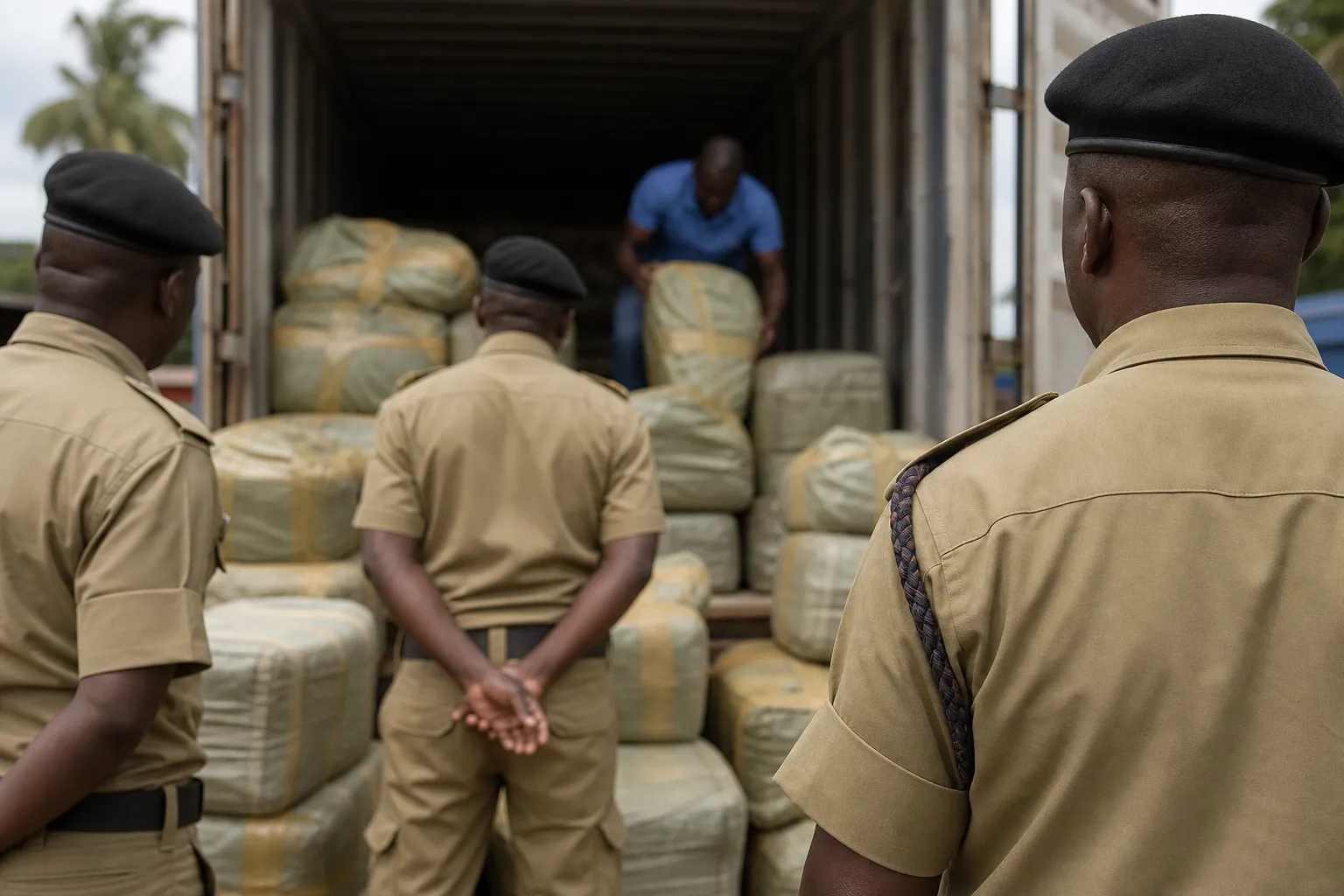
The moment infringement is confirmed, preservation begins. If you have lawful access, for example, a market stall or a warehouse entered with police or under a court order, document the scene before anything is moved. Photograph and video the goods in situ with visible timestamps, capturing packaging, labelling, batch codes and quantities. Do not allow suspect goods to be removed, substituted or privately returned. Where police are present, request that they take the goods into custody and open a formal inventory. Every item seized should be logged, numbered and signed for by the seizing officer and an independent witness. This establishes the chain of custody that will later determine whether the exhibits are admissible at trial.
A broken chain of custody is one of the most common reasons an otherwise compelling criminal IP prosecution uganda collapses.
Reporting counterfeits to police uganda is best done through a written complaint, not merely an oral report. Attend the police station, ideally the one with jurisdiction over the infringement location, and submit a signed statement of facts. Insist on an entry in the station diary (occurrence book) and request referral to the CID or a specialist desk where available. The complaint should identify the rights-holder, the registered right (attaching the URSB certificate), the infringing conduct observed, the location, the suspected offender, and the goods seized or to be seized. A sample opening for a police complaint might read: “I, [name], duly authorised representative of [proprietor], the registered owner of trade mark No.
[xxxx], report that on [date] at [location] I observed counterfeit goods bearing our registered mark offered for sale, and I request investigation and prosecution of the responsible persons. ” Treat this as a sample only and refine it with counsel.
Once the file is open, the police ip offences uganda investigation proceeds. Officers collate exhibits, record witness statements, obtain the accused’s statement where possible, and arrange any forensic or authenticity testing. The rights-holder’s role here is supportive but vital: provide samples of genuine goods for comparison, arrange an expert to confirm the goods are counterfeit, and supply commercial documents demonstrating your use of the mark or work. The quality of the police file dictates the ODPP’s decision, so cooperate closely and ensure every exhibit is properly labelled and referenced in the investigation report.
The police then forward the completed file to the ODPP for advice and, where required, consent to prosecute. The ODPP applies two tests familiar to prosecutors everywhere: whether there is sufficient admissible evidence to afford a realistic prospect of conviction, and whether prosecution is in the public interest. For IP matters the ODPP will scrutinise the chain of custody, the proof of ownership, the expert evidence establishing the goods are counterfeit, and the evidence of the accused’s knowledge or intent. A thin file, missing an expert report, or with gaps in custody, will usually be returned with a request for further investigation rather than approved. Consult the ODPP’s published guidance for current prosecution policy.
Once the ODPP decides to prosecute, a charge sheet is filed and the accused is arrested or summonsed. The accused may apply for bail, which the court may grant subject to conditions. Pre-trial steps include disclosure, the taking of a plea, and the fixing of hearing dates. If the accused pleads guilty, the court proceeds to sentence. If not, the matter is set down for trial, at which the prosecution must prove every element of the offence beyond reasonable doubt. The rights-holder’s witnesses, the investigator, the authenticity expert, and any employees who can speak to the genuineness of the goods, will usually be required to testify.
On conviction, the court may impose fines, imprisonment, and orders for forfeiture and destruction of the infringing goods. Throughout, remember that the ODPP, not the rights-holder, controls the prosecution, including any decision to discontinue by nolle prosequi.
Evidence wins criminal IP cases. The table below sets out the core documents and exhibits you should assemble, who provides each, and why it matters. Build this file before you report, so the police can open a strong investigation from day one.
| Document / Evidence | Who provides it | Why it matters |
|---|---|---|
| Duly signed police complaint (statement of facts) | Rights-holder / authorised agent | Starts the official investigation; provides clear facts for charges |
| Owner registration documents (URSB trademark certificate, copyright documentation) | Rights-holder / URSB | Establishes rights and prima facie ownership |
| Photographs & video of seized goods (timestamped) | Rights-holder / investigator | Visual proof of infringement and packaging |
| Inventory of seized goods (signed by officer & witness) | Police + rights-holder witness | Chain of custody and exhibit list |
| Witness statements (store owner, customer, investigator) | Rights-holder / witnesses | Corroborate activity and support testimony at trial |
| Expert report (authenticity / forensic analysis) | Forensic expert / appointed lab | Technical proof of counterfeiting or copying |
| Commercial documents (invoices, purchase orders, adverts) | Rights-holder | Prove use of the mark/work and commercial dealing |
| Samples of authentic goods for comparison | Rights-holder | Comparative evidence against seized samples |
| Customs seizure documents (if border action used) | Customs (URA) / URSB | Demonstrate prior interception and pattern |
| Chain of custody forms (signed on each transfer) | Police / custodians | Prevent admissibility challenges in court |
For physical counterfeits, prioritise the seizure inventory, timestamped photographs, and an expert authenticity report distinguishing the seized goods from genuine samples. Secure the goods in a controlled store, with every transfer documented on a chain-of-custody form. Retain packaging, labels and batch codes, which often reveal the source and scale of the operation. Where goods are perishable or voluminous, seek early agreement, with the ODPP informed, on representative sampling and destruction, so that admissible evidence is preserved even if the bulk cannot be stored.
Learning how to prosecute copyright infringement uganda in the digital context demands different evidence. Capture the infringing content with verifiable screenshots, download logs and metadata, ideally witnessed or captured by an independent investigator to establish authenticity and date. Preserve server records, URLs, and any communications showing the accused’s knowledge and commercial intent. Proof of ownership, evidence of authorship and first publication, or any registration held, and evidence that copies were made or distributed for trade are essential. Expert testimony on the technical provenance of the copies frequently makes the difference at trial.
As the Step/Who/Duration table shows, the realistic span from report to judgment runs from several months to eighteen months or more, driven largely by investigation complexity and court backlog. The controllable variable is the front end. Preservation and reporting should happen within the first 24 to 72 hours; evidence that is not secured promptly is lost or contaminated. Perishable goods, online content that can be deleted, and witnesses whose memories fade all demand urgency. The ODPP review and the court phases are largely outside your control, but a complete, well-organised police file shortens the ODPP decision and reduces adjournments at trial.
Where a limitation period might apply to a particular offence, confirm it with counsel against the current statute before delay prejudices the case. In short: move fast where you can, and build the file to withstand the inevitable slower phases.
A frequent advantage of criminal enforcement is that the state bears the cost of prosecution once the ODPP takes carriage. The rights-holder’s expenditure is concentrated in the investigation and evidence-gathering phase, together with any private legal support. The table below gives broad categories rather than fixed figures; confirm current amounts locally, as professional fees and exchange rates shift.
| Item | Typical payer | Note |
|---|---|---|
| Police filing & investigation | Rights-holder | Generally no statutory filing fee; private costs for transport, copying |
| Legal fees (retainer + court support) | Rights-holder | Varies widely by counsel and complexity; obtain a written engagement |
| Forensic / expert reports | Rights-holder | Depends on the tests required |
| Court-related fees | Rights-holder / state | Generally modest in criminal matters; confirm with the registry |
| Witness expenses & translations | Rights-holder | Variable, budget for travel and accommodation |
| Customs storage / seizure handling | Rights-holder / Customs (may require bond) | Possible storage charges or bond; case-by-case |
Budget realistically for expert testing and witness logistics, as these are the costs most often underestimated and most capable of undermining a case if cut.
Rights-holders planning a criminal IP prosecution uganda in 2026 should verify the current position on three fronts before acting. First, check ULII for any amendments to the Copyright and Neighbouring Rights Act or the Trademarks Act affecting offence definitions, thresholds or penalty ranges. Second, review the ODPP’s latest guidance and circulars on prosecution policy, which periodically refine how files are assessed and the evidence the ODPP expects. Third, search the Judiciary’s decisions for recent sentencing outcomes, which indicate how seriously courts are treating commercial counterfeiting. Because statutory and policy changes can be incremental yet material, treat this section as a prompt to confirm the live position with counsel rather than to rely on any fixed figure.
Choosing between criminal and civil action, or combining them, is a strategic decision. Criminal action delivers punishment and deterrence; civil action delivers compensation and tailored injunctive relief. The comparison below frames the trade-offs that shape rights holder criminal remedies uganda.
| Factor | Criminal prosecution | Civil action |
|---|---|---|
| Objective | Punish, deter, remove offenders | Compensate; injunctive relief; damages |
| Burden of proof | Beyond reasonable doubt | Balance of probabilities |
| Typical remedies | Fines, imprisonment, confiscation, forfeiture | Injunctions, damages, account of profits |
| Speed | Often slower (ODPP / prosecution backlog) | Can be faster for interim injunctions |
| Evidence threshold | Higher; requires strong proof of culpability | Lower; proof of infringement and loss |
| Use with customs | Strong when linked to criminal seizure | Customs used for immediate border relief |
In practice, a hybrid approach is often optimal: use an interim civil injunction or customs detention for immediate relief, while a parallel criminal prosecution pursues deterrence and forfeiture. Coordinate the two so that evidence gathered for one supports the other.
The following sample materials, all to be refined with local counsel, accelerate a criminal filing:
Your next step is to assemble the evidence file, engage counsel, and report. For deeper workflows, see the related guidance on when to use criminal vs civil IP remedies in Uganda, working with the ODPP on IP offences, and how to obtain customs seizures for counterfeit goods in Uganda. You can also explore the IP Litigation, Uganda practice area and find IP litigation lawyers in Uganda through the GLE directory. All sample materials are provided for guidance only; seek local counsel before use.
This article was produced by Global Law Experts. For specialist advice on this topic, contact Frederick J. Mpanga at AF Mpanga, a member of the Global Law Experts network.

posted 8 minutes ago

posted 28 minutes ago

posted 1 hour ago

posted 1 hour ago

posted 2 hours ago

posted 2 hours ago

posted 2 hours ago

posted 2 hours ago

posted 3 hours ago

posted 3 hours ago

posted 3 hours ago

posted 3 hours ago
No results available
Find the right Legal Expert for your business

Send welcome message