posted 2 months ago
Video games became a large-scale cultural and economic ecosystem, driven by advanced technologies and connected by a network of rights. In Brazil, its intersection with sports law is particularly sensitive. This sensitivity stems from the intense exploitation of elements of the sporting spectacle, be it the image of athletes, club and league brands, recreation of arenas and uniforms, as well as the increasing professionalization of esports and their digital broadcasts. The artistic layer, which includes scripts, characters, visual arts, soundtracks, voices, animations, three-dimensional environments, and other creative expressions, forms the symbolic heart, providing an immersive experience. Adequate legal protection of this layer, coupled with transparent management of usage permissions among the multiple rights holders, is fundamental to the legal certainty for all those involved in the digital sports environment: studios, publishers, competition organizers, clubs, leagues, broadcasters, digital platforms, and commercial partners. This article proposes an analysis of copyright and related protection regimes applicable to the artistic dimension of games, focusing on their applications and tensions within sports law.
Consumer Market:
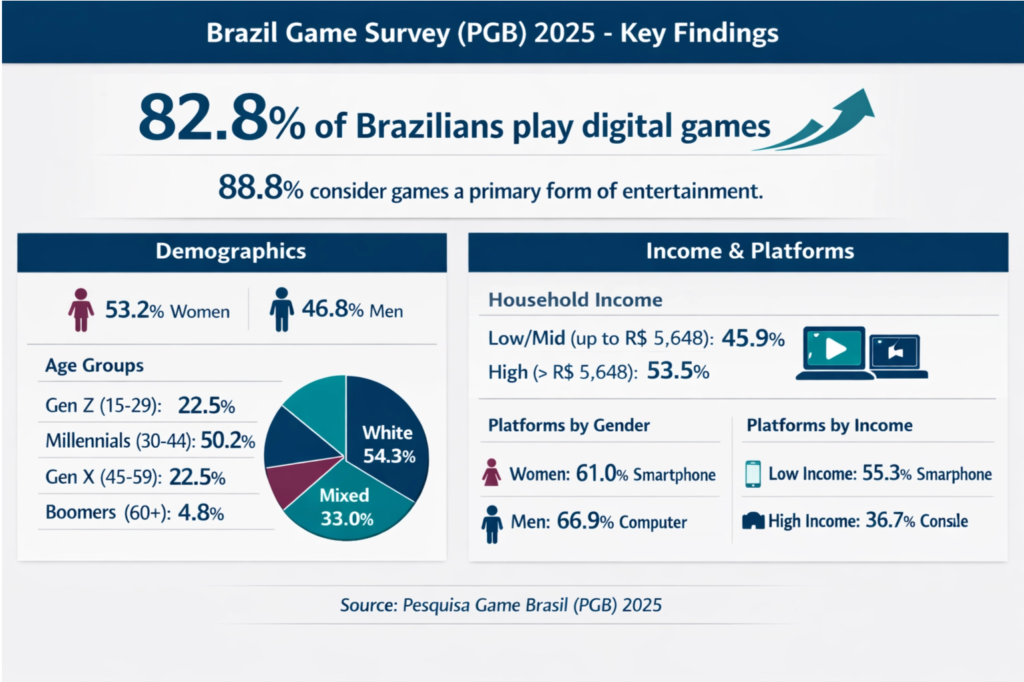
The Game Brasil Survey (PGB), conducted in 2025[1], one of the main surveys in the gaming segment in the country, indicated that 82.8% of respondents regularly play some type of digital game, an increase of 8.9 percentage points compared to 2024. In this context, games of chance have also become popular and have boosted some categories of players. Furthermore, 88.8% of respondents said that digital games are among their main forms of entertainment.
As illustrated in the graphs attached, other insights are related to gender, age groups, platforms and other aspects.
Legal nature of Electronic Games:
A videogame is, legally, a complex work, an integrated set of a computer program and multiple works protected by copyright and related rights. The computer program, governed by Law 9.609/1998 (Computer Program Law), provides interactivity and logic. The aesthetic and expressive elements, such as visual arts, models, textures, animations, scripts, dialogues, soundtracks, effects, voices, and interpretations, are predominantly protected under Law 9.610/1998 (Brazilian Copyright Act). Therefore, a game is not just a “program” or an “audiovisual work,” it is a complex work, with several layers of rights and holders, requiring clear contracts for its economic exploitation.
In the sports field, this complexity is amplified by the incorporation of elements from the real spectacle: physical and vocal characteristics of athletes, distinctive club and league symbols, recognizable arenas, uniforms, and even choreography. Many of these elements, while not “works of art,” are protected by other legal spheres, such as: personality rights, industrial property, and occasionally, specific copyright protection (e.g., architectural works in virtual settings). Managing this matrix of rights requires studios to align licenses that encompass programmers, composers, voice actors, athletes, designers, and clubs, as well as holders of rights over arenas and public visual works, when digital reproduction transcends legal permissions. Contractual clarity is therefore essential for legal certainty.
Copyright and related rights in the Artistic Layer:
Law 9.610/1998 guarantees authors moral rights, which are inalienable and non-waivable, such as authorship and integrity of the work, as well as patrimonial rights, which are transferable, allowing economic exploitation.
In games, elements such as the visual art of a character, the artistic concept, animations, and narrative are protected as intellectual creations; soundtracks and sound effects are musical works and phonograms; and the vocal interpretation of a voice actor is protected as a performance by an artist. The overlap of rights is clear; a scene may involve a screenwriter, audio director, composer, arranger, performer, recording studio, and animator. Therefore, each layer typically requires an express patrimonial authorization, detailing usage modalities, term, territory, and compensations, in accordance with the restrictive interpretation of copyright contracts.
Legal limitations and exceptions, such as quotation or parody, are strict and rarely cover the typical commercial exploitation of games. When a game replicates the atmosphere of a championship, including trademarks, uniforms, and identifiable performances on a large scale, the need for authorization increases considerably. According to several authors, copyright protection falls on the “form of expression” and not on the idea, underlining the importance of legal protection for artistic expression in games.
For example, Duval´s formulation: “On this basis, the most rudimentary analysis immediately reveals that in any literary, artistic, or scientific work two fundamental elements coexist in its composition: the idea and the form of expression. Thus, if two works, under different forms of expression, contain the same idea, it follows that neither can be deemed plagiarism of the other. Is it solely because the form of expression is different? No. Rather, because the idea is common, belonging to everyone, it does not belong exclusively to the authors of the works in conflict.”[2] In the software and digital context, see Caruso[3] who underscores that protection attaches to the expressive embodiment, not to abstract ideas or functionalities. Taken together, the Berne Convention’s material rules and Brazilian statutory law converge on robust protection for artistic expression in games while preserving the public domain of ideas, structures, and general concepts that remain free for all to use.
Software creation by an employee:
Law 9.609/1998 establishes that the patrimonial rights to computer programs developed under an employment or commission agreement belong to the employer or client, unless otherwise stipulated. However, this rule is limited to the code and functionality, not automatically encompassing artistic creations. Therefore, while the studio acquires the rights to the code, it must formalize the assignments or licenses of artistic and related works of other professionals (visual artists, animators, scriptwriters, composers, performers). This dissociation is a frequent cause of litigation, for example, when a soundtrack is licensed only for one platform, or a voice for a regional version, and the studio expands the reach without renegotiating the relevant terms. Detailed contracts for each artistic element are crucial to avoid vulnerabilities in the chain of title and ensure the future exploitation of the game.
Image, Name, and Voice Rights of Athletes:
In sports, the inclusion of personal attributes of athletes, coaches, and referees is highly sensitive. The Civil Code and the Constitution protect image, name, and voice as personality rights, requiring consent for economic exploitation. Brazilian sports legislation distinguishes between sports broadcasting rights (“arena rights,” in Brazil), and image rights contracts, which cover the commercial exploitation of personal attributes outside the arena, such as in games. The Brazilian General Sports Law (Law 14.597/2023) maintained this distinction, requiring specific authorizations for the use of athletes’ images in licensed products, not automatically covered by broadcasting rights.
In games that simulate real competitions, “identifiable likeness” is a critical point: even without the real name, the combination of physical characteristics, position, number, movements, and club context can distinguish an athlete. This form of identification generally justifies the requirement for specific authorization and remuneration. The voice, due to its biometric capacity, is protected as a personality right and, at times, as sensitive personal data under the LGPD (Brazilian General Data Protection Law), requiring caution in its collection, processing, and synthesis. Image protection goes beyond photography, covering any identifiable representation.
Protecting sports identity – Trademarks, Distinctive Signs, and Assets of Clubs and Leagues:
Distinctive signs of clubs and leagues, such as shields, logos, names, competition designations, and the presentation of uniforms, are protected by Law 9.279/1996 (Industrial Property Law). Their reproduction in electronic games for economic purposes requires authorization from the holder, under penalty of trademark infringement and unfair competition. In official products, collective licenses with associations or leagues simplify negotiation. In fragmented scenarios, the studio must seek individualized authorizations. Contractual exclusivity, common in the sector, demands competitive analysis, as it can create market barriers or attract the attention of antitrust authorities, requiring transparent economic justifications.
Stadium architecture and virtual scenarios – The “Right of Panorama”:
The representation of stadiums and arenas in games raises questions about architectural works, protected by Law 9.610/1998. The reproduction of works in public places (freedom of panorama) has limits. If the recreation of a stadium is merely contextual and does not interfere with the economic exploitation of the original architectural work, its legality is debatable. However, when the realism and distinctiveness of an architectural project become central to the game, negotiation with the rights holders is the prudent approach, mitigating controversies and aligning brands, naming rights, and sponsorships.
Licensed soundtrack and events:
The soundtrack in games involves the musical work (melody and lyrics) and the phonogram (sound recording). Musical synchronization requires authorization from the authors, publishers, and phonographic producers, unless the soundtrack is commissioned with full assignment of rights. Public performances at events and broadcasts, including esports, generally imply the payment of a fee to the ECAD[4]. Organizers must plan secure broadcast paths, with synchronization and performance documentation, to avoid digital blocks and sponsorship conflicts, especially in events integrated into the traditional sports calendar.
Related Rights – Voices, Dubbing, and Automated Synthesis:
Vocal interpretations by narrators and voice actors are protected related rights. In sports games, narration and sound design are crucial for player immersion and often involve voices of high reputational value participating in gameplay. The transfer of rights for use in games must detail modalities (updates, expansions, regional versions), deadlines, territories, and reuse in promotional materials.
For voice synthesis using automated techniques, specific, informed, and prominent consent is recommended, with clear rules regarding quality, scope, and additional remuneration. The General Data Protection Law (LGPD) requires a data protection impact assessment (DPIA) if the voice is treated as biometric data, demanding enhanced security and specific purposes.
Personal Data Protection and Biometrics – Athletes and Fans in interactive experiences:
Games and platforms that personalize experiences and collect biometric digital data (image, voice, body metrics) from athletes and fans must comply with the LGPD (Brazilian General Data Protection Law). It is essential to identify the legal basis, minimize data, guarantee the rights of data subjects (access, correction, deletion, and portability), and establish functional channels for these rights. Biometric data is sensitive, intensifying requirements for consent, transparency, certainty, and governance; international data transfers require joint liability and contractual adaptation mechanisms, in addition to robust privacy policies.
Electronic Sports – Broadcast Contracts and analogy with Sports Broadcasting Rights:
Electronic sports are organized competitions where the game is both the platform and the object. Unlike traditional sports, the electronic sports tournament organizer generally controls the game rights, and the organizer defines the rules for use and broadcasting. There is no statutory “arena right” for esports and its athletes, therefore images, broadcast licenses, and content policies must be contract‑based. When electronic sports are integrated into traditional sporting events, the requirements of general sports legislation are added, such as integrity, protection of minors, security, advertising, and sponsorship. Contractual clarity is vital to avoid conflicts between all parties involved.
Consumer Protection:
Advertising in games and broadcasts, whether on virtual uniforms, arenas, or interactive activations, must follow consumer protection and self-regulation rules. Even greater care must be taken with children and adolescents, requiring transparency, advertising identification, and prohibition of practices considered abusive. The sporting environment demands competitive integrity, prevention of match-fixing, and cautious handling of regulated products such as fixed-odds betting. Sponsorship conflicts between real and virtual clubs require prior contractual compatibility, emphasizing the importance of transparency in the digital realm to protect the end consumer.
For the consumer, games as continuous services, i.e., those with roster updates, for example, demand transparent content policies. Drastic changes that remove essential functionalities can be challenged by the duty to inform and protect against abusive practices. Mechanisms for moderating user-generated content (leagues, customized uniforms) must include human analysis, with contestation and response flows, as per the Brazilian Civil Rights Framework for the Internet. In the secondary market for virtual items, clear rules of use and transfer help prevent deceptive practices and ensure predictability.
Enforcement of rights – Judicial and extrajudicial measures:
The enforcement of copyright and image rights in games and broadcasts combines private and formal strategies. Contractually, clauses regarding auditing, removal of illicit content, suspension of licenses, and termination for non-compliance are the first barriers.
Extrajudicially, notifications for the removal of infringing content can be sent to infringers and intermediary platforms, according to the Brazilian Civil Rights Framework for the Internet. Judicially, urgent measures to cease improper exploitation or safeguard evidence are effective, especially for unauthorized use of athletes’ images, reproduction of club trademarks, and unlicensed musical synchronization. ECAD charges for unlicensed public musical performance at events are generally supported by jurisprudence.
Taxation and economic effects:
Tax planning is essential. Musical and phonogram licenses imply transfers to holders and payment for public performance. Assignments of patrimonial rights (voice, image, public works) generate civil contracts with specific tax incidence. Licensing and software provision services attract municipal ISS (Services Tax), with precedents from the STF (Supreme Federal Court) varying according to standardized or custom-made programs.
In any case, Brazil has recently undergone a sharp reform of its tax system, which will profoundly reshape the fiscal environment for e-games, events, and licensing. That is because it replaced four taxes with a dual Value Added Tax (VAT) model, composed of IBS (Tax on Goods and Services) and CBS (Contribution on Goods and Services). This change tends to reduce fiscal fragmentation among federal entities. Also, it adopts taxation at the destination and establishes full non-cumulativeness, allowing for broad tax credits on inputs.
For sectors that currently operate mainly under the ISS (Tax on Services) — such as software licensing, musical soundtracks, assignment of voice and image rights, and production services — the transition represents a structural change: the ISS, with rates between 2% and 5%, will be gradually replaced by a potentially higher tax burden, estimated at around 27% when IBS and CBS are combined. On the other hand, companies that use many taxed inputs, such as servers, cloud computing, engines, and digital tools, may be able to offset some of this impact from the new financial credits.
Regarding music and phonographic licenses, as well as the assignment of patrimonial rights, the Reform shifts the incidence to the new VAT, further reducing the relevance of the distinction between obligations to deliver and obligations to perform, a trend already induced by the jurisprudence of the Supreme Federal Court when dealing with the taxation of software. E-games events and competitions will also be covered by IBS, although municipal fees and administrative permits will remain valid, requiring a more rigorous compliance schedule.
The transition between 2026 and 2033 demands contract reviews, adaptation of billing systems, and reassessment of business models, especially in activities that depend on recurring licensing or the provision of digital services. The end result is a simpler scenario in the long term, but more costly for services, requiring careful tax planning to mitigate impacts and take advantage of credit opportunities.
Basis of legal predictability and protection of children and adolescents:
Legal certainty begins with mapping the chain of title. Even before creating a prototype, the studio must identify creative assets and owners, formalizing written contracts with visual artists, animators, scriptwriters, composers, performers, and technical collaborators. It is vital to foresee compatibility between trademark and image licenses of athletes/clubs, and clear rules for updates and future versions. Asset assignments must detail usage modalities (different platforms, promotional materials, additional content, adaptations for broadcasts). In sports projects, a governance committee (studio, club/league, media partners, sponsors) reconciles schedules, campaigns, and integrity requirements, reducing litigation and optimizing value capture.
Sports games must follow age rating rules. Promotional materials and broadcasts must identify the content and practice responsible advertising, especially with microtransactions or betting. The presence of minors, as audience members or athletes in e-sports, requires consent and adheres to the controls of the Statute of Children and Adolescents (ECA), including data processing, content moderation, and prevention of harassment in chat rooms and digital arenas.
Practical criteria for compliance in Sports Projects:
Experience in gaming and sports projects suggests practical guidelines: 1) detailed contractual planning, aligning copyright and related rights with sports calendars, broadcasts, and sponsorships; 2) reputational risk management, with content review to avoid undue associations, biases, or discrimination, and compatibility with the integrity policies of sports entities; 3) robust data protection architecture, especially for the voice and image of athletes and fans; 4) economic predictability, with attention to copyright compensation, public performance royalties, and revenue sharing among licensors. These guidelines, coordinated by a governance committee (studio, club/league, media partners, sponsors), minimize litigation and maximize value.
Electronic games legislative scenario:
The Brazilian Supreme Federal Court (STF) has already ruled (ADI 5.800) that the Union has exclusive legislative power over copyright, while the federal constitution establishes that the Union, states, and municipalities have concurrent legislative power over sports, with the issuance of general, supplementary, and local regulations, respectively.
In this sense, by way of illustration, there are committees dedicated to deliberating on the subject at the federal level (Federal Senate and House of Representatives) and at the state and municipal levels, and the different federative entities may issue public policies that can influence the supply and demand scenario for games in Brazil.
Thus, it is worth mentioning that at the federal level, in 2024, the government sanctioned Bill 2796/2021, which became Law 14.852/2024, establishing the Legal Framework for the Electronic Games Industry in Brazil. Also, Bill 4139/2024 is currently under analyses in the House of Representatives, which aims to include electronic games as an extracurricular activity in public and private basic education schools in Brazil, with the objective of fostering the development of cognitive, social, motor, and digital skills among students.
In parallel, as an illustration of the deliberation of the topic at the local level, Law 11.955/2026 was published in Belo Horizonte on January 14, 2026, which “establishes the Municipal Policy for the Promotion of Electronic Games and Electronic Sports – e-sports,” which aims to promote the development of the sector and foster social inclusion, education, culture, innovation, health, and the well-being of the population.
Regulatory trends:
The national debate on the regulation of electronic games is progressing, with legislative proposals for legal certainty, incentives, and regulatory competencies. The scope of sectoral bodies regarding interactive works and fees is discussed, with administrative and judicial decisions that sometimes bring games closer to, and sometimes distance them from, traditional audiovisual works. Law 14.597/2023 reorganizes sports institutions, reinforcing integrity and raising, by analogy, questions for e-sports integrated into larger events. Continuous monitoring of sub-legal acts and judicial decisions is essential, as jurisprudence is still being formed.
Conclusion:
The artistic layer of electronic games is the symbolic engine of the digital experience, requiring, for its safe exploitation, a legal engineering that articulates copyright, related rights, personality rights, trademark rights, and data rights. In its encounter with sports law, this plurality of rights imposes a governance that is faithful to the legal frameworks and attentive to the particularities of the sporting spectacle and its value chains. The way forward is to build transparent, predictable, and balanced licenses that respect the creativity and investment of studios and fairly remunerate the holders whose authentic participation enriches the experience. With planning, clear contracts, and careful regulatory oversight, the sector can thrive, contributing significantly to the culture, economy, and expansion of the sports ecosystem.
In a country where federal, state, and municipal authorities are each actively shaping the regulatory landscape for electronic games and esports, staying ahead of legislative and judicial developments at all levels is not a competitive advantage, but a prerequisite for operating safely and sustainably in the Brazilian market.
[1] Available in: https://materiais.pesquisagamebrasil.com.br/2025-painel-gratuito-pgb25
[2] Duval, Hermano. Violações dos Direitos Autorais. Rio de Janeiro: Borsoi, 1968, p. 56)
[3] CARUSO, Maria Adalgisa. Disciplina Giuridica del Software e Interesse dellla Collettività. Milano: Giuffrè, 1989, p. 34
[4] ECAD is the Brazilian Central Collection and Distribution Office for copyright, which is similar to ASCAP and BMI in the USA, or PRS in Great Britain.
Author


No results available


posted 4 days ago


posted 4 days ago

posted 5 days ago

No results available
Find the right Legal Expert for your business
Sign up for the latest legal briefings and news within Global Law Experts’ community, as well as a whole host of features, editorial and conference updates direct to your email inbox.
Naturally you can unsubscribe at any time.
Global Law Experts is dedicated to providing exceptional legal services to clients around the world. With a vast network of highly skilled and experienced lawyers, we are committed to delivering innovative and tailored solutions to meet the diverse needs of our clients in various jurisdictions.
Global Law Experts is dedicated to providing exceptional legal services to clients around the world. With a vast network of highly skilled and experienced lawyers, we are committed to delivering innovative and tailored solutions to meet the diverse needs of our clients in various jurisdictions.
Send welcome message