
Our Expert in France
No results available
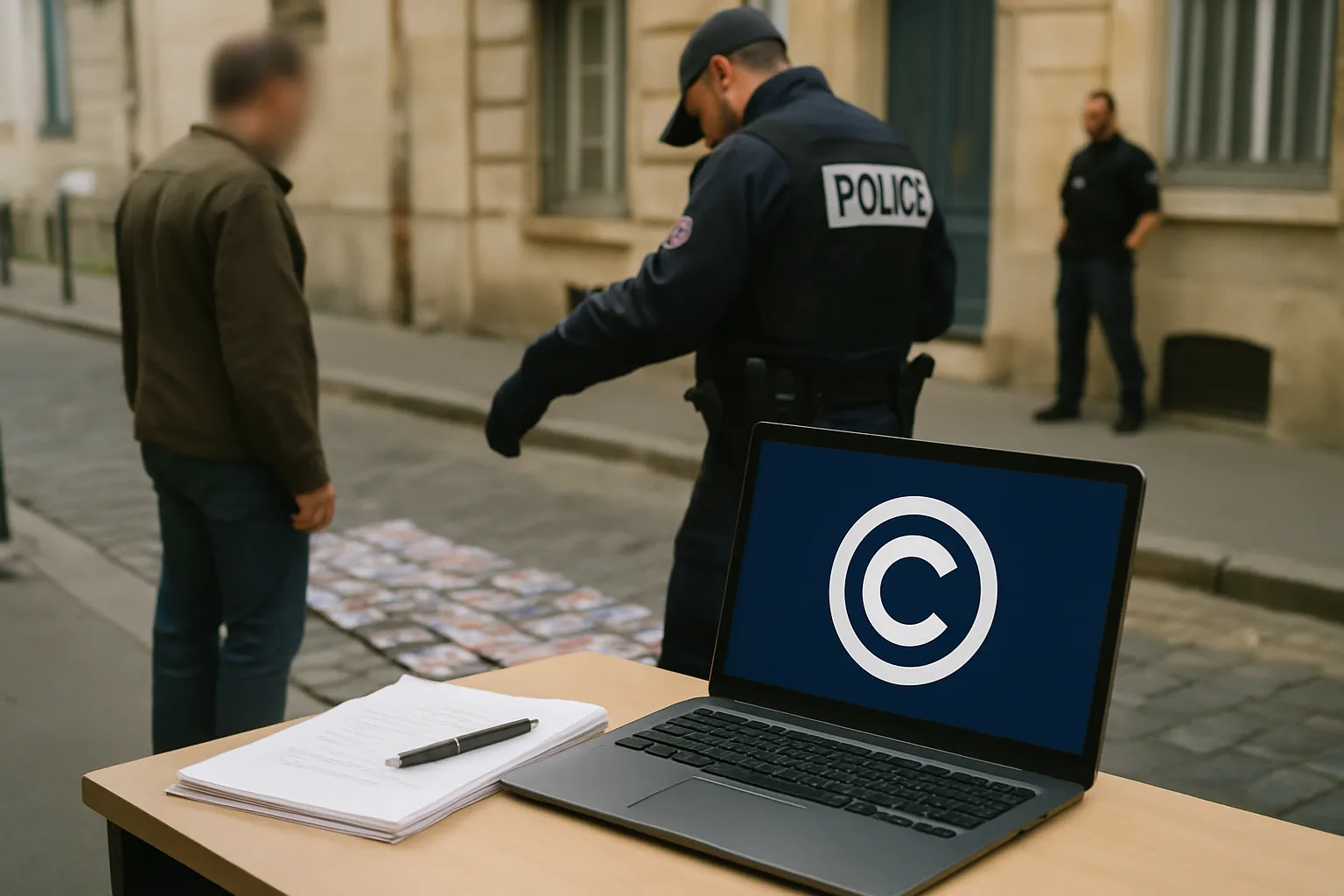
Copyright enforcement france is now a decision that media and creative businesses face on a near-weekly basis, as platform moderation, cross-border streaming and a run of high-profile French court decisions have made online infringement both faster and more damaging in 2025–26. When a film leaks before release, a live broadcast is restreamed without authorisation, or a catalogue is pirated across mirror sites, the practical question is never abstract, it is which remedy to fire first, how quickly it works, and what it costs. This guide gives rights-holders and in-house counsel a France-specific, operational playbook for the four main routes: platform takedowns, ISP blocking orders, provisional measures (référé) and full civil infringement proceedings.
It takes a position at every stage, compares the routes side by side, and ends with a clear decision framework you can apply the moment content appears.
Search-intent summary: Use a platform takedown when infringing content sits on an identifiable host and speed matters. Escalate to provisional measures (référé) when delay causes irreparable harm, timing depends on the court and the case. Seek an ISP blocking order for large-scale, site-wide or persistent piracy where takedowns have failed. Bring a full civil action when you need damages, permanent injunctions or a binding finding of liability.
For most single instances of platform-hosted infringement, start with a takedown. It is generally the cheapest, fastest and least formal route, and platforms operating in France remain subject to the intermediary liability framework that makes prompt removal on notice their safest course. Where delay would be genuinely harmful, a pre-release leak, an ongoing live stream, a broadcast in progress, do not wait for platform processes: apply for provisional measures before the civil court, because a référé judge can order rapid injunctive relief. For large-scale or persistent infringement, particularly rogue sites whose operators are outside easy reach, target ISP blocking orders and then, where recovery or deterrence matters, follow with a full civil action for damages.
The single most important discipline underpinning every route is evidence preservation. The moment you detect infringement, capture the exact URLs, timestamped screenshots, server response headers and any available metadata, and record your chain of title. A well-assembled evidence packet turns a slow, contestable request into a fast, persuasive one, and it is often the difference between a takedown that sticks and a court application that is refused.
Effective copyright enforcement france rests on a layered framework combining French statute, procedural rules and directly relevant EU law. Understanding how these interact is essential, because the remedy you can obtain, and the standard you must meet, flows from the correct legal basis.
Since 1 January 2022, the functions of the former Hadopi have been absorbed into Arcom (Autorité de régulation de la communication audiovisuelle et numérique), following the merger of Hadopi and the CSA. Arcom is the authority competent over the unlawful online distribution of protected works and provides an educational, regulatory and enforcement remit within the French system, including maintaining lists of infringing sites and supporting rights-holders against sports-broadcast and audiovisual piracy. The civil courts grant blocking orders, provisional measures and final judgments, while the Cour de cassation shapes the interpretation of infringement and intermediary responsibility, and the Conseil d’État addresses administrative and proportionality questions around blocking.
Above the national tier, the Court of Justice of the European Union sets the boundaries within which French blocking and platform-liability remedies must operate, notably on proportionality and the balance between enforcement and fundamental rights. Rights-holders relying on registered rights can also draw on INPI resources when establishing their position, although copyright itself arises without registration in France.
The platform takedown is the workhorse of copyright enforcement france. It is fast, inexpensive and, for content hosted on identifiable platforms, usually the correct first move. It leverages the intermediary’s own incentive: under the e-Commerce Directive / LCEN framework and the Digital Services Act, a host that acts expeditiously on a valid notice retains its safe harbour, while one that ignores a proper notice risks losing it.
Direct your notice at the party that actually controls the content. For user-generated-content services (YouTube, Facebook, TikTok and similar), use the platform’s dedicated rights-holder or copyright reporting channel. Where the infringing material sits on a standalone website, identify the hosting provider (hébergeur), often discoverable through domain registration and hosting lookups, and serve the host directly, because the host, not the domain registrar, is the intermediary with the technical ability to remove content. Where a content delivery network or reverse proxy obscures the true host, notify the intermediary you can reach and record the attempt; that record matters later if you escalate.
To get infringing content removed from a French website or platform quickly and durably, assemble the following before you submit:
A valid takedown results in removal of the specific content or suspension of the offending account. Two follow-up realities shape strategy. First, takedowns can be contested: an uploader may challenge the removal or re-upload the content, so preserve every record. Second, takedown notices carry a risk of liability if issued carelessly, the LCEN penalises knowingly inaccurate notifications, so ensure each notice is accurate and rights-backed. If the platform is unresponsive or the infringement recurs, escalate internally to the platform’s legal team and, where harm is mounting, pivot to provisional measures. Persistent, whack-a-mole infringement across many hosts is the classic signal that a takedown-only approach has run its course and a blocking order is the better tool.
Where infringement is large-scale, site-wide or persistent, and particularly where the operator is anonymous, offshore or simply unresponsive, the judicial blocking order is the decisive instrument in copyright enforcement france. Rather than chasing individual files, you ask a French court, on the basis of the CPI, to require national internet access providers (ISPs) to block access to the infringing site.
Choose blocking when takedowns have failed, when there is no realistic intermediary to notify, or when the sheer volume of infringing material makes item-by-item removal futile. Blocking is aimed squarely at structural piracy: dedicated infringing sites, repeat-offender operators and services built to distribute unauthorised content at scale. It is a heavier remedy than a takedown, so courts expect to see that lighter measures were tried or would plainly be inadequate.
Blocking applications succeed on evidence of persistent, site-wide infringement, a documented history of takedown attempts, and, critically, material addressing proportionality. French courts, applying principles the CJEU has developed, weigh the effectiveness of blocking against its impact on lawful content and users’ rights. You should therefore present: proof of infringement across the target site; records of prior notices and their outcomes; the scale and persistence of the activity; and a targeted, technically feasible request that minimises collateral effect on legitimate material. For live audiovisual and sports events, French law also provides expedited mechanisms involving Arcom to combat live piracy.
Once granted, a blocking order is enforced by the ISPs using technical measures such as DNS blocking, IP blocking and URL-level filtering. Each has trade-offs: DNS blocking is straightforward but easily circumvented by changing resolvers; IP blocking is broader but risks over-blocking shared addresses; URL-level approaches are more precise but more complex to implement. Rights-holders should anticipate circumvention, mirror sites, proxy domains and VPN access, and, where the framework allows, seek a mechanism to extend the order to newly identified mirrors, since a static order rapidly loses effect against a determined operator. In practice, obtaining and rolling out an ISP blocking order in France can take weeks to months, reflecting the court process plus the technical implementation across access providers.
When timing is everything, provisional measures are the sharpest tool in copyright enforcement france. The référé is a fast-track civil procedure that lets a judge grant urgent, provisional relief on an expedited basis, without waiting for a full trial on the merits. For pre-release leaks, live-streamed broadcasts and continuing infringements that inflict damage by the hour, it is frequently the only remedy that acts quickly enough to matter.
The référé is governed by the Code de procédure civile. Depending on the specific procedure invoked, an applicant may need to demonstrate urgency, the absence of a serious dispute or the existence of a manifestly unlawful disturbance, and, where the measure sought is intrusive, that intervention is justified. The judge is not deciding final liability; the judge is deciding whether, on the evidence presented at speed, provisional relief is justified to prevent harm. Because the standard is provisional and the timescale compressed, the quality and immediacy of your evidence do most of the work. The CPI also provides for specific IP measures, including the saisie-contrefaçon, obtained on application to secure evidence of infringement.
A référé judge can order injunctions to stop the infringing act, preservation orders to secure material, and expeditious takedown or blocking directed at the operator or host. Once the order is granted, enforcement runs through the enforcement officer (commissaire de justice) and, where necessary, the authorities. Respondents can seek to have the order varied or challenge it on appeal, so the relief is powerful but not final, which is precisely why serious matters pair a référé with a subsequent action on the merits.
Assemble a speed-first evidence packet designed to persuade a judge on urgency and prima facie infringement:
Provisional measures carry cost exposure, accelerated proceedings still require counsel, and a respondent may seek to vary or lift the order, so weigh the speed advantage against those risks. For genuinely time-critical infringement, though, that trade-off almost always favours acting.
The full civil action is the route to a determinate outcome: damages, permanent injunctions and a binding judicial finding of liability. It is the appropriate choice when monetary recovery matters, when you need lasting deterrence, or when a case is significant enough to justify establishing a precedent. In France, IP infringement claims are heard by designated specialised courts, and copyright matters of this kind are within the jurisdiction of the competent tribunal judiciaire, notably that of Paris for many IP disputes.
Bring the substantive action when the scale of infringement, the value of the loss, or the need for a definitive ruling outweighs the cost and time of full litigation. To succeed you must prove the subsistence of your right, the act of infringement, and, for damages, the harm suffered, which French courts assess having regard to the negative economic consequences for the rights-holder, the infringer’s profits and, where relevant, moral prejudice. A final judgment takes months to years, so it is rarely the first move, but it is often the necessary last one.
The routes are complementary, not mutually exclusive. A référé stops the bleeding; the action on the merits secures compensation and permanent relief; and a blocking order can be sought or maintained alongside both to contain ongoing distribution. Where infringement or assets sit abroad, cross-border enforcement of French orders and judgments becomes a distinct workstream that should be planned from the outset rather than left until judgment is in hand.
The table below compares the four routes dimension by dimension. Read it as a decision aid: the fastest and cheapest route is not always the right one, and the most powerful is rarely the first you should reach for.
| Dimension | Platform takedown | ISP blocking order | Provisional measures (référé) | Full civil action |
|---|---|---|---|---|
| Legal basis | Platform terms; e-Commerce Directive / LCEN / DSA safe harbour; CPI for substantive rights | Court order under CPI + procedural law; national courts enforce | Code de procédure civile (référé) + CPI | Code de la propriété intellectuelle (contrefaçon) |
| Who to target | Host / platform / UGC site | ISPs (access providers), sometimes host | Operator or host before civil court | Alleged infringer and intermediaries |
| Typical timeline | Hours–days | Weeks–months | Expedited (days–weeks, case-dependent) | Months–years |
| Evidence required | Work, ownership proof, URLs, notice | Persistent site-wide infringement, notice records, proportionality | Urgency / prima facie infringement + harm | Full proof of right, infringement and damages |
| Scope of remedy | Removal of content / account suspension | Nationwide blocking of site or URLs | Injunction, seizure, preservation | Permanent injunction, damages, costs |
| Cost (approx.) | Low; often no court fees | Medium–high (court, counsel, technical) | Medium (accelerated court + counsel) | High (full litigation, experts) |
| Enforceability | Fast but contestable; platform-dependent | High nationally; circumvention risk | High while in force; enforced via commissaire de justice | High (final judgment) |
| Risk of counterclaim | Low–medium (inaccurate notice) | Medium (proportionality/jurisdiction) | Medium (respondent may seek to vary/lift) | Medium–high (complex defences) |
| Evidence preservation | Immediate: URLs, headers, screenshots, metadata | Logs, notice history, takedown attempts | Immediate preservation crucial | Standard civil evidence-gathering |
| Typical use-cases | Single uploads on platforms | Large piracy sites, repeat infringers | Pre-release leaks, live streams | Monetary recovery, precedent |
The routes above only work as fast as your preparation allows. The following field lists are designed to be turned into reusable internal templates.
Whichever route you take, preserve evidence immediately and preserve it well. Content is deleted, sites go dark and metadata is overwritten; a robust capture taken at the point of detection is worth more than any argument made later.
Every enforcement route can be met with a defence, and courts weigh those defences against fundamental rights. The principal defences include authorisation or licence, statutory exceptions such as quotation and certain permitted uses, and, for intermediaries, the safe-harbour limits under the e-Commerce Directive / LCEN and the Digital Services Act, which protect hosts that act promptly once notified. French courts and the CJEU scrutinise blocking and injunctive orders for proportionality, balancing effective enforcement against freedom of expression and the interests of legitimate users. The clearest practical risk is the overbroad order: a blocking measure that catches lawful content, or a takedown issued without proper rights, invites challenge, reputational pushback and, potentially, liability for an inaccurate notification.
Precision and proportionality are not just legal niceties, they are what make orders survive scrutiny.
Operational relationships matter as much as legal ones. Build a clear escalation ladder: standard reporting channel first, then a dedicated rights-holder or trusted-flagger route, then direct contact with the platform’s legal team. Preserve every notice and every response so that a history of ignored requests is available if you need a court order. Engage technical partners early where blocking is likely, so that DNS, IP or URL-level measures can be implemented quickly once an order is granted, and so mirror sites can be identified and added. Consistent, well-documented liaison with platforms and ISPs turns enforcement from a series of one-off fights into a repeatable, defensible process.
Effective copyright enforcement france depends on matching the remedy to the harm, takedown for speed, référé for urgency, blocking for scale, and full civil action for damages and finality, and on preserving evidence from the first moment of detection. For tailored advice on any of these routes, or on cross-border enforcement of French orders, connect with an intellectual property specialist through Global Law Experts.
This article was produced by Global Law Experts. For specialist advice on this topic, contact Nathalie Marchand at d’Alverny Avocats, a member of the Global Law Experts network.

posted 17 minutes ago

posted 35 minutes ago

posted 1 hour ago

posted 1 hour ago

posted 2 hours ago

posted 2 hours ago

posted 2 hours ago

posted 2 hours ago

posted 2 hours ago

posted 2 hours ago

posted 2 hours ago

posted 2 hours ago
No results available
Find the right Legal Expert for your business

Send welcome message