
Our Expert in United Arab Emirates
No results available
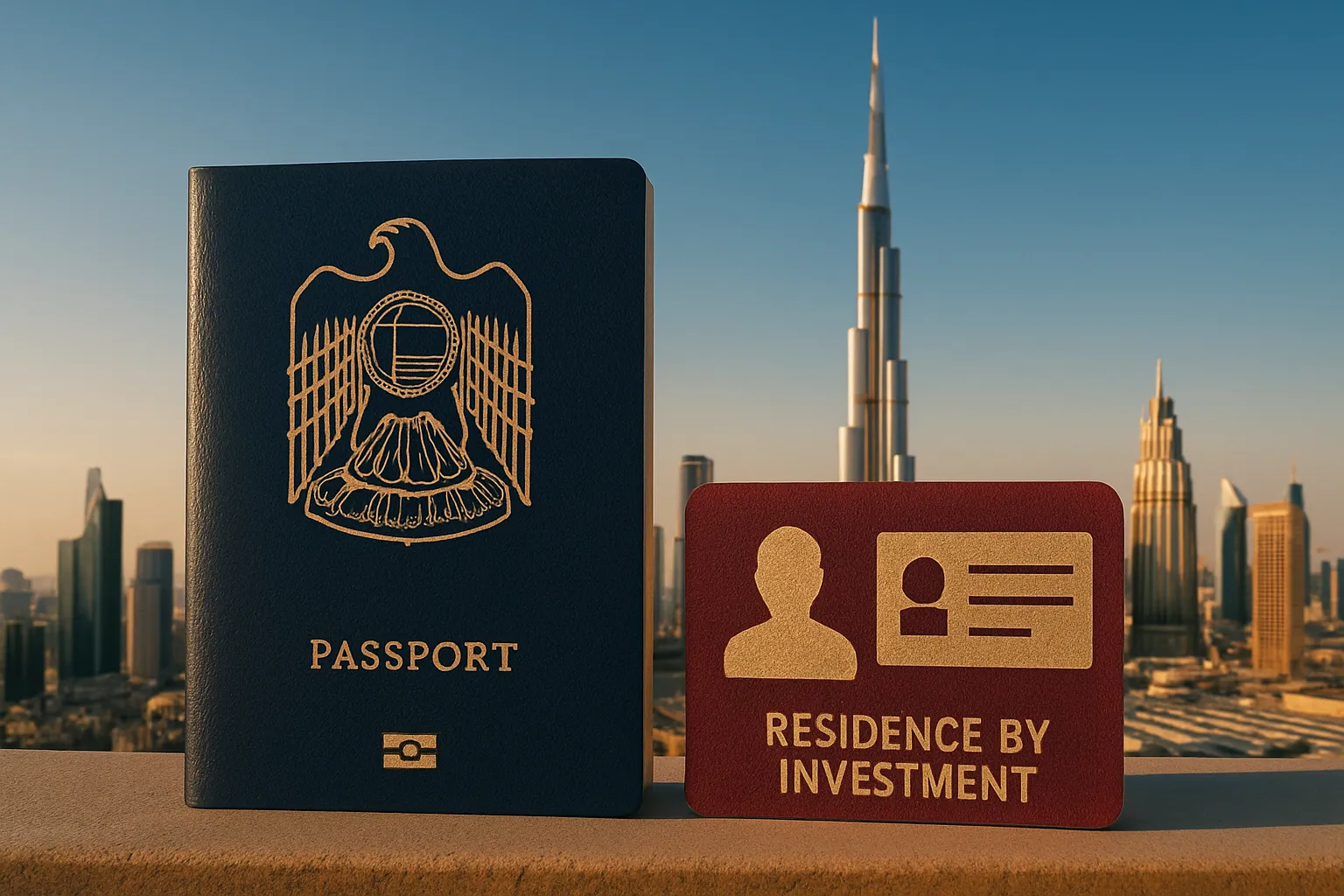
Citizenship vs residence by investment uae is one of the most consequential decisions a high-net-worth investor in the Emirates will make in 2026, and the two routes lead to very different destinations. Renewed momentum behind the UAE Golden Visa has pushed long-term residency firmly into the spotlight, while citizenship-by-investment (CBI) markets continue to shift under tighter due-diligence and pricing pressure. This guide is written for UAE-based investors, families and their advisers who need a clear, jurisdiction-aware answer rather than a marketing pitch. Below you will find a side-by-side comparison, a practical breakdown of mobility, tax, family, cost and legal risk, and a decision framework that tells you exactly when to choose each route.
If you want tailored advice after reading, you can arrange a consultation through the Global Law Experts network.
The starting point in any citizenship vs residence by investment uae analysis is understanding that these are two legally distinct outcomes. Citizenship by investment (CBI) confers nationality, a second passport and, in most jurisdictions, the associated civil and political rights. Residence by investment (RBI), including the UAE Golden Visa, grants the right to live in a country under a long-term residence permit, but it does not confer nationality or a passport.
Both routes require a qualifying economic contribution, but the mechanisms differ. CBI programmes typically accept a government donation, real estate purchase, or investment in bonds or approved funds. RBI programmes generally require property purchase, a bank deposit, business establishment, or qualification under a talent or skills category. Family inclusion rules also diverge: CBI programmes usually cover a spouse and dependent children, while several RBI programmes, the UAE Golden Visa among them, extend to parents and domestic staff under defined conditions (u.ae).
Most modern CBI programmes offer an accelerated grant of nationality without a prior residence period, in contrast to ordinary naturalisation which requires years of physical presence. The investor completes an application through an official Citizenship by Investment Unit, passes enhanced due-diligence checks, makes the qualifying contribution, and receives a certificate of naturalisation and passport. Official units in jurisdictions such as St Kitts and Nevis, Dominica and Antigua and Barbuda publish their processing standards and contribution routes (ciu.gov.kn; cbiu.gov.dm; cip.gov.ag).
RBI grants a renewable residence permit rather than a permanent legal status. The UAE Golden Visa, for example, provides long-term residence for eligible investors, entrepreneurs and specialised talent, together with the right to sponsor family members and, in many cases, to live in the country without a national sponsor (u.ae). Rights are defined by the host country’s permit rules and must be maintained through renewal and compliance with residency conditions. In some countries, qualifying residence can later count towards naturalisation.
Mobility is often the deciding factor in the citizenship vs residence by investment uae question. A passport and a residence permit are not interchangeable travel documents, and the difference matters at every border.
A CBI passport is a travel document in its own right. It provides visa-free or visa-on-arrival access to the countries with which the issuing state has agreements, plus consular protection when abroad. For a UAE resident who holds a passport from a country with limited travel access, a well-chosen second passport can materially widen visa-free reach. The exact list of accessible countries is programme-specific and changes over time, so investors should verify current access directly with the relevant official Citizenship by Investment Unit rather than rely on third-party rankings.
A residence permit is not a passport and does not, by itself, unlock visa-free travel to third countries. What it can do is ease movement within and around the issuing region, for example, residence in a Schengen state facilitates travel within the Schengen area under that area’s rules, and multi-entry long-stay visas reduce friction for frequent travellers. For UAE investors, the Golden Visa preserves the right to live and re-enter the Emirates on a long-term basis, which is valuable for those who want stability without changing nationality.
| Mobility feature | CBI (second passport) | RBI / Golden Visa |
|---|---|---|
| Visa-free travel to third countries | Yes, depends on issuing country’s agreements | No, permit does not substitute for a passport |
| Consular protection abroad | Yes, from country of citizenship | Limited; protection remains with country of nationality |
| Regional free movement | Depends on citizenship (e.g. within a union) | May allow regional movement per host rules |
| Re-entry stability | Permanent, tied to nationality | Conditional on renewal and compliance |
Investors should confirm current visa-free lists on official programme pages, as agreements are periodically renegotiated and access can be added or withdrawn.
Tax is the area where the citizenship vs residence by investment uae decision most often goes wrong. The common assumption, that acquiring a second passport changes where you pay tax, is usually false. Tax residence is generally determined by where you actually live and by national tax rules, not by which passports you hold (a small number of countries tax on the basis of citizenship, so specific advice is always needed).
If you obtain a second citizenship but continue to live in the UAE, your tax position generally does not change simply because you now hold another passport. The UAE does not levy a general personal income tax, though a federal corporate tax and value added tax apply to businesses at rates and thresholds set by the UAE authorities. By contrast, if you take up an RBI permit and physically relocate, you may create a taxable presence in the host country. That is precisely why residence, not nationality, is the trigger investors must scrutinise. Physical presence rules such as the UK’s Statutory Residence Test illustrate how days of presence can determine tax status (HMRC RDR3).
Where an investor could be considered resident in two countries at once, double tax agreements resolve the conflict through “tie-breaker” tests based on permanent home, centre of vital interests, habitual abode and nationality, a hierarchy set out in the OECD Model Tax Convention (OECD). UAE residents who need to prove their status can apply for a tax residency certificate through the UAE Federal Tax Authority, which is often essential to access treaty benefits (Federal Tax Authority). Nationality alone rarely governs the outcome; where you live and where your economic life is centred usually does.
Both routes engage international transparency frameworks. Under the Common Reporting Standard, financial institutions identify account holders by tax residence, so acquiring citizenship or residence does not allow an investor to escape reporting where a genuine tax-residence link exists. Banks apply anti-money-laundering and source-of-funds checks regardless of route, and any investor with a US connection remains subject to US reporting obligations. The practical lesson is that neither CBI nor RBI is a tool for concealment; both should be structured on the assumption of full transparency.
For many UAE investors the decision is really about the family, and here the two routes offer meaningfully different packages of rights, access and security.
CBI programmes typically include a spouse and dependent children, with some extending to dependent parents or adult children under age limits that vary by jurisdiction. RBI programmes are frequently broader in scope: the UAE Golden Visa allows sponsorship of a spouse, children, and in defined cases parents and domestic staff (u.ae). Investors with multi-generational households should map each dependant against the specific programme’s rules before committing, because eligibility ceilings and evidence requirements differ significantly.
Citizenship generally passes to children by descent, giving CBI a multi-generational dimension that RBI cannot match, a residence permit is personal and lapses, whereas nationality is typically heritable. Property and inheritance treatment depends on the host country’s civil law and any applicable succession regime. Access to public services, voting and other political rights follows citizenship, though the scope varies by country; residence permits confer the right to live and work locally and access services per the permit’s terms, but usually not political rights. For legacy planning, citizenship’s heritability is often decisive.
Budget and speed are practical constraints that shape the citizenship vs residence by investment uae choice as much as legal outcomes. Ranges are wide because programmes differ, so treat the figures below as planning benchmarks and confirm exact fees on official programme pages.
CBI programmes typically require a total outlay that varies widely by jurisdiction and route, with the qualifying donation or investment forming the core cost and government fees, mandatory due-diligence charges, and professional legal fees added on top. RBI routes generally involve a lower core investment, depending on whether the investor buys property, places a bank deposit, or establishes a business. The main cost components across both are:
Always verify the current schedule with the relevant official unit before budgeting, as minimum thresholds are periodically revised (ciu.gov.kn; cbiu.gov.dm; cip.gov.ag).
CBI applications commonly take several months, with timelines varying by programme and by the completeness of documentation. RBI permits, including the Golden Visa, are typically issued more quickly, but carry renewal obligations and conditions that must be maintained. Delays and red flags usually arise from incomplete source-of-funds evidence, complex corporate structures behind the applicant, prior visa refusals, or any adverse media surfacing during screening. Promises of guaranteed approval or timelines dramatically shorter than official norms should be treated with caution, legitimate programmes cannot bypass mandatory due diligence.
The durability of what you acquire is central to the citizenship vs residence by investment uae comparison. Rights that can be revoked or challenged are worth less than they appear at the point of grant.
CBI can be denied or revoked for fraud, material concealment, criminality, or where an applicant becomes subject to sanctions. Official units publish compliance and due-diligence policies precisely because programme integrity depends on them, and applications that fail enhanced screening are refused (cbiu.gov.dm; cip.gov.ag). RBI permits, including the Golden Visa, can be withdrawn for non-compliance with residency conditions, criminality, or breach of the terms under which the permit was granted (u.ae). In both cases, honesty at application stage is the single greatest protection.
Sound practice reduces exposure on both routes. Investors should:
The table below is the centrepiece of this citizenship vs residence by investment uae analysis. It maps the two routes across the dimensions that matter most to Emirates-based investors.
| Dimension | Citizenship by Investment (CBI), second passport | Residence by Investment (RBI / Golden Visa) |
|---|---|---|
| Legal status granted | Nationality / passport (full citizenship rights subject to jurisdiction) | Long-term residence permit; not a passport or nationality |
| Mobility / travel | Passport-based visa-free travel (depends on country), immediate travel document | Residency may ease travel (multi-entry visas) but not substitute passport for visa-free access |
| Family inclusion | Often includes spouse + dependent children; limits vary | Often broader: spouse, children, sometimes parents and domestic staff depending on programme |
| Tax impact | Citizenship alone usually does not change tax residence, tax depends on physical residence and domicile rules | Residency may create tax nexus depending on host rules (possible taxable presence) |
| Rights & benefits | Political rights (varies), consular protection, potential entitlement to social services (varies) | Right to live/work in host country; access to local services per permit rules; limited political rights |
| Typical investment types | Donation, real estate, government bond, business investment | Property purchase, bank deposit, business set-up, job-based sponsorship |
| Typical cost | Varies by jurisdiction and route; due diligence & fees extra, confirm on official pages | Generally lower core investment (purchase, deposit or investment), confirm on official pages |
| Typical timeline | Several months (varies by programme) | Generally faster to issue; renewal required (periods vary) |
| Revocation risk | Possible; strong due diligence; revocation for fraud/sanctions | Revocation for non-compliance, criminality or breach of residency conditions |
| Ease of future settlement | Citizenship confers settlement rights in country of citizenship | Residency may lead to naturalisation in some countries after qualifying period |
| Banking & reporting | May ease banking access in some cases but also triggers CRS/AML checks | Banks consider residency; CRS/US reporting implications remain if US-connected |
| Suitability for UAE investors | Best for mobility & long-term family security if willing to accept the associated obligations/tax implications | Best for temporary/medium-term relocation, preserving UAE ties and flexible tax planning |
Three short illustrations show how the table plays out in practice:
The citizenship vs residence by investment uae choice becomes clearer once you apply situational rules rather than treating the two as interchangeable. Use the paired lists below to identify your route, then follow the checklist.
Once the direction is set, work through the following process:
Professional advice is not optional at certain thresholds. Engage an adviser before you submit due-diligence documents, and specifically when:
You can review the residency route in more detail in the Residence By Investment UAE 2026: Essential Guide, and arrange bespoke advice via the Global Law Experts profile. Supporting resources on tax and compliance for UAE investors and on CBI programmes for UAE residents expand on the points above.
The citizenship vs residence by investment uae decision comes down to what you are actually buying: CBI delivers a heritable passport and mobility, while RBI delivers the right to live somewhere without changing nationality. For Emirates-based investors focused on travel freedom and multi-generational security, citizenship is usually the stronger fit; for those preserving UAE ties, planning a targeted relocation, or seeking broad family inclusion at lower cost, residence is the better route. Whichever direction you lean, the tax and due-diligence analysis must come before the application, not after. To pressure-test your options against your family, budget and tax position, arrange a consultation through the Global Law Experts network and read the supporting cluster guides.
This article was produced by Global Law Experts. For specialist advice on this topic, contact Abdelrahman Jabri at Holborn Assets Ltd., a member of the Global Law Experts network.

posted 18 seconds ago

posted 9 minutes ago

posted 41 minutes ago

posted 45 minutes ago

posted 1 hour ago

posted 1 hour ago

posted 2 hours ago

posted 2 hours ago

posted 2 hours ago

posted 3 hours ago

posted 3 hours ago

posted 3 hours ago
No results available
Find the right Legal Expert for your business

Send welcome message