
Author
No results available
For years, Brazil’s electricity sector had no dedicated legal category for stationary energy storage systems (BESS). Batteries connected to the grid were regulated, awkwardly, as if they were generation assets. That approach left developers, financiers and utilities without clear rules on remuneration, grid access or fiscal treatment.
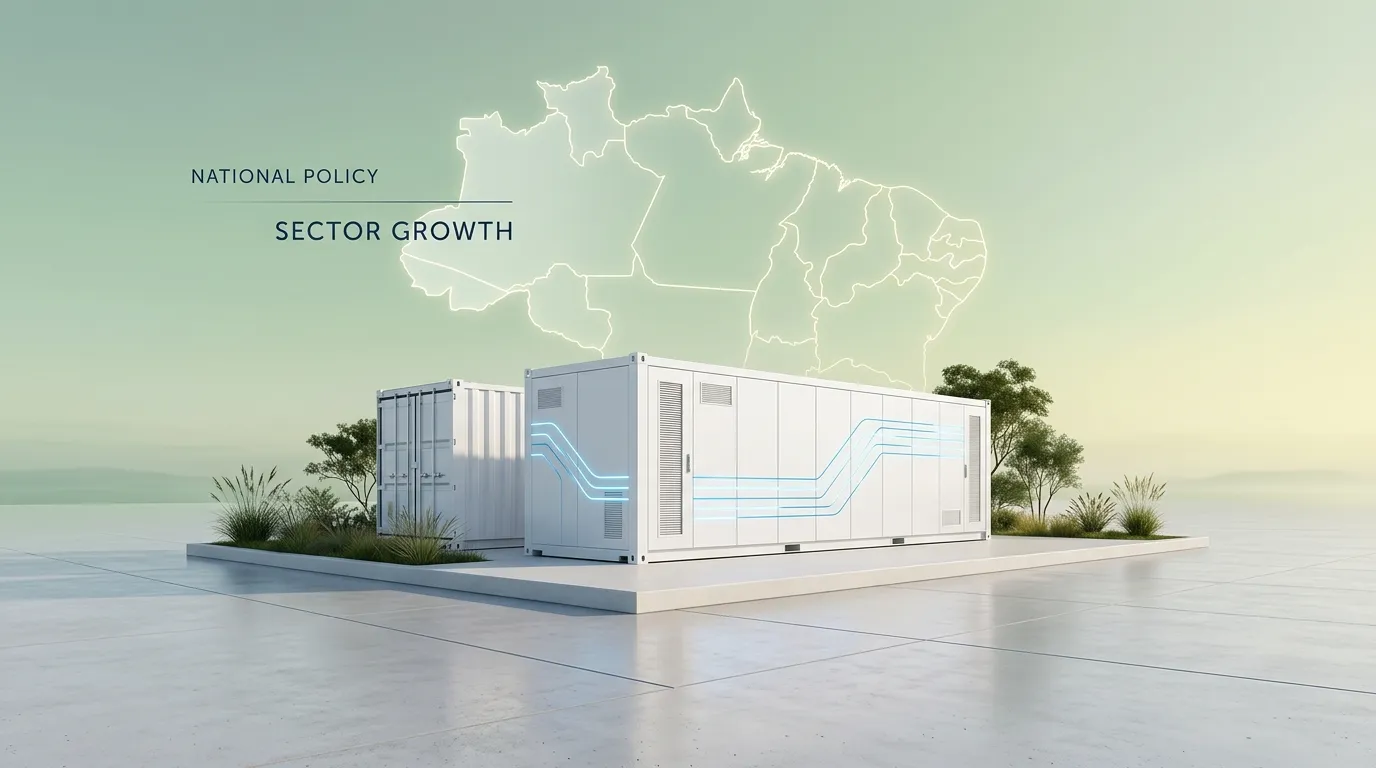
That gap has now been closed. With the enactment of Law No. 15,269/2025, Brazil has introduced its first comprehensive legal framework for energy storage, and the national electricity regulator, ANEEL, is now translating that framework into binding technical rules. For international investors looking at Latin America’s largest power market, the timing is significant: Brazil’s grid operator projects a capacity shortfall of roughly 55 GW by 2034, and analysts tied to the national system operator estimate that storage could unlock as much as R$40 billion in new investment over the coming years.
This article summarizes the new legal architecture, flags the issues still being worked out by regulators, and outlines what foreign counsel and investors should be watching over the next twenty-four months.
Law 15,269/2025, which originated from Provisional Measure 1,304, formally recognizes energy storage as an activity of the electricity sector subject to ANEEL’s regulatory and oversight authority. This is more than a technical clarification. By giving storage its own legal category (separate from generation, transmission and distribution) the law allows batteries to be treated, contracted and taxed on their own terms rather than through analogies to other asset categories that were never designed with storage in mind.
Among the law’s most consequential provisions for investors:
Statutory recognition is the foundation, but the operational rules are still being built. ANEEL is expected to create a distinct legal figure (the “energy storage agent”) as an autonomous participant in the sector, alongside updates to PRODIST (the technical distribution standards) governing how storage systems connect to the grid.
Progress has been incremental rather than immediate. A joint technical note published in early 2026 (Nota Técnica Conjunta nº 3/2026) addressed a question that had stalled part of the regulatory process since mid-2025: whether storage assets should be charged network-usage tariffs (TUSD/TUST) twice: once when charging (as a consumer) and again when discharging (as a generator injecting power). ANEEL’s technical staff concluded that the new law did not, on its own, change the underlying tariff logic, meaning storage operators currently remain subject to separate contracts and separate charges for consumption and injection. This “double tariff” question remains one of the most closely watched open issues in the sector, and a further resolution dedicated to network access, ancillary services and sector charges is still being drafted.
For structuring purposes, foreign investors should treat the tariff and remuneration framework as unsettled rather than finalized. Deal models built today should stress-test both outcomes (continued dual TUSD/TUST exposure and a future single-charge regime) until ANEEL’s follow-on resolutions are published.
Parallel to the electricity-sector reforms, Brazil’s telecommunications regulator, ANATEL, has introduced mandatory safety compliance requirements for stationary lithium-ion batteries under Act 5,314/2026, with certification obligations taking effect in October 2026. Any project involving imported battery systems (which, at this stage, is most of them) should build ANATEL certification lead times into procurement and commissioning schedules.
A dedicated capacity reserve auction (LRCAP 2026) is expected to be the first Brazilian auction structured specifically around storage, targeting roughly 2 GW of capacity under ten-year contracts. This creates, for the first time, a long-term contractual route for monetizing utility-scale BESS outside of bilateral or merchant arrangements. A structure likely to be of particular interest to infrastructure funds and project finance lenders accustomed to contracted revenue profiles.
Separately, Brazil’s national energy planning agency (EPE) has begun incorporating storage into its ten-year expansion plan, and the system operator (ONS) is evaluating storage as a tool to defer transmission investment — both signals that storage is moving from a niche solution to a planning-level asset class within the national grid.
For international law firms advising clients on entry into the Brazilian storage market, a few practical points stand out:
1. The legal category now exists, but the rulebook is incomplete. Diligence should distinguish between what Law 15,269/2025 settles definitively (statutory recognition, REIDI eligibility, the general market-opening timeline) and what remains subject to pending ANEEL resolutions (remuneration mechanics, network charges, ancillary-services compensation).
2. Tariff structuring risk is real and current. The TUSD/TUST double-charging question directly affects project economics and should be flagged in any term sheet or investment memorandum until ANEEL issues a final position.
3. Import and certification timelines now intersect. The combination of REIDI incentives, potential import tax relief, and mandatory ANATEL battery certification from October 2026 means procurement, tax and regulatory workstreams need to be coordinated earlier than in a typical generation project.
4. Capacity auctions offer a contracted revenue path. The upcoming LRCAP 2026 auction is likely to be the clearest near-term entry point for investors seeking predictable, contracted cash flows rather than merchant exposure.
5. This is a live regulatory process, not a settled one. ANEEL’s pending resolutions on grid access, commercialization and ancillary services, together with further guidance from CCEE and ONS, will materially shape bankability. Counsel should build in periodic regulatory refreshes rather than treating the current framework as final.
Over the next two to three years, expect the framework to mature along three tracks: (i) ANEEL finalizing the storage-agent licensing regime and network-access rules; (ii) the first storage-dedicated capacity auctions establishing market-clearing pricing; and (iii) continued liberalization of the open market through 2028, expanding the pool of commercial and industrial off-takers able to contract storage-backed products directly. Longer term, storage is increasingly discussed by Brazilian regulators and planners not as an ancillary technology but as strategic grid infrastructure: a shift that, if it holds, should support continued regulatory attention and, with it, greater investment certainty.
For now, Brazil has moved decisively out of the regulatory vacuum that constrained the storage market for years. The remaining work (tariff design, remuneration mechanics, and the details of grid access) is exactly the kind of technical rulemaking that determines whether a legal framework translates into bankable projects. Investors and counsel who track ANEEL’s implementing resolutions closely over the next twelve months will be best positioned to structure around, rather than be surprised by, the rules that are still being written.
Stay informed with the latest legal developments at Global Law Experts News.

posted 36 minutes ago

posted 55 minutes ago

posted 1 hour ago

posted 2 hours ago

posted 2 hours ago

posted 2 hours ago

posted 2 hours ago

posted 2 hours ago

posted 2 hours ago

posted 3 hours ago

posted 3 hours ago

posted 3 hours ago
No results available
Find the right Legal Expert for your business

Send welcome message