
Author
No results available
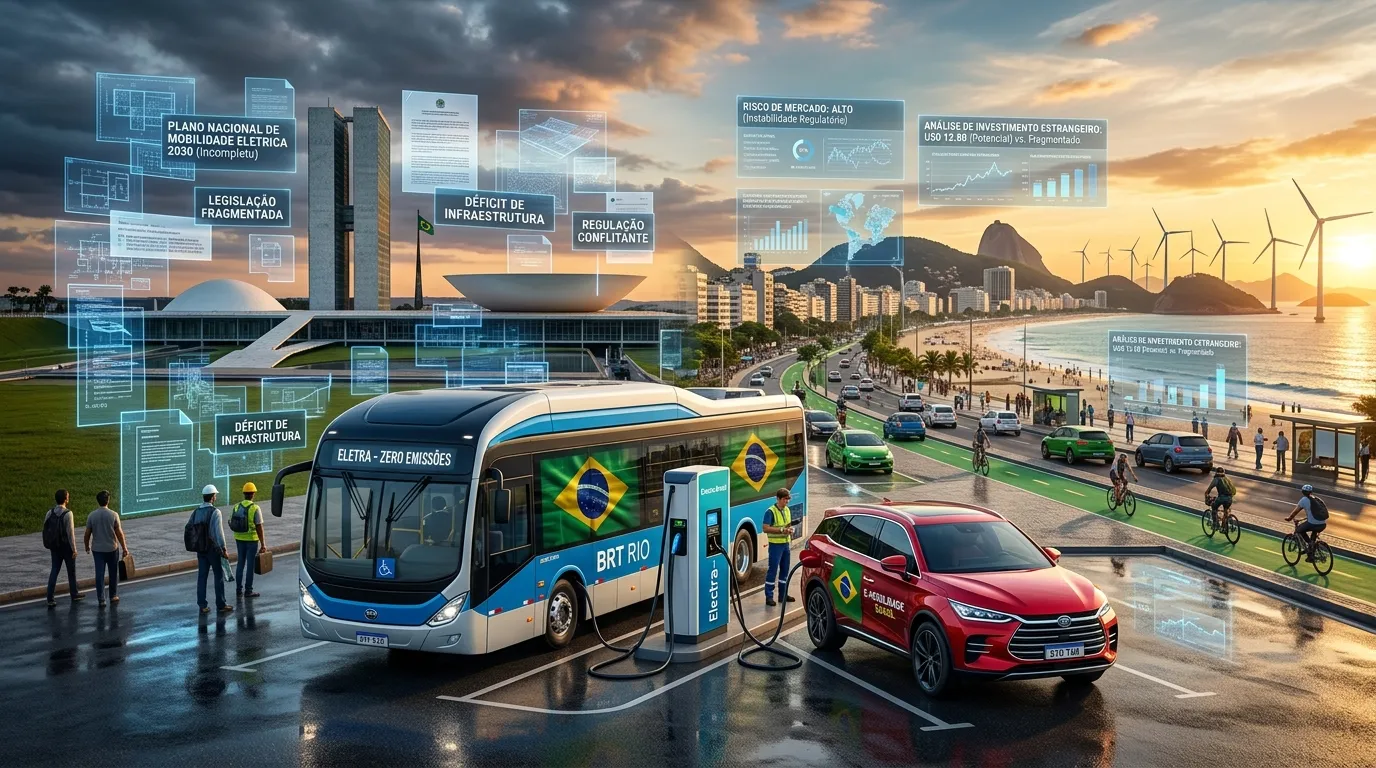
Brazil is, by most measures, Latin America’s largest electric mobility market. It has the region’s most renewable electricity matrix, a growing charging network, a bus manufacturing base historically ranked among the world’s largest, and an electric vehicle fleet that has expanded by several multiples since 2020. Yet the country that leads the region in scale is, paradoxically, one of the few major economies in the G20 and in Latin America without a national law, plan, or strategy dedicated to electromobility.
Chile published its first National Electromobility Strategy in 2017 and updated it in 2021. Costa Rica combined a National Electric Transport Plan with dedicated legislation as early as 2018. Colombia, Ecuador, Panama and the Dominican Republic each followed with their own frameworks. Among G20 economies, Germany, Austria, France, Norway, Sweden and India have long operated under formal national electromobility strategies. Brazil has none of this. What it has, instead, is a patchwork of sectoral incentives, none of which was designed with electromobility as its organizing purpose.
For foreign investors and their counsel, this is not an academic distinction. The absence of a coordinating national instrument shapes where regulatory risk sits, how long project timelines realistically run, and where the more interesting entry points into the Brazilian market may actually be found — often not in Brasília, but in the states and municipalities that are moving without waiting for the federal government to catch up.
Brazil’s most visible pro-electrification policy in recent years is the Green Mobility and Innovation Program (Programa Mover), instituted by federal law approved by the National Congress in 2024, with subsequent regulation and company-by-company qualification left to the Ministry of Development, Industry, Trade and Services (MDIC). Mover allocates roughly R$19.3 billion in tax credits over five years and reintroduces graduated import tariffs calibrated to a vehicle’s emissions profile. It is a meaningful industrial policy instrument, but it was built as a technology-neutral efficiency and decarbonization program for the automotive sector as a whole, not as an electrification plan. Its incentive structure rewards hybrids, flex-hybrids, and battery-electric vehicles roughly alike, and its recent revisions have adjusted the weighting between them largely in response to industry lobbying over which powertrain should count for more in manufacturers’ compliance calculations.
A second example cuts the other way and is, if anything, more telling: Brazil has no federal program dedicated to highway charging infrastructure at all. The fast-charging corridors that exist along federal highways today — run by fuel distributors such as Vibra, Raízen and Ipiranga, and by manufacturers including Volvo — are private-sector initiatives, built without public coordination or financing. A bill that would require federal highway fuel stations to install charging points (PL 392/2023, sponsored by Senator Eliziane Gama) has remained pending in the Senate since early 2023, with no scheduled date for a floor vote. Where other jurisdictions have paired national electromobility strategies with dedicated highway-charging financing instruments, Brazil has left the market to build this layer of infrastructure on its own.
Neither program sets an electrification target, a phase-out date for combustion vehicles, or a coordinated cross-ministerial governance structure. Electromobility appears in Brazilian public policy today the way a supporting character appears in someone else’s story: consistently present, occasionally decisive to the plot, but never the protagonist with its own arc, principles, and metrics.
Brazil has not lacked initiatives aimed at correcting this gap. It has lacked follow-through.
Parliament, twice. In May 2018, the House of Representatives launched the Joint Parliamentary Front in Defense of Electromobility, coordinated by then-representative Marcelo Matos and bringing together roughly 190 deputies and 10 senators around proposals to stimulate the domestic electric vehicle industry. Five years later, the Senate created another body: Resolution No. 2/2022 established the Joint Parliamentary Front for Electromobility, formally installed in July 2023, with 24 senators and 10 representatives signing on. Neither front has produced binding legislation establishing a national policy framework. Parliamentary fronts in Brazil are, by design, advocacy and agenda-setting bodies rather than legislative engines — useful for visibility, insufficient for statutory change.
A secretariat that became a department. In 2026, the Minister of Mines and Energy publicly announced the creation of a National Secretariat for Electromobility — signaling, at the time, that the federal government intended to treat the sector as a matter of state-level, medium-term planning comparable to how energy storage or renewable generation are institutionally organized. What was ultimately created, by Decree No. 12,973/2026, was a Department of Electromobility, a considerably narrower administrative unit nested within the Ministry’s National Secretariat for Energy Transition and Planning. The gap between the announcement and the instrument is instructive: departments in the Brazilian federal administrative structure carry less budgetary autonomy, less interministerial convening authority, and a narrower regulatory mandate than secretariats. The new department’s own founding text does task it with promoting policy coordination across federal, state, and municipal levels — an acknowledgment, arguably, of exactly the gap this article addresses — but coordination authority without secretariat-level standing is a modest instrument for a cross-cutting, multi-ministerial agenda.
A diagnosis that has yet to become a strategy. Specialized energy-policy press reported that the agenda for the September 2026 extraordinary meeting of the National Council for Energy Policy (CNPE) included the creation of an interministerial working group — reportedly involving at least seven ministries and three regulatory agencies — tasked with producing, within 120 days of its members’ appointment, a strategic diagnosis of electromobility in Brazil, draft guidelines for a national strategy, and recommendations for regulatory adjustments. Notably, the draft resolution reportedly instructed the working group to pursue “synergy” between electrification and biofuels policy in developing its recommendations — a framing that, on its face, treats the two as complementary tracks rather than establishing electromobility as a policy field with its own independent logic, targets, and principles. Whether this working group is formally constituted and what it ultimately produces remains to be seen; as of this writing, no public confirmation of the CNPE’s final resolution had been located.
No single explanation accounts for a decade of institutional tentative attempts, but a few structural factors recur across accounts from industry associations and policy observers.
The most frequently cited is fragmentation of ownership. Electromobility as a policy matter sits, simultaneously, inside the mandates of at least six federal ministries — Development, Industry, Trade and Services; Mines and Energy; Environment; Science, Technology and Innovation; Cities; and Transport — plus state and municipal transport authorities, without a single body holding clear coordinating authority. Industry representatives, including the Brazilian Electric Vehicle Association (ABVE), have publicly described Brazilian industrial policy as effectively organized along three competing strategic axes — electrification, ethanol and biofuels, and oil and gas — with electromobility historically the least institutionally resourced of the three. That framing, echoed by figures with direct visibility into federal policymaking, suggests less an active campaign against electrification than a structural condition: a policy area without a dedicated institutional champion tends to lose out, turn after turn, to policy areas that have one, particularly where the competing areas are deeply woven into Brazil’s existing industrial base, employment structure, and fiscal architecture. Brazil’s position as one of the world’s most successful ethanol producers and its role as a major state-linked oil and gas producer are not incidental to this dynamic; a bioenergy and hydrocarbons policy apparatus that is decades more mature, and considerably better resourced, will tend to absorb bandwidth and political capital that a nascent electromobility agenda has not yet accumulated for itself.
The practical stakes of this institutional drift are not abstract. Brazil has historically ranked among the world’s largest bus manufacturers and exporters, with a domestic body-building industry — anchored by firms such as Marcopolo and Caio — that shipped over 6,400 units abroad in 2025 alone, a 34% increase over the prior year. That export base was built on combustion-platform manufacturing scale accumulated over decades.
Electrification threatens to invert that position if domestic supply does not adapt at the pace foreign competitors are moving. In 2026, a fleet of 90 fully electric buses manufactured by China’s CRRC in Qingdao arrived in Brasília for the Federal District’s public transport concessionaire, imported rather than domestically produced — a small but symbolically significant data point. A country that has spent decades exporting finished buses risks becoming, in the electric segment specifically, a net importer of the vehicles that replace them, precisely because no coordinated national framework has yet aligned industrial policy, public procurement rules, and fleet-electrification timelines behind domestic electric bus and battery manufacturing the way Law No. 15,269/2025 did for stationary energy storage, or the way Mover has begun to do — imperfectly — for light passenger vehicles.
In the vacuum left at the federal level, Brazilian municipalities are not waiting. Public bus fleet electrification is advancing through municipal legislation, public tenders, and public-private financing structures that were designed locally, without a common national template to draw on.
This creates a genuinely mixed picture for foreign investors and equipment or financing partners. On one hand, the absence of a binding national framework means each municipal tender must be evaluated on its own legal architecture — the ownership structure of imported or domestically financed vehicles, the mechanism by which they are transferred to the operating concessionaire (commonly structured as a comodato, or gratuitous loan-for-use arrangement, tied to a specific local ordinance), the tariff and subsidy design, and the charging infrastructure obligations, all of which vary from city to city with no cross-referencing federal standard. Due diligence costs and structuring risk rise accordingly, and precedent from one municipality cannot be assumed to transfer cleanly to the next.
On the other hand, that same fragmentation is itself an opportunity. Municipalities with strong fiscal capacity and a mandate to electrify — often driven by state-level clean air or public transport modernization policy rather than any federal instruction — are free to negotiate financing, technology transfer, and long-term operating structures directly with foreign manufacturers, lenders, and fleet operators, without waiting for a national regulatory architecture to settle. For investors willing to absorb higher upfront structuring costs, this can mean earlier market entry, less regulatory competition, and closer, more direct relationships with the sub-national authorities that will ultimately control public transport concessions for the next one to two decades.
1. Treat federal policy as a moving, not a settled, backdrop. Unlike the storage sector under Law No. 15,269/2025, electromobility in Brazil has no statutory floor. Diligence should map exposure not against a single national instrument, but against the overlapping and sometimes inconsistent incentives of Mover, state-level programs, and whatever guidelines the CNPE’s working group — if formally constituted — eventually produces.
2. Municipal-level structuring is where near-term deal flow lives. Public transport electrification tenders, and the comodato or concession structures built around them, currently offer the clearest contractual entry points into the Brazilian market. Counsel advising on these transactions should expect meaningful legal variation from one municipality to the next.
3. Industrial policy risk cuts both ways. The absence of a coordinated national electrification strategy is a source of uncertainty, but it also means Brazil’s domestic manufacturing base for electric buses and components has not yet consolidated around incumbents protected by settled national rules — leaving room for new entrants, including foreign manufacturers and joint-venture partners, to establish position before any eventual national framework locks in market structure.
4. Watch the CNPE working group closely. If formally constituted, its 120-day diagnosis-and-guidelines mandate is the most concrete near-term signal of whether Brazil intends to move toward a coordinated national strategy, and on what terms it proposes to reconcile electrification with the country’s biofuels policy architecture.
5. Trade-position risk deserves its own line in investment memoranda. Brazil’s status as a historically major bus exporter is not guaranteed to survive the shift to electric platforms absent coordinated industrial policy. Investors in Brazilian manufacturing capacity, as opposed to import-based market entry, are betting on that transition happening domestically rather than abroad.
Over the next twelve to twenty-four months, three developments will indicate whether Brazil’s electromobility policy gap is closing or simply reproducing itself in a new form: whether the CNPE working group is formally constituted and delivers its diagnosis within the stated timeline; whether that diagnosis produces draft legislation or merely another set of non-binding guidelines; and whether the Department of Electromobility’s coordination mandate translates into actual alignment across the ministries and municipalities currently pursuing their own, disconnected paths.
Until then, Brazil will remain a market of considerable scale and genuine momentum, but one where foreign investors and their counsel must construct their own regulatory map rather than rely on the state to have already drawn one.
Stay informed with the latest legal developments at Global Law Experts News.

posted 14 minutes ago

posted 32 minutes ago
posted 34 minutes ago

posted 1 hour ago

posted 1 hour ago

posted 2 hours ago

posted 2 hours ago

posted 2 hours ago

posted 3 hours ago

posted 3 hours ago

posted 3 hours ago

posted 3 hours ago
No results available
Find the right Legal Expert for your business

Send welcome message