[codicts-css-switcher id=”346″]

Global Law Experts Logo

Author

  • GOLD

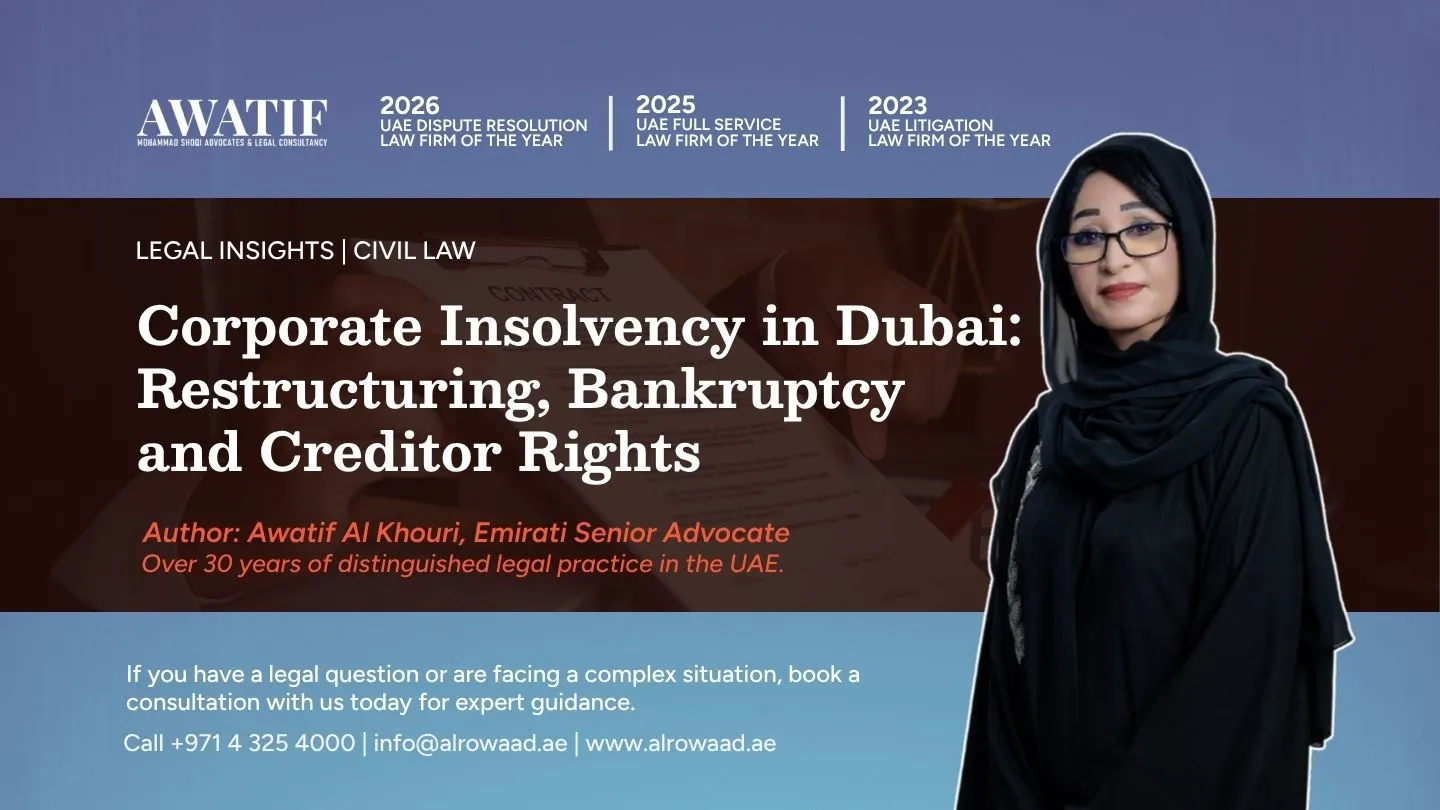
Corporate Insolvency in Dubai: Restructuring, Bankruptcy & Creditor Rights

By Awatif Al Khouri
– posted 2 hours ago

The legal framework governing commercial distress and corporate insolvency in the United Arab Emirates has shifted from a largely liquidation-based framework to a modern framework that is more focused on business rescue and financial restructuring. The key legislative amendment is Federal Decree-Law No. 51 of 2023 Promulgating the Financial Restructuring and Bankruptcy Law, which took effect on 1 May 2024 and replaces the previous bankruptcy regime established by Federal Decree-Law No. 9 of 2016. The law is issued pursuant to Cabinet Resolution No. 94 of 2024, issuing its Executive Regulations. These rules, together, establish procedures for preventive settlement, financial restructuring and bankruptcy, and regulate creditor rights, asset allocation, and debtor and management duties.

Insolvency issues also demand careful consideration of the applicable jurisdiction for businesses, creditors and advisers operating in Dubai. Most onshore businesses are regulated under the federal framework. Businesses incorporated within the Dubai International Financial Center (DIFC) are regulated by the DIFC’s own common law legal system and have their own insolvency regime. Accordingly, where a business is in serious financial distress or a creditor is seeking recovery from a defaulting commercial counterparty, engaging an experienced insolvency lawyer Dubai may assist in identifying the appropriate legal regime, evaluating restructuring or enforcement options, complying with applicable procedural requirements and safeguarding commercial value.


Jurisdictional Delineation and Statutory Scope

The federal insolvency framework’s scope of application is set out in Article 3 of Federal Decree-Law No. 51 of 2023. The Law shall apply to businesses subject to Federal Decree-Law No. (32) of 2021 on Commercial Companies; natural persons enjoying the status of trader; and licensed civil companies of a professional nature.

The Law also excludes certain categories from its scope. These include companies wholly or partially owned by the federal or local government where their constitutive legislation or constitutional documents provide special rules governing preventive settlement, restructuring or bankruptcy; companies and institutions established in free zones that are subject to special insolvency provisions; and banks, financial institutions and insurance companies licensed by the Central Bank of the UAE that are subject to special legislation governing such proceedings. Debts incurred by a debtor for personal, family or consumer purposes are also excluded.

Federal Decree-Law No. 51 of 2023 and Cabinet Resolution No. 94 of 2024 govern companies that are part of the federal system in Dubai. Applications, disputes and claims of bankruptcy filed before the Dubai Courts shall be heard by the competent Departments at the Courts of First Instance, in accordance with the rules of jurisdiction applicable thereto.

Entities established in the Dubai International Financial Centre are subject to the DIFC’s separate insolvency framework, principally governed by DIFC Law No. 1 of 2019, as amended, and the DIFC Insolvency Regulations. The DIFC regime provides procedures including Company Voluntary Arrangements, Rehabilitation, Administration and winding up.

Cabinet Resolution No. 94 of 2024 establishes the minimum debt levels for commencing proceedings under the federal regime. The debtor may file an application for preventive settlement, restructuring or bankruptcy proceedings if the debt that it has ceased to pay or expects to be unable to pay when due is not less than AED 300,000 for a natural person and AED 500,000 for a legal person. Where the debtor is subject to regulation, the threshold is AED 5,000,000.

Pursuant to Article 6 of Cabinet Resolution No. 94 of 2024, an ordinary creditor or a group of ordinary creditors may file an application to initiate the restructuring procedures or request a declaration of bankruptcy in the event that the qualifying debt is AED 1,000,000 or more. If the debtor is under a regulatory authority, then the threshold increases to AED 10,000,000. The debt must be unconditional, undisputed and payable, and the creditor must first call upon the debtor to make payment within 30 days in accordance with Article 16 of Federal Decree-Law No. 51 of 2023. Different thresholds apply if the debt of the creditor making the application is secured by a mortgage or lien.

Debtor Relief Mechanisms: Preventive Settlement and Restructuring

Federal Decree-Law No. 51 of 2023 introduces two main mechanisms that support financially distressed viable businesses: Preventive Settlement and Financial Restructuring.

Preventive Settlement

The debtor may request a Preventive Settlement under the terms of Articles 56-86. An application may be made under Article 56 by a debtor where the debtor has ceased or is about to or is likely to cease paying its debts, in whole or in part, as they fall due.

Article 58 permits the debtor to operate its business and assets in the ordinary course unless otherwise ordered by the Bankruptcy Court. Article 59 provides for an initial suspension of creditor claims for three months, extendable for up to one month at a time, for a maximum suspension of six months.

The debtor must also prepare a Preventive Settlement proposal containing the matters prescribed by Article 66, including the proposed treatment of liabilities, creditor classifications, repayment terms, financing requirements and the expected outcome for creditors compared with bankruptcy.

Financial Restructuring

Financial Restructuring is governed by Articles 87 to 119. Under Article 87, restructuring proceedings may be initiated by the debtor, creditors or the competent regulatory authority where the debtor’s business remains viable, and the debtor has stopped paying its debts or is experiencing a financial deficit.

Article 88 requires the application to include key information concerning the proposed restructuring, including an outline of the restructuring plan, its implementation timetable and guarantees, creditor classifications, proposed agreements with creditors and the procedures for creditor voting.

Post-Petition and Rescue Financing

According to Article 62 of Federal Decree-Law No. 51 of 2023, debtors subject to a Preventive Settlement may get additional loans or banking facilities as permitted by the statutory procedure. The Bankruptcy Court may sanction the extension of new financing on better terms than current ordinary debts, provided it is required for the debtor’s business and does not harm creditors’ common interests.

Such financing may be secured over unencumbered assets or by a security ranking behind an existing security. Where the new security is intended to rank equally with or ahead of an existing security, the consent of the prior secured creditor is required. Under Article 94, these new financing provisions also apply to Financial Restructuring proceedings.

Creditor Rights, Enforcement, and Statutory Priorities

Article 16 of Federal Decree-Law No. 51 of 2023 Promulgating the Financial Restructuring and Bankruptcy Law states that an ordinary creditor or group of creditors may seek restructuring or bankruptcy if an unconditional, undisputed, and due obligation is unpaid after 30 days’ notice. Article 24 of the same Law outlines the supporting requirements for the creditor’s application.

Articles 63 to 65 govern the formation and representation of the Creditors’ Committee and apply to restructuring pursuant to Article 94 of the same Law. Where the debtor has stopped paying, has a deficit in its financial position and its business is no longer viable, Article 120 of the same Law provides for bankruptcy proceedings. The liquidation and distribution process is governed by Articles 169 to 179.

Under Article 179, secured creditors have priority over the proceeds of secured assets and may seek permission to enforce their security if the trustee does not commence the sale within 30 days of the bankruptcy declaration. Preferred debts, including administration expenses, court-ordered alimony, government dues and certain employee claims, rank ahead of ordinary unsecured debts.

Director, Manager, and Officer Liability

In the event of the declaration of bankruptcy of the company, Federal Decree-Law No. 51 of 2023, Article 246, allows the Bankruptcy Court to order the directors, managers, personnel in charge of real management, as well as certain liquidators to contribute to the obligations of the company, in proportion to their culpability. Liability can also arise from certain actions in the two years prior to the stoppage of payment, such as trading without due care, transactions at undervalued prices, preferential payments to creditors or mismanagement that leads to assets which are not sufficient for the coverage of at least 20% of the company’s debt.

This operates alongside Article 22 of Federal Decree-Law No. 32 of 2021 on Commercial Companies, which requires the company’s managing director to preserve the company’s rights and act with due care.

Under Article 151 of Federal Decree-Law No. 51 of 2023, the trustee may also seek to invalidate pre-bankruptcy transactions carried out to prejudice creditors, subject to the Civil Transactions Law.

Separately, Article 270 of Federal Decree-Law No. 51 of 2023 provides penalties for bankruptcy due to negligence by a debtor. Article 271 specifically provides criminal penalties for specified misconduct by company directors, managers and liquidators following a company’s bankruptcy.

Judicial Administration and Enforcement in Dubai

Based on Article 5 of Federal Decree-Law No. 51 of 2023, the competent federal or local courts may establish specific panels or circuits, referred to as the Bankruptcy Court, to hear disputes and applications pertaining to bankruptcy.

Article 9 of the same Law establishes a Bankruptcy Administration at the seat of the Bankruptcy Court, headed by a judge of at least Court of Appeal rank. Articles 12 and 13 establish the Financial Reorganisation and Bankruptcy Unit, which coordinates proceedings involving regulated entities, maintains the Bankruptcy Register, approves the list of bankruptcy experts and supervises the unified electronic platform.

The judgments and decisions of the Bankruptcy Court shall be effective and generally enforceable immediately upon their issuance in accordance with Articles 7 and 8 unless the enforcement may be suspended in the cases provided for by the Law.

Conclusion

Under Federal Decree-Law No. 51 of 2023, the UAE has enhanced its approach to corporate insolvency by adding business rescue mechanisms, clearer creditor protections and greater accountability on the part of company management. Preventive Settlement and Financial Restructuring provide viable businesses with opportunities to resolve financial distress before liquidation is unavoidable. The bankruptcy framework provides structured processes for enforcement, liquidation and distribution.

For businesses and creditors in Dubai, identifying whether the federal regime or the separate DIFC insolvency framework applies is an essential first step. Early advice from an experienced insolvency lawyer in Dubai may help businesses assess restructuring options, protect creditor rights and manage the legal and commercial risks arising from financial distress.

Find the right Legal Expert for your business

The premier guide to leading legal professionals throughout the world

Specialism
Country
Practice Area
LAWYERS RECOGNIZED
0
EVALUATIONS OF LAWYERS BY THEIR PEERS
0 m+
PRACTICE AREAS
0
COUNTRIES AROUND THE WORLD
0
Lawyer Profile Page - Lead Capture
GLE-Logo-White
Lawyer Profile Page - Lead Capture

Corporate Insolvency in Dubai: Restructuring, Bankruptcy & Creditor Rights

Send welcome message

Custom Message