
Author
No results available
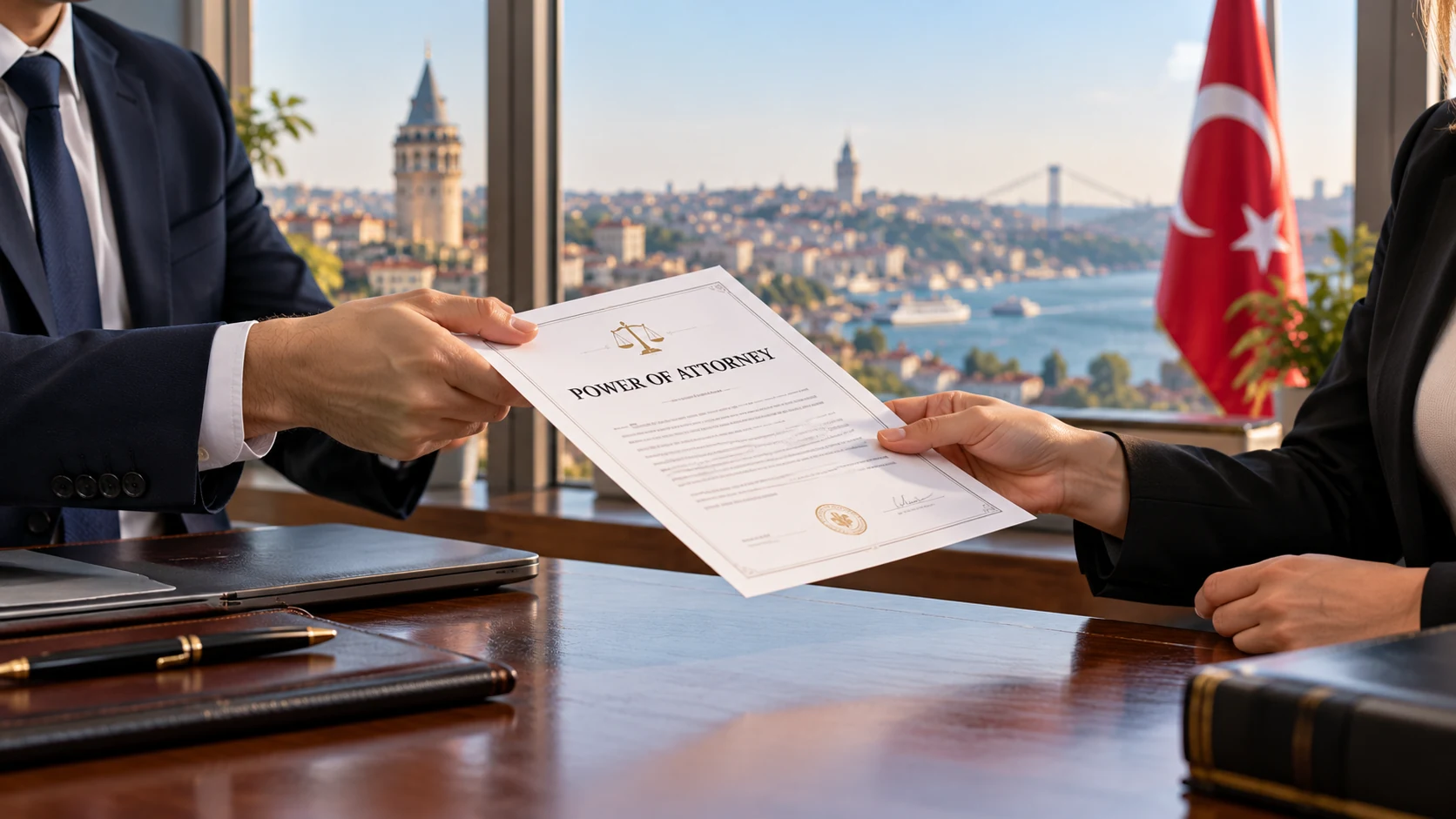
A Power of Attorney (PoA) in Turkey is a legal document that authorizes another person to act on behalf of an individual or company within a defined scope of authority. Foreign investors commonly use a PoA for company formation, tax registration, corporate changes, property transactions and certain administrative procedures.
A PoA can be executed before a Turkish notary or, where available and appropriate, a Turkish consulate abroad. A document issued by a foreign notary may require an apostille or consular legalization, together with an official Turkish translation and notarization, depending on the country of issue and the intended transaction.
The wording must reflect the specific powers required by the relevant authority. A PoA does not automatically guarantee acceptance by every institution or remove the need to meet other legal and administrative requirements.
A Power of Attorney allows an authorized representative to perform specified legal, commercial or administrative acts on behalf of the principal.
Foreign individuals and companies can use a PoA for eligible procedures in Turkey.
Company formation, tax registration, branch establishment and property transactions may require specific wording.
Foreign-issued documents may need an apostille or consular legalization, followed by a Turkish translation and notarization where applicable.
Remote company formation may be possible through an authorized representative, subject to the applicable registration procedures.
Banks retain their own customer identification, compliance and account-opening requirements.
A PoA can be limited by transaction, scope or duration and may generally be revoked subject to applicable law.
A Power of Attorney, commonly abbreviated as PoA, is a legal instrument through which an individual or company authorizes another person to perform specified actions on their behalf.
The person granting the authority is generally referred to as the principal, while the authorized representative is the attorney-in-fact or agent. Under Turkish law, the representative must act within the scope of the authority granted and comply with the applicable legal requirements.
A PoA is particularly useful for foreign investors who live outside Turkey, cannot attend a transaction personally or prefer to delegate specific administrative and corporate procedures to a representative.
Depending on its wording, a PoA may authorize a representative to submit documents, sign specified applications, follow up on company registration procedures, obtain certain tax documents or complete other permitted transactions.
However, a PoA does not replace mandatory personal attendance, identification checks, corporate approvals or other formalities where the law or the relevant institution requires them.
Foreign individuals and companies may use a PoA for a wide range of legal, commercial and administrative procedures. The required form and scope depend on the transaction.
A foreign investor may authorize a representative to follow up on eligible company establishment procedures before the relevant Trade Registry Directorate and other public authorities.
The PoA should specify the powers required for the intended registration process. Additional documents may be needed to establish the identity of the shareholder, the authority of a corporate signatory and the legal status of a foreign corporate shareholder.
A representative may be authorized to handle specified tax-related procedures, including applications for a Turkish tax identification number or potential tax identification number.
The authorization should expressly cover the intended tax office procedure where required. The relevant tax office may also request supporting documents.
Foreign companies may use a PoA to authorize a representative to coordinate or carry out eligible procedures for establishing a branch or liaison office in Turkey.
A branch and a liaison office are different legal and administrative arrangements. A branch conducts activities within the scope permitted by its registration and applicable law, while a liaison office is subject to restrictions on commercial activities and requires the relevant authorization.
The PoA must be consistent with the foreign company’s corporate approvals, the appointment of its representative and the requirements of the competent authority.
A PoA may be relevant to certain banking and commercial procedures, depending on the bank’s policies and applicable law.
However, a PoA does not guarantee that a bank will open an account or permit all transactions through an authorized representative. Banks may require the account holder’s personal attendance, additional corporate documents, beneficial ownership information or enhanced compliance checks.
A representative may be authorized to submit applications, deliver documents, receive specified correspondence or follow up on administrative procedures where representation is permitted.
Court proceedings and regulated legal activities may be subject to additional requirements. A general PoA should not be assumed to authorize every type of legal representation.
Foreign investors can often delegate eligible company establishment procedures to an authorized representative, reducing the need to travel to Turkey for every administrative step.
The scope of the PoA should be determined before the document is signed, taking into account the company’s legal form, the shareholders and the registration procedures to be completed.
Remote company formation may be possible when the investor grants a properly prepared PoA and the applicable registration procedures permit representation.
The representative may be authorized to submit company establishment documents, coordinate registration and follow up on applications before the relevant Trade Registry Directorate and other competent authorities.
The process may still require original documents, notarized translations, corporate resolutions, identity verification or other formalities. Whether a particular step can be completed by proxy should be confirmed before the PoA is executed.
For further information about company establishment requirements, see A&M Consulting Co.’s Company Registration in Turkey guide.
A Turkish tax identification number may be required for foreign individuals involved in company establishment and other official procedures.
For company formation, a potential tax identification number may also be needed for foreign shareholders or other relevant persons, depending on their role and the registration requirements.
If an authorized representative will apply on behalf of the principal, the PoA may need to state specifically that the representative is authorized to act before the relevant tax authority for the purpose of obtaining the tax identification number or potential tax identification number.
The tax office may request identification documents, company establishment documents, an application petition and other supporting records.
A corporate bank account may be required for capital-related procedures and the company’s subsequent operations.
A PoA can authorize certain banking-related actions where the bank accepts representation. Nevertheless, the account-opening decision remains subject to the bank’s internal policies, customer due diligence, beneficial ownership checks and applicable banking regulations.
Before preparing the document, the investor should confirm whether the selected bank accepts a representative for the intended procedure and whether the bank requires specific wording, original documents or personal attendance.
Important: A PoA does not guarantee corporate bank account approval, nor does it override the bank’s customer identification and compliance requirements.
A foreign company establishing a branch may need to appoint a representative and grant the powers required for registration and ongoing representation. Supporting documents can include a resolution of the parent company’s competent corporate body, evidence of its legal status and a PoA in favor of the appointed representative.
A liaison office requires authorization from the competent Turkish authority and must comply with the restrictions applicable to its activities. Where a representative will handle the establishment procedures, the relevant application and supporting documents must satisfy the authority’s requirements.
Foreign-issued corporate documents may require authentication and official Turkish translation before they can be used in Turkey.
The appropriate type of PoA depends on the purpose, scope and formal requirements of the transaction.
A general PoA grants authority over a defined range of matters. Its effectiveness depends on the actual wording and the applicable legal rules.
It should not be treated as unlimited authority. Certain transactions require express authorization or compliance with special formalities.
A special PoA authorizes one or more clearly identified transactions or activities.
Examples include:
Establishing a company in Turkey.
Applying for a tax identification number.
Handling a specified corporate registration procedure.
Purchasing or selling a particular property.
Completing an identified administrative transaction.
For transactions with strict formal requirements, a carefully drafted special PoA can help reduce the risk of rejection or delay.
A corporate PoA is granted by a company through its duly authorized signatories in accordance with its representation rules and applicable corporate documents.
It may authorize a representative to carry out specified corporate or administrative procedures on behalf of the company.
Before execution, the company’s current authorized signatories, signing rules and any necessary corporate approvals should be checked. A person signing for a company cannot grant authority beyond the powers legally available to them.
Representation in court proceedings may require specific authorization and compliance with Turkish procedural rules, including rules governing professional legal representation.
A PoA prepared for ordinary company administration should not automatically be assumed to cover litigation, settlement or other procedural acts requiring express authority.
Where court representation is involved, the required wording and the eligibility of the representative should be confirmed with a qualified Turkish lawyer.
The process depends on where the PoA is executed, the identity of the principal and the intended transaction.
Foreign investors should understand the legal formalities before authorizing a representative in Turkey. For a detailed overview of the applicable procedures, document requirements, and practical considerations, read our guide to Power of Attorney in Turkey.
Identify the precise actions the representative will be authorized to perform.
For example, a PoA for company formation may need to authorize specified procedures before the Trade Registry Directorate and other competent authorities. A PoA for a property transaction must satisfy the applicable land registry requirements.
Clearly defining the scope helps avoid insufficient authority and unnecessarily broad powers.
Depending on the circumstances, the following may be required:
Valid passport or other acceptable identification.
Full legal names and identification details of the principal and representative.
Company registration documents and corporate resolutions, where a company is granting the PoA.
Evidence of the signatory’s authority to represent a corporate principal.
A draft PoA containing the intended powers.
Property details or other transaction-specific information, where applicable.
Supporting documents required by the notary or receiving authority.
The exact list should be confirmed before the appointment.
A PoA may be executed before a Turkish notary in Turkey. Where available and appropriate, it may also be executed through a Turkish consulate abroad.
A foreign notary may be able to authenticate a document for use in Turkey, subject to the relevant country’s law and the applicable international authentication requirements.
The procedure differs depending on whether the principal is an individual or a company and whether the transaction requires a specific form of authorization.
If the PoA is issued abroad, an apostille or consular legalization may be required, depending on the country and the applicable rules.
Where the document is in a foreign language, an official Turkish translation and notarization may also be necessary.
The receiving institution’s requirements should be checked before execution, particularly for property transactions, company registration and other formal procedures.
The representative submits the PoA and any required supporting documents to the relevant authority or institution.
The institution will assess whether the document meets the applicable formal requirements and whether the stated powers cover the requested transaction.
Foreign individuals and companies frequently execute PoAs outside Turkey and then use them for procedures in Turkey.
A foreign-issued PoA may be accepted if it satisfies the applicable requirements concerning execution, authentication, translation and the scope of authority.
Where the Hague Apostille Convention applies between the relevant countries, an apostille may be used to authenticate the origin of a public document.
An apostille generally certifies the authenticity of the signature, the capacity in which the signatory acted and, where applicable, the identity of the seal or stamp on the document.
It does not confirm that the contents of the PoA are legally sufficient for the intended transaction.
The apostille must be issued by the competent authority in the country concerned. The requirements should be verified for the specific document and country of issue.
If the apostille procedure is not applicable, the document may need to follow the relevant authentication or consular legalization procedure.
The appropriate process depends on the country, the type of document and the applicable international arrangements. The required chain of authentication should be confirmed with the competent authorities or the relevant Turkish diplomatic or consular mission.
A foreign-language PoA generally needs an official Turkish translation for use before Turkish authorities.
Depending on the transaction, the translation may need to be certified or notarized by a Turkish notary. The receiving institution may also require the original PoA and its authentication documents.
A PoA issued abroad for a property transaction may be subject to additional formal requirements, including specific authorization, photograph and authentication requirements, depending on how and where it was executed.
The Land Registry Directorate’s applicable requirements should be checked before the document is signed. A PoA accepted for a general administrative procedure may not necessarily be sufficient for a property transaction.
A PoA may authorize a representative to carry out specified property-related transactions in Turkey on behalf of a buyer, seller or other interested party.
Real estate transactions require particular care because the authorization must satisfy the applicable formal requirements of the Land Registry Directorate.
The document should clearly identify the powers granted and the transaction to be performed.
Depending on the circumstances, this may involve the authority to purchase or sell a property, sign the relevant documents or complete specified registration procedures.
The wording should be reviewed before execution, particularly where the PoA is being prepared abroad.
A PoA executed abroad for use in a Turkish property transaction may need to be issued before a competent authority and authenticated through an apostille or the applicable consular legalization process.
A Turkish translation certified or notarized as required by the relevant authority may also be necessary.
Additional formalities can apply to the photograph, identification details and presentation of the document. The applicable requirements should be confirmed with the Land Registry Directorate before the PoA is finalized.
A PoA does not itself transfer ownership of a property. The authorized representative must complete the required transaction and registration procedures in accordance with the applicable law.
The principal should ensure that the document authorizes only the intended actions and that the representative’s powers are appropriate for the transaction.
The validity and effect of a PoA depend on its wording, the legal relationship between the parties and the applicable rules.
A PoA may specify an expiry date or limit the authority to a particular transaction.
If no expiry date is specified, this does not necessarily mean the authorization remains effective indefinitely in every circumstance. The terms of the document and any applicable grounds for termination must be considered.
For ongoing corporate or administrative matters, the principal should confirm that the PoA remains valid and that the receiving institution will accept it.
The principal may generally revoke a PoA, subject to the applicable legal rules and any relevant exceptions.
The appropriate revocation procedure depends on how the original PoA was issued and how it is being used. A formal revocation document or notice may be appropriate.
The principal should ensure that the representative and relevant institutions are informed where necessary. Revocation does not automatically resolve the legal consequences of actions already taken by the representative.
A principal living outside Turkey may need to arrange the revocation through an appropriate notarial or consular procedure.
The process depends on the circumstances, the original document and the requirements of the receiving institutions. Where the original PoA was executed abroad, the revocation document may itself require authentication and Turkish translation before it can be used in Turkey.
Relevant institutions should be notified as appropriate so that they can update their records and assess the effect of the revocation on pending procedures.
The representative must act within the scope of the powers granted. The principal should carefully review whether the PoA permits the representative to sign contracts, handle funds, delegate authority to another person or perform other sensitive actions.
For significant transactions, limiting the authorization to the necessary acts can help manage legal and commercial risk.
Errors in a PoA can lead to rejected applications, repeated appointments, additional translation or authentication costs and delays.
Common issues include:
Insufficient scope of authority: The document does not expressly authorize the transaction required by the receiving institution.
Incorrect authentication: An apostille or legalization step is missing or has been completed by an inappropriate authority.
Incomplete translation: The Turkish translation or its certification does not satisfy the applicable requirements.
Inconsistent identification details: Names, passport details or company information differ between the PoA and supporting documents.
Unverified corporate authority: The person signing for a foreign company cannot adequately demonstrate their authority to do so.
Overly broad powers: The document grants more authority than is necessary for the intended purpose.
Assuming universal acceptance: A PoA accepted by one institution is assumed to be sufficient for another institution or a different transaction.
Ignoring bank-specific requirements: The principal assumes that a PoA will guarantee corporate bank account opening or eliminate the need for personal identification.
Failure to notify revocation: Relevant institutions are not informed that the authority has been revoked.
The most effective way to reduce these risks is to identify the intended transaction and confirm the receiving institution’s requirements before the document is executed.
A Power of Attorney can help foreign individuals and companies complete eligible legal, corporate and administrative procedures in Turkey without attending every step personally. However, the document must be prepared with the correct scope of authority and comply with the applicable notarization, authentication, translation and transaction-specific requirements.
For foreign investors, an incorrectly prepared PoA can delay company formation, tax registration, branch or liaison office establishment, banking procedures and property transactions. Confirming the requirements in advance helps reduce the risk of rejected documents and unnecessary costs.
A&M Consulting Co. assists international clients with company formation and corporate procedures in Turkey, as well as related tax, accounting, payroll and compliance services. For investors coordinating a PoA with company establishment or ongoing corporate administration, professional guidance can help identify the required documents and procedural steps.
Invest in Türkiye — Establishing a Business
https://www.invest.gov.tr/en/InvestmentGuide/Pages/establishing-a-business.aspx
Official information on company establishment procedures, corporate documentation, tax identification numbers, branch establishment and the use of a PoA.
Ministry of Foreign Affairs of the Republic of Türkiye — Consular Procedures
https://www.konsolosluk.gov.tr/Procedure/Index
Official information on consular and notarial procedures, including applications for a Power of Attorney.
Ministry of Foreign Affairs of the Republic of Türkiye — Consular FAQ
https://www.konsolosluk.gov.tr/Faq
Information concerning PoAs executed abroad and authentication procedures.
Invest in Türkiye — Acquiring Property and Citizenship
https://www.invest.gov.tr/en/investmentguide/pages/acquiring-property-and-citizenship.aspx
Official guidance on foreign-issued PoAs used for property transactions, including authentication and Turkish translation.
General Directorate of Land Registry and Cadastre (TKGM) — Procedures Guide
https://www.tkgm.gov.tr/sites/default/files/2020-12/procedures_guide_2.pdf
Guidance on formal requirements for foreign-issued PoAs used in land registry transactions. The document should be read together with current applicable rules and institutional requirements.

posted 4 minutes ago

posted 21 minutes ago

posted 43 minutes ago

posted 1 hour ago

posted 2 hours ago

posted 2 hours ago

posted 2 hours ago

posted 3 hours ago

posted 3 hours ago

posted 3 hours ago

posted 4 hours ago

posted 4 hours ago
No results available
Find the right Legal Expert for your business

Send welcome message